
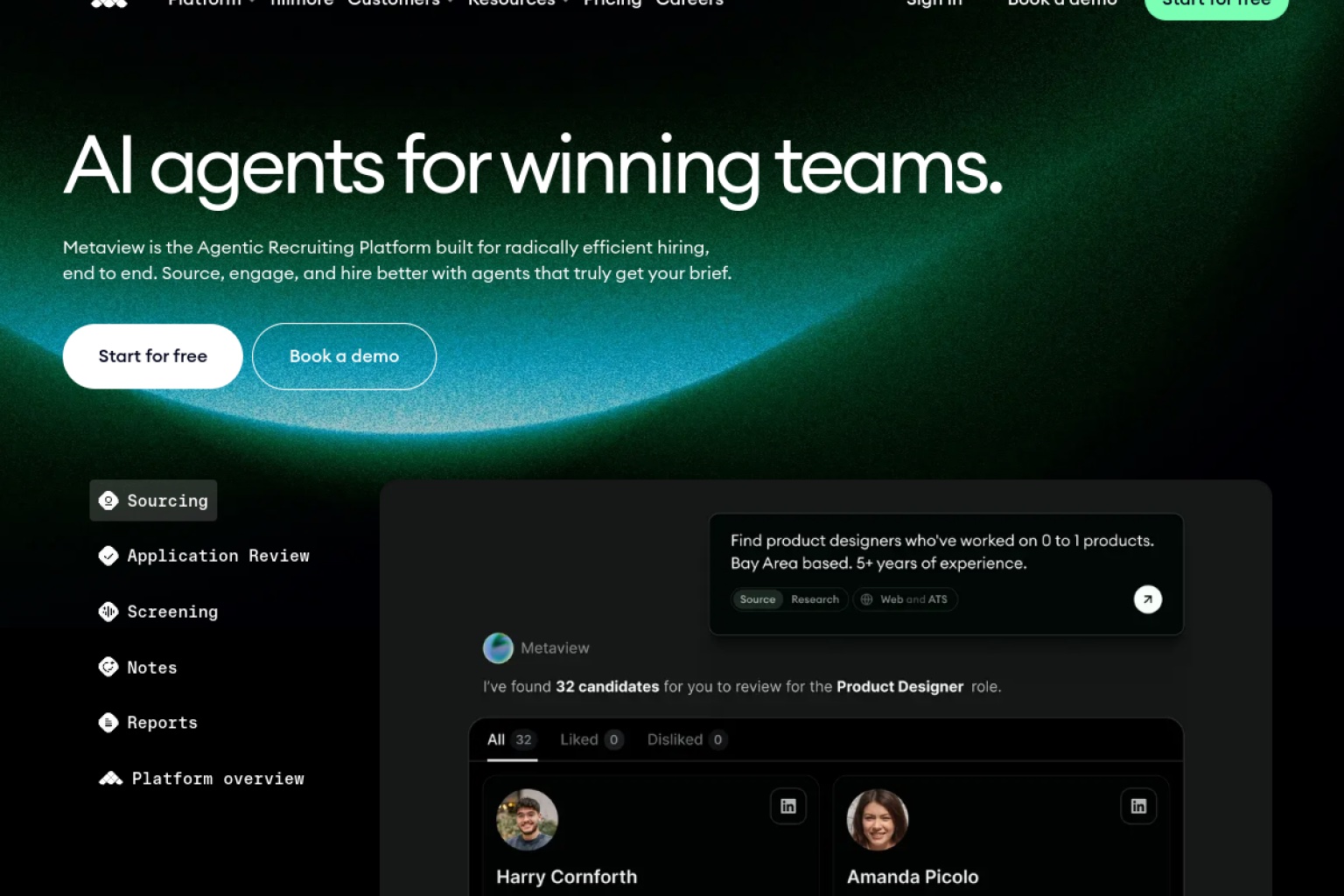
Metaview is a multi-product AI recruiting platform whose clearest entry point is still interview documentation. It combines conversation capture and structured notes with application review, sourcing, outreach, and reporting. The value proposition is practical rather than abstract: information from role-intake calls, recruiter screens, panel interviews, and debriefs can remain available to recruiters and hiring managers instead of being fragmented across personal notes and isolated ATS fields. Metaview calls the wider approach an “Agentic Recruiting Platform.” Buyers should treat that as a description of product scope, not as proof that every workflow should be automated or that every module is required. Sources: Metaview Pricing and Metaview Help Center, checked 20 August 2026.
| Criterion | Metaview position |
|---|---|
| Category | AI recruiting platform, centred on interview notes and conversation intelligence, with sourcing, application review, outreach, and reporting. |
| Target market | Recruiters, hiring managers, executive-search partners, agencies, scaling businesses, and larger recruiting organisations. Metaview does not publish a minimum employee count. |
| Pricing model | Module-specific: monthly per-user Notetaker and Sourcing subscriptions, a volume-based Application Review plan, custom Enterprise contracts; Reports is a paid add-on with no public amount. |
| Published prices | Notetaker: Free at US$0 and Pro at US$60 per user/month. Sourcing: Free at US$0, Pro at US$100 and Max at US$300 per user/month. Application Review: Free at US$0 and Pro at US$150/month for 500 reviews. Enterprise and the full platform: not public. Source: Metaview Pricing, checked 20 August 2026. |
| Language coverage | The vendor documents 50+ spoken transcription languages, including German. Within-call multilingual transcription is limited to specified language combinations. |
| Hosting and privacy | The vendor states that customer data is stored on AWS in the United Kingdom, encrypted in transit and at rest, and processed under its DPA in line with GDPR. No public commitment to EU-only hosting was identified. |
| Integrations | ATS/CRM, calendar, phone, and video-conferencing tools. Publicly named examples include Ashby, Greenhouse, Lever, Gem, and SmartRecruiters; data read/write behaviour varies by integration. |
| Suitable company size | Individual recruiters can test it through self-service plans. It is most compelling where several people interview, roles recur, or application volume is material; this is an assessment, not a vendor-published threshold. |
What the product does technically
For Notes, Metaview first uses speech-to-text to capture the call. The note-generation inputs can include the transcript, meeting chat, available screen-sharing context such as code, demos, or presentations, plus optional uploaded files and prior conversations. The selected template then turns those sources into structured notes. Users can edit the result and navigate from a note section back to the relevant part of the transcript and recording. The product also has note version history. Its redaction function is explicitly irreversible and applies to the transcript, recording, notes, and derived material, which matters when an organisation needs a practical removal path for sensitive content. Source: Metaview AI Notes, checked 20 August 2026.
The note templates are recruitment-specific rather than merely generic meeting summaries. The documented choices include recruiter screen, role intake, candidate pack, coding interview, system-design interview, and several debrief structures. Teams can also build custom templates around their own scorecards or feedback forms. That can produce more comparable interview evidence, but it does not repair a weak interview process by itself: question design, interviewer calibration, participant labelling, and review discipline remain human work. Metaview documents one useful structural limitation itself: its question-and-answer template is not suitable for long conversations containing many short questions, because it may not summarise them adequately. Source: Metaview AI Notes, checked 20 August 2026.
Automation therefore reaches the production, storage, sharing, and potential ATS writeback of interview notes; it does not turn the tool into an autonomous hiring decision-maker. Notes can be pushed to an integrated ATS and, when the integration supports it, linked to a scorecard. People still choose templates, correct the record, and evaluate the candidate. Misidentified languages, proper names, and specialised domain language can still require editing. A credible evaluation should measure that correction workload on the organisation’s own interviews rather than relying only on a polished demo.
Application Review, sourcing, and outreach: data sources and automation levels
Application Review is driven by a role and pipeline stage from a connected ATS. Metaview combines the job description, optional role documents, and team-defined requirements to create an editable Ideal Candidate Profile covering experience, skills, education, positive signals, red flags, and weighting. Once approved, it assesses every candidate in the chosen stage and returns written reasoning with a match category from Strong Match to Inconclusive. An absent, corrupted, or unparseable CV can result in an inconclusive outcome. New incoming applications can be evaluated against the live profile without setting up a new review. Source: Application Review Overview, checked 20 August 2026.
The limits are just as important as the feature list. The match categories are intended to support, not replace, human review. Users can revise the Ideal Candidate Profile, give Yes/Maybe/No feedback, and trigger re-evaluation. Metaview states that it never auto-rejects candidates: a person makes the final progression or rejection decision. That makes it a fit for teams seeking prioritised, reasoned review, not for buyers looking to remove individual review entirely. There are also familiar integration boundaries: anonymised, restricted, or confidential ATS records are not synced, and new ATS changes can take up to about 30 minutes to appear. Source: Application Review Overview, checked 20 August 2026.
AI Sourcing starts with a natural-language brief, optional manual filters, and optionally a job description or role documents. Metaview drafts an Ideal Candidate Profile for the user to approve. Initial matches can appear immediately while a more detailed background search continues, after which a candidate pack provides available external professional-profile links. Recruiters can rate candidates Yes, Maybe, or No and use feedback to refine the search. Metaview can also start a search from a captured role-intake conversation or find similar people after an interview. Search reruns on a schedule are documented for Max and Enterprise subscriptions. Source: Sourcing Overview, checked 20 August 2026.
A discovered profile is not necessarily a contactable or suitable person. Email and phone enrichment is an optional service using third-party providers and separate credits. The system shows the credit cost in-product before an enrichment attempt, but the public pricing page does not state a standard unit price. Metaview also warns that sourced profiles can be unavailable, outdated, duplicated, incorrectly matched, or unsuitable, and that used sourcing credits are non-refundable. Its sourcing guidance asks customers to ensure a suitable legal basis, an appropriate privacy notice, and transparent first outreach. Source: Sourcing Overview, checked 20 August 2026.
Sequences can send activated multi-step outreach from a connected email account, use AI personalisation, and detect replies. Automated email and WhatsApp steps are available; LinkedIn messages, connection requests, calls, SMS, and WhatsApp can also be configured as manual tasks. Replies, Calendly bookings, Metaview-captured interviews, and qualifying ATS events can stop a sequence automatically. Metaview says there is no additional charge to send sequences, but the related sourcing and contact enrichment remain credit-consuming activities. Open tracking should not be treated as ground truth, because privacy features and mail-security scanners can distort it. Source: Sequences Overview, checked 20 August 2026.
Reports makes conversation data searchable alongside calendar metadata, integrated ATS attributes, and configured custom properties. AI columns can extract a consistent text, number, currency, or Yes/No field from each conversation in a filtered report. A report-level assistant can answer broader questions over the included conversations, and reports can be exported as CSV. This is useful for analysing recurring interview themes, candidate motivations, or process patterns, but it remains constrained by recording coverage, access permissions, and the quality of the underlying conversations. Source: Reports Overview, checked 20 August 2026.
Pricing, inclusions, and the real cost picture
Metaview publishes separate packages rather than one flat recruiting-suite price. Notetaker Free includes 25 calls per user/month and basic transcription; the support documentation additionally specifies a 60-call organisation-wide free allowance and access limited to the most recent 14 days. Pro is US$60 per user/month and includes unlimited calls and priority processing. Sourcing Free includes the first 100 sourced profiles, Pro is US$100 per user/month for 200 sourced profiles per month, and Max is US$300 per user/month for unlimited sourced profiles. Application Review Free includes 50 applications per month; Pro is US$150/month for 500 reviews and unlimited users. Enterprise is custom for all three products. Sources: Metaview Pricing and Managing Subscriptions, checked 20 August 2026.
The visible tariffs do not fully price the operating model. Buyers should separately establish the price of enrichment credits, the Reports add-on, implementation or advisory services, Application Review top-up validity, and Enterprise commitments. Application Review consumes one credit per application. Monthly credits do not roll over; paid top-ups remain available only for a limited period and are non-refundable. Resuming a paused review can consume credits for all newly accumulated applications. Those details matter more to a high-volume employer than the headline price alone. Source: Application Review Overview, checked 20 August 2026.
For self-service subscriptions, the vendor states that customers can pay month to month by card and cancel to stop auto-renewal, with no long-term commitment. Cancellation takes effect at the end of the current billing period. The documentation expressly excludes team and Enterprise arrangements from this self-service description, so their term, minimum spend, renewal, and exit provisions need to be confirmed in the order form. Seats are intended for individual use rather than continuous sharing or rotation; the documented reassignment limit is once per calendar month. Source: Managing Subscriptions, checked 20 August 2026.
A transparent buyer-side calculation illustrates the decision without claiming a vendor ROI. At full use, US$150 for 500 Application Reviews is US$0.30 per reviewed application, while US$100 for 200 sourced profiles is US$0.50 per profile. Neither figure includes enrichment, other agents, or the human time needed to validate outputs. Five active Note Pro users cost US$300 per month. At an assumed fully loaded internal cost of US$60 per hour, the subscription cost would be offset by five hours saved across the team in a month; that is only a scenario, not a performance promise. The team should replace the assumption with its own cost and pilot result.
Usage density matters more than company headcount. A single recruiter conducting only a few calls can first test Free. Once several interviewers repeatedly document conversations, use common scorecards, or need to share evidence quickly, paid notes can be easier to justify. A team processing a steady flow close to 500 applications can assess the Application Review tariff against its actual screening time. Conversely, unused seats, low review volume, or an unintegrated ATS make the monthly plans less attractive. Test one full monthly cycle using real calls, application volume, and a realistic approval workflow before committing to an Enterprise model.
| Use case | When Metaview is a good choice | When it is not the best fit | Alternative category to evaluate |
|---|---|---|---|
| Structured interviews | Several interviewers need editable, traceable notes using shared scorecards and want direct access to the underlying transcript. | There are very few video conversations, or generic transcription is all that is required. | General meeting-transcription or collaboration software. |
| High application volume in a connected ATS | The team wants a reasoned prioritisation against an editable role profile while retaining human decisions. | The primary need is a complete recruiting system with careers site, job posting, applicant records, and workflow ownership. | ATS or recruiting suite with native applicant management. |
| Collaborative sourcing | Role context, search, interview evidence, evaluation, and outreach should be connected in one recruiting workspace. | The key requirement is maximum reach in a specific data source or highly specialised market mapping. | Specialist talent-intelligence, talent-mapping, or sourcing platform. |
| Conversation-based recruiting insight | Talent leaders need to filter, structure, alert on, and export interview findings with selected ATS properties. | The organisation needs enterprise-wide people analytics, compensation datasets, or a fully custom data warehouse. | HR analytics, business-intelligence, or data-warehouse solution. |
| EU-only data residency | UK hosting is acceptable after contractual and legal review, and the DPA/subprocessor arrangement meets the organisation’s requirements. | Physical hosting exclusively in an EU region is a contractual requirement. | Recruiting or interview software with an explicit EU-data-residency commitment. |
What users report
Documented praise is consistent on the practical core of the product. G2’s published review summary highlights ease of use, automated transcription, and structured summaries, with reviewers saying that less manual note-taking lets them stay more engaged in the conversation. A visible reviewer also credits asynchronous review of interview insights and ATS integration with more consistent information sharing. These are customer experiences, not an independent guarantee that every deployment will save the same amount of time. Source: G2 Metaview reviews, checked 20 August 2026.
Documented criticism focuses on customisation and edge-case accuracy. G2’s summary flags room for improvement in interview-summary templates. Reviewed comments describe generic summaries for non-standard or highly technical interviews that require manual adjustment, and a current review points to the absence of an API as a limitation. That is consistent with Metaview’s own documentation on occasional language misidentification and template limits. A serious pilot should therefore include technical language, real names, German or mixed-language calls, and a genuine ATS writeback test rather than only a standard recruiter-screen demo. Sources: G2 Metaview reviews and Metaview AI Notes, checked 20 August 2026.
DACH, EU, and governance considerations
For German-speaking recruiting teams, the documented language coverage is encouraging but should be tested in context. Metaview lists German among 50+ transcription languages and supports note translation. Within one call, multilingual transcription is currently limited to combinations of English, Spanish, Portuguese, French, German, and Italian; for other combinations, only the chosen primary language is transcribed. If the language is misidentified, users can correct it and request retranscription. A DACH evaluation should use regional accents, role-specific terminology, and real code-switching rather than treating a German language tick-box as proof of quality. Source: Metaview AI Notes, checked 20 August 2026.
Metaview states that it stores customer data on AWS in the United Kingdom and encrypts it at rest and in transit. It describes itself as a GDPR-compliant data processor, links to a data-processing agreement, states SOC 2 Type II certification, and says customer data is not used to train AI models. UK hosting is not physical EU-only hosting. Organisations with EU-only residency, specific subprocessor limits, or defined deletion schedules should validate the contractual region, full data flow, DPA, retention configuration, and Trust Center documentation. No broader public commitment to EU-only hosting was identified in the sources reviewed. Source: Privacy & Security Overview, checked 20 August 2026.
Metaview makes a specific EU AI Act statement for its AI Notetaker only: the vendor classifies it as non-high-risk through a documented Article 6(3) exemption and says that the Notetaker does not decide, evaluate, or recommend candidates. This is the vendor’s position, not legal advice. The public materials reviewed do not provide an equally detailed, module-by-module AI Act classification for Application Review, Sourcing, or Outreach. Because Application Review classifies applications, a European buyer should assess the particular deployment, human oversight, audit trail, documentation, testing evidence, works-council process where relevant, and contractual support before go-live. Source: Privacy & Security Overview, checked 20 August 2026.
Eight questions for the evaluation meeting
- Which Metaview modules are genuinely needed for our intended workflow? Ask for Notes, Sourcing, Application Review, Reports, enrichment, and services to be priced separately so that a modular promise becomes a verifiable cost model.
- What precisely is read from and written back to our ATS? Have the vendor demonstrate fields, notes, scorecards, stages, rejection reasons, permissions, and error handling for your exact ATS configuration.
- How does the product perform on our German, multilingual, accented, and technical interviews? Test a recruiter screen, specialist interview, and debrief, then separately score transcript accuracy, summary usefulness, and correction time.
- What human controls are enforced before candidates progress or are rejected? Clarify how Ideal Candidate Profile changes, individual overrides, written reasoning, and user actions are recorded and reviewed.
- What will all variable costs be at our actual volume? Ask about enrichment unit pricing, Application Review top-ups, expiries, no-rollover rules, paused-review catch-up usage, and any Enterprise minimums.
- Where do recordings, transcripts, notes, and derived AI outputs reside? Request the DPA, current subprocessors, retention and deletion options, security materials, and a clear answer on whether UK hosting meets your residency policy.
- Which AI Act and governance evidence covers each module we will activate? Do not assume the Notetaker statement applies to Application Review or Sourcing; ask about human oversight, testing, accountability, and implementation support.
- How will we judge the pilot objectively? Agree in advance on measures such as correction time per interview, interviewer adoption, successful ATS writeback, useful application prioritisation, and credits actually consumed.
Our own take: we also publish an editorial comparison for buyers weighing this tool against alternatives — read it here.