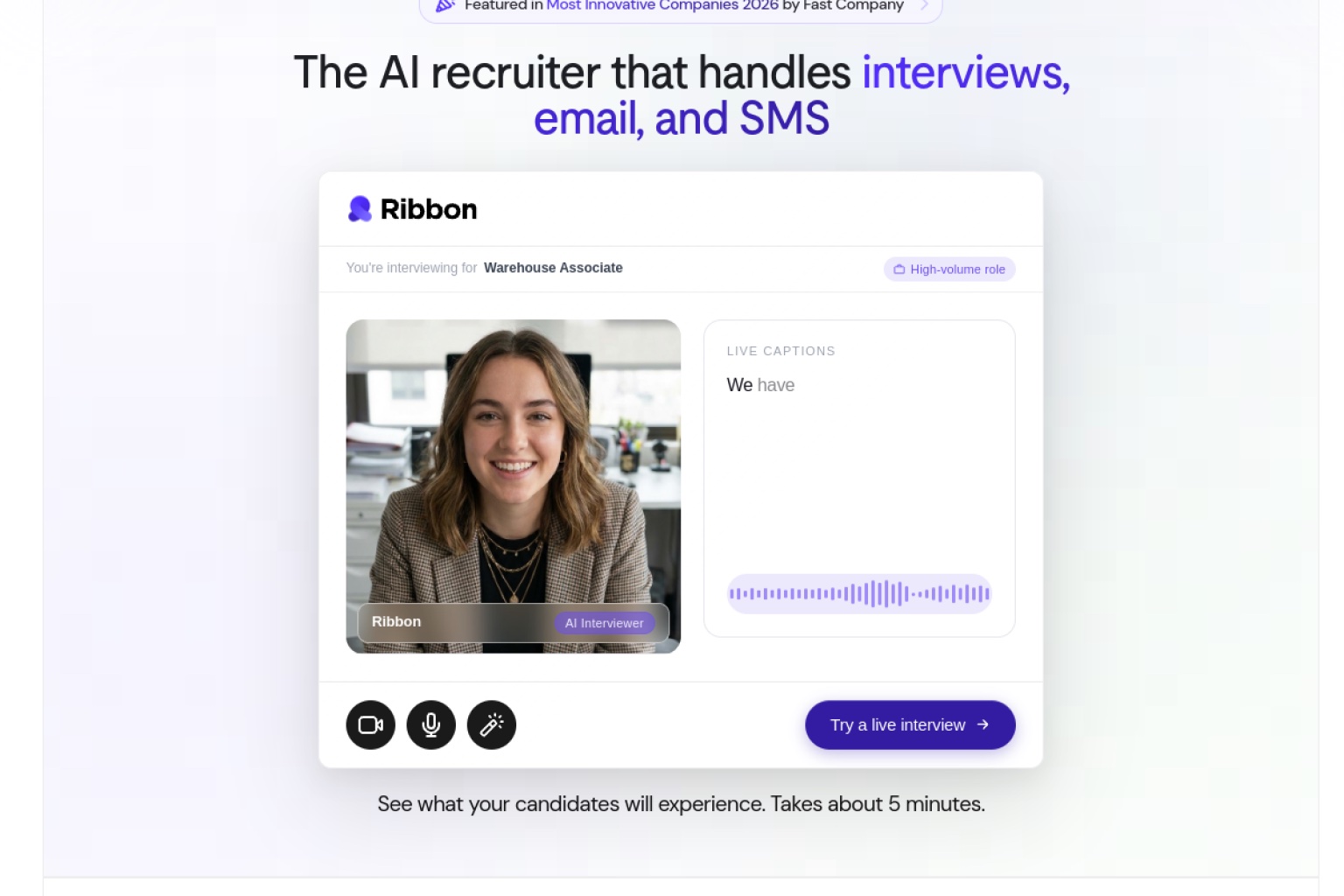
Ribbon at a glance: an AI-led first interview for repeatable, high-volume screening
Ribbon is an AI interviewing platform designed for the point between an application and a recruiter-led conversation. A candidate is invited to complete a structured voice, phone or video interview; the hiring team can then review the recording, transcript, summary, scorecard and ranking. Its intended role is early-stage qualification, not the replacement of every human interview. Ribbon is most useful when a team repeatedly asks comparable first-round questions, needs to reach applicants outside business hours, and wants consistent material for human review. The provider describes the product as the bridge from application to the first human-led interview. Source: Ribbon product page, accessed 20 August 2026.
Where Ribbon is a good choice: high-volume recruiting or staffing environments where speed, availability and consistency are more important at the first stage than a recruiter personally conducting every initial call. Multi-location operations, frontline or seasonal hiring, and agencies with recurring qualification questions are plausible fits. It is a less natural primary tool for retained executive search, highly bespoke technical evaluation, or a process in which the first personal conversation is deliberately central to relationship-building. In those cases, it may still support a narrow screening step, but it should not be assumed to replace the human process.
Provider facts
| Criterion | Publicly documented position |
|---|---|
| Category | AI-led voice and video interviews for first-round screening, producing transcripts, summaries, scores and rankings for recruiters. |
| Target market | Ribbon visibly addresses high-volume recruiting teams, including manufacturers, airports, quick-service restaurants and recruitment agencies. It does not publish a fixed employee-count target. |
| Pricing model | Subscription plans with monthly interview allowances plus seat and active-role limits; public prices are shown as annually billed. Enterprise is custom priced. |
| Published price | Growth: US$499/month annually billed, 100 interviews/month. Business: US$999, 400 interviews. Scale: US$1,999, 1,000 interviews. Overage: US$4.00 / US$3.00 / US$2.50 per interview. Source: Ribbon pricing page, accessed 20 August 2026 |
| Language coverage | Ribbon states 10+ languages. The G2 product profile lists German among supported languages, but public evidence does not establish DACH-specific support or quality for a particular role. Source: Ribbon pricing page, accessed 20 August 2026; Source: G2 product profile, accessed 20 August 2026 |
| Hosting and privacy statement | Ribbon states GDPR compliance. Its public sub-processor list identifies AWS hosting, storage and compute in the US, Canada and UK, and OpenAI and Supabase in the US. It does not publish an EU-only data-residency commitment. Source: Ribbon DPA and sub-processor list, updated 29 September 2025, accessed 20 August 2026 |
| Integrations | Ribbon states that it has two-way integrations with 60+ ATS products; its product page shows Greenhouse, Workday, Ashby, UKG and Workable. The exact depth of each integration is not publicly specified. Source: Ribbon product page, accessed 20 August 2026 |
| Organisation size | Published plans range from two seats, two active roles and 100 interviews per month to ten seats, ten roles and 1,000 interviews. This supports a volume-based buying decision, not a published employee-size threshold. |
What Ribbon actually automates
Ribbon begins with data already present in the hiring process. Its privacy policy lists candidate names and contact details, résumés or professional background, interview answers, and session metadata among the data it may process. During the interview, that can include audio and video recordings, a transcript, device and timing information, and AI-generated summaries or scores. The customer needs to provide the role design: the questions, required qualifications, scoring rubric, workflow and escalation rules. That configuration matters because it defines what the system is able to elicit and how answers are compared. Source: Ribbon privacy policy, accessed 20 August 2026.
The operational flow can be automated from invitation to initial decision support. Ribbon promotes email, SMS and WhatsApp outreach, automated follow-ups, recorded voice or video interviews, live captions, structured evaluation and ATS synchronisation. It describes the conversation as two-way: instead of simply presenting a fixed recording prompt, the interviewer can respond to answers with follow-up questions. Recruiters can configure rubrics and then review a comparable set of transcripts, summaries, scores and rankings. The product page also describes integrity flags for off-screen activity and unusual response patterns. Source: Ribbon product page, accessed 20 August 2026.
That is a substantial automation level for the top of the funnel. Candidate contact, reminders, interview delivery, transcription, summarisation and first-pass organisation of the evidence can happen without a recruiter hosting every call. It does not make the workflow safely self-governing. Ribbon says it does not make autonomous employment decisions and that generated outputs support customer human decision-making. The employer therefore still needs an accountable reviewer, a process to override a score, a route for candidate questions and accommodation, and a documented rule for how an integrity flag is investigated. Source: Ribbon privacy policy, accessed 20 August 2026.
There are structural limits to keep in view. A structured conversation can compare answers to the criteria it was configured to collect; it cannot independently establish technical mastery, validate a work history, replace a job simulation, or infer qualities never tested in the interview. Recording and ranking may make review faster, but they do not eliminate the need to assess relevance, context and fairness. The public material also does not set out a model version, language-specific accuracy measures, accent performance, error rates, or the thresholds behind every ranking or integrity signal. Absence of that information is not proof of a product defect, but it makes an evidence-based pilot important.
Pricing: what is included, what is unspecified, and when the package changes
Ribbon publishes three packaged plans. Growth contains two seats, two active roles and 100 monthly interviews for US$499 per month on annual billing. Business contains five seats, five active roles and 400 interviews for US$999. Scale contains ten seats, ten roles and 1,000 interviews for US$1,999. Each published tier includes voice and video interviewing, 10+ languages, email and SMS outreach, ATS integrations, an analytics dashboard and API access. Growth is listed with standard self-service support, Business with priority self-service, and Scale with implementation and faster support; Scale also explicitly lists ATS mapping. Source: Ribbon pricing page, accessed 20 August 2026.
The public price is therefore not simply a per-recruiter licence. It bundles a monthly interview allowance with limits on seats and concurrently active roles. Extra interviews are listed at US$4.00 on Growth, US$3.00 on Business and US$2.50 on Scale. This is useful for budget modelling, but a buyer should check the operational limits as carefully as the interview count: a team running many roles at once may outgrow an active-role cap before it outgrows its interview allowance. Source: Ribbon pricing page, accessed 20 August 2026.
The page labels the public plans as annually billed. It does not itself publish full contractual terms for a minimum commitment, renewal, cancellation, refunds, bespoke implementation, data export, or the treatment of every communication channel. It also does not prove that no other fees can apply. A careful buying conversation should therefore separate what is public from what needs contractual confirmation: invoicing period, renewal window, currency and tax treatment, onboarding, ATS mapping, support response levels, messaging costs, data-return obligations and the price of a volume spike.
A practical volume calculation using Ribbon's public list prices
The calculation below uses only the published annually billed monthly prices and assumes the included allowance is fully used. It is not a forecast, quote or total-cost model; taxes, enterprise terms and services outside the public plan are excluded. It is useful because it shows where overage makes the next tier economically sensible. At 250 interviews per month, Growth would be US$1,099 after 150 overage interviews, while Business remains US$999. Business plus US$3 overage reaches roughly the Scale price at 734 interviews per month. Seat and role constraints can change that conclusion sooner.
| Monthly scenario | Public-price calculation | Buying implication |
|---|---|---|
| 100 interviews, no more than 2 seats and 2 active roles | Growth: US$499/month annually billed | A reasonable starting point when volume is stable and self-service support is sufficient. |
| 250 interviews | Growth: 499 + 150 × 4 = US$1,099; Business: US$999 | Business is less expensive on interview spend alone and includes more seats and active roles. |
| 734 interviews | Business: 999 + 334 × 3 = US$2,001; Scale: US$1,999 | At about this volume, Scale becomes cheaper than Business plus published overage. |
| 1,000 interviews | Scale: US$1,999/month annually billed | If the full allowance is used, that is roughly US$2.00 per included interview before other costs. |
There is no universal employee-count threshold at which Ribbon “pays for itself.” The stronger trigger is recurring, standardisable first-round volume: enough similar screening conversations to keep the included interview capacity busy and enough scheduling effort that an asynchronous interview improves responsiveness. A small team with hundreds of comparable applicants may gain more than a much larger company hiring a handful of highly bespoke specialists. Conversely, a large enterprise with low interview volume may still need a custom plan because of governance, integration or data-residency requirements.
Fit by use case
| Use case | When Ribbon is a good fit | When it is not the natural fit | Alternative category to assess |
|---|---|---|---|
| Many comparable first-round interviews | Questions, minimum requirements and scoring standards can be defined clearly, and candidates benefit from rapid access to the first conversation. | Every early conversation needs extensive individual preparation and relationship-building by a recruiter. | Recruiting coordination with human-led screens or interview-scheduling software. |
| Multi-site, frontline or seasonal hiring | After-hours availability and reduced scheduling friction are material to application completion. | The target population cannot reliably use the selected digital or phone channel. | Mobile recruiting and candidate-support platforms with human assistance. |
| Technical or specialist evaluation | Ribbon is used as structured pre-qualification before a human technical interview or work sample. | The decision depends mainly on code, a portfolio, a practical simulation or regulated professional evidence. | Role-specific assessment, coding-test or work-sample platforms. |
| Strict EU or German data-residency requirement | Only if the required region, sub-processors and deletion path are contractually committed for the proposed implementation. | EU-only or Germany-only hosting without third-country transfers is non-negotiable. | Interview or assessment software with contractually guaranteed EU/Germany data residency. |
What users report: evidence for both upside and caution
Ribbon's G2 profile showed a 4.3 out of 5 rating from ten reviews when accessed. That is a limited review base, so it should be treated as a source of pilot questions rather than a conclusive product-quality score. Reported positives include quick onboarding, configurable questions, reduced work around repetitive screening, consolidated interview summaries and candidate ranking. Reviewers also value that applicants can interview outside recruiter working hours. Source: G2 reviews, accessed 20 August 2026.
The same public review source contains specific cautions. Individual reviewers mention long pauses during calls, occasionally over-casual wording, pricing that felt high, and a need to fine-tune more complex workflows. G2's review summary likewise mentions delays and workflow tuning. These are individual reports rather than findings that apply to every customer, but they point to useful pilot measures: candidate completion and dropout rates, latency, tone, relevance of follow-up questions, ATS sync errors, reviewer agreement with scores and the actual reduction in recruiter time. Source: G2 pros and cons, accessed 20 August 2026.
DACH and EU considerations: language, data processing and the EU AI Act
German appears in G2's supported-language list, while Ribbon's pricing page states 10+ languages. Neither statement validates performance in a real German-language hiring workflow: terminology, regional accents, formal versus informal address, sensitive conversations and role-specific follow-ups need testing. The reviewed public pages do not document a DACH-specific product, German local support, or a dedicated German hosting option. For a DACH rollout, a pilot should use actual role questions and include review by people who know the intended candidate audience. Source: G2 product profile, accessed 20 August 2026; Source: Ribbon pricing page, accessed 20 August 2026.
Ribbon says that it acts as a processor for customer candidate data and describes GDPR legal bases plus rights to human review and to contest automated outputs. Its policy says interview recordings and transcripts may typically be retained for up to 24 months unless deleted earlier at the customer's or data subject's request. It also says that transfers outside the European Economic Area may use safeguards including European Commission Standard Contractual Clauses. These are provider statements, not a legal assessment of a particular employer's proposed use. Source: Ribbon privacy policy, accessed 20 August 2026.
The public sub-processor information is particularly relevant to a European buyer. Ribbon identifies AWS as the provider of hosting, storage and compute, listing the US, Canada and UK; it lists OpenAI and Supabase in the US. The list does not promise that a customer's interview data will stay in an EU data region. Buyers with strict residency or transfer requirements should obtain written answers about each data category, region, backups, support access, sub-processors and deletion route, rather than relying on the general GDPR statement. Source: Ribbon DPA and sub-processor list, updated 29 September 2025, accessed 20 August 2026.
The EU AI Act also matters for a product that scores or evaluates candidates. Annex III places AI systems intended for recruitment, selection and candidate evaluation within the employment high-risk area, subject to the Regulation's detailed conditions and exceptions. Ribbon says it has human-in-the-loop design, documentation, bias-mitigation practices, logging and monitoring, while making customers responsible for appropriate human oversight and compliance with employment and non-discrimination law. That does not settle the legal status of every deployment. The practical review should focus on the intended use of scores and rankings, documented human intervention, candidate notices, challenge routes, bias governance and local employee-representation requirements. Source: Regulation (EU) 2024/1689, Annex III, accessed 20 August 2026; Source: Ribbon privacy policy, accessed 20 August 2026.
Eight questions to ask Ribbon before selecting it
- Which data region applies to each data type? Request a written mapping for recordings, transcripts, metadata, backups and support access, including every sub-processor.
- What does the integration do in our exact ATS? Confirm fields, candidate-state changes, errors, deletion requests, duplicate handling and whether recordings, transcripts and scores are returned.
- Which stages can be automated and which require an approval? Separate invitation, reminder, interview, ranking, forwarding and rejection in the proposed workflow.
- Can we test our German-language workflows before rollout? Use real questions and representative candidate scenarios to test accents, tone, response latency and follow-up quality.
- How are scores, follow-ups and integrity alerts configured and audited? Ask for transparency, logs, a human override and a documented escalation process for disputed results.
- What does our chosen price actually include? Confirm interviews, seats, active roles, implementation, mapping, API, support, messaging and the treatment of overage in writing.
- What are the contract and exit terms? Clarify annual billing, renewal, cancellation, data export, return and deletion, including backups.
- Which current assurance material is available? Request the current SOC 2 evidence, bias-audit material, DPA, sub-processor list and documentation supporting human oversight and AI Act controls.
Our own take: we also publish an editorial comparison for buyers weighing this tool against alternatives — read it here.