
HeyMilo at a glance
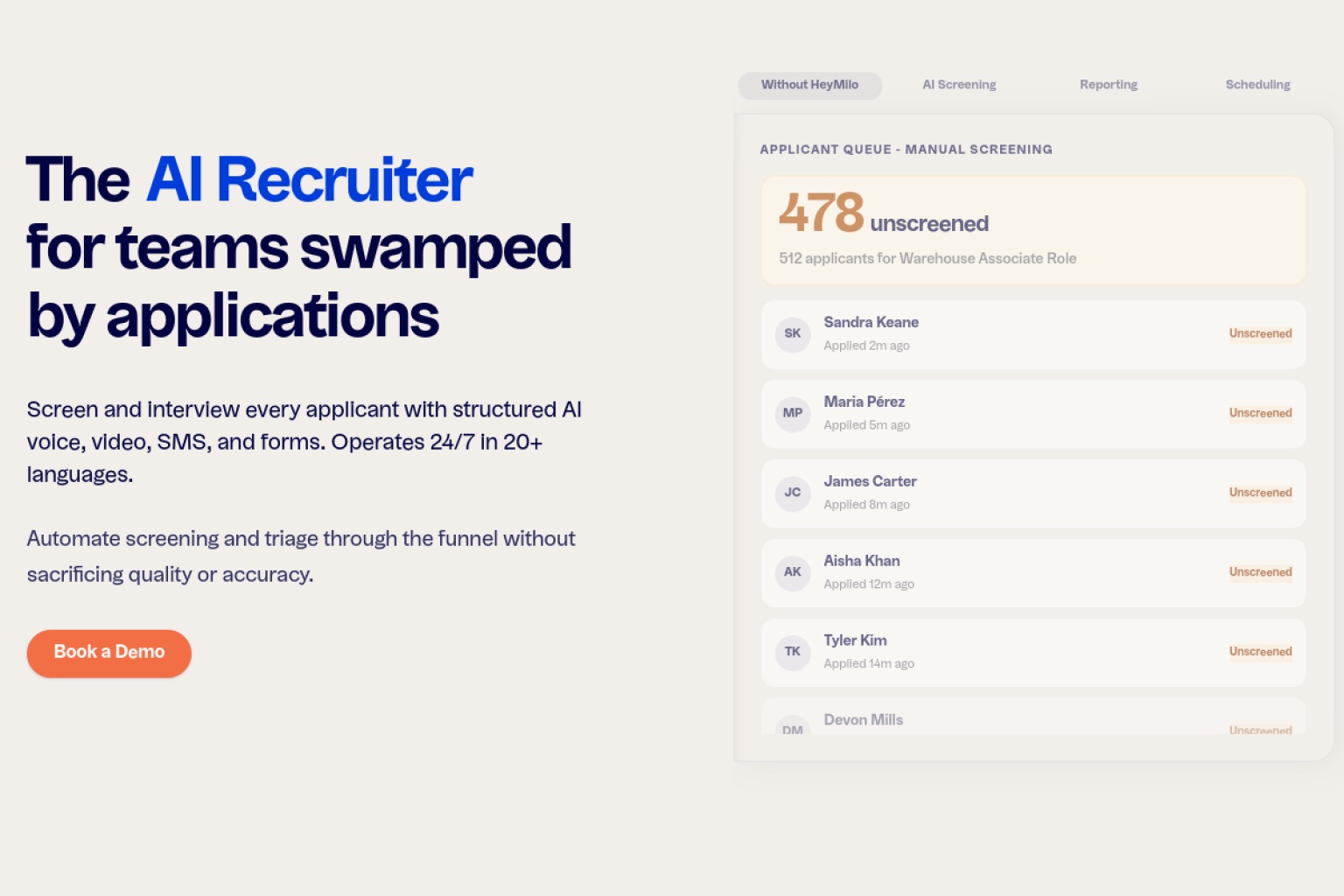
HeyMilo automates the repeatable early parts of recruitment: engaging candidates, checking basic criteria, conducting a structured conversation, evaluating responses against a defined rubric, and returning the resulting information to an applicant tracking system. It should therefore be assessed as a screening and interview layer rather than as a conventional ATS. HeyMilo’s integration material describes the ATS as the continuing system of record for candidate data and the wider hiring process. Source: HeyMilo integrations, accessed August 20, 2026.
HeyMilo is a good choice where a hiring organisation repeatedly asks candidates a similar set of first-round questions: staffing agencies, recruitment-process outsourcers, franchises and multi-site employers, contact centres, logistics businesses, care providers, industrial employers, and other high-volume hiring environments. Its value proposition is not to replace the substantive human interview. It is to standardise the preparation before it: candidates can participate on their own time, recruiters receive comparable evidence, and human time is reserved for cases that need judgment. HeyMilo explicitly positions the platform for talent teams hiring at volume. Source: HeyMilo, accessed August 20, 2026.
| Criterion | Publicly evidenced position | Source and status |
|---|---|---|
| Category | AI-driven candidate screening, asynchronous voice and video interviews, and workflow automation around an ATS. | HeyMilo product page, accessed August 20, 2026 |
| Target market | High-volume recruitment, corporate talent acquisition, staffing, BPO, data annotation, and franchise hiring. | HeyMilo product page, accessed August 20, 2026 |
| Pricing model | Custom quote. The provider refers to subscription or usage-based models but does not publish a binding rate card. | HeyMilo multilingual interviews and Terms of Service, accessed August 20, 2026 |
| Price | Not public. A written proposal is required for prices, minimum volume, and scope. | Terms of Service, accessed August 20, 2026 |
| Language coverage | HeyMilo lists 13+ languages and dialects; German is listed as a standard language. Regional variants are not universally confirmed. | HeyMilo multilingual interviews, published January 15, 2026; accessed August 20, 2026 |
| Hosting and privacy | The Terms state that services are hosted in the United States. HeyMilo makes GDPR, SOC 2, and AI-governance statements; no public evidence of an EU data-residency option was found. | Terms of Service and Responsible AI, accessed August 20, 2026 |
| Integrations | Documented ATS integrations include Ashby, Avionté, Bullhorn, Greenhouse, iCIMS, JobDiva, Lever, SAP SuccessFactors, SmartRecruiters, Teamtailor, UKG, Workable, Workday, and Zoho Recruit. The product page also lists API and MCP connectivity. | HeyMilo integrations and HeyMilo product page, accessed August 20, 2026 |
| Organisation size | Most clearly positioned for teams hiring at volume. In practice, recurring first-round interview volume is a more useful fit criterion than employee headcount. | HeyMilo product page, accessed August 20, 2026; second statement is a process assessment |
What the platform does technically
In the documented workflow, an employer connects its ATS, maps jobs to interview agents, and triggers automation when a person applies or reaches a given pipeline stage. Depending on the integration, HeyMilo says that connection uses API credentials, OAuth, or webhooks. Candidates are then invited by email, SMS, or both. They complete a voice, video, SMS, or form-based flow when it suits them. This is a substantial degree of automation: a stage change in the ATS can lead all the way to a completed report without a recruiter manually issuing each invitation. Source: HeyMilo integrations, accessed August 20, 2026.
The provider describes inputs including applicant and job information from the ATS, resumes and documents, form responses, and the contents of text, audio, or video conversations. It says the platform can produce question-level scores against a recruiter-defined rubric, rationale, summaries, transcripts, recordings, and, for some integrations, extracted tags or skills. Those outputs can return to the candidate record as PDFs, notes, activities, custom fields, or report links. The fields actually written back and whether a candidate can move automatically through a stage depend on the individual connector, so the buyer should test the exact ATS configuration rather than infer capability from the integration directory. Source: HeyMilo integrations, accessed August 20, 2026.
HeyMilo says its agents can adapt follow-up questions in real time based on candidate answers rather than merely play a fixed questionnaire. In a standardised first conversation, that can deliver richer context than a basic knockout form. There is still a structural limit: the system can assess only the material it receives, the answers given, and the criteria it has been configured to use. Whether an explanation is credible, evidence is role-relevant, or a score is well calibrated for a particular job remains a human question. HeyMilo characterises its AI as advisory and says recruiters define rubrics and thresholds before making the final hiring decision. Source: HeyMilo Responsible AI, accessed August 20, 2026.
Alongside interview and evaluation, the platform lists resume and document checks, SMS screening, scenario assessments, scheduling, and identity or cheating signals. These signals should be treated as review inputs rather than as conclusive evidence about a candidate. A selection process should ask not simply whether a signal exists, but how false positives are handled, what underlying evidence a recruiter sees, and how a person can challenge or override an assessment. Source: HeyMilo product page, accessed August 20, 2026.
Automation, integration, and practical limits
- Stage-based triggers: Several published integrations can start an invitation from a pipeline stage or webhook. This can remove manual list work when the ATS stages are maintained consistently. Source: HeyMilo integrations, accessed August 20, 2026.
- Writeback rather than a parallel process: Scores, reports, notes, and in some cases transcripts can return to the ATS. Depth is connector- and field-specific, not uniform across every ATS. Source: HeyMilo integrations, accessed August 20, 2026.
- Configurable evaluation: The employer defines questions, rubrics, and pass/fail thresholds according to HeyMilo. That creates room for role-specific design, but it also creates calibration work when jobs, markets, or applicant profiles change. Source: HeyMilo Responsible AI, accessed August 20, 2026.
- Asynchronous candidate experience: Candidates do not need to find time in a recruiter’s calendar. This can help with shifts, time zones, and applicant surges; roles where personal relationship-building is essential in the first contact need a deliberately designed human step. Source: HeyMilo multilingual interviews, accessed August 20, 2026.
- Custom integration as a project: HeyMilo says it can build custom connections for enterprise requirements. Availability is not evidence of delivery effort, timetable, or price, which should be specified in the proposal. Source: HeyMilo integrations, accessed August 20, 2026.
When HeyMilo is the right choice – and when another category is better
| Use case | HeyMilo fit | If not: alternative category |
|---|---|---|
| Many similar first interviews every week, an existing ATS, and a clear phone-screen bottleneck | Good fit. Asynchronous interviews, standardised rubrics, and ATS writeback address this workflow directly. | No alternative category is required by default; first validate the ATS connector in a pilot. |
| Staffing, BPO, or multi-location hiring with volume peaks and standardised roles | Good fit. Public positioning and several staffing-related integrations support this use case. | For a full operating-model change, consider recruitment-process outsourcing or a broader recruiting-operations platform. |
| A small team conducting a limited number of highly individual executive or specialist interviews | Often not the first choice. Configuration and governance may outweigh the benefit of automating the first round. | Structured interviewer training or an interview-intelligence tool for notes and analysis. |
| The principal requirement is to find candidates rather than process inbound applicants | Not the core fit. HeyMilo lists sourcing features, but is publicly positioned primarily around screening and interview workflows. | Active-sourcing or talent-intelligence platform. |
| EU data residency is a non-negotiable procurement requirement | Consider only after written confirmation. Public terms state US hosting and do not evidence an EU-hosting option. | EU-hosted interview or applicant-tracking platform. |
| One system must replace the ATS, job administration, compliance workflows, and career site | Do not assess it as an ATS replacement. HeyMilo describes the ATS as the system of record. | Applicant-tracking system or recruiting suite. |
The key buying question is therefore not simply whether a recruiting team is large enough. It is whether it handles enough comparable first checks. A three-person staffing desk with sustained incoming volume may derive more value than a large specialist business hiring a small number of highly individual roles. With no public pricing, there is no defensible universal minimum team size. A practical decision rule is to compare the monthly platform cost, including amortised implementation, with the monthly preparation work avoided. That work equals the number of interviews that could be automated multiplied by the current recruiter minutes per interview, divided by 60, multiplied by the fully loaded hourly recruiting cost. The model should also include human result review, pilot work, training, ATS integration, and any channel-specific communication costs. A pilot is economically credible if it remains positive under cautious assumptions, not only during an exceptional applicant peak.
Pricing, commitment, and possible extra cost
Pricing is not public. As of August 20, 2026, neither the product pages nor the Terms of Service provided a public, binding rate card for the recruiting platform. HeyMilo refers to subscription or usage-based models on its multilingual product page without publishing tariff tiers or amounts. Its Terms say payments are made in US dollars and prices may change, but they are not an enterprise proposal. Source: HeyMilo multilingual interviews and Terms of Service, accessed August 20, 2026.
The public feature set is visible: SMS, forms, resume and document checks, voice or video interviews, structured reports, ATS integrations, and, depending on the scenario, scheduling and cheating signals. What is not publicly evidenced is what the base quote includes, whether channels or connectors incur additional charges, whether custom integrations are separately priced, or what level of implementation and support comes with a contract. A feature list is not a statement of the scope included in a particular proposal. Sources: HeyMilo product page and HeyMilo integrations, accessed August 20, 2026.
There is no public enterprise rate card establishing a minimum contract term. The general Terms say a subscription can be cancelled through the account and that cancellation may take effect immediately; they also say purchases are non-refundable. An employer should not assume that an enterprise order follows those general provisions. Minimum term, prepayment, committed volume, renewal mechanics, and notice periods should appear in the order form. Source: HeyMilo Terms of Service, accessed August 20, 2026.
It would be speculative to label any cost as hidden without evidence. A more useful procurement approach is to make each potential cost driver explicit: one-off implementation and data mapping, standard versus custom integration, interview or message volume, voice and video minutes, countries and languages, WhatsApp or SMS delivery, recording retention, white-label requirements, support tier, and changes to rubrics or workflows. No public HeyMilo price was found for these items, so each should be a line item in the proposal rather than an assumption in the business case.
What users report
The visible public review base remains limited. When accessed on August 20, 2026, HeyMilo’s G2 profile showed 4.8 out of 5 from ten reviews. That is a positive indicator, but it is too small a sample to support a broad conclusion across countries, industries, or job types. Source: G2: HeyMilo AI Reviews, accessed August 20, 2026.
Positive comments in individual G2 reviews mention quick implementation, the ability to screen more candidates at convenient times, standardised interviews, and responsive support. One small-business reviewer described relief from a capacity constraint created by many manual interviews; other reviewers valued candidates being able to engage when it suited them. These are individual user accounts, not independently verified performance figures. Source: G2: HeyMilo AI Reviews, accessed August 20, 2026.
Documented criticism also exists, although it is not yet a broad pattern: one reviewer wanted more tools to coach and refine AI interviewers, and another wanted more ATS integration options. These comments point to a practical evaluation requirement: assess more than the demo by testing the buyer’s own jobs, scoring rubrics, and exact ATS environment. Source: G2: HeyMilo AI Reviews, accessed August 20, 2026.
DACH, EU, GDPR, and the EU AI Act
For German-language hiring, German is explicitly listed as a supported standard language. HeyMilo lists 13+ languages and dialects, while also noting that not every regional variant is available and that deeply idiomatic or culturally specific communication can need additional human review. A German-language pilot using the organisation’s terminology, accents, and realistic evaluation cases matters more than a language-list entry. Source: HeyMilo multilingual interviews, published January 15, 2026; accessed August 20, 2026.
Public hosting information is clear: the Terms state that services are hosted in the United States and that data may be transferred to and processed in the US when the service is used from another region. No public evidence of EU hosting or EU data residency was found in the reviewed documentation. For an organisation with an explicit European-residency requirement, this is a procurement decision to resolve before contract signature, not a post-implementation detail. Source: HeyMilo Terms of Service, accessed August 20, 2026.
HeyMilo publishes a data processing agreement that refers to GDPR concepts, offers assistance with data-protection impact assessments, and says EU-approved Standard Contractual Clauses will ordinarily be used for EEA transfers. Its Responsible AI page also states SOC 2 Type I and Type II, GDPR compliance, deletion on request, no use of customer data for model training, and monthly bias audits through Warden AI. Those are vendor statements or linked assurance materials, not a replacement for the buyer’s own review. Buyers should examine subprocessors, actual storage locations, retention for audio, video, transcripts, and prompt logs, plus the final contract. Sources: HeyMilo Data Processing Agreement and HeyMilo Responsible AI, accessed August 20, 2026.
Annex III of the EU AI Act identifies AI systems intended for recruiting or selecting people, including analysing, filtering, and evaluating applications. Whether a particular HeyMilo configuration and use by an employer gives rise to specific obligations depends on intended purpose and deployment design and should be assessed through legal and governance processes. HeyMilo says it has completed a classification analysis for its standard configurations and supports additional controls where a customer use case requires them. For procurement, demonstrable human oversight, candidate transparency, documented rubrics, auditability, and a controlled route for correcting an assessment are essential. Sources: EU AI Act Service Desk: Annex III and HeyMilo Responsible AI, accessed August 20, 2026.
Eight questions for the vendor selection conversation
- What does a complete pilot for our three priority roles look like? Ask to see invitation, interview, follow-ups, transcript, score, report, and ATS writeback using realistic test cases.
- What data does the platform read from our ATS and which precise fields does it write back? Ask per connector about field mapping, webhooks, error handling, retries, and the ability to disable automatic stage movement.
- What is included in the quote and what is not? Request separate lines for platform access, interview or usage volume, SMS and WhatsApp, voice and video, implementation, standard and custom integrations, support, storage, and white labelling.
- Which minimum term, minimum commitment, payment terms, and renewal mechanics apply? Have these points documented in the proposal or order form rather than relying on general website terms.
- How will evaluation be calibrated for our roles? Clarify who builds rubrics, how thresholds are tested, how language and cultural bias are reviewed, and how a recruiter can transparently override a score.
- How do German, regional variants, and role-specific terminology work in our candidate market? Request a trial with realistic, privacy-safe examples and assess conversational quality, transcription, and scoring separately.
- Which data leaves the EU, which subprocessors are involved, and how are audio, video, and transcripts deleted? Review the DPA, Standard Contractual Clauses, storage locations, retention, data-subject rights, and deletion evidence.
- How are candidates informed about AI, recording, and their options? Ask about consent, stopping an interaction, human escalation, appeal paths, audit export, and treatment of identity or cheating signals.
Our own take: we also publish an editorial comparison for buyers weighing this tool against alternatives — read it here.