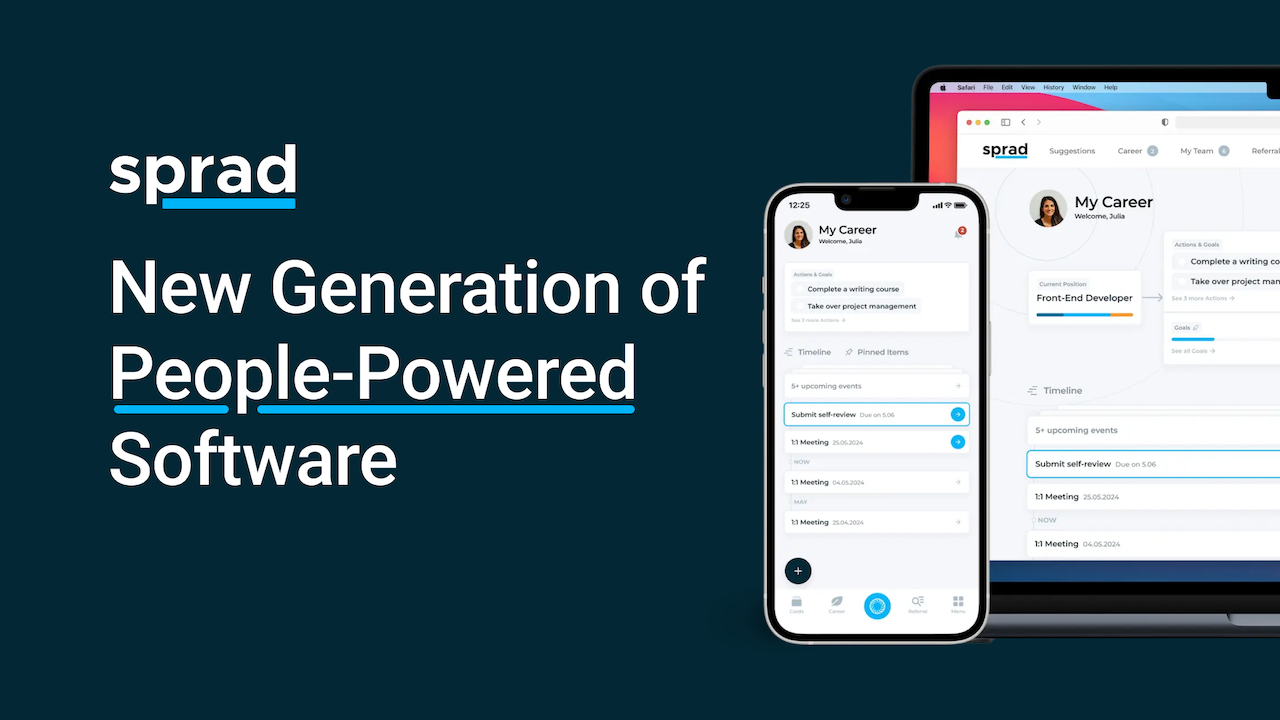
What is Sprad?
Sprad is a modular HR platform for recruiting, talent management and HR operations. It is therefore broader than its newer Atlas products for sourcing and applicant workflows. The platform combines three product areas: an employee referral system, a talent-management workspace and Atlas, an AI layer that runs processes across existing systems. Companies can start with individual modules and combine them later. A team may begin with employee referral, performance cycles, skill management or active sourcing without replacing its full HRIS.
The portfolio covers the people journey from recruiting and recruitment marketing through screening and candidate relationship management to employee referrals, goals and performance, skills and career paths, feedback, people analytics, HR management and employee self service. Atlas connects existing ATS, HRIS, calendars, chat tools and documents. Sprad is positioned as a connected set of modules and automation workflows on top of the existing stack, rather than as a forced HRIS or ATS replacement.
Module overview
| Product area | What Sprad does | Who it is for | Status |
|---|---|---|---|
| Talent management | Connects performance, skills, feedback, goals, surveys and succession into a living employee view. Atlas can combine HRIS, 1:1, survey and work-tool signals. | People teams, managers and employees working on development and internal mobility. | Established |
| Employee referral | Activates employees to make referrals through Teams, Slack, email, WhatsApp, SMS or an employee app. Includes one-click referrals, gamification, LinkedIn network suggestions and ATS sync. | Recruiting teams with desk and non-desk workforces. | Established |
| HR analytics | Connects engagement, performance and 1:1 signals, flags attrition risk and supports headcount and people-reporting workflows. | HR leaders and management teams that need actionable people signals. | Established |
| HR management | Automates HR workflows across existing tools, including onboarding, documents, data changes and recurring process steps. | HR operations teams with manual, cross-system work. | Established |
| Employee self service | An HR helpdesk answers recurring policy and HR questions around the clock from approved company documents, with the source attached. | Employees and HR teams aiming to reduce repeat requests. | Established |
| Performance management | Launches review cycles, collects self and peer input, nudges participants, creates evidence-based drafts and prepares 1:1s. | Managers, people teams and organisations running regular performance cycles. | Established |
| Skills and competency management | Maps skills to roles, highlights gaps and role readiness, and supports development paths and internal moves. Employees can confirm or correct skills in check-ins. | Organisations building career frameworks, development or workforce plans. | Established |
| Recruitment marketing | Uses employee advocacy as a recruiting channel: relevant roles are distributed through the communication channels employees use, then shared and linked to referrals. | Recruiting and employer-brand teams seeking reach through their own networks. | Established |
| Candidate relationship management | The candidate portal brings together process steps and confirmed profile data. The talent pool imports existing records and Apply candidates, ranks them with AI and can identify later job-search signals. | Recruiting teams that want to maintain candidate relationships beyond one application. | New, live |
| 360-degree feedback | Atlas coordinates rater selection, reminders, synthesis and calibration. Results are turned into a traceable report and development plan. | People teams and managers with multi-rater feedback processes. | Established |
| AI sourcing tools | People Search finds candidates, supports configurable outreach and follow-ups, selects suitable contact channels and can automate work through booked meetings. | Recruiting teams with hard-to-fill roles or active-sourcing needs. | New |
| AI interview voice tools | Structured first interviews can run shortly after application via WhatsApp, email, phone or chat. Results are structured and traceable to transcript quotes. | Teams with high applicant volume, mobile audiences or limited recruiter capacity. | New |
| AI CV screening tools | Atlas combines CV, LinkedIn and a short interview into a confirmed, enriched profile and returns the result to the ATS. | Recruiting teams that need to prioritise applications using more context than a CV alone. | New |
Recruiting, sourcing and applicant workflow
People Search is Sprad’s active-sourcing module. It combines candidate discovery with the work that follows: teams can choose whether Atlas should only suggest prospects or also reach out, handle follow-ups, answer initial questions and follow up after a positive response. Outreach tone and the depth of pre-qualification remain configurable. Sprad describes the workflow as automation from search through a booked meeting, with management kept in the system rather than split across side spreadsheets. An optional voice interview adds context on motivation, language, availability and fit before the first personal conversation.
For sourcing, Sprad currently communicates only the following carefully limited comparison: We tested Atlas against four well-known sourcing tools. Of everything the others found combined, Atlas found about 38 percent—the best single tool reached 9 percent. We are publishing the full study shortly. This is not an independent audit and does not promise the same result for every role, region or search.
Atlas Apply and CV Screening do not rely on a stand-alone résumé score. The module combines a CV, LinkedIn and interview input into one profile, checks hard facts such as location, licences and must-haves, then returns the enriched result to the existing ATS. Candidates can view, correct and confirm their profiles, which distinguishes the workflow from hidden background matching. Invitations can be sent after application via WhatsApp or email.
The voice interview is a separate but combinable step. Sprad conducts structured first interviews in the portal, by WhatsApp, email or phone; when speaking does not fit, the same flow can continue in chat. Role-specific questions, role plays, knock-out checks and follow-up questions can be included. For content, Sprad conservatively states that voice is available in more than 30 languages. Every assessment is traceable to transcript quotes and results can flow back into the ATS. The workflow does not replace professional judgement or a personal interview; it takes over the preparation work.
With the candidate portal and talent pool, Sprad extends the workflow beyond the immediate decision. Candidates receive a portable, confirmable profile; they can add information, return to the profile and generate a CV from it. The talent pool can be filled through imported records and Apply candidates. Given a role profile, AI ranks the inventory and reviews it in top-100 packages. Sprad also describes candidate interaction, refreshed online signals and a job agent as ways to keep the pool current and identify who may be looking again, together with relevant context.
Employee referrals and recruitment marketing
The employee referral system is a separate Sprad product, not merely a sourcing feature. It distributes open roles through channels employees already use: Microsoft Teams, Slack, email, WhatsApp, SMS or an employee app. For non-desk employees, participation through WhatsApp or SMS without an additional app is particularly relevant. Referrals can be made through personal links or social sharing. Points, interim milestones and peer recognition are intended to make participation durable, while jobs and applications are synchronised with the ATS.
For knowledge workers, LinkedIn network suggestions show employees potentially suitable contacts from their own network; employees decide whether a recruiter receives access. This connects employee referral, recruiting activation and recruitment marketing while leaving the ATS as the system of record. The modular scope matters: a company can adopt referral as its entry point even if People Search or Atlas Apply is not yet required.
Talent management, performance, skills and feedback
The talent-management workspace combines performance, skills, feedback, goals, surveys and succession in a shared employee view. For employees and managers, it is designed as a lean one-page experience where career framework, ambitions and goals sit together instead of in disconnected tools. Atlas can combine information from an HRIS, 1:1 notes, surveys and connected work tools into an evidence-based picture.
In performance management, Atlas drafts reviews from existing goals, 1:1s and peer feedback. Managers review and refine instead of writing from a blank page. Atlas can also prepare agendas, talking points and notes for 1:1s, and support cycle reminders and calibration. This module fits organisations that want reviews to lead into development plans and continuing conversations, rather than remain static documentation.
Skill management connects competencies to actual roles, levels and business needs. Atlas keeps skill signals current from check-ins, reviews, 1:1s and work activity, supports lightweight assessments and identifies skill gaps, internal matches, readiness and key-person risk. Sprad describes skill frameworks as generated for each customer’s organisation and roles, rather than as a one-time generic matrix. Career paths and development suggestions make the information useful to employees as well as HR.
The 360-degree feedback module runs the complete cycle: raters can be suggested and selected, reminders automated and responses synthesised into a report. Atlas accounts for different scoring styles in calibration. Anonymity can be configured by rater group, and results are shown only after the chosen minimum number of responses. The report surfaces strengths, development areas and perception gaps, then can become a development plan.
People analytics, HR management and employee self service
Sprad does not frame people analytics as a separate reporting silo. Atlas can connect engagement, performance and 1:1 signals, flag potential attrition risks early and give managers a retention-oriented briefing. The workspace also lists headcount and reporting flows alongside skill, engagement and workforce-planning questions. These signals are not automatic employment decisions: HR and managers need to review the relevant context.
For HR management and employee self service, Sprad offers agentic workflows. These range from onboarding steps across connected systems to HR-helpdesk answers. The helpdesk answers recurring questions about company policies and documents around the clock, in the user’s language and with the source attached. Sprad also presents automations for documents, absences, data changes and other HR-operations processes. For individual workflows, Sprad can tailor automation to the current systems and rules; companies should define and approve the automated steps in advance.
Atlas credits: packages and usage
| Type | Scope | Price | Context |
|---|---|---|---|
| Free entry | 200 credits per month, 300 in the first month | €0 | Candidate portal, forms, knock-out check, talent-pool management and unlimited jobs are credit-free; credits at the list price of €0.10. |
| Atlas Base | Membership, 6,000 starting credits | €450 per year | €0.080 per additional credit (−20% on list price). |
| Atlas Base Pro | Membership, 25,000 starting credits | €1,900 per year | €0.075 per additional credit (−25%). |
| Atlas Base Max | Membership, 65,000 starting credits | €4,900 per year | €0.070 per additional credit (−30%). |
| Credit package | 1,000 / 3,000 / 5,000 credits per month | €95 / €270 / €425 per month | Can be added at any tier; the lower credit price applies, discounts do not stack. |
| Review an application | per application | 2 credits | The assessment does not replace the final selection decision. |
| Search your own talent pool | per search | 10 credits | AI ranking of existing profiles. |
| External search | per search (standard depth, adjustable) | 100 credits | Search across public profiles beyond your own pool. |
| Voice interview with Atlas | per interview | 40 credits | Structured first conversation as preparatory work. |
Sprad's other products are not billed in credits: Sprad Growth (performance, 360-degree feedback, goals, skills, surveys) starts at €5 per employee per month, Sprad Referral is priced on request, tiered by company size (up to 300, 1,000 and 2,000 employees, plus Enterprise). As of 30 September 2026, per sprad.io/pricing.
Time versus cost: what the credits are intended to cover
| Task | Atlas cost at list price | Comparison with current preparation work |
|---|---|---|
| Review 100 applications | 200 credits, about €20 | about 13 hours of manual work (8 minutes per application) |
| Run 100 first interviews by voice | 4,000 credits, about €400 | about 50 hours (30 minutes per conversation) |
| One search in your own talent pool | 10 credits, about €1 | about 8 hours of manual screening |
| One external search | 100 credits, about €10 | about 10 hours of research |
With a membership, the credit price drops by 20 to 30%. The comparison describes AI pre-work, not final human selection.
Which module is a sensible starting point?
| Starting situation | Suggested entry module | Why |
|---|---|---|
| Hard-to-fill role and too little relevant outbound reach | People Search | Search, controlled outreach, follow-ups and optional pre-qualification can be combined. |
| High application volume but little reliable context | Atlas Apply: CV screening plus voice interview | CV, LinkedIn and interview are combined in one candidate-confirmed profile. |
| Candidates drop out or disappear after rejection | Candidate portal plus talent pool | The process becomes visible and the confirmed profile can remain available for later roles. |
| A referral programme does not reach blue-collar staff | Employee Referral | WhatsApp and SMS complement desk channels, while ATS sync reduces administration. |
| Performance cycles take too much manager time | Performance Management | Review drafts, 1:1 preparation, reminders and calibration reduce recurring preparation work. |
| Skills, career paths and internal hiring sit in separate files | Skill Management plus Talent Management | Skills, roles, gaps, development paths and internal mobility are connected. |
| HR answers the same questions repeatedly or operates manual workflows | HR Helpdesk and HR Automation | Approved sources, workflow automation and escalation give HR more time for exceptions. |
Data protection, limitations and context
For English-language content, Sprad describes its offering as data-protection compliant, meeting relevant EU and US requirements, with EU hosting available. In recruiting, candidate control is a central principle: in Atlas Apply, candidates can view, correct and confirm the profile. Before rollout, companies should still review configuration, data sources, permissions, works-council requirements and their own legal and professional processes.
There are clear limitations. First, screening scores, voice interviews, talent-pool rankings and people-analytics signals do not replace a personal interview or accountable human decision-making. Second, the current sourcing benchmark is Sprad’s own, not-yet-fully-published comparison across three role profiles; it is not an independent audit or a general performance proof. Third, integrations, custom HR automation and ATS write-back require suitable configuration in the actual stack. Fourth, voice interviews and enriched profiles depend on candidate participation, consent and accurate input. Finally, usage-based Atlas cost rises with the volume of assessments, interview minutes and talent-pool reviews.
Further product information is available for People Search, CV Screening, Voice Interviews, the Candidate Portal and Talent Pool, Talent Management and Employee Referral.