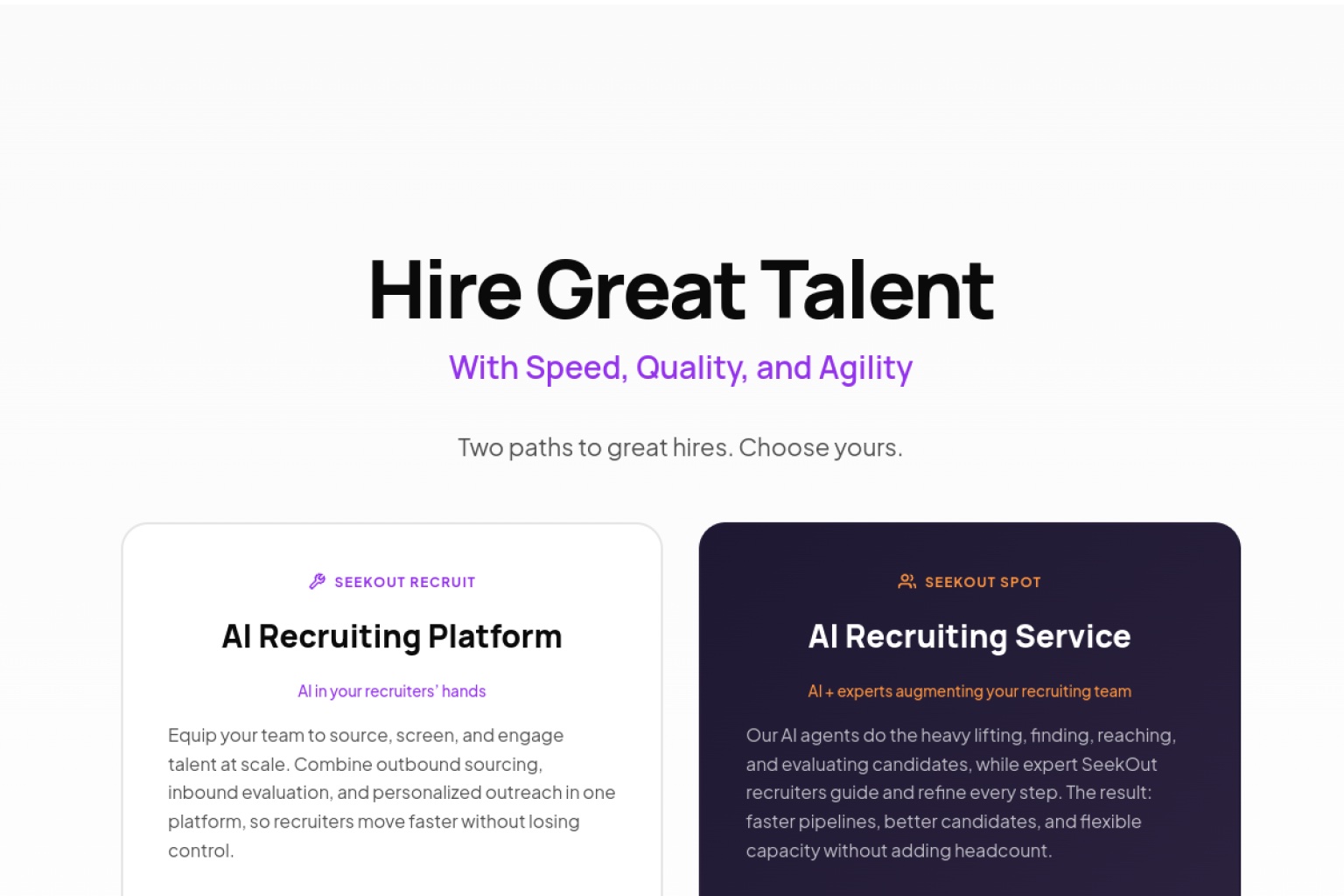
Positioning: when SeekOut is a strong choice
SeekOut is a sourcing and talent-intelligence platform for teams that need to find, assess, engage, and, where appropriate, reconcile passive candidates with their applicant-tracking system. It combines an external candidate database advertised by the vendor as containing more than one billion profiles with filters, AI-assisted search, projects or Workspaces, contact information, outreach, and—depending on the plan—ATS rediscovery and AI-assisted applicant review. The profile count is a vendor claim, not a promise that a specific location, occupation, or language will contain enough current and reachable people. Source: SeekOut Pricing, checked 20 August 2026
SeekOut is a particularly good choice when a recruiting organisation needs more than a single profile source: recurring active sourcing for specialist or leadership roles, a consistent shortlist workflow, or re-engagement of people already known to the business. The value is not simply an AI prompt. It is the operational chain from role brief through search, filters, review, shortlist, contact, and record keeping. For an occasional, low-effort vacancy, that workflow may be broader than necessary.
| Criterion | SeekOut assessment |
|---|---|
| Category | AI-assisted candidate search, active sourcing, talent rediscovery, and recruiting workflow. |
| Target market | Recruiters and talent-acquisition teams. SeekOut presents Recruit Core for solo recruiters and smaller teams, and higher tiers for sourcing, integration, and enterprise needs. |
| Pricing model and published price | Recruit Core: US$149 per month when paid annually in advance (US$1,788 per year), or US$179 per month billed monthly. Sourcing, integration, full-funnel, and Spot plans: not public; a quote is required. Source and date: SeekOut Pricing, checked 20 August 2026. |
| Language coverage | International candidate search is documented. No public commitment to a German-language interface, German-language support, or a verified language list for AI features was found on the reviewed pages. |
| Hosting and privacy | SeekOut states SOC 2 Type II, DPAs, and support for data-subject-rights requests. It documents infrastructure in SOC-2-certified US data centres; EU or German hosting is not publicly documented. Source: SeekOut Security, checked 20 August 2026 |
| Integrations | ATS and CRM export plus, for supported systems and packages, rediscovery and applicant-review integrations. Examples include Greenhouse, iCIMS, Lever, SmartRecruiters, SAP SuccessFactors, and Workday. Source: SeekOut Help Center, checked 20 August 2026 |
| Organisation size | From solo sourcing to enterprise. SeekOut does not publish a universal employee or recruiter threshold; search volume, integration needs, and governance requirements matter more. |
What the product technically does
According to its privacy policy, SeekOut’s external candidate database is built from publicly available and licensed professional information. The listed data can include names, business or other email addresses, phone numbers, titles, employers, work and education history, qualifications, skills, professional-social-profile links, GitHub data, publications, and patents. This is one reason the platform may be more useful for roles with visible professional or technical traces than for occupations with little public online presence. It is not evidence that every record is complete, accurate, current, or contactable. Source: SeekOut Privacy Policy, updated 1 June 2026, checked 20 August 2026
Search combines conventional keyword and Boolean methods with AI features. Smart Match can create an initial query from a job description or an existing candidate profile, while Clone Candidate proposes lookalike profiles. Recruiters can then narrow a pool through filters such as location, country, skills, experience, employer, company size, education, and alumni status. AI does not remove the need for a well-defined role: an ambiguous brief simply creates an ambiguous candidate set faster. A sound operating model reviews generated criteria, records exclusion rules, and checks a small, human-validated sample against the search output. Source: SeekOut Help Center, AI Features, checked 20 August 2026 Source: SeekOut Help Center, Filters, checked 20 August 2026
SeekOut Workspaces groups the elements of a live role: search, candidate evaluations, shortlist, and outreach. AI may provide summaries, recommendations, and personalised email drafts; the public plan comparison also lists multi-step campaigns and send-on-behalf email. This is meaningful workflow automation and assistance, but not proof of an autonomous hiring decision. The employer remains accountable for search design, lawful contact, message approval, and selection. SeekOut’s use policy also says users initiate communications and that its data is provided without a warranty of accuracy, completeness, timeliness, or reliability. Source: SeekOut Help Center, Workspaces, checked 20 August 2026 Source: SeekOut Use Policy, checked 20 August 2026
ATS rediscovery and inbound review: verify the actual scope
The technical value of an integration is not limited to export. In Talent Rediscovery, SeekOut says it links ATS applicant and prospect data to the platform so it can be searched alongside external data and enriched with professional information. Its documentation describes daily synchronisation for particular integrations; that should not be read as a universal real-time promise across every ATS. In Applicant Review, open jobs and applicants from supported ATS products can be imported, filtered, enriched, and ranked by role, with stage changes able to flow back to the ATS. Field coverage, permissions, data residency, error handling, and practical synchronisation timing still depend on the specific ATS and the contracted connection. Source: SeekOut Help Center, Talent Rediscovery, checked 20 August 2026 Source: SeekOut Help Center, Applicant Review, checked 20 August 2026
The public comparison correctly distinguishes sourcing, sourcing with integration, and full recruiting funnel. ATS rediscovery is not listed for Recruit Core or the sourcing-only plan. AI inbound screening is an add-on in the sourcing plan and included in Full Recruiting Funnel. A team that only needs external sourcing should not automatically pay for integration architecture. A team that wants to rediscover former applicants or triage large inbound volumes should test the relevant package using real requisitions, real data fields, and an agreed human-review process.
| If the use case is … | SeekOut is usually a good fit when … | It is not the first choice when … | Consider this alternative category first |
|---|---|---|---|
| Recurring active sourcing for specialist or passive talent | The team wants repeatable search, shortlist, and outreach workflows and another profile source beyond one professional network. | Nearly all relevant candidates already live in one professional network and an additional data source is unnecessary. | Professional-network sourcing or a specialist talent-research agency. |
| Re-engaging previous applicants | A supported ATS is in place and the quote explicitly covers rediscovery, data flows, and user permissions. | The ATS already offers sufficiently strong native talent-pool and CRM search. | An ATS with native talent pool or candidate-relationship management. |
| Large inbound applicant volume | Applicant Review or the relevant screening module is included and meaningful human oversight is designed into the process. | The requirement is fully automated interviewing, scheduling, or high-volume call automation. | Recruiting-specific AI screening or interview automation. |
| DACH or EU deployment with strict data-residency rules | US hosting, transfer safeguards, and contractual privacy review meet internal requirements. | EU or German hosting is a non-negotiable procurement condition. | An EU-hosted sourcing platform or European ATS with talent-pool capability. |
| An infrequent, one-off hire | The role is strategically important or difficult enough that the search process will be reused. | The task is a small local search with no enduring sourcing process. | A job advertisement, recruitment agency, or lightweight recruiter tool with a short commitment. |
Pricing, commitment, and the buying decision
Recruit Core is the public self-service entry plan. It includes three seats, unlimited search, more than 30 filters, 500 contact credits per month, 1,000 exports per month, Excel, PDF, and ATS export, email integration, send-on-behalf email, AI campaigns, and talent-pool insights. The annual-prepayment option is US$1,788 per year; the monthly, cancel-any-time option is listed at US$179 per month. That means the monthly plan does not publicly state a twelve-month minimum, whereas the lower annual price is paid up front. SeekOut also advertises a 14-day trial without a credit card. Source: SeekOut Pricing, checked 20 August 2026
SeekOut does not publish fixed prices for Recruit Sourcing, Sourcing + Integration, Full Recruiting Funnel, or its managed SeekOut Spot service. Those plans are annual or tailored around seats, usage, role types, and integration requirements. A comparable quote should therefore separately state additional seats, contact credits, export limits, overages, data sources, SSO, implementation, ATS connection, migration, support level, training, term, renewal, and optional modules. These are not asserted hidden fees; they are the line items that turn a custom-priced team package into a decision that procurement can actually compare.
A simple decision rule avoids an invented ROI claim. At full Core-plan utilisation, US$149 divided by 500 included contact credits is roughly US$0.30 per included credit before recruiter time, deliverability, and any additional costs. That arithmetic assumes the credits are used and that three seats are sufficient; it does not define the value of a successful contact. A small team sourcing regularly without ATS integration can therefore start by testing the self-service plan. When rediscovery, SSO, special data residency, deep integrations, or larger outreach volumes matter, a pilot against an individually priced proposal is more reliable than extrapolating from the Core plan.
What users report
Public reviews are not independent service guarantees, but they show recurring patterns. G2 reviewers commonly cite ease of use, detailed filters, passive-candidate sourcing, diversity sourcing, and access to contact information as useful. TrustRadius reviews similarly point to search filters, projects, talent-market insights, and multiple ways to contact candidates. These experiences align with the product’s documented strengths in search, filtering, and pipeline work. Source: G2 SeekOut Reviews, checked 20 August 2026 Source: TrustRadius SeekOut Reviews, checked 20 August 2026
The criticism deserves equal weight. G2 and TrustRadius reviews mention variable or outdated contact and profile data, missing phone numbers, slower result changes when filters are applied, duplicated search results, and integration problems shaped by an employer’s security restrictions. Those issues are structurally plausible for a system aggregating public and licensed data; they do not mean all records are wrong. The practical evaluation is clear: test representative roles and known target people, then record hit quality, freshness, contact usability, and ATS data flow rather than judging only a sales demonstration. Source: G2 SeekOut Reviews, checked 20 August 2026 Source: TrustRadius SeekOut Reviews, checked 20 August 2026
DACH, EU, GDPR, and the EU AI Act
For DACH buyers, data and governance deserve more attention than a generic statement about international search. SeekOut documents international candidate search, but the reviewed public pages do not provide a DACH-specific positioning, commitment to a German-language interface or support, or guaranteed coverage for German-speaking professional profiles. Nor was a binding language matrix found for AI search, generated outreach, or screening. A DACH pilot should therefore use German-language job descriptions, German and Austrian locations, real occupational terminology, and subject-matter review of the results. Source: SeekOut Help Center, Search Filters, checked 20 August 2026
SeekOut says it supports GDPR requirements, offers DPAs, and supports data-subject-rights requests. Its privacy policy describes transfers from the EEA to the United States and says it uses appropriate safeguards including standard contractual clauses. Its security page identifies US Microsoft Azure data centres as the hosting location. EU or German hosting is therefore not publicly documented and should not be inferred from a general GDPR claim. Privacy, information security, procurement, and—where relevant—employee representatives should assess the DPA, subprocessors, transfer mechanism, deletion practice, technical and organisational measures, access model, and ATS data flows in the actual agreement. Source: SeekOut Security, checked 20 August 2026 Source: SeekOut Privacy Policy, updated 1 June 2026, checked 20 August 2026
AI-assisted diversity and matching functions require extra care. SeekOut describes machine-learning inferences such as likelihood of changing jobs and, where available, demographic inferences. Its privacy policy says race, ethnicity, and country-of-origin inferences are unavailable in its European database, and says it does not process special-category personal data about candidates located in the EEA, United Kingdom, or Switzerland. Those statements do not replace an assessment of the employer’s actual configuration—especially where filters, rankings, or Applicant Review influence a selection workflow. Source: SeekOut Privacy Policy, updated 1 June 2026, checked 20 August 2026
No concrete public statement from SeekOut about EU AI Act conformity for individual features was found on the reviewed pricing, security, privacy, and help-centre pages. That matters because AI systems used for recruitment and selection can fall within the EU AI Act’s high-risk category, which brings requirements including risk management, data quality, user information, and human oversight. Whether a particular deployment is in scope depends on the active feature and its role in the decision process; it cannot be concluded from a product label alone. Source: European Commission on the EU AI Act, checked 20 August 2026
Questions for the vendor evaluation
- Which data sources and country indexes are available for our actual target roles? Ask for a live demonstration using representative roles in Germany, Austria, and Switzerland, showing profiles, contact data, and filters. Separate coverage, update logic, and the cost of usable contact information.
- What is contractually included in the proposed plan? Request line items for seats, credits, exports, campaigns, SSO, integrations, support, onboarding, training, and overage rules. For custom plans, term and termination notice should be part of the quote.
- How deep is the integration with our ATS? Clarify export, rediscovery, Applicant Review, fields, sync cadence, stage updates, error handling, and required administrator rights. Confirm what works for the buyer’s ATS version and selected plan.
- Where are candidate, ATS, and usage data processed? Request the DPA, current subprocessors, transfer terms, retention and deletion rules, backup design, and support-access process. Explicitly test whether documented US hosting fits the organisation’s residency requirement.
- Which AI features are enabled, and how can they be disabled or audited? Review Smart Match, outreach drafting, diversity filters, applicant ranking, and screening separately. Ask what inputs and outputs are retained, what logs exist, where human approval sits, and how organisation-wide disablement works.
- How is data quality measured and remediated? Ask what a contact credit means, how records are refreshed, how undeliverable contacts are handled, and which reports or remedies are available. Validate the answers in a blind test against known target people.
- How can the deployment be governed legally and operationally? Request material on privacy, discrimination risk, AI governance, and auditable use. For EU deployment, ask what documentation SeekOut provides for the buyer’s own EU AI Act and privacy assessment.
Our own take: we also publish an editorial comparison for buyers weighing this tool against alternatives — read it here.