Gem and Sprad solve different problems, and the right choice depends on which one is yours. Gem is an all-in-one recruiting suite (ATS, CRM, sourcing, scheduling, analytics) for larger talent acquisition teams. Sprad is a sourcing and outreach tool: it checks every profile individually (first place in the Recruiting area of the public PeopleSearchBench), runs LinkedIn and email in one inbox and starts free. If sourcing is the core job, choose Sprad; if you use the whole suite daily, stay with Gem.
Sprad vs Gem at a glance
Gem figures are the vendor's own claims or public estimates, as of October 2026; Sprad prices are net of VAT and billed annually.
| Criterion | Sprad (Atlas) | Gem |
|---|---|---|
| Core idea | Sourcing, outreach, pre-qualification, talent network | ATS + CRM + sourcing + scheduling + analytics suite |
| Search | Requirement search; every profile checked with a reason per requirement; LinkedIn, XING, GitHub, own pool, colleagues' networks; Deep Context search | Profile index of 650M–800M+ (claimed, differs by page) plus your ATS; Chrome extension for one-click adds |
| Outreach | LinkedIn, email and InMail, automated with follow-ups; AI templates and pitch format; one inbox per talent with duplicate-contact warning | Email, InMail, SMS, sequences |
| Pre-qualification | Voice, video, chat and agent pre-qualification; fully automated agents with approval option | Not a core feature |
| ATS / reporting | CRM and talent network; no placement reporting, no call notetaker yet | Built-in ATS, scheduling, funnel analytics (Talent Compass) |
| Benchmark | PeopleSearchBench (Recruiting): 73.5 (own re-measurement, converted) of 100 | Did not take part |
| Price | Free start (100 credits/month); Recruiter Lite 79 €/seat/month; Atlas Recruiter 299 €/seat/month | Custom; 135 $/month startup tier to about 24,900 $/year median (third-party) |
| Data after cancelling | Talent network stays free; full export | Ask the vendor |
| EU / GDPR | EU hosting | DPA offered; EU residency not stated publicly |
Which one finds more matching candidates?
Search quality is where the two differ most, because they are built for different jobs. In the Recruiting area of the public PeopleSearchBench (119 real search tasks, four categories), Atlas reaches 73.5 of 100 in our own re-measurement, converted to the published scale (Lessie 68.2, Juicebox 65.7 as published). In the re-measurement Atlas delivered 14.2 matching profiles out of 15 per recruiting search on average. Gem did not take part, so there is no like-for-like number for Gem; anyone quoting one is guessing.

A simple field test beats any chart: if results appear instantly, it is almost always a (semantic) keyword search. Atlas takes a few minutes for a deep search because it reads and checks each profile; a Quick Search returns in about three seconds. Run one of your own open roles through both tools and count how many results you would actually contact.
Sprad: what you get
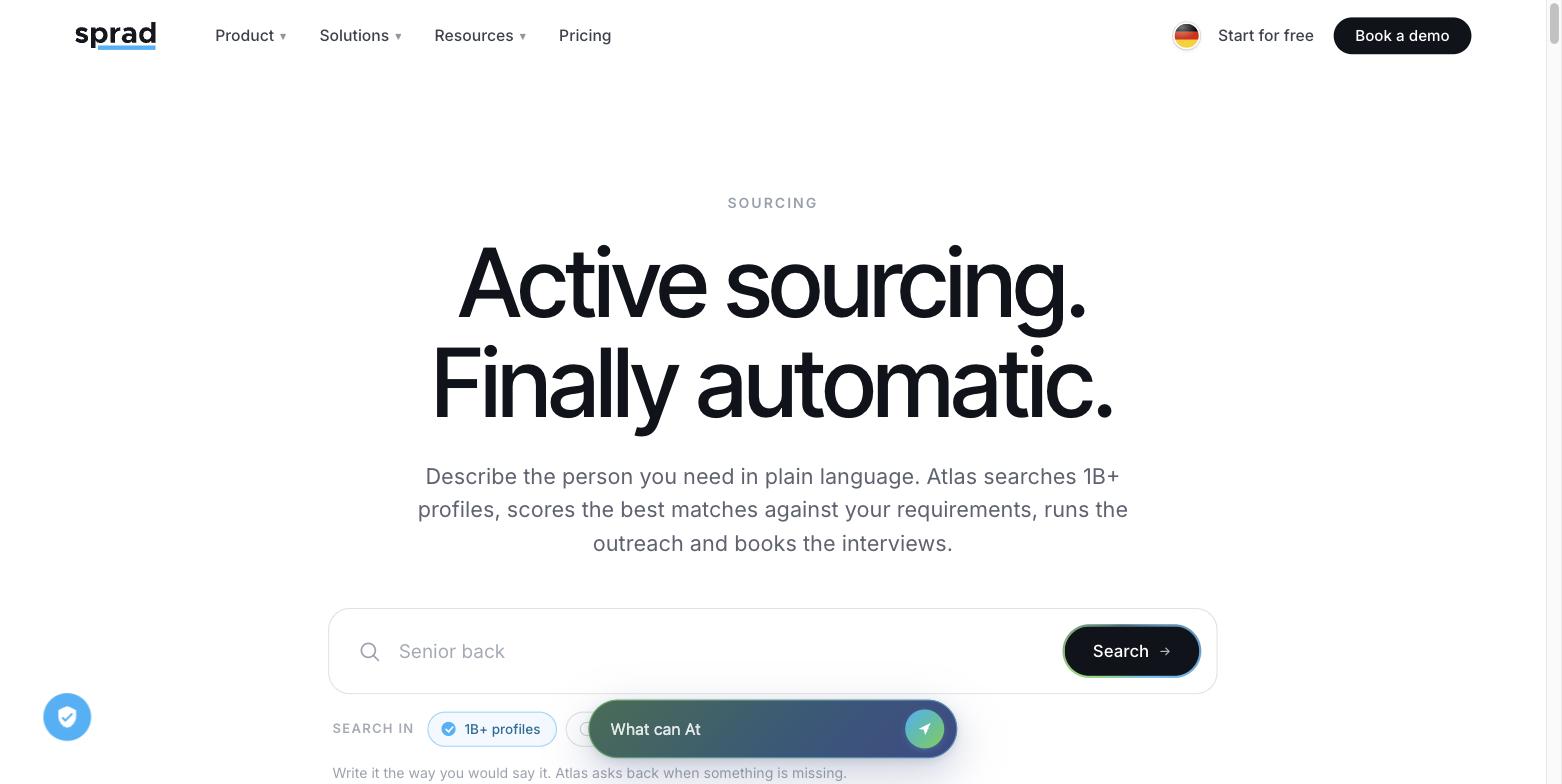
Sprad takes a requirement instead of a Boolean string and returns a reason per requirement, so it also finds people with poorly maintained profiles. Deep Context search finds companies first and then the people who worked there in a given period, for example a CFO who led an acquisition or someone who took a start-up through Series A/B. Outreach runs over LinkedIn and email, with InMails, follow-ups, trainable AI templates and a pitch format; we see the combination of both channels as the biggest lever for reply rates. Everything per talent sits in one inbox, and the system warns you if a colleague already contacted the person. Sprad has built recruiting software for seven years, starting with employee referrals, which is the same job: matching profiles to requirements.
Gem: what you get, and where it is stronger
Gem is the stronger choice when you need the funnel around the sourcing: a built-in ATS, interview scheduling, funnel analytics and SMS outreach. It can also sit on top of the ATS you already run. Those are real strengths, and Sprad does not replace them: Sprad has no placement reporting, no AI call notetaker and no SMS. The cost of that breadth is price and opacity: Gem publishes no list price, and part of the cost buys modules a sourcing-only team never opens.
What does it cost? A worked example for 5 recruiters
Assumptions: five people source every week, annual billing, list prices, no discounts. Sprad Recruiter Lite: 5 × 79 € × 12 = 4,740 € per year (Quick and Normal searches included; deep search, company search and contact data through credits). Sprad Atlas Recruiter: 5 × 299 € × 12 = 17,940 € per year with unlimited (fair use) searches, 10 Deep Context searches per seat and month and one automated LinkedIn and mailbox account per seat. Gem: no public list; the only anchor is a median contract of about 24,900 $ per year from Vendr data (218 purchases, cited by a competitor, team size unknown), and it buys an ATS and CRM suite, not just search. These numbers are not like for like, so compare what you really use. Teams that currently pay separate LinkedIn and XING recruiter licences save 30–80 % with Sprad, depending on the licence mix. More: AI sourcing pricing models.
How do outreach and compliance compare?
Both tools reach candidates by email and InMail. Sprad adds LinkedIn automation and keeps everything in one inbox per talent, which prevents the most common sourcing mistake: two recruiters writing to the same person from two tools. Gem adds SMS. On compliance, sourcing processes data of people who have not applied. In the EU that usually rests on legitimate interest (Article 6(1)(f) GDPR, see the EDPB guidelines 1/2024) and brings an information duty (Article 14) and a right to object. The EU AI Act (Regulation 2024/1689) lists AI used to select or filter applicants as potentially high-risk (Annex III), so a human must decide. In New York City, Local Law 144 requires a bias audit and notices for automated employment decision tools. Sprad hosts in the EU; Gem offers a data processing addendum, but we found no public statement on EU data residency, so ask for it in writing. This is orientation, not legal advice. More: Active sourcing and GDPR.
When is Gem the better choice?
- You use the whole suite. A large TA team that works in the ATS, scheduling and analytics every day gets one system instead of four.
- You need SMS or funnel reporting today.
- Your processes are built around Gem and migration cost outweighs the gain.
Choose Sprad if sourcing and outreach are the core job, if the share of matching profiles is the pain, if you are an agency that wants to search its own talent pool, or if you want a published price and EU hosting. Using both works too: keep your ATS and let Sprad be the sourcing and outreach layer.
Typical mistakes when comparing
- Comparing a suite with a search tool by price alone; compare what you actually use.
- Judging by a demo search instead of one of your own open roles.
- Not asking what happens to candidate data after cancelling.
- Quoting profile counts: 650M, 800M or 1B+ are vendor claims; what counts is how many results match your role.
FAQ
How does Sprad Atlas compare with Gem?
Gem is a recruiting suite (ATS, CRM, sourcing, scheduling, analytics); Sprad is a sourcing and outreach tool with talent network. Sprad is stronger in search quality, LinkedIn plus email in one inbox and price transparency; Gem is stronger in ATS, scheduling, reporting and SMS.
Which finds more matching candidates?
In the Recruiting area of the public PeopleSearchBench, Atlas reaches 73.5 of 100 in our own re-measurement, converted to the published scale. Gem did not take part, so there is no direct comparison.
How do price, outreach and compliance compare?
Sprad: free start, 79 € or 299 € per seat and month, LinkedIn, email and InMail in one inbox, EU hosting. Gem: custom pricing (third-party figures 135 $ per month to about 24,900 $ per year), email, InMail and SMS, DPA offered, EU residency not stated.
When is Gem the better choice?
When a large team uses the ATS, scheduling and analytics daily, or needs SMS outreach and funnel reporting.
Can I use Sprad on top of Gem?
Yes. Many teams keep their ATS and use Sprad for search and outreach. Free start: pricing, search product: Active Sourcing. More comparisons: Juicebox alternatives, active sourcing tools compared.
Jürgen Ulbrich
Jürgen Ulbrich has more than a decade of experience in developing and leading high-performing teams and companies. As an expert in employee referral programs as well as feedback and performance processes, Jürgen has helped over 100 organizations optimize their talent acquisition and development strategies.