An active sourcing agency has no standard price: it bills a flat fee per role, a monthly retainer, a fee per profile, or, for search firms, a fee of about 26 percent of target pay on the German market average. Pure sourcing service providers mostly quote prices on request only. A worked example with open assumptions helps as a yardstick: for a role at €80,000 target pay, a search firm costs about €20,800 plus VAT, while the in-house route with sourcing software costs about €2,000 over three months. With Sprad you can start free, and Recruiter Lite costs €79 per seat per month. As of 30 October 2026.
What does an active sourcing agency cost per month or per year?
It depends on the billing model, not on a market price list. We reviewed the pricing pages and trade articles among the top results for this question: almost none quote real amounts; most only say that active sourcing saves on job ads and external recruiters. That is honest but does not help your budget. So this article calculates with figures that are documented (labour cost, salaries, search-firm fees, Sprad prices) and marks every assumption.
The common models at a glance:
| Model | Billing | Who carries the risk? | Typical strength | Typical weakness |
|---|---|---|---|---|
| Flat fee per role or month | fixed amount per mandate, often with a minimum term | You: you pay even without a hire | predictable, one briefing, shortlist as output | no guarantee, quality hard to judge upfront |
| Per profile (pay per lead) | amount per delivered, interested candidate | shared | cost grows with output | incentive for volume over fit |
| Hourly or daily rate | effort by time | You | flexible for a pilot or peaks | hard to compare, effort hard to verify |
| Contingency fee (search firm) | percentage of target pay, due at signature | The firm | pay only if the role is filled | expensive per hire, little say in the process |
| Retainer (search firm) | usually in instalments, due even without a hire | You | exclusive search, confidentiality | highest fixed cost |
| Software plus your own time | seat licence or credits | You (time) | lowest cost, the pool stays with you | needs capacity in the team |
Per month or per year can only be derived from what you pay per hire and how many hires you need. That is what we calculate below.
What is included and what costs extra?
Do not compare offers by price alone; compare them against this list. From seven years of building recruiting software, these are the items that surprise later:
- Briefing and sign-off: Who writes the outreach, who approves it? A provider writes in your name, and responsibility stays with you.
- Handling replies: In the Monster and University of Bamberg study "Social Recruiting und Active Sourcing" (2019), two thirds of people approached never reply. The replies you do get need a fast response, or the search was wasted. Clarify who owns that.
- Contact data and tools: Does the provider pay the LinkedIn licence and email lookups, or are they listed as separate expenses?
- Data ownership: Do the profiles and conversation history belong to you after the contract ends? In many models the pool stays with the provider.
- Term and notice: Minimum terms of several months are common. Factor in the ramp-up.
- Data protection: See the section below. Processing agreement, information duty, retention periods.
Worked example: what does one hire cost?
Assumptions: role with €80,000 target pay, three months of search time, prices net. The figures come from sources; only the service-provider price is our assumption, because no public price list exists.
- Search firm: The German association of management consultants BDU reported an average of 26 percent of target pay for 2017. At €80,000 that is €20,800, once per hire.
- Sourcing service provider: Assumption €1,500 per month and role, three months: €4,500. Check whether a hire is guaranteed. Usually it is not.
- Sprad service: €300 per role and month plus a 6 to 8% success fee, only if someone is hired. Three months and 7%: €900 + €5,600 = €6,500. No minimum term, no exclusivity.
- In-house with Recruiter Lite: 3 × €79 = €237. Plus your time: assumption 40 hours of sourcing and follow-up per role. The German Federal Statistical Office puts average labour cost in 2025 at €45 per hour. 40 × €45 = €1,800. Total about €2,037 plus any credits.
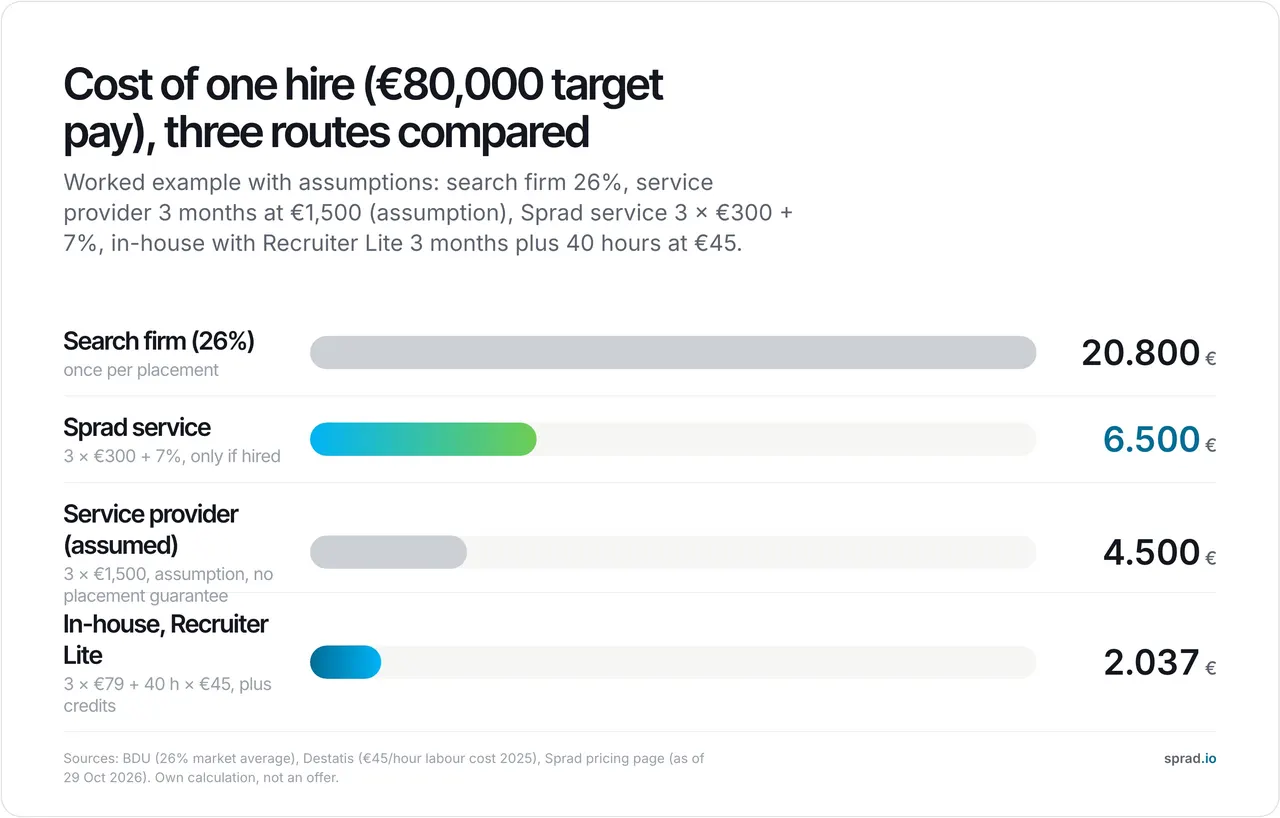
The chart shows the order of magnitude: the in-house route is a tenth of the search firm but needs free capacity. The service provider sits in between and pays off if your time is scarcer than your budget. What your time is worth is yours to say; use your own payroll cost. In Germany a sourcer earns around €41,400 gross per year on average according to StepStone, and with employer on-costs the role costs notably more.
When does outsourcing pay off, and when does doing it yourself?
A simple rule from practice: count how many hires per year you need through direct outreach.
- One or two hard roles a year and no sourcing know-how in house: a service provider or search firm. Building your own process does not pay.
- Three to ten hires a year: doing it yourself with software is usually cheaper. One avoided search-firm hire already costs more than a full year of Recruiter Lite (€948).
- Ongoing demand or several clients (staffing and search firms): your own tool and talent pool, topped up with outside help for peaks.
Important: active sourcing works. In the Monster study, about one in seven of the 1,000 largest German companies filled vacancies through direct approach, and about one in four IT firms. The question is not whether but who does it. A typical mistake we see: a provider is hired, but nobody in house answers interested candidates within 24 hours. That burns the budget.
Is there a free plan or trial?
With Sprad, yes: the free account includes 100 credits a month (200 in the first month). Searches, screening and interviews run on them, and web search starts with a budget from 50 credits per run. Talent network, CRM and career site cost nothing. Free accounts are currently released in waves. Providers rarely offer a free trial; pilots with a single role are the norm, so agree a right to cancel after month one in advance.
How does it compare with LinkedIn Recruiter and Sprad on price?
The table sets the tools for the in-house route side by side. LinkedIn prices are third-party figures and vary by region and contract.
| Criterion | Sprad | LinkedIn Recruiter Lite | Sourcing service provider |
|---|---|---|---|
| Price | start free, Recruiter Lite €79/seat/month, Atlas Recruiter €299/seat/month, flexible credits | third-party figures around $140–170 per month | mostly on request |
| Sources | LinkedIn, XING, GitHub, own talent pool, over 1 billion profiles | LinkedIn only | depends on the provider |
| Profile review | AI checks every profile against the requirements | filters and keywords | manual by researchers |
| Outreach | LinkedIn and email automated with follow-ups, one inbox | InMail and messages | by the provider |
| Pre-qualification | voice, chat and agent pre-qualification | – | by agreement |
| Data after cancelling | talent network stays free, export possible | data is deleted | usually stays with the provider |
Why Sprad fits here: Atlas checks every profile individually with AI instead of only filtering keywords. If results appear instantly, it is almost always a keyword search; the deep search in Atlas takes a few minutes, while Quick Search returns first hits in about three seconds. LinkedIn and email run in one inbox, and the system warns about double outreach, including by colleagues. In the Recruiting area of the open PeopleSearchBench, Atlas reaches 73.5 of 100 in our own re-measurement, converted to the published scale (Juicebox 65.7 as published). PeopleSearchBench (Recruiting), published by Lessie, October 2026. Other systems' scores as published in the benchmark; Atlas is our own re-measurement with the benchmark's open test procedure, converted to the published scale; not an official entry. Method on the benchmark page. To be fair: Atlas has no AI notetaker and no placement reporting, and the deep search takes a few minutes.
An agency can be added when needed: the Sprad service handles search, outreach and pre-qualification from €300 per role and month. More on the tools in our active sourcing tools comparison and the DACH-focused comparison.
Doing active sourcing yourself: how to start
- Write the requirements: describe the role in plain language, not keywords, including must-haves and nice-to-haves.
- Search: start with the requirement search and check ten hits by hand before you scale.
- Reach out: combine LinkedIn and email, two follow-ups, a short message with a concrete benefit for the person.
- Answer within 24 hours: this is the most common bottleneck.
- Maintain the pool: people who do not fit now stay in the talent network for the next role.
Background on the format: What Is Active Sourcing?
What to look for in offers
- Ask for sample profiles and a breakdown: how many people were approached, how many replied?
- Clarify which channels are used and under which sender name.
- Get data ownership after the contract in writing.
- Agree a pilot, a right to cancel and a quality measure (match rate after your review).
Data protection and law: GDPR, brokerage law, AI Act
When you reach out directly, Article 14 GDPR requires you to inform data subjects within one month at the latest. If you hire a provider, responsibility stays with you and you need a data processing agreement. More in Active sourcing and GDPR. Under German law, a success fee requires that the contract is concluded (§ 652 BGB). AI systems that evaluate or filter candidates are listed as high-risk in Annex III of the EU AI Act; people must take the decision. Check the current start date of the obligations. Broadly comparable in Germany, Austria and Switzerland; Switzerland applies its own data protection act (revDSG) instead of the GDPR.
What applies in Europe and the US?
The models are similar internationally: search firms work with retainer or contingency, sourcing providers with flat fees. In the US, fees are quoted in dollars, and Sprad prices are also available in USD (Recruiter Lite $95, Atlas Recruiter $359 per seat per month). In the EU the GDPR and the AI Act apply; the US has no single federal law, but state and city rules on automated decisions in hiring. Prices in this article: as of 30 October 2026, net.
FAQ
Who pays if the hire does not work out?
With a flat fee or retainer, you do; with contingency, only if the contract is concluded (§ 652 BGB). Check guarantee periods for leavers in the probation period.
What does active sourcing cost with software alone?
With Sprad: start free, Recruiter Lite €79 per seat and month, Atlas Recruiter €299. Your working time comes on top.
Is an agency worth it for a single role?
Yes, if the role is rare and you lack time. With several hires a year, software is cheaper.
What percentage does a search firm charge?
About 26 percent of target pay on the BDU market average, roughly 20 to 35 percent depending on model and role.
Do I keep the candidates after the contract ends?
Only if the contract says so. With Sprad the talent network stays free and every view can be exported.
Jürgen Ulbrich
Jürgen Ulbrich has more than a decade of experience in developing and leading high-performing teams and companies. As an expert in employee referral programs as well as feedback and performance processes, Jürgen has helped over 100 organizations optimize their talent acquisition and development strategies.