Free Self-Evaluation Phrase Catalog | 200+ Phrases by Skill, Role & Rating


Free Self-Evaluation Phrase Catalog | 200+ Phrases by Skill, Role & Rating
An AI job application works when AI drafts and you decide: let it structure your CV and phrase your cover letter, then check every fact, name and number yourself and apply in the format the ad and the country expect. It fails when you send unedited mass output or US-style documents to German-speaking employers: a one-page, photo-free resume and a breezy letter are often read as incomplete in Germany, Austria and Switzerland. In the EU you also have to care about privacy, because your CV is personal data under GDPR.
This guide shows what changes between DACH and the US, five steps for an AI application that still sounds like you, a worked time calculation, the mistakes recruiters notice first, and which data you should never paste into a chatbot. At the end you will see where Atlas, a free career agent, fits in.
What is an AI job application, and is it allowed?
An AI job application is any application where AI helps with at least one step: finding roles, tailoring the CV, drafting the cover letter, filling in forms or tracking replies. Using AI for this is not forbidden. Employers do not have a rule against it, but they expect the content to be true and to be yours. Recruiters who see obviously generic AI text tend to discard it, as Haufe reports (German HR trade press, accessed October 2026).
The rule of thumb: AI may write the first draft, you own the final version. Anything you cannot explain in an interview does not belong in the document.
1. Why US-style AI job application advice fails in Europe
Most generic advice is written for US hiring. In the US, photos, age or marital status are usually left out for equal-opportunity reasons. In Germany, Austria and parts of continental Europe a professional photo and personal details are still common (Hireflow), although no law requires them. The Anti-Discrimination Act (AGG) prohibits discrimination based on, among other things, age, gender and ethnic origin, and a photo shows exactly that, so the photo is your free choice. If the ad says “no photo”, follow the ad.
European CVs are also longer and more structured: 2–4 pages, strict chronology, education, certifications and languages listed in detail. The EU’s own Europass format is a good reference for sections and language levels. In DACH, a formal cover letter (Anschreiben) with subject line, correct salutation and a clear structure is still close to standard for qualified roles.
Tests with AI cover letter generators show the gap: only about 22% of generic AI letters meet German recruiter expectations, while an AI draft plus human review reaches about 96% compliance with DACH norms (Sprad).
| Requirement | US norm | DACH / Europe norm |
|---|---|---|
| Photo on CV | Almost never | Common, but optional by law |
| Cover letter | Optional, conversational | Formal Anschreiben expected for qualified roles |
| Length | 1 page (2 for senior) | 2–4 pages typical |
| Personal details | Minimal | Birth date and nationality possible, never required |
| Structure | Flexible, achievement-focused | Strict chronology, clear sections |
| Dates and numbers | MM/DD/YYYY | DD.MM.YYYY, decimal comma |
For more on the letter itself, see our guide to AI cover letters for Europe.
2. Five steps for an AI job application that works
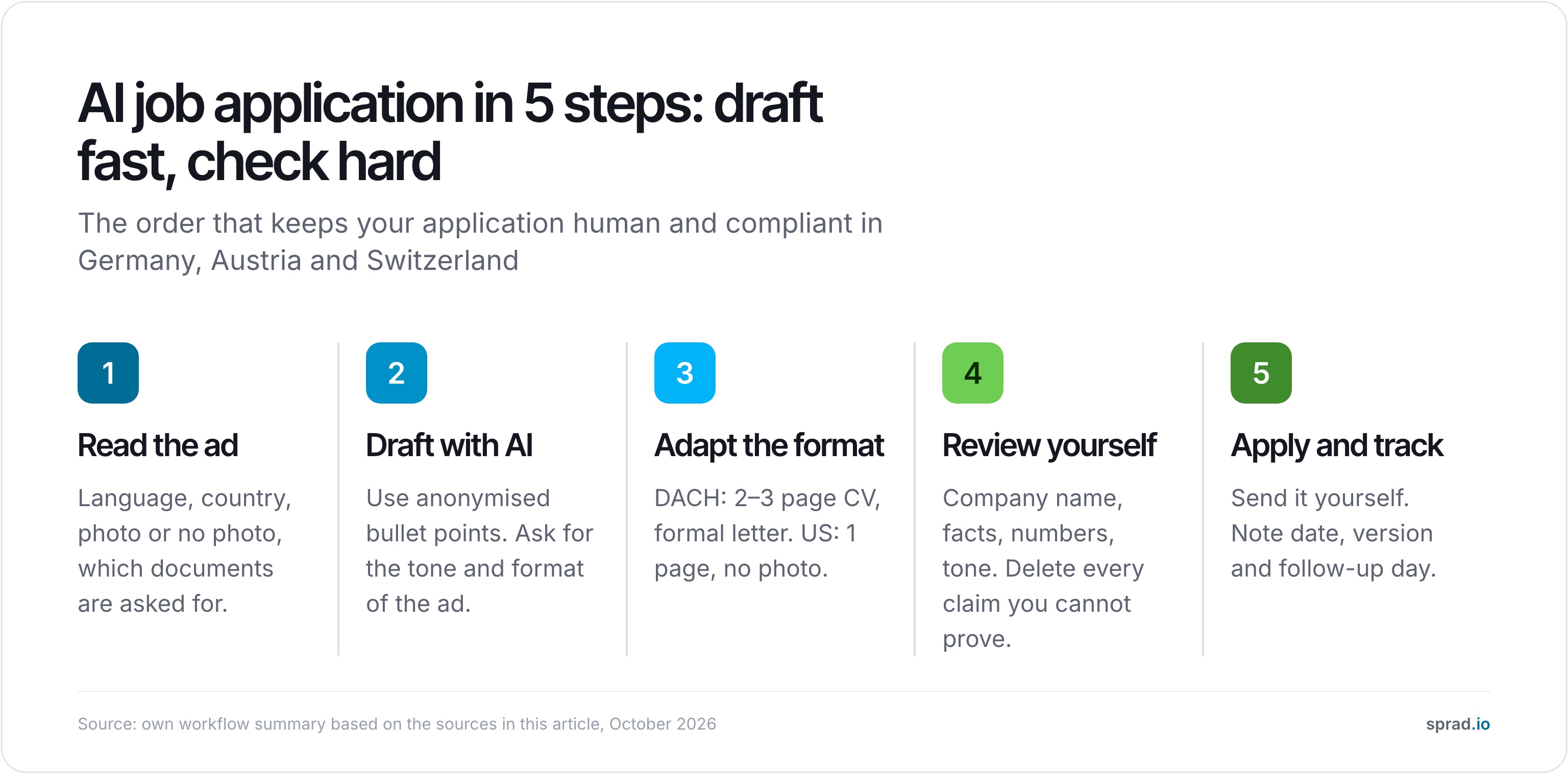
Step 1: Read the ad before you open any tool
Note the language, the country, whether a photo or documents are requested and which three requirements come up most often. This is your brief for the AI.
Step 2: Draft with anonymised input
Paste only bullet points of your experience, without name, address, phone number or employer names. Give the tool the job ad and ask for the tone and format of that country. A prompt that works: “Rewrite these bullets for a German mid-sized engineering firm. Formal tone, no buzzwords, each bullet with task, action and result. Do not invent numbers.”
Step 3: Adapt the format to the market
For a German ad: 2–3 page CV with photo (optional), formal Anschreiben with subject line and “Sehr geehrte Frau …”. For a US ad: one-page resume, no photo, no birth date. For an English-speaking startup in Berlin or Amsterdam: concise English CV, photo optional, polite but not casual.
Step 4: Review like a recruiter
Check the company name, the job title, every number and every claim. Replace generic phrases (“I am excited to apply at your esteemed company”) with one concrete sentence about the employer. Recruiters spot template openings quickly: in one analysis 80–90% of recruiters distrusted obvious template letters (Sprad).
Step 5: Apply yourself and track
Send the application yourself, note date and version, and set a follow-up day. A simple spreadsheet is enough; trackers such as Teal or Huntr add reminders.
3. How much time does it save? A worked example
Assumptions (ours, not a study): you apply to 10 roles. Tailoring a CV and letter from scratch takes about 45 minutes per role. With a good base CV, an AI draft and a 15-minute review, one role takes about 20 minutes.
| Approach | Per role | 10 roles | Risk |
|---|---|---|---|
| Everything by hand | ~45 min | ~7.5 h | Low quality drops late in the batch |
| AI draft + 15 min review | ~20 min | ~3.3 h | Low, if you review |
| Mass auto-apply, no review | ~2 min | ~0.3 h | High: wrong names, spam flag |
The saving is about four hours for ten applications. The last row looks fastest, but it is the one recruiters punish: in one analysis 63% of recruiters flagged mass auto-applied applications as spam or low quality (Sprad). A LinkedIn-based survey cited in another analysis found that 57% of hiring managers were less likely to consider candidates who sent unchecked AI answers (Sprad).
4. Which AI tools for which job
Most candidates use AI in four ways. All can work in Europe if you adapt them.
| Tool type | Good for | Watch out | Risk |
|---|---|---|---|
| Atlas Career (free) | Finding roles, match score with reasons, tailored CV and letter per ad, in the ad’s language | You review and send everything yourself | Minimal |
| Chat assistants (ChatGPT and similar) | Drafts, rephrasing, interview practice | Never paste a full identified CV; prompt for local format | Low |
| Form autofill (e.g. Simplify) | Static fields: name, dates, education | Do not auto-answer motivation or salary questions | Low |
| Trackers (Teal, Huntr, spreadsheet) | Deadlines, versions, follow-ups | Does not improve the documents | Low |
| Mass auto-apply bots | Nothing important | Spam flags, wrong company names | High |
For job search, national boards still matter in Europe, for example StepStone in Germany and jobup in Switzerland, plus LinkedIn filters. Autofill is safe for static fields only; our guide to AI autofill without hurting your chances has the checklist, and the DACH-friendly tool playbook compares more tools.
5. Mistakes recruiters notice first
- Wrong company or role name copied from the previous application. The fastest way to look like a bot.
- Template opening that fits any employer.
- US format in DACH: one page, no Anschreiben, no language levels.
- Invented or inflated claims. AI likes round numbers. If you cannot prove it, delete it.
- Same text for every role, with only the company name swapped.
- Salary answered by autofill without checking the market in that country.
More detail in our list of 12 AI job application mistakes.
6. Three workflows for typical candidates
DACH specialist applying to a Mittelstand company
You are a mechanical engineer in Stuttgart applying to 10–15 firms. Build one base CV in German (2–3 pages, photo optional), have AI polish anonymised bullets in formal German, prepare an Anschreiben template with placeholders, then tailor each one to the ad. Check names, titles and salary lines before sending.
International candidate targeting Berlin or Amsterdam startups
You live in Spain, Brazil or India. Create a concise English CV with AI, collect roles in a tracker, draft a one-page letter outline per priority role and rewrite it with your own story, work permit status and relocation plan. Mention EU work authorisation and time zone up front.
Remote-first candidate targeting EU-based companies
Filter for EU-based employers or CET time zones, add a short profile paragraph and EU projects to your CV, and write the long answers (“How do you work asynchronously?”) with real examples. Because your data crosses borders, be extra careful where you upload your full CV.
7. GDPR and privacy: what you can paste into a chatbot
Your CV contains personal data under the GDPR. Article 5(1)(c) requires data minimisation: process only what is necessary. For you as an applicant this means: share as little as the tool needs. A review of online CV tools found that over 70% could store or reuse your data in ways you may not fully understand (CareerSorter).
| Action | Safe? | Reason |
|---|---|---|
| Pasting a full CV with name, address and salary into a public chatbot | No | Data may be logged or processed outside the EU |
| Uploading only anonymised bullet points for wording help | Mostly | Minimal exposure, easy to delete |
| Using a tool with EU hosting, GDPR compliance and deletion on request | Yes | Built for this use; check the provider’s statement |
| Leaving old profiles on many tools after the job search | No | Unneeded data raises the risk of leaks. Use your right to erasure (Art. 17 GDPR) |
There is a second side. When a company screens applications with software, it is regulated too: the EU AI Act lists AI systems for recruitment and candidate selection as high-risk (Regulation (EU) 2024/1689, Annex III), and Article 22 GDPR limits decisions based solely on automated processing. The European Court of Justice ruled in case C-634/21 (December 2023) that even an automated score can count as such a decision if it decides the outcome in practice; German legal press explains this for applications in Legal Tribune Online. For you it means: you may ask an employer whether automated systems were involved. The start dates of the high-risk duties have been moved more than once, so check the current status before you rely on a date.
8. How Atlas Career fits in
Atlas Career is a free AI career agent made by Sprad in Vienna. After a voice conversation of a few minutes (the “Atlas Brief”: role, level, salary, location, no-gos) it keeps searching over 1.5 million active jobs straight from employers’ career sites, more than 100,000 of them in DACH, and emails new matches. Each role gets a match score from 0 to 100 with reasons, and for every application Atlas tailors a CV and, on request, a cover letter. It follows the ad: a German ad gets a structured CV and a formal Anschreiben, a US ad a one-page resume without photo.
It is free with no limits. Atlas sends nothing itself: you review every document, download it as a PDF and apply directly with the employer, which is exactly step 4 and 5 above. It is hosted in the EU, complies with GDPR and the EU AI Act, never sells your data, does not train third-party AI models on it and lets you delete it at any time.
Where others are stronger: US-focused tools can cover American job boards more deeply, and autofill tools such as Simplify save more clicks on long forms. For targeted applications in DACH, where document quality and your own review matter most, Atlas is the free option to start with. Try Atlas free.
Conclusion: use AI for speed, keep control for quality
- Follow the country and the ad: in DACH a structured CV and a formal letter still matter.
- Let AI draft, then review every fact, name and number yourself.
- Anonymise before you paste, and delete old data after your search.
- Quality beats volume: a tailored application is worth more than ten generic ones.
Frequently Asked Questions (FAQ)
1. Can I use AI for my job application?
Yes. There is no rule against it. Use AI for drafts and structure, and make sure the final text is accurate and written in your voice. Many recruiters discard obviously generic AI text.
2. Do recruiters notice AI-written applications?
They notice generic phrases, wrong company names and identical structures across applications. AI-assisted applications that are specific, truthful and reviewed are accepted.
3. What is different about AI job applications in Germany vs the US?
In Germany a 2–4 page CV and a formal Anschreiben are normal and a photo is common but optional. In the US a one-page resume without photo is the norm.
4. How do I use ChatGPT safely for a German application?
Remove name, address, phone and employer names, ask for formal German and correct salutations, then add your real details in your own editor. Delete chats that still contain identifiable data.
5. Are auto-apply bots worth it?
Rarely. They are fast, but they often send wrong company names and generic text. For roles you really want, tailor and send the application yourself.
6. Is it GDPR-safe to upload my CV to an AI tool?
Only if the tool states where it hosts data, does not sell it, and lets you delete it. Otherwise anonymise first and share only what the tool needs.
7. Is there a free AI tool for job applications?
Atlas Career is free with no limits: it finds roles, scores the match and tailors CV and cover letter for each ad. You review and apply yourself.
8. Do employers have to tell me if AI screens my application?
Under GDPR you can ask for information about automated decision-making, and Article 22 restricts decisions made solely by automated means. Details depend on the case, so ask the employer directly.
Jürgen Ulbrich
Jürgen Ulbrich has more than a decade of experience in developing and leading high-performing teams and companies. As an expert in employee referral programs as well as feedback and performance processes, Jürgen has helped over 100 organizations optimize their talent acquisition and development strategies.