Apollo.io is rated 4.7 of 5 on G2 (about 9,700 reviews), 4.5 on Capterra (about 390) and 4.7 on OMR (12). Users like the search, the filters and the free start; the main complaint is data accuracy, above all mobile numbers and data outside the US. Apollo is built for sales. It has no candidate pipeline and filters by job title rather than fit, so for recruiting it is a contact source. Status 9 November 2026.
What are Apollo.io's ratings?
| Source | Rating | Reviews | What it tells you |
|---|---|---|---|
| G2 | 4.7 / 5 | about 9,700 | very large sample; mostly sales use |
| Capterra | 4.5 / 5 | about 390 | small teams, pricing and data-quality remarks |
| OMR Reviews (German market) | 4.7 / 5 | 12 | small sample; weak DACH data and export credits are the main criticism |
| Apollo's own claim | 98 % email accuracy | – | vendor figure, not independent; reviews are more mixed |
One caution: Apollo is built for sales, so its reviews mostly reflect sales use. A 4.7 tells you the tool does that job well, not that it works as an active sourcing tool. Platform figures change daily; these are the ones displayed on 9 November 2026.
What do users like about Apollo?
- Search and filters. Reviewers on G2 and Capterra praise how quickly they can build lists by title, company size and industry.
- Value for money at the start. One Capterra reviewer found enough reliable company and contact data without enterprise pricing; the free plan makes testing easy.
- Sequences in one place. Email sequences, tasks and calls sit next to the data.
- Emails are the strong part. A Capterra reviewer put it as emails being excellent, anything beyond that limited.
What do users criticise?
- Contact data accuracy. G2's aggregated complaints centre on mobile numbers and outdated information; reviewers name EMEA phone data in particular.
- Bounces and outdated titles. After job changes the record often lags behind.
- Export credits and price. OMR reviewers call export credits a bottleneck, one names price and performance as a drawback, and several report weak data for the DACH region.
- Credits. A phone number costs 8 credits, unused credits expire each cycle and all seats share one plan.
- Setup effort. Sequences and mailboxes need care before they perform.
Is Apollo good for recruiting?
It is good for one part of recruiting: finding business contacts, such as hiring managers or client companies. For candidate sourcing it stops short in four places:
| What a recruiter needs | What Apollo gives you | Consequence |
|---|---|---|
| Find people by fit | filters on title, company, keywords | a strong candidate with an unusual title is missed |
| Private or current contact | mostly business emails at the current employer | weak first impression, spam filter risk |
| LinkedIn outreach | view, connect and message are manual tasks in sequences | no real automation on LinkedIn |
| Candidate record and notes | none | no pipeline per role, no shared notes |
Who should use Apollo, and who should not?
Use it if your team already uses Apollo for sales, recruits a few roles on the side, or needs company contacts. Look elsewhere if you recruit full-time, need a record per candidate, or want to find people by fit. A workable split for agencies is Apollo for company data and a recruiting tool for candidates.
Apollo alternatives for recruiters
Disclosure: Sprad is our own product. Its Active Sourcing tool checks every profile against your requirements and explains the result, searches LinkedIn, XING, GitHub and your own pool, and sends LinkedIn and email from one inbox. In Sprad's own test (15 August 2026, three roles, 218 profiles, each system's own hits excluded) coverage was 38 % against 9 % for the best of the four other tools; method on our sourcing benchmark page. Honest limits: no call notetaker, no placement reporting, no SMS. Start free with 100 credits a month; prices here.
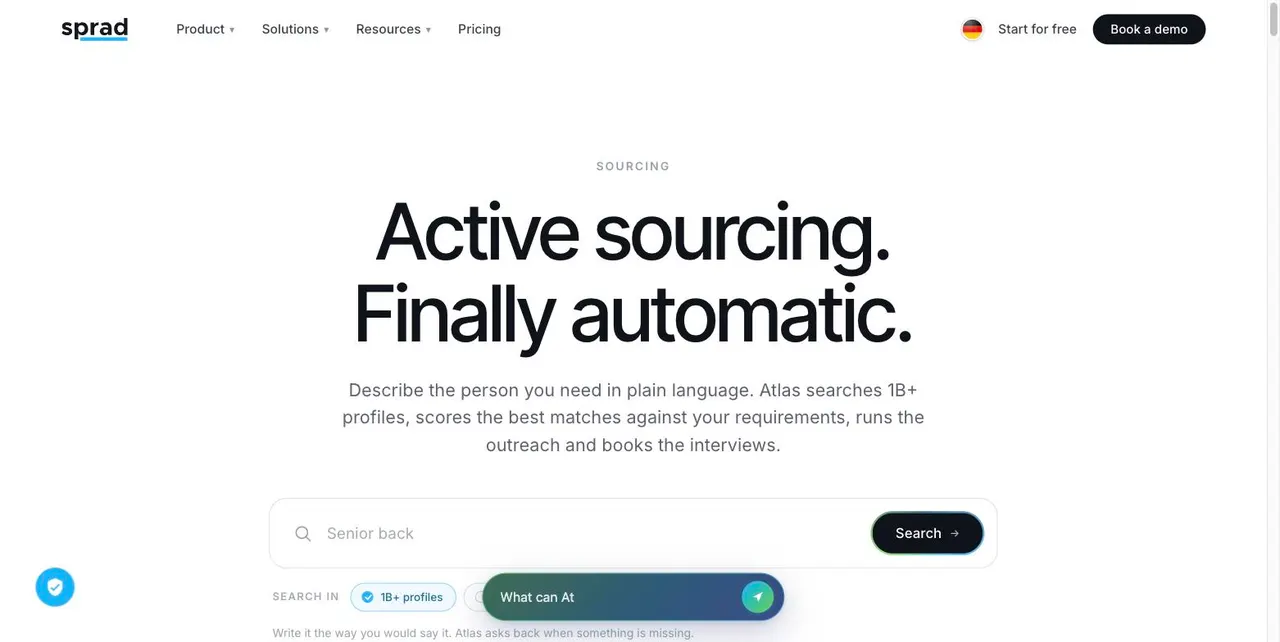
For the full list including LinkedIn Recruiter, Juicebox, SeekOut and hireEZ, read Apollo.io alternatives for recruiting; for the category as a whole, the comparison of active sourcing tools.
Legal checks before you buy
Contact data does not remove your duties. Under Articles 6 and 14 GDPR you need a lawful basis and must inform people whose data you did not collect from them, generally within one month. Cold emails also fall under Article 13 of the ePrivacy Directive; in Germany, section 7 UWG is strict about email advertising. In the US, commercial emails must follow the CAN-SPAM Act. Apollo is a US vendor: ask where data is hosted, for a data processing agreement and how transfers outside the EU are covered. More in our guide to active sourcing and GDPR.
FAQ
Is Apollo.io good?
For B2B prospecting, yes: 4.7/5 on G2 and 4.5/5 on Capterra. For recruiting it covers contact data but not the candidate process.
Is Apollo.io legit and safe?
It is an established vendor with thousands of reviews. As with any contact database, you stay responsible for a lawful basis and for informing the people you contact.
How accurate is Apollo's data?
Apollo claims 98 % email accuracy. Reviewers confirm emails are strong but report weaker mobile numbers and outdated records, especially outside the US.
Is Apollo.io worth the money?
Paid plans start at $49 per user and month on annual billing. It pays off for sales; for recruiting only as a contact source next to a recruiting tool.
Is Apollo.io GDPR compliant?
Apollo's privacy policy names legitimate interests as the basis for its contact data and does not say where data is hosted. That is the vendor's framing, not a certification: your own lawful basis and information duties remain.
What is better than Apollo for recruiting?
A tool built for candidates: Sprad, LinkedIn Recruiter, Juicebox, SeekOut, hireEZ or, in German-speaking markets, XING TalentManager.
Sources: G2 and Capterra figures for Apollo.io as displayed in search results, and OMR Reviews read directly, all on 9 November 2026; Apollo's pricing page and privacy policy; Apollo's accuracy figure is a vendor claim. Sprad prices from sprad.io/pricing.
Jürgen Ulbrich
Jürgen Ulbrich has more than a decade of experience in developing and leading high-performing teams and companies. As an expert in employee referral programs as well as feedback and performance processes, Jürgen has helped over 100 organizations optimize their talent acquisition and development strategies.