Carv (carv.com) is an AI platform for recruiting agents, built mainly for high-volume hiring: it takes over admin such as intake and interview notes, ATS updates, scheduling and chat or voice screening. It is not a candidate search tool, it publishes no price (directory listings show from about €60 per user and month, unverified) and independent reviews are thin, so most proof is the vendor’s own. It is worth a demo if your problem is admin and volume. If your problem is finding and reaching the right people, Sprad is the better pick: every profile checked individually, LinkedIn and email in one inbox, and a free start.
What is Carv, and which Carv do you mean?
Carv is an Amsterdam recruiting-technology company, founded by Barend Raaff and Matthijs Metzemaekers, who say they previously built the hiring-assessment company Harver. It raised a seed round of about $10 million in June 2024 from Global Founders Capital and angels (tech.eu) and bought the Tilburg chatbot company Recrubo in March 2025 to add WhatsApp, SMS and voice agents (Silicon Canals).
Do not confuse it with CARV, the ski-tracking app. A search for “carv reviews” returns mostly ski forums and gear sites. This article covers the recruiting product.
What Carv does, and what it does not
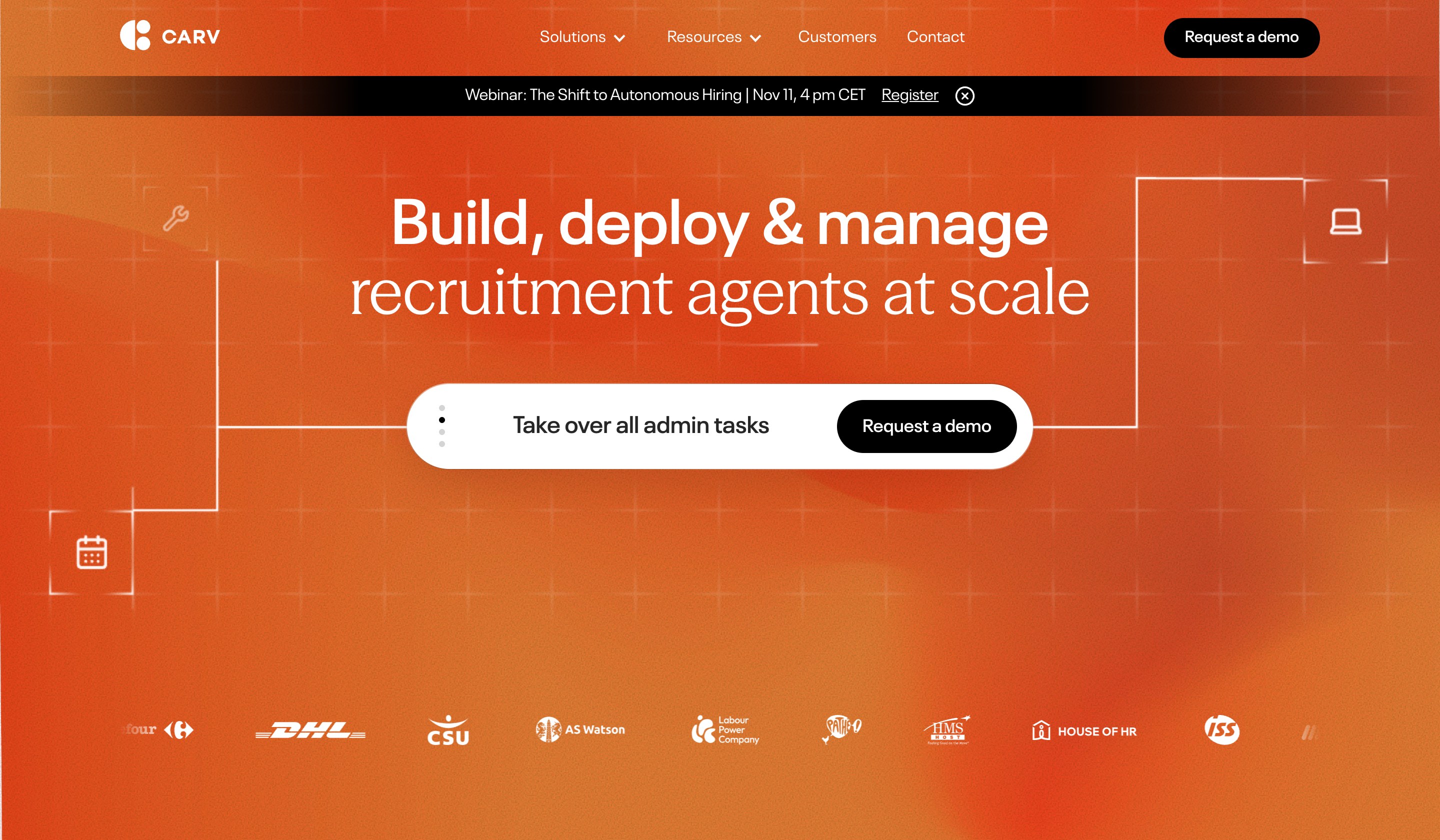
On its homepage (checked 30 October 2026) Carv describes itself as a platform to “build, deploy & manage recruitment agents at scale”. Its agent library covers screening, scheduling, rediscovery of past candidates, onboarding, compliance and talent-pool management, with a recruiter hub where people monitor the agents and step in. The focus is volume: staffing, logistics, retail and BPO or contact centres.
- Admin: notes from intake calls and interviews, candidate write-ups, and automatic ATS updates, according to Carv’s product pages.
- Candidate engagement: chat and voice agents that screen applicants and answer questions, extended by the Recrubo deal.
- Not the core: finding passive candidates. Sourcing appears in the feature list, but no public page shows how it works, and an independent summary describes the product as workflow automation around interviews rather than a source of contact data or outbound sequences.
Is Carv worth it? What users say
There is too little independent feedback to say. As of 30 October 2026, the software directories we checked show no or almost no user reviews: Gartner Peer Insights and Software Advice list none yet, and TrustRadius shows a single review (8 out of 10). That is not a verdict against Carv, because the buyers are mostly enterprise recruiting teams who rarely post. It does mean the numbers you will hear in a demo are the vendor’s: 60% shorter time to hire, 80% fewer admin tasks, 70% lower cost per hire, 3x faster hiring. Carv gives no method or sample size for them. Ask for references in your own sector and ATS.
What does Carv cost?
Carv publishes no price; the website offers a demo and a discovery call. Two directories list “starting at about €60 per user and month”, but we could not confirm that on Carv’s own site. Treat it as a floor for a recruiter seat, not as the cost of the agent platform that large staffing customers buy. Budget for a quote, and ask what is included in volume (conversations, voice minutes, integrations).
Strengths and limits
Strengths
- Clear focus on admin. The founders cite industry data that 20–40% of a recruiter’s day goes to admin (Carv press release, June 2024); automating notes and ATS entry attacks exactly that.
- Volume references. The homepage shows logos such as DHL, Carrefour, ISS and House of HR, and press coverage names ManpowerGroup and G4S.
- Chat and voice screening through the Recrubo acquisition, relevant for high-volume roles.
- Security claim: Carv says it is “backed by ISO and SOC 2 compliance”. Ask for the certificates.
Limits
- It does not find candidates for you. If your bottleneck is a shortage of qualified applicants, an admin tool does not fix it.
- No public price and no public ATS list. The site mentions ATS and CRM integration but names none.
- Thin independent proof and vendor-only outcome figures.
- Availability: a separate “Carv for recruiters” product is shown with a waitlist banner, so check what is live today.
Which teams is Carv right for, and which not?
Right for: staffing and RPO firms, logistics, retail and contact-centre employers with thousands of applicants a year, an ATS that Carv supports, and a recruiter team drowning in notes, scheduling and status updates.
Not right for: small agencies and in-house teams whose problem is finding candidates, tech and specialist hiring, and anyone who needs a public price to decide this week. They need search and outreach first.
EU and US compliance: what to check before you buy
Any tool that screens or evaluates candidates is an AI system for recruitment under Annex III of the EU AI Act and therefore high-risk. The Digital Omnibus on AI (Regulation (EU) 2026/1744, in force since 27 July 2026) has moved the high-risk obligations from August 2026 to 2 December 2027 (see also Cooley); the classification itself did not change. A pure note-taker may fall outside, a screening agent will not, so ask the vendor how each agent is classified. Under GDPR Article 22 candidates may not be subject to decisions based solely on automated processing with significant effect, so keep a human in the decision. In New York City, Local Law 144 requires a bias audit and candidate notice for automated employment decision tools. Recording calls also needs notice or consent. Status: October 2026; not legal advice.
Carv alternatives: which tool fits which job
Carv and the sourcing tools solve different problems, so the right alternative depends on where your hours go. We compared the three tools people most often put side by side.
| Sprad | Carv | Juicebox | |
|---|---|---|---|
| Core job | Search, outreach, pre-qualification, talent network | Recruiting admin and screening agents | AI people search and outreach |
| Candidate search | One search across LinkedIn, XING, GitHub and your own pool; 1 bn+ profiles; each profile checked | Not its core; automated sourcing listed among agents, no public detail | Yes, search-first |
| Outreach | LinkedIn (incl. InMail) + email, automated with follow-ups, one inbox | Chat and voice agents for candidate engagement (WhatsApp, SMS, voice via Recrubo) | Email and LinkedIn sequences |
| Interview / admin automation | Voice, video, chat and agent pre-qualification; no call notetaker | Intake and interview notes, ATS write-back, scheduling | Limited |
| Public price | Yes: free start, 79 € / 299 € per seat, credits | No (quote); listings show about €60 per user | Yes, from about 99 $ per month |
| PeopleSearchBench (Recruiting)* | 73.5 (own re-measurement, converted) | Not part of the benchmark | 65.7 |
*PeopleSearchBench (Recruiting), published by Lessie, October 2026. Other systems' scores as published in the benchmark; Atlas is our own re-measurement with the benchmark's open test procedure, converted to the published scale; not an official entry. Details: sprad.io/sourcing-benchmark.
Sprad: the pick when you need to find and reach candidates
Sprad has built recruiting software for seven years, starting with employee referrals, from start-ups to large corporates, public bodies and insurers, so matching profiles to requirements is the core skill. The sourcing tool, Atlas, checks every profile individually against your requirements instead of filtering keywords. If results appear instantly, it is almost always a keyword search. In the recruiting area of the open PeopleSearchBench, our own re-measurement gives Atlas 73.5 of 100, converted to the published scale, with 14.2 of 15 profiles matching on average in recruiting searches (see the footnote for the method).
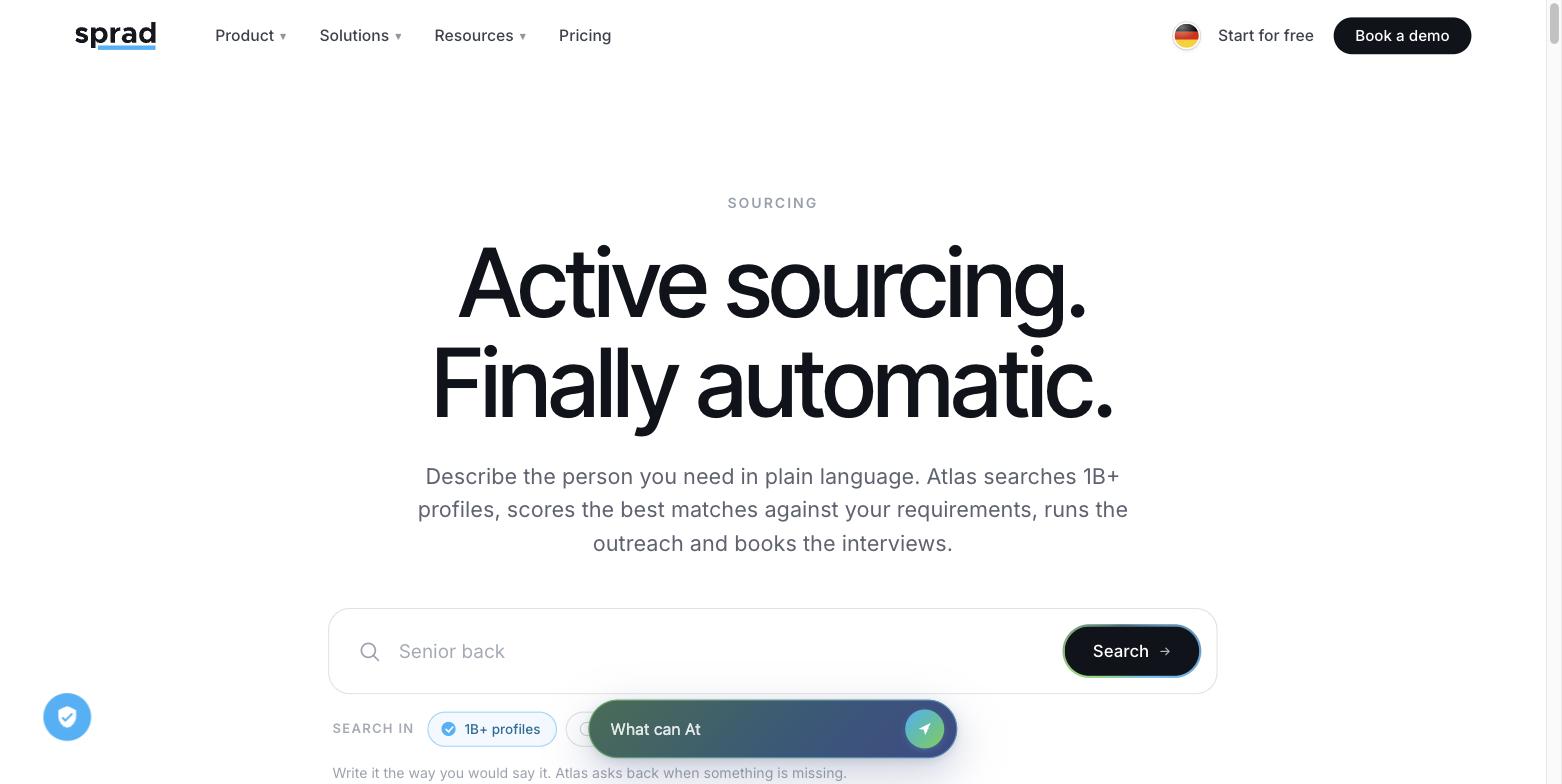
The second difference is outreach. LinkedIn (including InMail) and email run automated with follow-ups, and the whole conversation per talent sits in one inbox; the system warns if someone was already contacted, even for another role or by a colleague. Trainable AI templates and a pitch format help with reply rates. One search covers LinkedIn, XING, GitHub and your own pool, and you can upload your LinkedIn network and search it. See also our guides to the best active sourcing tools and the active sourcing AI agent.
Where Carv is ahead: Sprad has no AI call notetaker and no placement reporting today. If call notes are your main pain, Carv is built for that.
A worked example
Sourcing team of five. Recruiter Lite at 79 € per seat and month, billed annually, is 395 € per month or 4,740 € a year. Teams that pay separate LinkedIn and XING licences save 30–80% depending on what they cancel. A directory price of about €60 per user would be 300 € per month for five, but that buys a different job (admin, not search), so the numbers are not like for like.
Volume screening. Sprad prices CV screening, chat interviews and the candidate portal at 0.49 € per application, 0.69 € with voice for every fifth applicant; 2,500 applications a year are 1,725 €. Get Carv’s quote for the same volume and compare the same scope.
Typical mistakes we see
- Buying admin automation to fix a funnel problem. Measure first: hours on notes and scheduling versus hours finding candidates.
- Taking outcome percentages at face value. Ask what the baseline was.
- Skipping the ATS check. Write-back only helps if your ATS is on the supported list.
- Ignoring the AI Act early. Screening agents are high-risk; document human oversight now.
How to decide
- List where your recruiters lose time: search, outreach, notes, scheduling.
- Admin and volume: ask Carv for a demo, a quote and two references in your sector.
- Search and outreach: start free with Sprad and run one real role through it.
- Both problems: they are not exclusive; run a search tool plus an admin tool.
FAQ
Is Carv worth it?
For high-volume hiring with admin overload, probably worth a demo. For finding candidates, no, it is not built for that. Independent reviews are too few to judge beyond the vendor’s claims.
How much does Carv cost?
No public price; directory listings show from about €60 per user per month (unverified, October 2026). Expect a quote.
Is Carv a sourcing tool?
Not mainly. Its core is intake and interview admin, ATS updates and chat or voice screening.
Who uses Carv?
Its site shows large employers and staffing firms such as DHL, Carrefour, ISS and House of HR; press coverage names ManpowerGroup and G4S.
What is the best alternative to Carv?
For search and outreach, Sprad (free start, 79 € per seat). For call notes, a notetaker tool. For high-volume screening, ask for a like-for-like quote including Sprad’s per-application price.
The short version: plan on Sprad when the work is finding candidates, plan on Carv when the work is admin at volume. Sprad starts free, has public prices and one inbox for LinkedIn and email. See Sprad for recruitment agencies and pricing.
Jürgen Ulbrich
Jürgen Ulbrich has more than a decade of experience in developing and leading high-performing teams and companies. As an expert in employee referral programs as well as feedback and performance processes, Jürgen has helped over 100 organizations optimize their talent acquisition and development strategies.