The opening of a cover letter is two to four lines that tell the reader why you are applying for this exact role, and it replaces filler such as “I am writing to apply for”. The best first sentence points to the job ad and names one concrete result of yours, ideally with a number. The UK National Careers Service recommends three to five paragraphs in total, written fresh for every job, and the German Federal Employment Agency asks for an opening of three to five lines. Below you get a three-sentence formula, example openers for ten situations, closing lines and the mistakes we see most often.
What does “cover letter opening” actually mean?
The opening (also called introduction or first paragraph) is the first block of text after the greeting. Its one job is to show who you are, what you are responding to and why this role fits you. It is not the place for your life story, and it should not repeat the job title that already sits in the subject line.
Do you need a cover letter at all? If the ad asks for one, yes. In the Randstad-ifo survey of HR managers in Germany (Q1 2024, more than 500 respondents), 20 % of companies said they skip the cover letter in classic applications. The rest still read it, and the first lines decide how carefully they read the remainder.
The formula: an opening in three sentences
After seven years of building recruiting software, we know how applications are read: hiring teams go through many letters in a row and look in the first lines for a reason to keep reading. A formula that holds up in practice has three sentences. This is our practical experience, not a study.
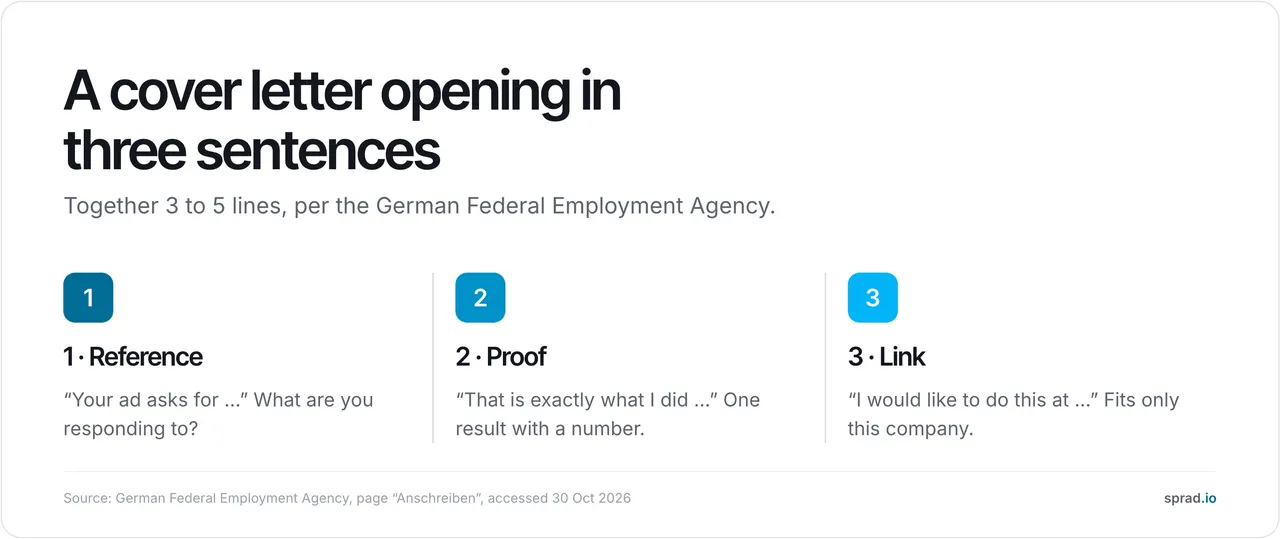
- Reference: What are you responding to? The job ad, a conversation, a referral or a company project.
- Proof: Which one achievement of yours fits? With a number, a timeframe or a result.
- Link: What do you want to do at this company? One sentence that would not work for any other employer.
Length check (assumption): A line in a standard letter holds about 12 to 15 words, so three to five lines are roughly 40 to 70 words. Three sentences of 15 to 20 words fit that frame.
Example openers by situation: weak versus strong
All examples are fictional. They show the blueprint, not text to copy: use your own numbers, tools and companies.
| Situation | Weak first sentence | Strong first sentence |
|---|---|---|
| Answering an ad | I am writing to apply for the advertised position. | Your ad asks for someone who coordinates suppliers reliably. Last year I managed six suppliers on a project worth €180,000. |
| Graduate | As a recent graduate I am looking for a challenge. | During my placement at a machinery maker I ran the weekly status report for three projects. I would like to continue that work as your junior project coordinator. |
| Career changer | I would like to explore new paths. | After eight years in hospitality I scheduled teams of up to 14 people. I would like to take on shift planning at your hotel group. |
| Referral | I heard about your vacancy. | Sarah Berger from your sales team suggested I apply because I manage a similar client portfolio. |
| After a call or fair | As discussed, please find my documents attached. | Thank you for speaking with me on Tuesday. You mentioned the move to a new ticketing system, which I supported at my current employer. |
| Speculative | I am sending a speculative application. | Your new site in Linz adds warehouse capacity. I have run a 12,000-bin warehouse for five years and would like to bring that experience to you. |
| Returning to work | After a long break I want to work again. | After three years of parental leave I am returning to accounting. I completed my bookkeeping qualification during that time. |
| Trades and care | I am very motivated and reliable. | I have worked six years as an electrician in housing and recently took 40 units to final inspection. Your service technician role offers the fixed customer base I am looking for. |
| Leadership | I read your ad with great interest. | As team lead I reduced staff turnover from 18 to 11 % over two years. I see the same task in your head-of-department role. |
| Apprenticeship | I am looking for an apprenticeship. | During my three-week placement in your store I learned to stock shelves and advise customers. I enjoyed it so much that I am applying for the retail apprenticeship. |
What all strong openings share
- They name something concrete: a number, a result, a name, a date.
- They are written from the company's point of view (“You are looking for …” rather than “I am looking for …”).
- They fit only this one job. If you can swap the company name and the sentence still works, it is too generic.
The first sentence: what to avoid
The German Federal Employment Agency explicitly advises against opening with “Hiermit bewerbe ich mich” (the German equivalent of “I hereby apply”). These lines appear in practice all the time and say nothing:
- “I am writing to apply for the position of …” (already in the subject line)
- “I read your ad with great interest.” (everyone claims that)
- “I am a team player and a hard worker.” (traits without proof)
- “In today's fast-paced world …” (a typical text-generator opener)
- “I would be delighted if …” (the conditional weakens the first line)
From practice: The most common problem is not tone but an opening that fits any company. Readers know the ad and look for the link to it.
The closing line
For the ending, the Federal Employment Agency names two things: show that you are ready for a personal interview, online if wanted, and ask for a reply. One short sentence is enough, followed by a formal sign-off and your name.
| Weak | Better | Why |
|---|---|---|
| I would appreciate an invitation. | I look forward to talking, in person or online. | Plain statement instead of conditional. |
| I hope you are convinced. | In an interview I can walk you through the system migration in detail. | An offer instead of a hope. |
| I am eager to hear from you. | I am available from 1 February. | Useful information for planning. |
| Thank you for your time and effort. | I look forward to your reply. | Short, polite, not grovelling. |
Structure: where the opening sits
The order follows the Federal Employment Agency (as of October 2026): header with contact details and date, subject line, greeting with the contact person's name, opening (3 to 5 lines), main part (about 8 lines), link to the role (about 2 lines), closing sentence, sign-off. Everything on one page.
DACH, UK and US: what changes in the opening?
| Country | Greeting and sign-off | Note |
|---|---|---|
| Germany | “Sehr geehrte Frau Meyer,” / “Mit freundlichen Grüßen” | Name the contact person if known (Federal Employment Agency) |
| Switzerland | “Freundliche Grüsse” (no ß) | Bold subject line, send as PDF (berufsberatung.ch, aimed at apprenticeships) |
| UK | “Dear Ms Meyer” / “Yours sincerely” (“Yours faithfully” without a name) | 3 to 5 paragraphs, new for every job (National Careers Service) |
| US | “Dear Ms. Meyer” / “Sincerely” | Common practice, not a legal rule; no photo |
Which tools and templates help?
| Option | Cost | Strength | Limit |
|---|---|---|---|
| Federal Employment Agency templates | free | Reliable structure | You write the content |
| Word templates | mostly free | Clean layout | No text |
| Chatbots | depends on provider, check as of Oct 2026 | Fast drafts | They do not know you; clichés |
| Cover letter generators | often paywalled | Structure on demand | Little link to the ad |
| Atlas Career | free, no limits | A letter per job, tied to the ad | You review and apply yourself |
Atlas Career: a cover letter per job, no limits
Atlas Career (formerly Atlas Career) is a free AI career agent built by Sprad in Vienna. Atlas searches 1.5M+ active jobs straight from employers, over 100,000 of them in the DACH region, and gives every role a match score from 0 to 100 with reasons. For each application Atlas writes a tailored CV and, on request, a cover letter whose opening refers to that specific ad, with no limits and no cost.
Atlas sends nothing on its own. You review the draft, download it as PDF and apply directly to the employer. Atlas strengthens your real experience but does not invent facts. EU hosting, GDPR, never sold, deletable any time. Straight to the job search.
Worked example: what does a tailored opening cost in time?
Assumptions (freely chosen): 15 applications a month. Rewriting the opening from scratch takes about 10 minutes, so 150 minutes or 2.5 hours. With a fixed three-sentence frame and a prepared list of your five best achievements it is about 4 minutes per application, or 60 minutes. You save 90 minutes a month and the opening stays individual.
What does AI change about the opening?
AI writes a clean draft in seconds but knows neither your achievements nor the role. The Federal Employment Agency puts it plainly: the AI does not know you. The result is often the sentence that fits every company. Use AI as a drafting aid: you supply ad, achievements and numbers, check every sentence and delete the clichés. More in our guide to AI for cover letters.
Employers use AI too. Under the EU AI Act (Regulation 2024/1689), Annex III, recruiting AI is high-risk; the obligations apply from 2 December 2027 under Regulation (EU) 2026/1744. For you this means a clear structure and concrete facts help human and automated readers alike. Your data may only be processed for a defined purpose under GDPR Art. 5.
Which mistakes should you avoid?
- An opening like a CV: listing every career step in paragraph one.
- Cliché instead of reference: “With great interest …” without pointing to the ad.
- Wrong name: a greeting or company left over from a previous application, the most common slip in practice.
- Too long: more than five lines for the opening.
- Conditional chains: “would”, “could” in the first and last sentence.
More typical pitfalls are covered in 12 ways candidates damage their chances, and our guide to AI tools for applications compares tools for Europe. Full letters with filled-in samples are in our cover letter template guide.
Step by step: a good opening in ten minutes
- Read the ad and mark the two key requirements.
- Pick the achievement that best matches one of them, with a number.
- Write the reference (“Your ad asks for …”).
- Add the proof (“That is exactly what I did …”).
- Close with the link (“I would like to do this at …”).
- Check length: five lines at most.
- Swap the company name in your head. Still works? Sharpen it.
Frequently asked questions
How do I start a cover letter?
With a sentence that refers to the job and names a concrete achievement, for example: “Your ad asks for someone who … That is exactly what I did …”. Avoid “I hereby apply”.
How long should the introduction be?
Three to five lines according to the German Federal Employment Agency, roughly 40 to 70 words (assuming 12 to 15 words per line).
What is a good first sentence?
One that is concrete, written from the company's point of view and fits only this role. A number or result makes it credible.
How do I write the closing sentence?
Short and direct: you are ready for an interview, online if wanted, and ask for a reply. Then the sign-off and your name.
How is a cover letter structured?
Header, subject, greeting, opening, main part, link to the role, closing, sign-off and name, all on one page.
Can I use AI for the opening?
Yes, as a drafting aid. Check every sentence and replace clichés with your own proof. Atlas Career writes a free cover letter per job; you review it and apply yourself.
Jürgen Ulbrich
Jürgen Ulbrich has more than a decade of experience in developing and leading high-performing teams and companies. As an expert in employee referral programs as well as feedback and performance processes, Jürgen has helped over 100 organizations optimize their talent acquisition and development strategies.