Set CV screening criteria in three tiers: must-have (without it the work cannot be done), nice-to-have (a plus that changes the review order but never excludes) and knockout (an objectively checkable minimum, such as a work permit or shift availability). Write each criterion so a reviewer can point to a passage in the CV or an answer that proves it, keep the must-haves to the few that are truly mandatory, and document why each one is job-related. That is what makes screening fair, explainable and defensible. As of November 2026.
What is the difference between must-have, nice-to-have and knockout?
| Tier | Meaning | Effect in screening | Example |
|---|---|---|---|
| Must-have | Without it the work cannot be done from day one | Open or unmet must-haves lower the grade and trigger a closer human look | Forklift licence for a warehouse role |
| Nice-to-have | Useful, but learnable or replaceable | Moves a person up the review order, never down to zero | Experience with a specific software |
| Knockout (exclusion) | Objective condition that is checked yes or no | Can end the process, but only with a human confirming the rejection | Work permit, required shift pattern |
Three terms, three jobs. The most common error is blurring them: if a nice-to-have is handled like a must-have, you lose good people; if a real must-have is handled like a nice-to-have, the ranking looks fine and the shortlist is wrong. In our conversations with recruiting teams, requirements marked as nice-to-have instead of must-have are the most frequent mistake, and results improve clearly once the true must-haves are set.
How do you decide whether something is really a must-have?
Ask four questions about every requirement:
- Could a person who lacks it do the job within the first months with normal onboarding? If yes, it is a nice-to-have.
- Is it required by law or by the employer's insurance or safety rules? If yes, it is a must-have or knockout.
- Can it be proven from the CV or one question? If not, it is not a screening criterion; test it in the interview.
- Does it indirectly exclude a protected group (for example through age, gaps or language level beyond the real need)? If yes, rework it.
How do you write criteria that can be checked?
A criterion is checkable when a reviewer can point to a sentence that proves it. Vague words create arbitrary scores.
| Weak | Better |
|---|---|
| Team player | Has led or coordinated at least three people (project, shift or team) |
| Strong communicator | Customer-facing role of at least two years |
| Good German | Documented German at the level the job needs (for example B2 for customer calls) |
| Experienced | At least three years in a comparable role, month and year given |
Three example criteria sets
| Role | Must-have | Nice-to-have | Knockout |
|---|---|---|---|
| Office: accountant | Training or degree in accounting; balance-sheet experience | Experience with the ledger software you use; SAP | Right to work; on-site presence at the location |
| Technical: backend developer | Production experience in the stack named in the ad | Cloud and container experience; open-source work | Right to work; location or remote rules |
| Shift work: warehouse | Forklift licence | Experience with a scanner system | Availability for the shift pattern; reachable by commute |
How do you weigh nice-to-haves? A worked example
Nice-to-haves only make sense with weights, otherwise every plus counts the same. Assumption for an accountant role: the must-haves are already met (they are gates, not points), and you weigh three nice-to-haves with a total of 100: ledger software 50, SAP 30, group consolidation 20. Candidate A shows the ledger software and SAP in the CV: 50 + 30 = 80. Candidate B shows only group consolidation: 20. A third candidate has no mention of SAP: do not score 0 for SAP, mark it unclear and ask. The points are a reading order for people who already pass the must-haves; they are no pass mark and no reason for an automatic rejection. This table is an illustration of the method; in Sprad Atlas the grade follows rules your team sets (how many must-haves open, how many nice-to-haves proven), not a point sum.
How should grades and unclear answers be handled?
Define grades before you see candidates, for example: grade A means all must-haves proven; B means one open; C means more open. Treat unclear as a reason to ask, never as a reason to reject. A missing sentence in a CV is not proof of a missing skill. In Sprad Atlas, unclear never counts against a person, and the grade follows the rules your team defines; no model hands out the grade.
What are the legal risks when you set criteria?
This is general information, not legal advice.
- Discrimination: The General Equal Treatment Act (AGG) § 7 prohibits disadvantage on protected grounds; under § 22 AGG you carry the burden of proof if there are indications. Written, job-related criteria are your evidence.
- Automated decisions: GDPR Art. 22 restricts decisions based solely on automated processing; after the SCHUFA ruling (C-634/21) even a score can count as a decision. A person must be able to deviate.
- AI Act: Screening AI is high-risk under Annex III; the high-risk duties apply from 2 December 2027 (Regulation (EU) 2026/1744).
- When may you require something? § 8 AGG allows different treatment on a protected ground only if it is an essential and decisive occupational requirement, with a legitimate aim and proportionate. This is the legal test behind "job-related".
- Salary history: Article 5(2) of the Pay Transparency Directive (EU) 2023/970 bars employers from asking applicants about their pay history; member states had to implement it by 7 June 2026. Do not use it as a knockout; check how your country has implemented it.
- Works council: Where one exists, § 95 para. 2a BetrVG covers selection guidelines made with AI.
How do you calibrate the criteria before going live?
Run 20 applications you have already decided against the new criteria. Compare the result with your real decisions: Who was pushed down although you hired or invited them? Which must-have caused it? Fix the criterion, not the person. Repeat after every changed job profile. The cost is small: at 6 minutes per application, 20 applications take two hours.
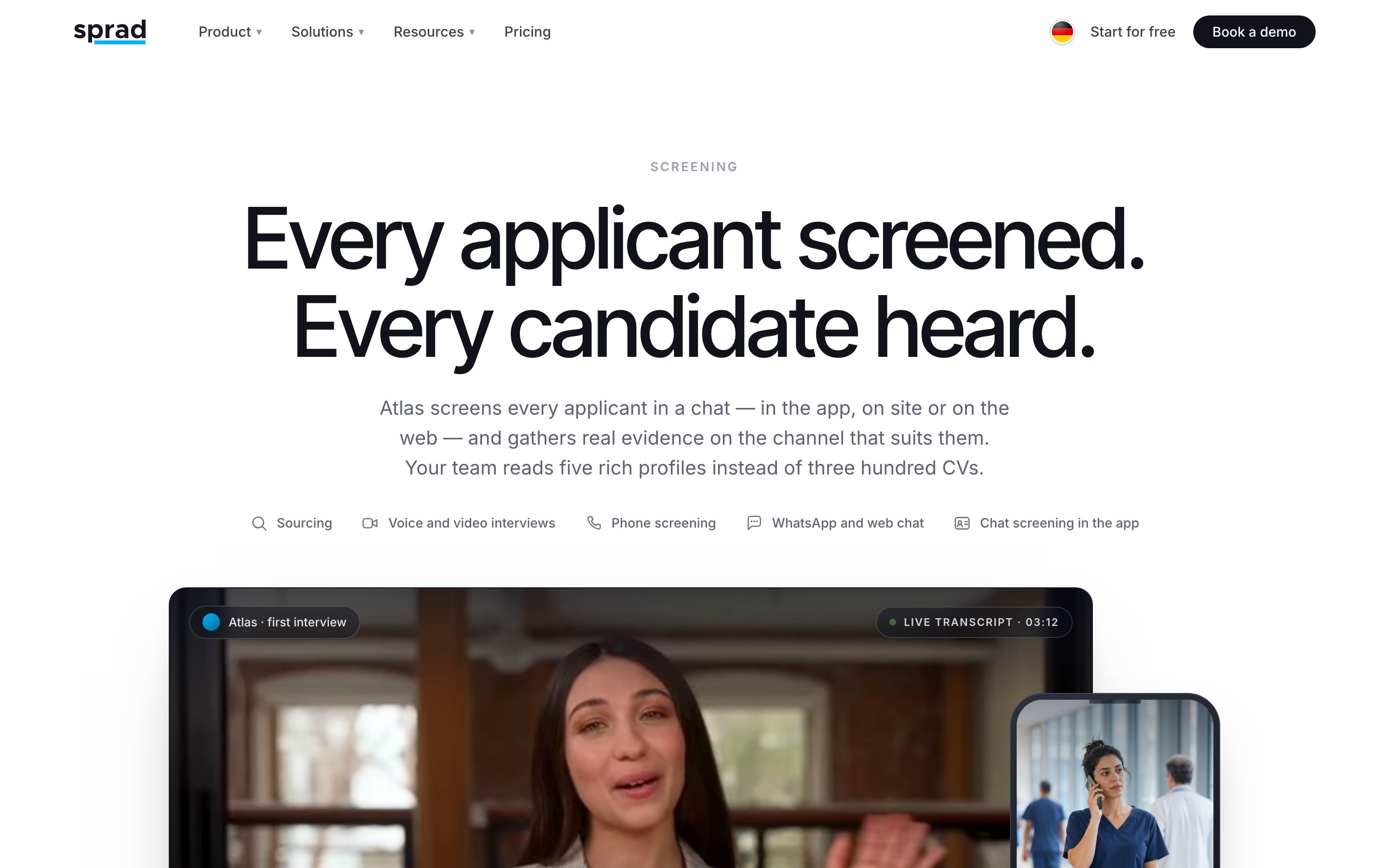
Sprad Atlas turns this into a workflow: import the job ad, Atlas suggests requirements, you mark each as must-have, nice-to-have or exclusion, weight it and describe how to check it. Each requirement is judged three times independently and shown as certain or likely, with the exact sentence from the CV or conversation behind it. A rejection only goes out after someone on your team confirms it. Limits: the criteria are only as good as your job profile, and every assessment uses credits or flat volume (from 0.49 € per application, as of 29 October 2026). Sprad is the provider of this page. Compare options in CV screening software: how to choose, and see AI resume screening: what it can and cannot do for limits.
FAQ
How many must-have criteria should a role have?
As few as the work truly requires. Guides from recruiting vendors suggest about three; if you list eight, you have a wish list, not must-haves. Every extra must-have shrinks the pool.
Can nice-to-have criteria exclude someone?
No. If a nice-to-have excludes, it is a must-have and should be labelled and justified as one.
What are red flags in screening?
Objectively checkable facts that conflict with the job, such as a missing work permit. Avoid subjective red flags such as gaps or job changes without context.
Is a knockout question the same as a must-have?
A knockout is a yes/no check that can end the process; a must-have is mandatory but is weighed in the grade. See automating knockout criteria.
Are knockout questions legal in Germany and the EU?
Yes, if the condition is genuinely job-related and applied the same way to everyone (§ 7 and § 8 AGG), and if a person confirms a rejection (GDPR Art. 22). Questions that proxy protected characteristics, or pay history, do not belong in a knockout.
Who decides the final grade?
Your team defines the grading rules and a person makes the decision; see can AI reject candidates automatically?.
Jürgen Ulbrich
Jürgen Ulbrich has more than a decade of experience in developing and leading high-performing teams and companies. As an expert in employee referral programs as well as feedback and performance processes, Jürgen has helped over 100 organizations optimize their talent acquisition and development strategies.