A pre-screening interview is a short first conversation (10 to 15 minutes) that checks a few must-have criteria before a full interview. In most hiring funnels you should run CV screening first, because it is the cheapest way to remove clear mismatches, and then invite the remaining applicants to an AI or phone pre-screening interview. Put the interview first only when CVs say little, for example in frontline and high-volume roles with a short application form. Either way, a person makes the final decision to invite or reject.
What a pre-screening interview is, and what it is not
A pre-screening interview sits between the application and the real interview. It confirms facts the CV cannot settle: availability, location, salary range, work authorisation, language level, shift or travel willingness and one or two skills that are truly required. It is not a test of culture fit and not the place for deep technical questions.
The format can be a recruiter phone call, an AI voice or video interview, a web chat or a WhatsApp conversation. What matters is that it is short, that every applicant gets the same questions and that the result is written down. The difference to CV screening is the source: a CV is a document the applicant wrote for everyone, an interview answer is a reply to your question.
CV screening or AI interview first?
The question is really about cost per signal. A CV check costs seconds or a few credits per application. A 15-minute interview costs the applicant's time and, with a human, the recruiter's time too. So the cheap, broad filter goes first and the expensive, deep filter only gets the people who survive it.
| Order | Best for | Strength | Risk |
|---|---|---|---|
| 1. CV screening, then interview | Office, specialist and technical roles; any funnel with more than about 50 applications per role | Lowest cost per qualified applicant; interviews only for plausible fits | Good people with unusual CVs can be rated too low; keep a visible reason per rating and a human check |
| 2. Interview first, then CV | Frontline, retail, logistics, care; short forms or applications without a CV | Better signal where CVs are thin; low barrier for applicants | Interview capacity is spent on clear mismatches; costs rise with volume |
| 3. Both at once | Teams that want a ranked list in one step | Fast; the interview answers refine the CV rating | Applicants who would have failed the CV check still spend 15 minutes |
Our rule of thumb from recruiting projects: if a CV tells you whether someone meets your must-haves, check the CV first. If it does not, ask the question directly. A nurse's licence, a driving licence or a night-shift requirement is a question, not something you infer from a CV. For a deeper look at formats, see AI video interview, voice or phone screening: which format fits which role?
How to run a pre-screening interview, step by step
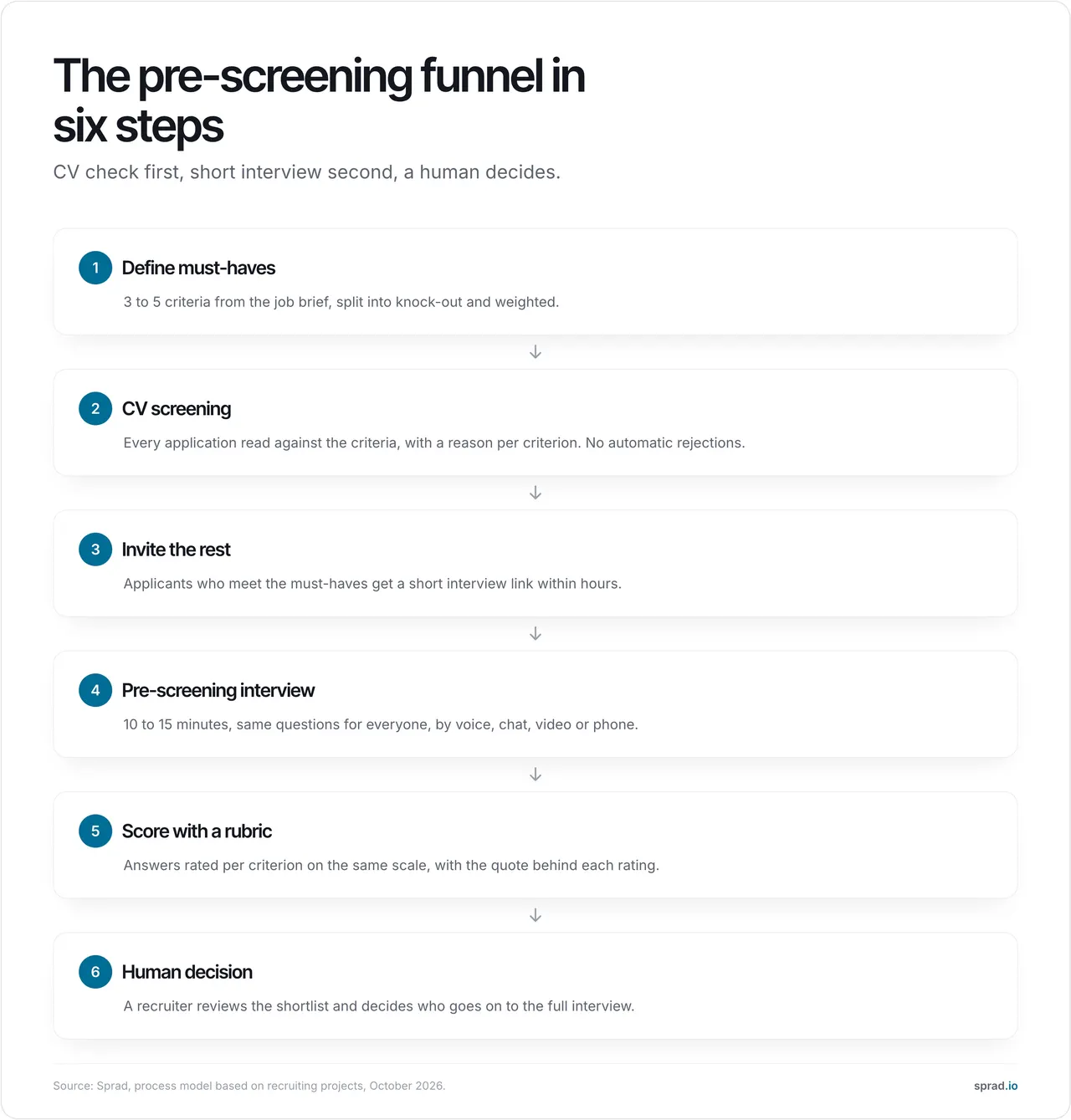
- Define 3 to 5 must-haves. Take them from the job brief and mark each as knock-out (without it the applicant cannot be hired) or weighted (it counts for or against). Fewer is better. A degree requirement that people succeed without is not a knock-out.
- Screen the CVs against these criteria. Record a reason for every rating. Do not reject automatically; the result is a recommendation.
- Invite fast. Send the interview link within hours, not days. Applicants who wait a week have often moved on.
- Ask the same 5 to 8 questions of everyone, in the same order. Open with the knock-outs, then one or two situational questions about the work itself.
- Score with a rubric. Define in advance what a weak, acceptable and strong answer looks like for each criterion. Structured interviews rank first among selection methods in the most recent large meta-analysis of their predictive validity (Sackett, Zhang, Berry and Lievens, Journal of Applied Psychology 2022), and the structure is what makes an AI interview comparable.
- Let a person decide. A recruiter reads the shortlist with the quotes behind each rating and decides who moves on.
What to ask: a question set that works
- Fit facts: "Where are you based, and could you work on site in [city] from [date]?" "What notice period do you have?"
- Expectations: "What salary range are you looking for?" Ask this early so neither side loses time.
- Must-have skill: "Tell me about the last time you [core task of the role]. What did you do, and what was the result?"
- Motivation: "Why this role, and what would make you say no?"
- Work conditions: shifts, travel, language, equipment, as the role requires.
Leave out anything unrelated to the job: age, family plans, health, origin. In Germany such questions invite claims under the General Equal Treatment Act (AGG § 1); an applicant who is not hired despite a discriminatory process can claim compensation of up to three monthly salaries under § 15 (2) AGG, if they would not have been hired even in a fair process. For free question banks and a 20-minute script see our phone screen interview templates.
What it costs: a worked example with 1,000 applications
The sequence changes the bill more than the tool does. Assumptions: 1,000 applications for one role, 20 % pass the CV check (200), a recruiter phone screen takes 15 minutes at a loaded cost of 40 € per hour, and a credit costs 0.07 to 0.10 €. Sprad prices as of October 2026, net, from sprad.io/pricing: CV rating 2 credits, voice interview 30 credits.
| Setup | Calculation | Cost |
|---|---|---|
| Recruiter phone screen for all | 1,000 × 15 min = 250 h × 40 € | 10,000 € |
| AI voice interview for all, no CV check | 1,000 × 30 credits = 30,000 credits | 2,100 to 3,000 € |
| CV check for all, AI voice for the 200 who pass | 1,000 × 2 + 200 × 30 = 8,000 credits | 560 to 800 € |
| CV check for all, recruiter phone screen for the 200 | 2,000 credits + 50 h × 40 € | 2,140 to 2,200 € |
| Flat rate per application, voice for every fifth | 1,000 × (0.49 € + 0.20 €) | 690 € |
The CV-first order with an AI voice interview is about a quarter of the cost of interviewing everyone with the same tool, and a small fraction of phone-screening everyone by hand. These are our assumptions, not a benchmark: if 50 % pass the CV check, the interview part grows accordingly. More on time versus cost: 8,000 applications a year: the time-versus-cost math.
How AI changes the pre-screening interview
AI changes three things. Speed: every applicant can be interviewed within hours, at night and in their own language, instead of waiting for a recruiter's calendar. Consistency: every applicant gets the same questions and is rated against the same criteria, which is hard to achieve with ten recruiters on the phone. Documentation: every answer is stored with a transcript, so you can see the reason behind a rating.
What AI does not change is accountability. It prepares the decision; it should not make it. In Sprad, the CV check reads each application, rates it per criterion and shows the quote behind the rating; nothing is rejected automatically. AI interviews run by voice, video or web chat in many languages, with invitation and the whole conversation also possible over WhatsApp, which is popular in Europe. In the US, text chat works best today; phone interviews and local numbers are possible through a custom setup, typically in larger plans. Limits worth knowing: an AI interview does not replace the conversation about motivation and team fit, and very senior or highly personal roles belong with a person from the start. For how the tools compare, see CV screening software in 2026: how to choose.
Legal checkpoints in the EU, DACH and the US
- EU, GDPR: Article 22 gives people the right not to be subject to a decision based solely on automated processing that significantly affects them. In the SCHUFA ruling (CJEU, C-634/21, December 2023) the court held that a score can itself count as such a decision when others rely on it heavily. For you that means: the recruiter must actually review the result, not just click it through.
- EU AI Act: AI used to select or screen applicants is high-risk (Annex III). Its obligations apply from 2 December 2027 under the Digital Omnibus (Regulation (EU) 2026/1744). Transparency duties under Article 50, including telling people they are talking to an AI system, apply from 2 August 2026. Inferring emotions of applicants has been prohibited since 2 February 2025 (Article 5), so avoid "emotion analysis" features in video interviews.
- Germany: a works council has co-determination rights over tools that can monitor behaviour or performance (§ 87 (1) no. 6 BetrVG); involve it before launch.
- USA: screening steps count as selection procedures. The four-fifths rule in 29 CFR 1607.4 flags adverse impact when a group's pass rate is below 80 % of the highest group's, so track pass rates per step. In Illinois, the Artificial Intelligence Video Interview Act requires notice and consent before AI evaluates a video interview.
This is orientation, not legal advice. Sprad is hosted in the EU and built to the data protection and security standards of enterprise, public and insurance customers, which applies to Europe and the US.
Seven mistakes to avoid
- Too many questions. More than eight, and completion drops.
- Knock-outs that are not real. Every false knock-out removes good people silently.
- Different questions per candidate or no rubric, so ratings cannot be compared.
- Automatic rejections without a human check.
- No disclosure that an AI conducts the interview.
- Slow follow-up. The best applicants have several processes running.
- Never measuring the funnel. Check the pass rate per step and per group, and read a sample of rejected applications every month.
Which tools and templates help
You can start with a template and a phone call. Once volume grows, you need a tool that reads CVs, runs the interview and stores the evidence in the applicant record. Sprad covers this in one place: CV screening, chat, voice, video and WhatsApp interviews, a candidate portal and a free ATS. You can start free with 100 credits a month. For screening there are two options: credits (2 per CV rating, 10 for a chat interview, 30 for voice, 80 for video) or a flat rate of 0.49 € per application including CV screening, chat interviews and portal, plus 0.20 € if every fifth applicant gets a voice interview. All prices net, as of October 2026. Sprad has built recruiting software for 7 years; see sprad.io/pricing.
Where screening ends and interviewing begins is also a question about time use: Screening vs interviewing: where recruiters waste 40 % of their time.
FAQ
What is a pre-screening interview?
A short first conversation or structured questionnaire, usually 10 to 15 minutes, that checks a few must-have criteria such as availability, location, salary range and one core skill before a full interview.
Should CV screening or the interview come first?
CV screening first in most cases, because it is cheaper per applicant. Interview first for frontline and high-volume roles where CVs say little or do not exist.
How long should a pre-screening interview be?
10 to 15 minutes with 5 to 8 questions. Longer interviews lose applicants and add little signal at this stage.
Can AI conduct a pre-screening interview?
Yes, by voice, video, chat or WhatsApp. Tell applicants they are speaking to an AI system, rate answers against a fixed rubric and let a person make the final decision.
Is an AI pre-screening interview legal in the EU?
Yes, with conditions: no decision based solely on automated processing without human review (GDPR Art. 22), transparency about the AI, no emotion recognition, and from 2 December 2027 the high-risk obligations of the AI Act.
Is a pre-screening interview the same as a phone screen?
The phone screen is one format of it. A pre-screening interview can also run as an AI voice call, video, chat or WhatsApp conversation.
Jürgen Ulbrich
Jürgen Ulbrich has more than a decade of experience in developing and leading high-performing teams and companies. As an expert in employee referral programs as well as feedback and performance processes, Jürgen has helped over 100 organizations optimize their talent acquisition and development strategies.