Sourcing from employee networks means searching the professional contacts your staff already have, instead of only the open market. In practice, employees export their LinkedIn connections (or share them in a tool), you merge and de-duplicate them into one pool, search it against the role's requirements, and let the employee who knows the person make the first move. It works because trust is already there; it only works in Europe if participation is voluntary and the data handling is documented under GDPR.
What does "sourcing from employee networks" mean in practice?
Most hiring teams treat employee referrals as a push channel: you post a job, employees may forward it. Network sourcing turns this around into a pull channel. You start from the role, look through the combined contacts of your workforce, and ask the right colleague for an introduction.
The difference matters. A referral programme depends on employees remembering the open role and thinking of the right person at the right moment. Network sourcing does not: the contacts sit in the pool, and the search finds the fit. Employee referrals remain valuable on their own. In the Randstad-ifo survey of HR managers (Q1 2022, reported by yumda), 77 % of companies rated referrals as important, ahead of LinkedIn and XING (34 %). Network sourcing is the systematic version of that channel (see also our guide to employee referral programmes).
Why bother? What the data says and does not say
Referred hires tend to stay longer. An analysis of more than 50 companies and about 91,000 employees by iCIMS (October 2018) found a median tenure of 38 months for referral hires against 22 months for other hires. Two honest caveats: the study is vendor-run and from 2018, and referred people may simply be better pre-selected, so it proves correlation, not cause. We do not use unsourced "referrals are 4x more likely to be hired" figures, because they circulate without a traceable original.
What follows without any statistic: every connection in your staff's networks is a person who has already been vouched for by a real relationship. Cold outreach has to build that trust from zero.
How do I do it, step by step?
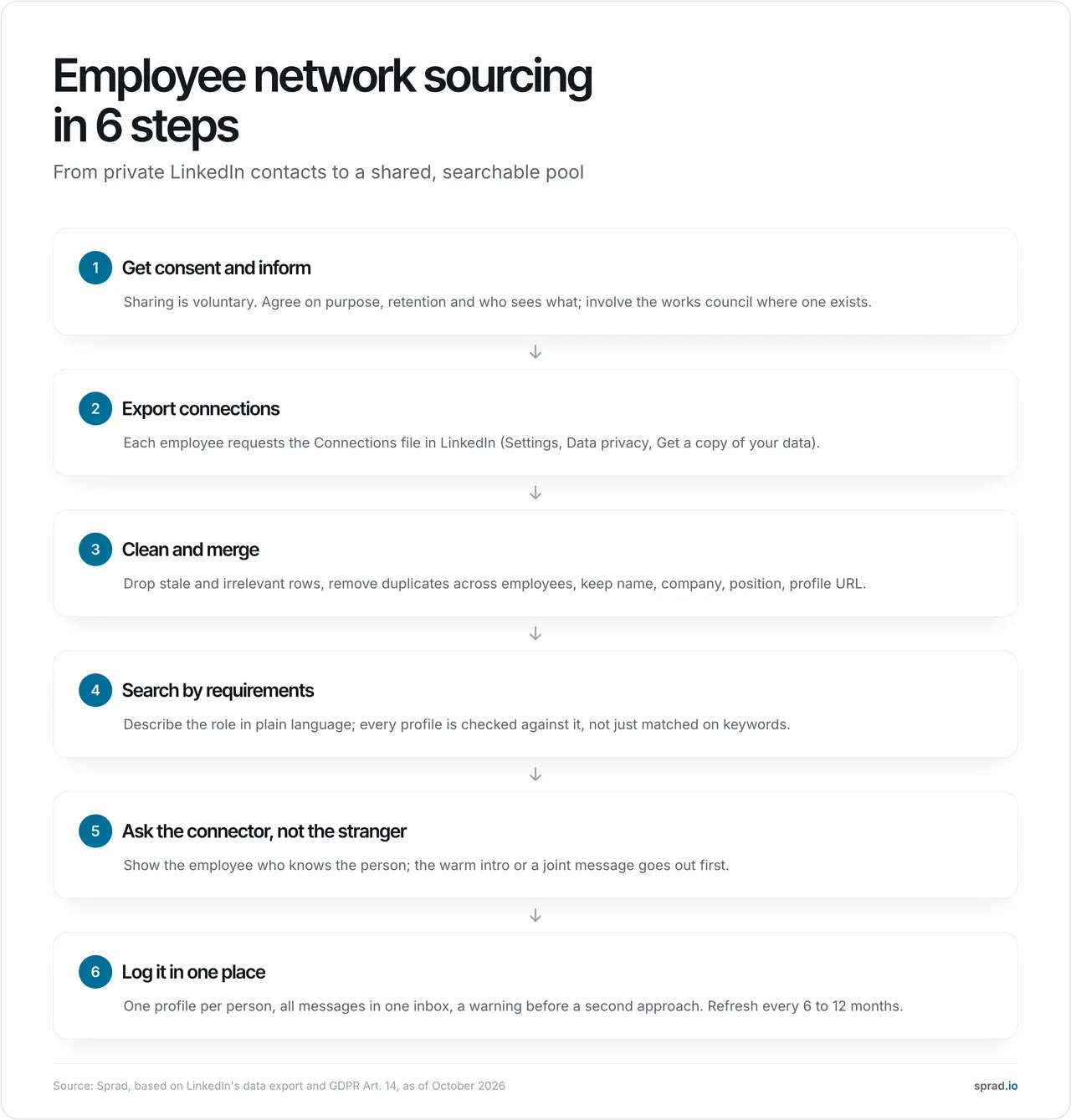
1. Get voluntary participation and inform properly
Nobody should be pushed to hand over a private network. Explain the purpose (open roles only, no profiling of the employee), who can see what, how long data is kept, and how to withdraw. In works-council companies, involve the council early: tools that process employee-related data fall under co-determination, for example § 87 BetrVG in Germany. This is a practical note, not legal advice.
2. Export the connections
Each participant requests the data in LinkedIn: Me → Settings & Privacy → Data privacy → Get a copy of your data, then selects the connections file and requests the archive; LinkedIn emails the download link (LinkedIn Help, checked October 2026). Two limits to plan for: only first-degree connections can be exported, and email addresses appear only for people who allowed their connections to see them, so many rows will have none.
3. Clean and merge
The raw file is usually a CSV with name, profile URL, company, position and the date of connection. Three practical rules save most of the pain: delete rows older than your relevance window (for example five years, unless the person is senior), merge duplicates across employees on the profile URL rather than on the name, and keep a column "known by", because that column is what makes the warm introduction possible later.
4. Search by requirements, not keywords
This is where tools differ most. A keyword search over a connections file finds only people who wrote the right word in their headline. Describing the role in plain language and having every profile checked against it also finds the engineer whose profile says "Software Craftsman" instead of "Backend Developer". Sprad does this with a requirements-based check of each profile; a quick search returns first results in about three seconds, and the deep search takes a few minutes because far more AI runs per profile. Rule of thumb: if results appear instantly, it is almost always a keyword or semantic filter.
5. Ask the connector first
The best outcome of network sourcing is not a cold message with a mutual-connection hint. It is a colleague saying "I know her, I'll ask". A short request to the employee works well:
Hi Sam, we are hiring a Senior Data Engineer. Our search turned up Jo Meyer, who is in your network. Would you be comfortable pinging Jo, or should we write and mention that you know each other? No pressure either way.
Offering the employee a choice keeps participation voluntary and is more respectful than a blanket "send us names" mail.
6. Keep everything in one place
Networks overlap. Without a shared record, two recruiters write to the same person within a week, or a colleague approaches someone who is already in the process. Keep one profile per person with all notes and messages. In Sprad, LinkedIn and email conversations run into one inbox per talent, and the system warns you if someone was already contacted, also for a different role or by a colleague. Existing contacts can be imported from your mailbox or LinkedIn.
A worked example: what a small company's networks are worth
Assumptions, not measurements: 40 employees each share 450 first-degree connections. That is 18,000 rows. If a quarter overlap between colleagues, about 13,500 unique people remain after de-duplication.
Checking that list against a role's requirements costs 1 credit per 100 profiles in Sprad, so 135 credits. At the Atlas Base credit price of €0.09 that is roughly €12 (list price €0.10: €13.50); the free plan already includes 100 credits per month (prices excl. VAT, as of 29 October 2026, sprad.io/pricing). Finding a business email costs 1 credit per hit, and you only pay for what is found. The cost is small next to the real expense of this method: the time of the colleague you ask.
Is it legal under GDPR? What to document
Employees' contacts are third-party personal data. Three points matter, none of them a reason to skip the method:
- Legal basis. Legitimate interest (Art. 6(1)(f) GDPR) is the usual route for recruiting outreach, backed by a documented balancing test. Do not use contacts for any purpose other than hiring.
- Information duty. If you hold data about someone who did not give it to you, Art. 14 requires telling them, at the latest within one month and at the latest at first contact. Put the notice into your first message.
- Platform terms. Exporting your own connections through LinkedIn's data download is a supported function. Scraping other people's profiles is a different matter and is prohibited by the LinkedIn User Agreement.
If AI ranks candidates, note that recruitment systems count as high-risk under Annex III of the EU AI Act, with obligations applying from 2 December 2027 (Regulation (EU) 2026/1744, in force since 27 July 2026). Keep a human in the decision: the tool prepares the shortlist, people decide.
Which tools or templates help?
| Approach | Strength | Weak spot |
|---|---|---|
| Sprad (Atlas) | Upload your own LinkedIn network, employees share theirs, one search over LinkedIn, XING, GitHub and your pool; every profile checked against requirements; LinkedIn + email in one inbox with duplicate-contact warning | Deep search takes a few minutes; no AI call notetaker yet |
| CSV in Excel or Google Sheets | Free, fast to start, full control | Keyword filters only, no duplicate warning, goes stale, hard to keep GDPR-clean |
| ATS or CRM import | Fits existing process and records | Contacts have no relationship context; weak search by requirements |
| Referral platform | Good for campaigns, rewards, gamification | Depends on employees remembering, not on search |
Where Sprad can show a measurable result is the search itself. In the public PeopleSearchBench (Recruiting, 119 search tasks), Atlas reaches 73.5 out of 100 in our own re-measurement, converted to the published scale (Lessie 68.2, Juicebox 65.7 as published). Source: PeopleSearchBench (Recruiting), published by Lessie, October 2026. Other systems' scores as published in the benchmark; Atlas is our own re-measurement with the benchmark's open test procedure, converted to the published scale; not an official entry. For small teams, Recruiter Lite starts at €79 per seat and month; the Atlas Recruiter plan is €299 and includes unlimited search under fair use. Those seat prices are higher than some tools, which is why the credit model is worth a look first. Pair this with the referral rewards guide if you want a bonus on top.
Which mistakes should I avoid?
- Importing without asking. Employees who feel harvested stop sharing. Voluntary and transparent beats comprehensive.
- Writing to the stranger first. The warm path is the whole point. If the colleague hears about it afterwards, you have burned their trust.
- Never refreshing. People change jobs. Re-export every 6 to 12 months and treat anything older as a lead to re-check, not a fact.
- Counting names instead of fits. 13,500 contacts are worth little if no one checks them against the role. Measure matches per role, not list size.
- Ignoring overlap. Without a shared record, double outreach is nearly guaranteed once more than a handful of people use the pool.
How does AI change employee network sourcing?
Three things. First, it reads each profile against the requirements instead of matching words, so a poorly maintained profile no longer hides a good candidate. Second, it enriches thin records (a connections file holds no skills, only a title), which makes older contacts searchable. Third, it automates the dull follow-ups, for example a reminder to the colleague who has not replied. It does not replace the judgement call on who is approached and how; that stays with your team, which is also what the AI Act expects.
The same logic applies to your own alumni and past candidates. In Sprad you can invite your talent pool, for example earlier placed candidates, to connect their networks, and then search those networks as well. More in our overview of the talent network.
FAQ
Can I upload my own LinkedIn network to search it?
Yes. Export your connections from LinkedIn and upload them; you can then search them and see with whom you are already connected. Only first-degree connections are in the file.
Do employees have to participate?
No, and they should not. Participation should be voluntary, documented and revocable.
Does the LinkedIn export contain email addresses?
Only for connections who allowed their connections to see them. Plan to find business emails separately.
How often should I refresh the pool?
Every 6 to 12 months, depending on how heavily you rely on it.
Is network sourcing the same as an employee referral programme?
No. A referral programme waits for employees to name people; network sourcing searches their contacts and then asks. They complement each other. For inspiration on the referral side, see our referral programme insights.
Jürgen Ulbrich
Jürgen Ulbrich has more than a decade of experience in developing and leading high-performing teams and companies. As an expert in employee referral programs as well as feedback and performance processes, Jürgen has helped over 100 organizations optimize their talent acquisition and development strategies.