Under the EU AI Act, AI that ranks CVs or scores interview answers is a high-risk system (Annex III, point 4), and AI that infers emotions from a candidate's voice or face is banned. The employer's own duties for high-risk systems apply from 2 December 2027; the ban has applied since 2 February 2025, and the duty to tell candidates they are talking to an AI starts on 2 August 2026. In practice you need four things before you switch an AI interview or CV screening on: a function map, fixed criteria, a person who can overrule the tool, and a short notice for candidates.
Which of your AI screening and interview functions are high-risk?
The test is the intended purpose, not the product label. Annex III, point 4(a) of Regulation (EU) 2024/1689 lists systems used to place targeted job ads, to analyse and filter applications and to evaluate candidates. Article 6(3) allows a narrow exception for purely preparatory tasks, but not where the system profiles people. Sort every function of your tools into one row of this table.
| Function | Typical classification | What to do |
|---|---|---|
| CV parsing into fields (name, skills, dates) | Usually not high-risk if it only prepares data for a person | Let people correct errors; do not let parsed fields drive rejections |
| CV summary for a human reader | Generally not high-risk | Keep the original CV one click away |
| CV scoring, ranking or shortlist | High-risk (Annex III 4(a)) | Fixed criteria, reasons per criterion, human decision, logs |
| AI interview that asks questions and records answers | Transparency duty (Art. 50); high-risk once it evaluates | Tell candidates it is an AI; offer a human alternative |
| Scoring or ranking interview answers | High-risk (evaluating candidates) | Score content against job criteria only; human decision |
| Inferring emotions, stress or personality from voice, face or video | Banned (Art. 5(1)(f)) | Do not buy it, switch it off, get it out of the contract |
| Interview scheduling bot | Transparency at most | Say it is automated |
| Targeted job-ad delivery | High-risk (Annex III 4(a)) | Ask the ad platform or vendor for documentation |
This is practical orientation, not legal advice; the final classification depends on how your vendor describes the intended purpose and how you configure the tool. For the full list of employer duties see our guide to EU AI Act recruiting obligations. This page covers only the two workflows that cause most questions: CV screening and AI interviews.
When do the rules apply?
- Since 2 February 2025: prohibited practices (Article 5), including emotion inference at work, and the AI literacy duty.
- From 2 August 2026: transparency duties (Article 50), for example telling people they interact with an AI system.
- From 2 December 2027: high-risk duties for recruiting systems under Annex III. The date was moved by the Digital Omnibus, Regulation (EU) 2026/1744, in force since 27 July 2026.
Do not read 2027 as a waiting period. Your GDPR duties, anti-discrimination law and works council rights apply today, and a tool you buy now will still be in use in December 2027.
What is banned in an AI interview?
Article 5(1)(f) prohibits AI systems that infer emotions of people in the workplace, with exceptions for medical or safety reasons. The Commission's guidelines on prohibited practices (published 4 February 2025) are widely read as covering the recruitment phase, so a tool that rates "confidence", "enthusiasm" or "stress" from tone of voice or facial expression is off the table for candidate selection. Both the vendor and you as the employer can be responsible.
What stays allowed: transcribing what a candidate said and evaluating the content of the answer against the job criteria. Ask every vendor in writing which signals feed the score. If the answer includes voice tone, facial movement or "personality traits", walk away. Penalties for banned practices reach EUR 35 million or 7 % of global annual turnover (Art. 99).
Checklist: CV screening and AI interviews, step by step
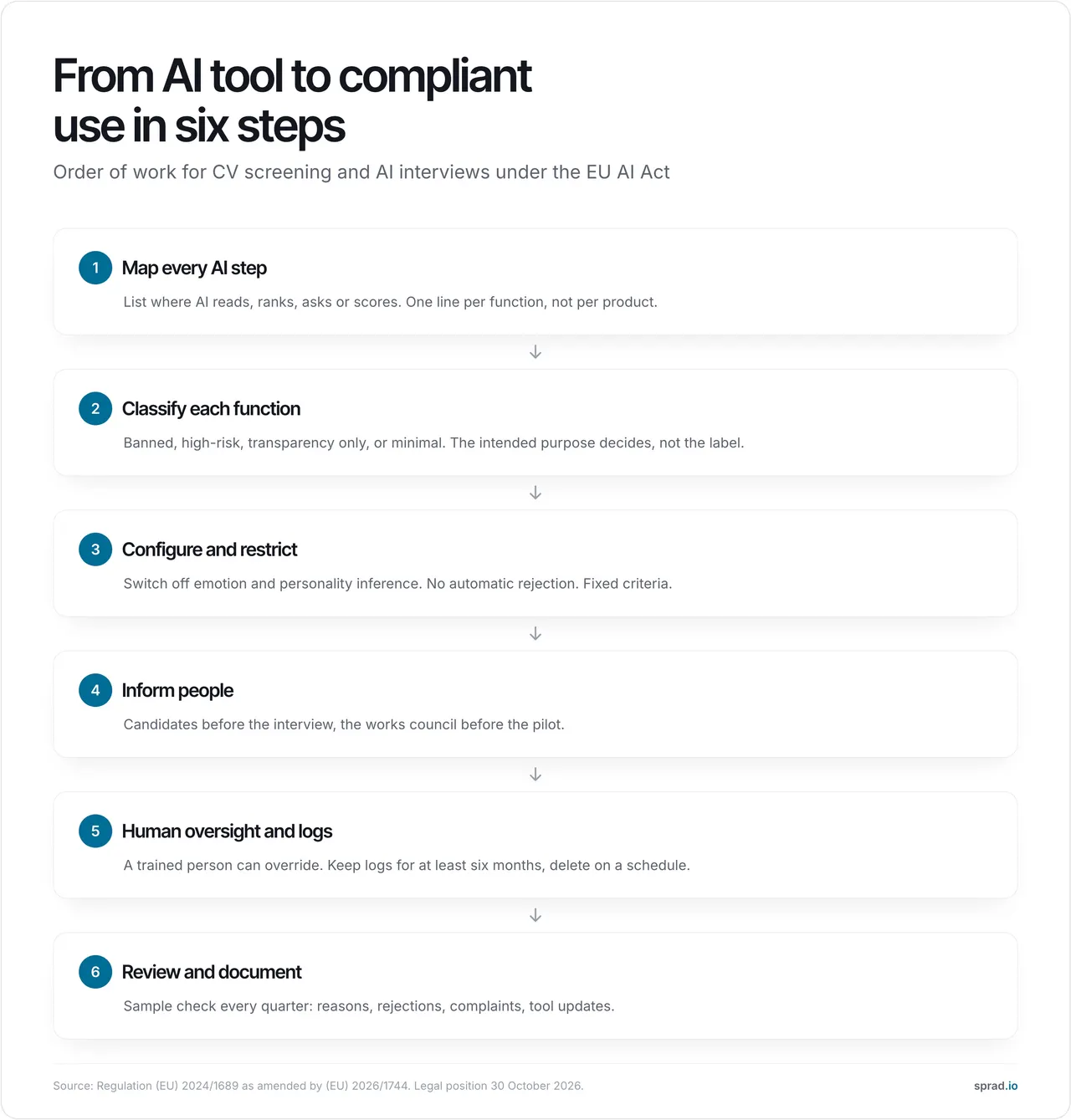
The six steps above are the order of work. This table shows what each step means for the two workflows.
| Check | CV screening | AI interview |
|---|---|---|
| Criteria | Written must-haves per job, agreed with the hiring manager before the first CV | Same question set and rubric for every candidate in the role |
| Reasons | Reason per criterion with the CV passage behind it | Reason per answer with the quote from the transcript |
| Decision | A recruiter confirms every rejection | A recruiter listens or reads before an invite or rejection |
| Prohibited signals | No age, gender, photo, nationality proxies | No emotion, personality or accent scoring |
| Candidate notice | Say that AI supports the review | Say that the interviewer is an AI, before it starts |
| Alternative | Route to a person on request | Offer a human conversation or a text option |
| Data and logs | Log score, reasons, reviewer, time; delete on schedule | Keep transcript only as long as the process needs it |
| Works council | Inform and agree before the pilot (Germany, Austria) | Same, plus rules on recordings |
What do you have to tell candidates?
Three layers apply. Article 50 requires that people are informed when they interact directly with an AI system, unless it is obvious. For high-risk systems that assist decisions about people, Article 26(11) adds a duty to inform them that such a system is used, and Article 86 gives them a right to a meaningful explanation of the system's role in an adverse decision. Under GDPR Articles 13 and 14 you also describe the processing in the privacy notice.
A short notice at the start of the invitation is enough as a pattern: "This first interview is conducted by an AI assistant. It asks questions about your experience and records your answers. Your answers are evaluated against the requirements of the job, not your voice or appearance. A recruiter reviews every result and makes the decision. If you prefer to speak to a person, reply to this email."
How long may you keep logs and transcripts?
Article 26(6) requires deployers of high-risk systems to keep automatically generated logs for at least six months, unless other Union or national law, in particular data protection law, says otherwise. That collides with the data minimisation rule when you hold applicant data. A workable approach from practice: log decisions and system events (who reviewed, which score, which reason, when), not full applicant content, and delete CVs and transcripts of rejected applicants on a fixed schedule. In Germany, many employers use about six months after rejection because discrimination claims can be filed within two months and then taken to court within three months (Section 15(4) AGG, Section 61b ArbGG). Agree the period with your data protection officer and write it down.
Does the human really have to decide?
Yes, and not as a formality. Article 26(2) requires oversight by people with competence, training and authority. Under GDPR Article 22 a decision based solely on automated processing with significant effects is restricted. The Court of Justice held in SCHUFA (C-634/21, December 2023) that a score can itself count as an automated decision when a third party draws strongly on it. A recruiter who clicks "accept" on every AI ranking is the situation that case warns about. Test it: if reviewers overrule the tool in fewer than 1 in 20 cases, check whether they are reviewing or just confirming.
What about Germany, Austria and the US?
DACH. A works council has co-determination rights over technical devices that can monitor behaviour or performance (Section 87(1) no. 6 BetrVG) and over selection guidelines, including where AI is used to draw them up (Section 95(2a)). Involve it before the pilot; our guide on works councils and AI recruiting has the agreement structure. Recruiting also needs a data protection impact assessment in most cases, because it is new technology applied to people at scale.
USA. The EU AI Act reaches you if you hire in the EU or your tool's output is used there. Separately, US rules are state and city based. New York City's Local Law 144 requires a bias audit within one year before use of an automated employment decision tool, a public summary and notice to candidates 10 business days in advance (NYC DCWP, enforced since 5 July 2023). Illinois requires notice, an explanation and consent for AI video interview analysis (820 ILCS 42), and since 1 January 2026 its Human Rights Act covers discriminatory AI use in hiring. Colorado and California have their own rules; check the current status before you launch in those states.
Five mistakes we see in practice
- Treating the vendor's "compliant" label as the end. The provider documents the system; you still own oversight, notices and logs as the deployer.
- Letting the tool auto-reject. A "knock-out" rule on years of experience or a score threshold is an automated decision in all but name.
- Different questions per candidate. A free-form AI interview that probes each person differently makes scores incomparable and hard to defend.
- Keeping everything forever. Full video and transcripts of rejected candidates are the first thing a data protection authority asks about.
- Forgetting tool updates. A new feature such as "sentiment" or "culture fit" can turn a harmless tool into a banned or high-risk one. Put updates on the quarterly review list.
How does AI change the effort, and what does it cost?
AI makes volume manageable, but oversight is a real cost line. A worked example with stated assumptions: 2,500 applications a year, the tool proposes rejection for 60 % (1,500), and a recruiter samples 10 % of those proposals (150) at two minutes each. That is five hours a year of structured review, plus the normal reading of the shortlist. With Sprad's published screening price of 0.49 EUR per application, 2,500 applications cost 1,225 EUR a year; adding voice interviews for every fifth application brings it to 0.69 EUR per application, 1,725 EUR a year (sprad.io/pricing, net, as of 29 October 2026). The oversight hours are the part that keeps the setup defensible, so budget them. For the time side of that trade-off see the pre-screening time and cost math.
Sprad has built recruiting software for seven years, for start-ups, large corporations, public bodies and insurers. In Sprad's CV screening every application is read and evaluated with a reason per criterion and the quote behind it, and nothing is rejected automatically. Interviews run by voice, video or chat in many languages (AI voice interviews), hosting is in Germany (Frankfurt), and customer data never trains AI models. The limit stays the same for every vendor, ours included: the legal duties of the deployer remain with your company, so keep the checklist above.
FAQ
Is the vendor or the employer responsible under the EU AI Act?
Both, for different things. The provider owes risk management, documentation and technical safeguards; the deployer, usually the employer or staffing firm, owes proper use, oversight, logs and candidate information (Art. 26).
Does the AI Act apply to a US company that hires in the EU?
Yes, if the AI system is used in the Union or its output is used in the Union. A US company screening EU candidates should plan for both regimes.
Is a chatbot that only schedules interviews high-risk?
Generally no. It needs a clear statement that it is automated, but it does not rank or evaluate anyone.
What are the fines?
Up to EUR 35 million or 7 % of turnover for banned practices, up to EUR 15 million or 3 % for breaches of high-risk duties (Art. 99). Fines for high-risk duties only become relevant once they apply on 2 December 2027.
Can candidates refuse an AI interview?
Offer a human alternative. It is required in practice where consent is the legal basis (for example under the Illinois act), and it reduces complaint risk everywhere else.
Sources: Regulation (EU) 2024/1689 (consolidated 27 July 2026), Regulation (EU) 2026/1744, GDPR, CJEU C-634/21, BetrVG, NYC DCWP, Illinois General Assembly. Legal position 30 October 2026. This article is not legal advice.
Jürgen Ulbrich
Jürgen Ulbrich has more than a decade of experience in developing and leading high-performing teams and companies. As an expert in employee referral programs as well as feedback and performance processes, Jürgen has helped over 100 organizations optimize their talent acquisition and development strategies.