Fetcher does not publish a price list. Its own help center says pricing depends on the number of seats and the number of candidate leads sourced, and you have to book a call. Third-party trackers report self-serve from about 115 $ per month, Growth at 379 to 499 $ and Amplify at 649 to 849 $ per month (lower figures with annual billing), plus a custom Enterprise tier, and Vendr's contract data puts a typical deal at about 11,000 $ per year. There is no free plan or trial. For comparison, Sprad starts free, and Recruiter Lite costs 79 € (95 $) per seat and month.
How much does Fetcher cost per month or year?
Fetcher's help center describes the model in one sentence: price depends on “the number of seats your team needs, along with the number of candidate leads we source”, and for licences it says “pricing varies based on # of seats”. Its pricing page, at the time of writing, shows an ROI calculator but no tier prices. So every number below comes from third parties and should be confirmed with Fetcher before you budget.
Two trackers (Pin's pricing explainer, updated 22 October 2026, and a SyncGTM review, updated 30 September 2026) describe the same four tiers but disagree on the limits. We show both so you can see where the uncertainty is.
| Tier | Reported price (USD) | Seats | Sourced candidates per year (sources disagree) |
|---|---|---|---|
| Self-serve | 115 $/month (about 80 $ with annual billing) | 1 | none to 500; 300 leads per month |
| Growth | 379 $/month billed annually (499 $ month to month) | 1 | 500 or 1,000; 2,500 to 5,000 leads |
| Amplify | 649 $/month billed annually (849 $ month to month) | 2 | 1,000 or 2,000+; dedicated sourcer for about 4 to 6 roles |
| Enterprise | custom quote | 3+ | 2,000+ |
On the annual rates, Growth works out to 4,548 $ per year and Amplify to 7,788 $ per year (our arithmetic: 379 × 12 and 649 × 12). Annual billing is advertised as roughly 30 % cheaper. Older sites still list 149 $ per user and month, which does not match current tiers. Vendr, which tracks real software contracts, reports a median of about 11,000 $ per year and a range from roughly 8,400 to 26,000 $, with multi-year commitments often unlocking further discounts.
What is included, and what costs extra?
According to Fetcher's help center, every package includes automated sourcing, a Chrome extension, unlimited outbound emails to candidates, templated emails, top-of-funnel analytics, email and ATS integration, onboarding and a dedicated customer success manager. Third-party reviews add integrations to Greenhouse, Lever and Workable via a unified API, SSO on higher tiers and a SOC 2 Type 2 badge (shown on Fetcher's site).
What we found no price for, and what you should ask about in a quote:
- The caps. The real unit is sourced candidates per year, not emails. Once you hit the cap, ask what an extra batch costs.
- Seats. Growth is one seat. A team of five needs five seats or a custom Enterprise deal.
- Channels. The help center describes email outreach. We found no automated LinkedIn outreach documented, so if your best candidates answer on LinkedIn, you cover that channel separately.
- Renewal. Ask for the renewal uplift in writing; Vendr data suggests multi-year terms are where discounts appear.
Is there a free plan or trial?
No. Both trackers list no free tier and no trial; the help center tells prospects to schedule a call. The cheapest way in is the self-serve plan at about 115 $ per month. By contrast, Sprad has a free plan with 100 credits per month (200 in the first month), and searches, screening and interviews all run on those credits. Sprad's talent network, CRM and career page are free in every plan, and your whole team can work in the tool without paying for seats; only people who actively source need a seat.
What does Fetcher really cost for 5 and 15 recruiters?
List prices hide the point that matters: how many seats you need. Our assumption is that every recruiter who sources needs a seat. Fetcher figures use the lower, annual rates from above; Sprad figures use the published USD prices, billed annually, net of VAT.
| Option (per year, USD, list price) | 5 recruiters | 15 recruiters |
|---|---|---|
| Fetcher Growth, 1 seat each (reported) | 22,740 $ | 68,220 $ |
| Fetcher Amplify, 2 seats each (reported) | 3 plans: 23,364 $ | 8 plans: 62,304 $ |
| LinkedIn Recruiter Corporate (estimate, 3-seat minimum commonly reported) | about 60,000 $ | about 180,000 $ |
| Sprad Recruiter Lite (95 $/seat/month) | 5,700 $ | 17,100 $ |
| Sprad Recruiter Lite + outreach agent add-on (216 $/month) | 18,660 $ | 55,980 $ |
| Sprad Atlas Recruiter (359 $/seat/month, outreach account included) | 21,540 $ | 64,620 $ |
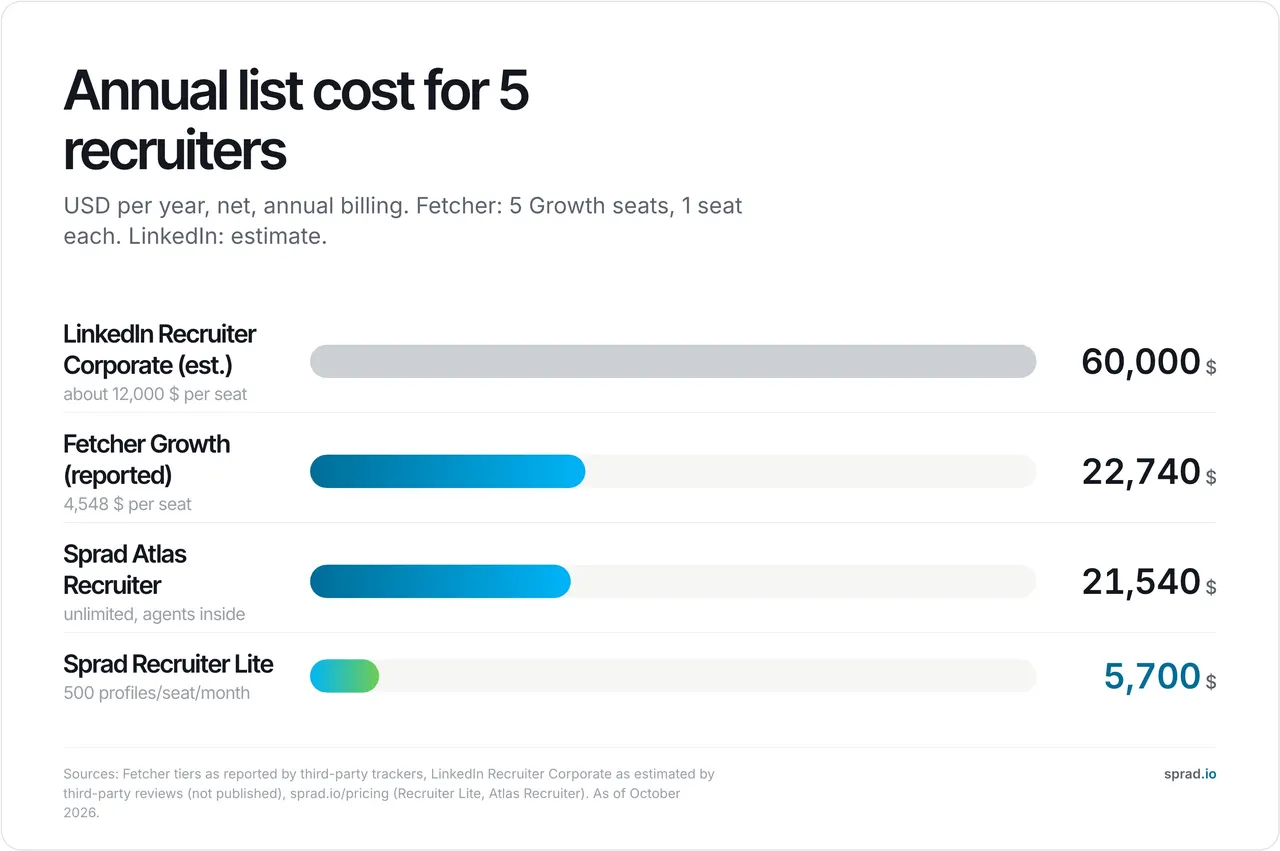
Three things stand out. First, at the full-featured level, Fetcher and Atlas Recruiter cost about the same: 21,540 $ against 22,740 to 23,364 $ at 5 recruiters, 64,620 $ against 62,304 to 68,220 $ at 15. The difference is what you get for it: unlimited search and an outreach account in Atlas Recruiter, a managed email service at Fetcher. Second, Fetcher's enterprise quote will not be at list, so treat both Fetcher rows as a ceiling. Third, Recruiter Lite is far cheaper, but it is capped at 500 profiles and 50 pool searches per seat and month, with deep search and contact data on credits, so it fits teams that source weekly rather than all day.
A second lens is cost per delivered candidate. At the annual rates and the two reported caps, Growth costs 4.55 to 9.10 $ per sourced candidate and Amplify 3.89 to 7.79 $. In Sprad, a profile shown in a web search costs 2 credits, which is 0.14 to 0.20 € depending on your credit pack. These are not the same unit: Fetcher's candidates come with a managed process and, on Amplify, a dedicated sourcer, while a Sprad profile is a search result with a reason per requirement. Use it as a sanity check, not a verdict.
Fetcher vs LinkedIn Recruiter vs Sprad
| Fetcher | LinkedIn Recruiter | Sprad | |
|---|---|---|---|
| Price | quote; about 115 to 849 $/month reported | Lite about 170 $/month; Corporate not published, estimates 10,000 to 13,000 $ per seat and year | free start; 79 € or 299 € per seat and month |
| Search | AI-recommended candidates, managed | LinkedIn network, Boolean and filters | requirement search over 1B+ profiles (LinkedIn, GitHub), your own pool and colleagues' networks |
| Outreach | email; unlimited sends | InMail (credits per seat) | LinkedIn, email and InMail, automated with follow-ups, in one inbox |
| Free plan | no | no | yes, 100 credits per month |
| Your data after cancelling | ask in the quote | pool is lost | talent network stays free, raw data export |
LinkedIn Recruiter remains the reference for sheer reach into LinkedIn's own network, and we say so. The catch is price and lock-in: LinkedIn does not publish the Corporate price, and the only official figure we found is about 12,000 $ per licence and year in a UK government marketplace document. Fetcher sits between the two as a service with a human-in-the-loop flavour. Sprad is built for teams that want search, outreach and their own pool in one place.
Hidden costs and mistakes we see when teams compare
Sprad has built recruiting software for seven years, starting with employee referrals, which is the same job as sourcing: matching profiles to requirements. These are the checks we recommend before you sign any sourcing contract, Fetcher or otherwise.
- Comparing seat prices instead of cost per interested candidate. Ask each vendor how many profiles per month you actually get, and how many replies a comparable team gets.
- Ignoring the channel. Email-only outreach leaves out candidates who only answer on LinkedIn. We think the combination of LinkedIn and email is the biggest lever for reply rates, and in our product both run in one inbox so nobody is contacted twice.
- Buying annually before a test. The 30 % annual discount is real, but a tool without a free plan or trial makes you pay for the learning period.
- Not asking what happens to the data. Pools built inside a rented tool often vanish at cancellation.
- Trusting a result list that appears instantly. In our experience, results that appear within a second are usually a (semantic) keyword search; real AI evaluation of each profile takes minutes. Quick Search in Sprad returns first results in about 3 seconds, the deep search a few minutes.
Compliance: what you still own when a tool contacts candidates for you
Outsourcing the search does not outsource the legal duty. Under GDPR Article 14, if you obtain a candidate's data from a source other than the candidate, you must inform them, normally within one month and at the latest at first contact. In the US, applicants in California have privacy rights under the California Privacy Protection Agency's rules, and employers in New York City that use automated employment decision tools face bias-audit and notice rules under Local Law 144. In the EU, AI systems used to filter applications or evaluate candidates are listed as high-risk in Annex III of the AI Act, so check which obligations apply to you and when. Sprad's design keeps humans in the decision: the AI prepares and explains, people decide. Hosting is in the EU.
Is Fetcher worth it?
It can be, if you want a managed service with a named customer success manager, your hiring is email-friendly, and you can commit to an annual contract. It is a weaker fit if you need a free test, LinkedIn outreach, public prices, or a tool for a whole team that sources a little each. Fetcher did not take part in PeopleSearchBench, so we make no claim about its candidate quality.
Cheaper ways to get the same result
1. Sprad: search, outreach and your own pool in one tool
Sprad takes a requirement instead of a Boolean string. Atlas, the sourcing product, checks every profile individually against your requirements, so it also finds people whose profile is poorly maintained or lacks the “right” keywords. Outreach runs on LinkedIn and email, automated with follow-ups, with InMails sent from Sprad and a warning if someone was already contacted. You can search your own LinkedIn network, colleagues' networks and your agency's former candidates.
Benchmark: in the public PeopleSearchBench (Recruiting; 119 real search tasks in four areas) Atlas reaches 73.5 in our own re-measurement, converted to the published scale (Juicebox 65.7 as published). In recruiting it returns almost always 15 matching profiles per search (14.2 on average).1 Plans: sprad.io/pricing. More: Active Sourcing, Sprad for agencies and our tool comparison.
1 PeopleSearchBench (Recruiting), published by Lessie, October 2026. Other systems' scores as published in the benchmark; Atlas measured with the benchmark's open test procedure. Contact data came from the “find email” button. Method and details.
2. Juicebox and Pin
Juicebox publishes its prices and lets you search in plain language; in the public PeopleSearchBench (Recruiting) it published 65.7. Details: Juicebox pricing and Juicebox alternatives. Pin offers a published free tier and an autopilot mode (vendor description); it did not take part in the benchmark, so we have no comparable measurement. A profile of the vendor is at Fetcher in our software directory.
FAQ
How much does Fetcher cost?
Fetcher publishes no price list. Third-party trackers report about 115 $ per month for self-serve, 379 to 499 $ for Growth and 649 to 849 $ for Amplify, with Enterprise on quote. Vendr data suggests a typical contract of about 11,000 $ per year. Confirm with Fetcher.
Is Fetcher free?
No. No free plan or trial is listed. Sprad has a free plan with 100 credits per month.
Does Fetcher charge per seat or per candidate?
Both, according to its help center: price depends on the number of seats and the number of candidate leads sourced.
How does Fetcher compare with LinkedIn Recruiter?
LinkedIn Recruiter is a self-service search tool with unpublished Corporate pricing (estimates of 10,000 to 13,000 $ per seat and year). Fetcher is a managed sourcing service starting far lower per seat. Sprad combines search, outreach and your own pool from 79 € per seat and month.
What is the best Fetcher alternative?
Sprad if you want the most matching candidates (every profile checked individually), LinkedIn and email outreach in one inbox, your own talent network and EU hosting. Juicebox and Pin are solid options for small budgets.
Prices as of October 2026, net of VAT. Fetcher figures are reported by third parties and may have changed; please check with the vendor.
Jürgen Ulbrich
Jürgen Ulbrich has more than a decade of experience in developing and leading high-performing teams and companies. As an expert in employee referral programs as well as feedback and performance processes, Jürgen has helped over 100 organizations optimize their talent acquisition and development strategies.