Is Findem worth it? For a large enterprise TA team that uses structured talent data, analytics and an ATS-connected data layer every day, usually yes; for small teams, for a recruiter whose real problem is finding the right people this week, or for hiring mostly in Europe, probably not. Findem is well rated (4.7 out of 5 on G2 from about 36 reviews, 4.4 on Capterra from 20, October 2026), and reviewers praise sourcing volume, filters and support. The recurring criticism: a learning curve, clunky campaigns, patchy contact data and a price that Findem does not publish; third parties estimate about 6,000 $ per seat and year. If you want the most matching candidates per search at published prices, Sprad is the alternative to check first.
What Findem is, and what it is not
Findem is a US talent data platform. By its own account it builds “3D” profiles: career histories, publications, patents, funding events and company milestones are combined over time and labelled with attributes such as “startup experience”, which you then search and analyse. It sells this as talent acquisition (sourcing and talent marketing), executive search, market intelligence and Findem Studio, a set of AI agents that can also be used from other AI tools. Findem raised 51 million US dollars in October 2025 (Staffing Industry Analysts), so it is an established, funded vendor.
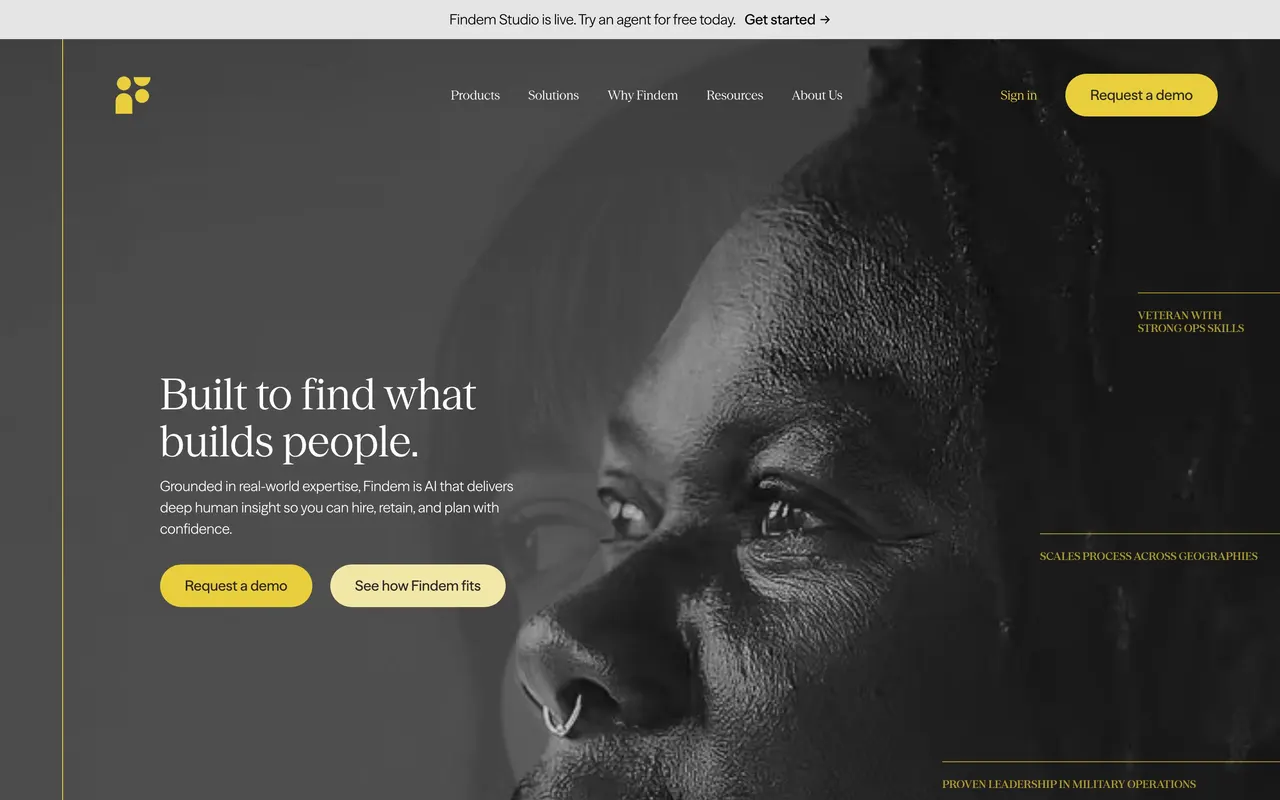
What it is not: a tool you start with on a Monday and use on a Tuesday. Findem is sized for enterprise programmes. Its homepage claims 24x faster sourcing, 2 to 8 times more interested candidates and an 80 % interview advancement rate; it gives no method, sample or period for these numbers, so treat them as marketing, not measurement. We also found no profile count on the homepage (older vendor material speaks of 800 million+ profiles).
What users say: ratings and recurring themes
As of October 2026 Findem shows 4.7 out of 5 on G2 (about 36 reviews) and 4.4 on Capterra (20 reviews). Those are good scores, but the samples are small and the pages disagree slightly depending on the day, so we look at the themes, not the stars. Review sites also reward vendors that actively collect reviews.
What reviewers praise
- Sourcing volume and filters. Recruiters say the platform pulls in many candidates; the search filters and skills search are named as strengths.
- AI recommendations and bulk actions. G2 comparison pages single out the AI copilot recommendations and bulk rejection.
- Support. Customer support is praised consistently, across several review sites.
- ATS fit. The Greenhouse integration gets good marks.
What reviewers criticise
- Learning curve. G2 lists it as a recurring con: the platform is powerful, and you have to learn it.
- Campaigns. Some users call campaign functions clunky or finicky, for example when sending on someone else’s behalf needs a new campaign.
- Contact data. One reviewer reports profiles without contact details, another some inaccurate data.
- Reporting and speed. Reporting is described as informative but hard to navigate, and one reviewer mentions a slow dashboard.
- ATS projects. Building projects and moving candidates into the ATS feels clunky to at least one user.
Most of these are single reports, so read them as questions for your demo rather than verdicts. The contact-data point is the one to test with candidates from your own markets.
What Findem costs, with worked examples
Findem publishes no price. Everything below is a third-party estimate, not an offer (October 2026):
| Source | What it says | How to read it |
|---|---|---|
| Buyer reports via an independent price tracker | About 6,000 $ per user and year for the core platform | A seat-style estimate; actual quotes depend on modules and volume |
| Vendr (procurement data) | Median contract about 58,000 $ per year, range roughly 7,225 to 94,840 $ | Total contract value, not a seat price |
| CostBench (five buyer reports) | Median about 62,500 $ per year, labelled directional | A very small sample |
| Findem's own product structure | Five tiers, all by quote: Sourcing, Talent Marketing, Executive Search, Analytics, Market Intelligence | You buy modules, so the bill depends on which you add |
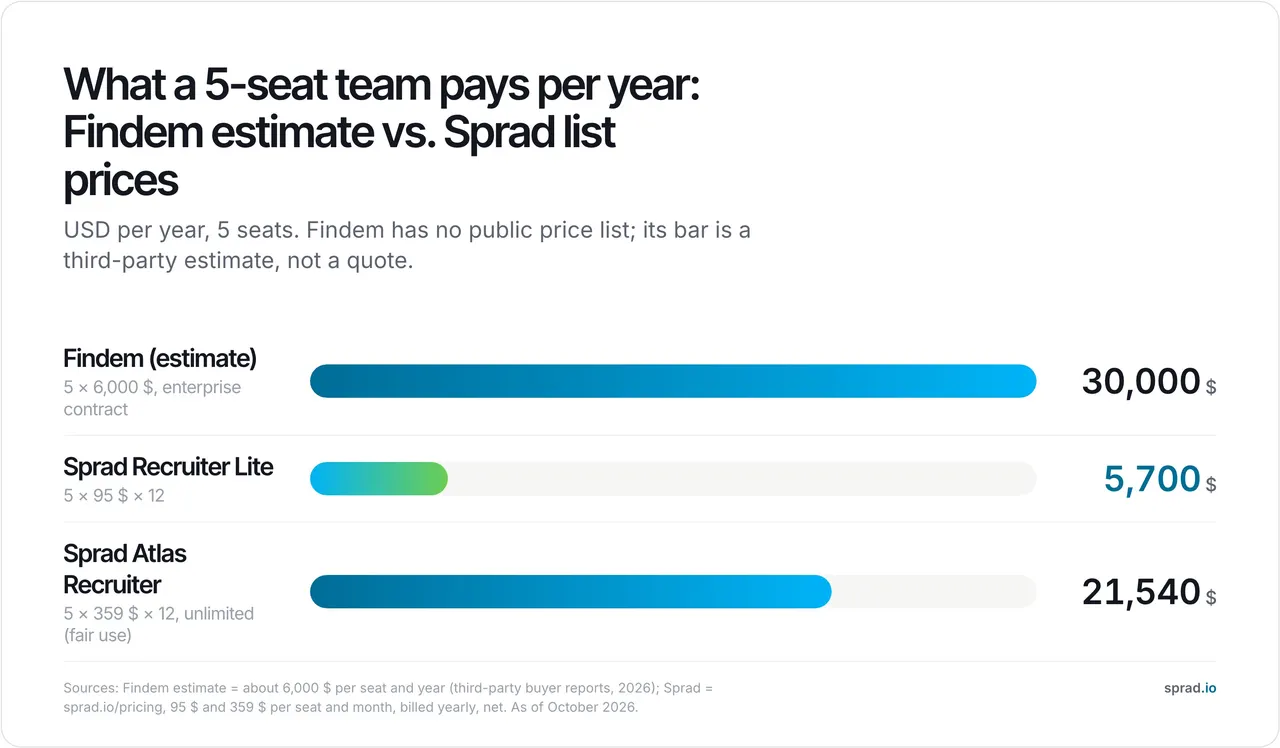
Example 1, team of 3 recruiters: 3 × 6,000 $ = about 18,000 $ per year at the seat estimate. Example 2, team of 5: about 30,000 $. Example 3, team of 10: about 60,000 $, which lines up with the Vendr median of 58,000 $; a median contract of that size therefore looks like a team of nine or ten seats. One buyer on the Vendr page reports a 51 % discount on a new purchase after bundling several products, a single anecdote, but a reminder that list and signed prices differ.
Budget beyond the licence: implementation, training and add-on modules are typically extra, and third-party calculators add a further share on top of the base fee (treat that as a question for your quote, not a number). For comparison, the same 5-seat team on Sprad pays 5 × 79 € × 12 = 4,740 € per year for Recruiter Lite (5 × 95 $ × 12 = 5,700 $), or 5 × 299 € × 12 = 17,940 € on Atlas Recruiter (21,540 $) with unlimited deep search and an outreach agent. The numbers are not like for like: Findem buys a data and analytics platform, Lite includes Quick and Normal searches while deep search and contact data run on credits. Teams that search only now and then can start free (100 credits per month) or take Atlas Base at 450 € per year including 5,000 credits. Prices net, billed annually, sprad.io/pricing, October 2026.
Which teams Findem fits, and which not
Findem is a good fit if
- you run a large in-house TA programme and want structured attribute search, talent analytics and market intelligence in one data layer on top of your ATS;
- an owner in your team will run the rollout and the training, because the learning curve is real;
- you have the budget for a platform contract and your hiring is mostly in markets where its data is strong.
Look elsewhere if
- your bottleneck is a good shortlist by Friday, not analytics. Test how many of the first 15 results you would really contact;
- you are a solo recruiter, an agency or a team of two to five and need a price you can read before talking to sales;
- you want outreach and the conversation in the same tool. Findem’s public pages describe signals and shortlists; we found no inbox or sequencing description there;
- you hire mainly in the DACH region or the EU. Ask for coverage in your markets, including XING-heavy professions, and for the data processing agreement (see below).
Europe: what to check before you sign
Sourcing means processing personal data of people who never applied. Under Article 14 of the GDPR you must inform them, in general within one month of collecting their data, and you need a legal basis, usually legitimate interest under Article 6(1)(f), documented in a balancing test (see the EDPB guidelines 1/2024). A tool does not take that duty away. The Findem homepage we read carries no GDPR statement or data-residency claim and links to a trust centre we did not assess. That does not mean there is none: ask in writing for the data processing agreement, the sub-processor list, the storage location and the transfer mechanism.
The EU AI Act lists AI systems used to filter applications or evaluate candidates as high-risk (Annex III), which adds duties for you as the user. In New York City, Local Law 144 requires a bias audit and notices for automated employment decision tools. In practice: keep a human in the decision and document how ranking works. More in our guide to sourcing and GDPR.
Findem alternatives compared
| Tool | Best for | Entry price (published) | Channels | Note |
|---|---|---|---|---|
| Sprad | Most matching candidates, broadest toolkit | Free start; Recruiter Lite 79 €/seat/month; Atlas Recruiter 299 € | LinkedIn, email and InMail in one inbox; voice, chat and agent pre-qualification; search across LinkedIn, GitHub and your own pool | Every profile checked individually; EU hosting |
| Findem | Enterprise attribute data and analytics | Quote only; third-party estimate about 6,000 $ per seat and year | Mainly via integrations (per public pages) | Not part of PeopleSearchBench |
| SeekOut | Mid-market and enterprise, deep filters | Solo from 149 $ per month, annual | Integrations | Team plans by quote |
| hireEZ | Sequences and a large filter set | About 169 to 199 $ per month, solo | Sequences | Reviewers report steep renewal increases |
| Juicebox | Plain-language search, small budget | Starter 99 $ per month, billed yearly | Email, LinkedIn | PeopleSearchBench (Recruiting): 65.7 |
| Gem | ATS, CRM and sourcing in one suite | Custom for in-house teams; agencies from 99 $ per user | Email, InMail, SMS | Closest to Findem in enterprise feel |
Prices are those the vendors publish or public roundups report, as of October 2026. More detail: Findem alternatives, Sprad vs Findem, Active sourcing tools compared, Juicebox alternatives and AI sourcing pricing models. Our neutral profile of the vendor: Findem.
Why Sprad is the first alternative to check
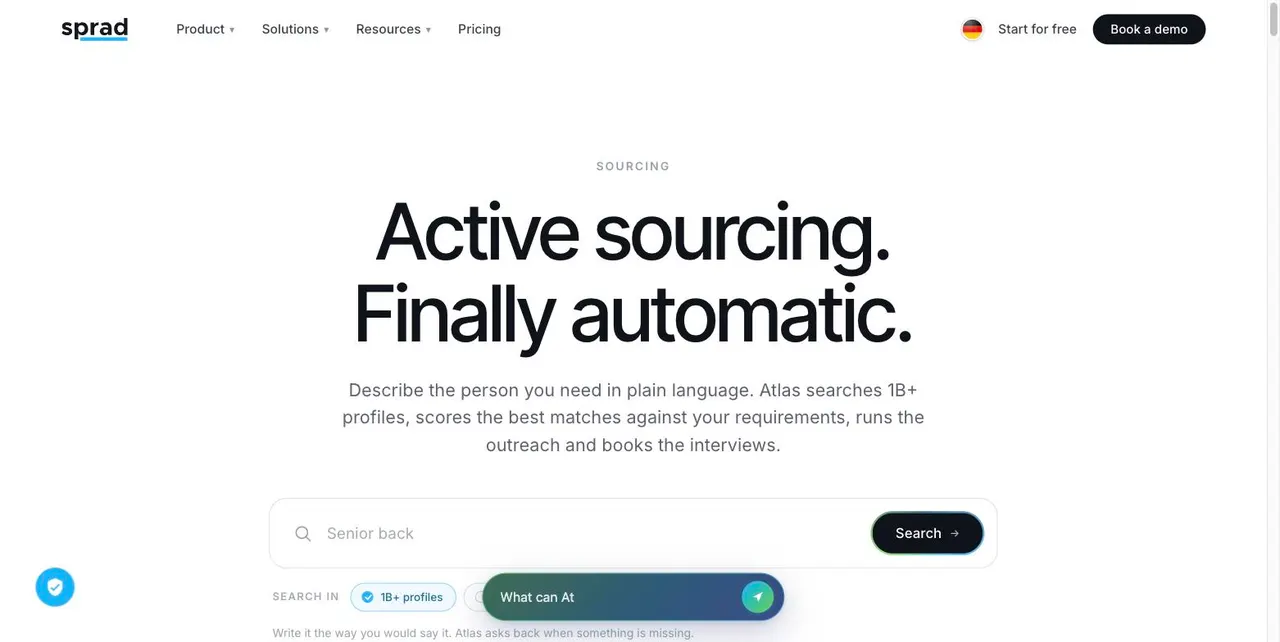
Sprad takes a requirement instead of a Boolean string or an attribute filter. Atlas, the sourcing product, checks every profile individually against your requirements rather than running a keyword search, so it also finds people whose profile is thin or lacks the “right” keywords. Each result comes with a reason per requirement.
- Benchmark. In the public PeopleSearchBench (Recruiting; 119 real search tasks in four areas) Atlas reaches 73.5 in our own re-measurement, converted to the published scale (Juicebox 65.7 as published). In recruiting it returns almost always 15 matching profiles per search (14.2 on average).1 Findem did not take part, so we make no claim about Findem from it.
- LinkedIn and email in one inbox. Automated outreach with follow-ups, InMails from within Sprad, AI templates you can train, and a pitch format for the selling points of the role. Per talent you see the whole conversation, and the system warns you if a colleague already wrote to them.
- Context without a data platform. Deep Context finds companies first and then the people who worked there in a given period, for example a CFO who led an acquisition. That covers much of what attribute tools sell as “context”.
- One search over all sources: LinkedIn, GitHub, your own talent pool and the networks of your colleagues, in one of the largest profile databases (1B+ profiles worldwide).
- Your data stays yours. After cancelling, the talent network stays free to use, and a full raw-data export is available.
- Experience. Sprad has built recruiting software for 7 years, from start-ups to large enterprises, public bodies and insurers, starting with employee referrals, which is matching profiles to requirements.
Fair limits: no AI call notetaker and no placement reporting yet, no SMS, and the deep search takes a few minutes because far more AI runs per profile. If your enterprise team lives in Findem’s analytics, keep it and add Sprad for requirement search and outreach. See Active Sourcing.
1 PeopleSearchBench (Recruiting), published by Lessie, October 2026. Other systems' scores as published in the benchmark; Atlas measured with the benchmark's open test procedure. Contact data came from the “find email” button. Method and details.
Questions to ask Findem before you sign
- Which modules are in the quote? Sourcing, Talent Marketing, Executive Search, Analytics and Market Intelligence are sold separately.
- What are implementation, training and add-ons? Get the one-off and recurring amounts in writing.
- What are contract length, renewal terms and the price at renewal? Reviewers of other tools in this category report steep renewal increases.
- What is the contact-data hit rate for my markets? Ask for a test on 50 of your own past candidates.
- Where is data stored, and is a data processing agreement included?
- What can I export when I leave?
A 30-minute test before you decide
- Pick one open role and write the requirements in plain sentences.
- Run the same role in each tool you shortlist and take the first 15 results.
- Count how many you would really contact. That number matters more than any star rating.
- Add one “hidden candidate”, a person with a thin or differently worded profile, and see which tool finds them. Our rule of thumb from building a requirement search: if results appear instantly, it is almost always a (semantic) keyword search.
- Check the email hit rate on candidates from your own markets.
Typical mistakes we see: judging a platform by a vendor demo instead of one of your own roles; comparing a seat price with a platform contract as if they bought the same thing; letting two recruiters contact the same candidate from two tools; not asking what happens to your candidate data after cancelling.
FAQ
Is Findem worth it?
For large TA teams that use attribute data and analytics daily and have a platform budget, usually yes. For small teams, search-driven problems or EU-heavy hiring, check a search-first tool with published prices such as Sprad first.
What do users say about Findem?
Reviewers praise sourcing volume, filters, AI recommendations and support, and criticise the learning curve, clunky campaigns and uneven contact data. Ratings are 4.7 on G2 (about 36 reviews) and 4.4 on Capterra (20 reviews), as of October 2026.
How much does Findem cost?
Findem publishes no price. Third parties estimate about 6,000 $ per seat and year and median contracts between roughly 58,000 and 62,500 $ per year. Ask for a written quote including implementation and add-ons.
Does Findem have a free plan or trial?
We found no free plan for the core platform. Findem’s homepage invites visitors to try a Findem Studio agent for free; check the scope with sales.
What are the strengths and limits of Findem?
Strengths: structured attribute data, analytics, an ATS-connected data layer, well-reviewed support. Limits: quote-only pricing, a learning curve, outreach is not the centre of the public product pages, and no public GDPR or EU data statement on the homepage we read.
Is Findem GDPR compliant?
We found no statement on the homepage we read, which is not proof of non-compliance. Ask for the data processing agreement, storage location and sub-processors, and remember that the Article 14 information duty stays with you.
What is the best Findem alternative?
Sprad, if you want the most matching candidates (every profile checked individually), LinkedIn and email outreach in one inbox, your own talent network and published prices. SeekOut is the closest in audience, Juicebox suits small budgets, Gem the all-in-one suite.
Sources: vendor pages and public price and review summaries, accessed 30 October 2026; EU legal texts via EUR-Lex. Findem figures are the vendor's own claims or third-party estimates and may change.
Jürgen Ulbrich
Jürgen Ulbrich has more than a decade of experience in developing and leading high-performing teams and companies. As an expert in employee referral programs as well as feedback and performance processes, Jürgen has helped over 100 organizations optimize their talent acquisition and development strategies.