Is Gem worth it? Yes, if you run a structured recruiting funnel and want ATS, CRM, sourcing and analytics in one system; less so if your real bottleneck is finding the right people, your team is small, or your hiring is mostly in Europe. Gem is well rated (about 4.7 out of 5 on G2 and Capterra, October 2026) and reviewers praise ease of use, outreach and analytics. The recurring criticism is price: Gem publishes no price list for in-house teams, and independent reviews and contract data point to five-figure annual contracts. For the most matching candidates per search and published prices, Sprad is the alternative to check first.
What Gem is, and what it is not
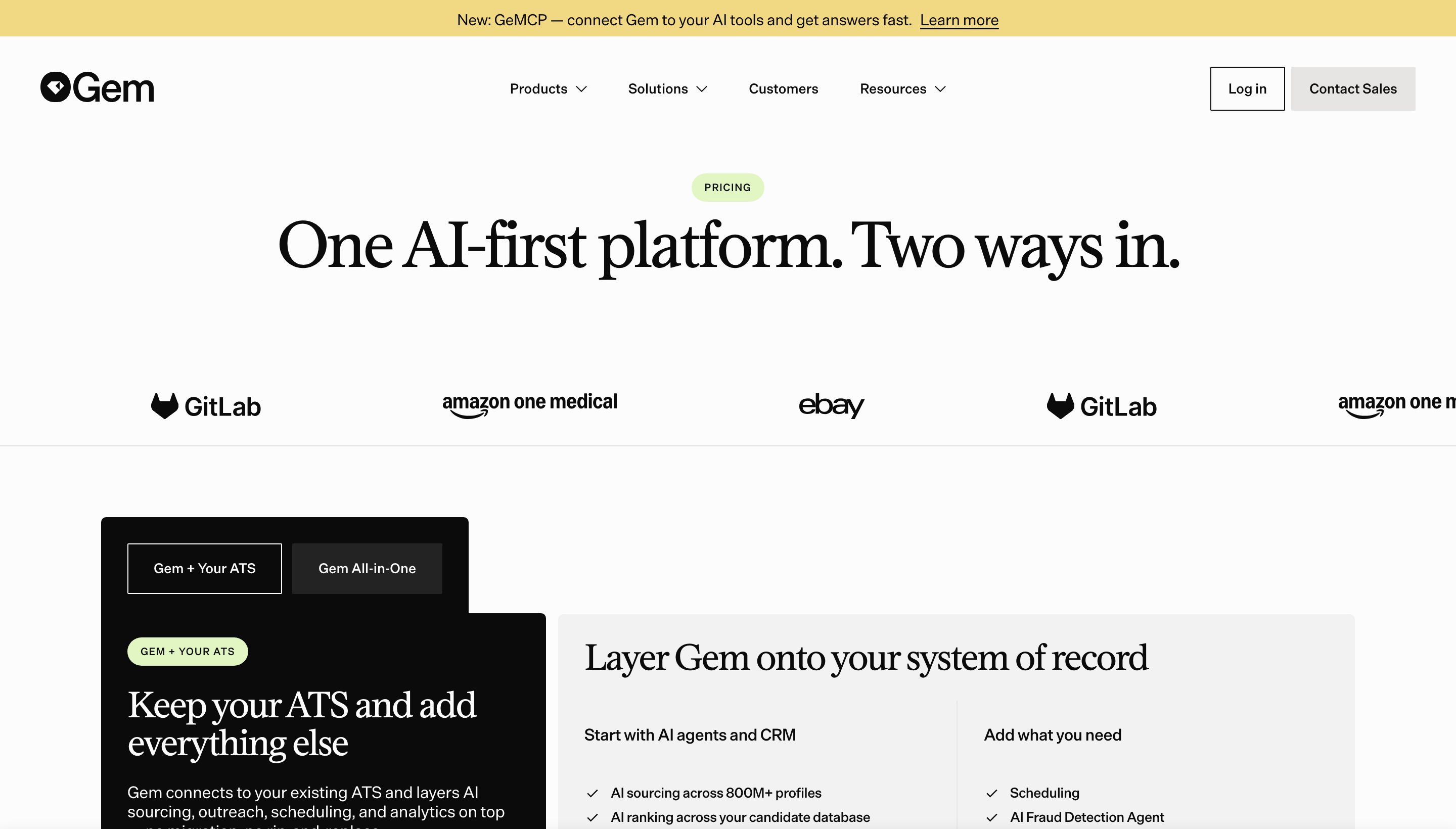
Gem is a US recruiting platform that started as a recruiting CRM and has grown into an all-in-one stack: applicant tracking (ATS), a talent CRM, AI sourcing across an index Gem puts at 800M+ profiles, multi-channel outreach sequences, scheduling and analytics. It can run on top of the ATS you already have (Greenhouse, Workday, Lever and others) or replace it. It raised a $100 million Series C at a $1.2 billion valuation in September 2021 (TechCrunch), so it is an established vendor, not a start-up experiment.
What it is not: a tool whose main promise is search quality. Gem's strength is the system around the candidate: pipeline, sequences, collaboration, reporting. Whether the first 15 profiles it suggests are the right ones for your role is something you must test yourself, as with every sourcing tool (see the test further down).
What users say: ratings and recurring themes
As of October 2026 Gem shows about 4.7 out of 5 on G2 (roughly 270 to 290 reviews, depending on the day) and 4.7 on Capterra (123 reviews); Gem itself quotes 4.8 on G2. Scores like these are high for the category. Two cautions: review sites reward vendors that actively collect reviews, and some platforms mark reviews as incentivized. We therefore look at the themes, not the stars.
What reviewers praise
- Ease of use. It is the most frequent pro in G2's comparison summaries (23 mentions at the time of writing).
- Outreach and sequences. Reviewers like multi-step sequences, shared projects and a verified email database.
- Analytics. Users say pipeline reporting helps them find bottlenecks in sourcing and hiring.
- Support. Customer support and responsiveness come up repeatedly.
What reviewers criticise
- Price. The top con on G2's comparison pages (7 mentions), and the main theme in independent write-ups: ROI is hard to justify for mid-sized teams.
- Integrations. The second con in the same summaries (8 mentions); details are not public.
- Reporting and workflow flexibility. One reviewer misses the option to build different dashboards; another feels limited in customising workflows.
- Sequences. One user reports that a sequence cannot be edited after the first email has gone out.
- Email finding outside the USA. One reviewer says it works badly there. This is a single report, but it matches how contact databases are usually built, so test it with candidates from your own markets.
What Gem costs, with a worked example
Gem has three price logics, and they are not interchangeable (Gem pricing pages, October 2026, prices net in USD):
| Who | Price | What is included |
|---|---|---|
| In-house teams (Gem + your ATS, or All-in-One) | Custom, based on company headcount | AI sourcing, AI ranking, multi-channel sequences, email finding; scheduling, fraud detection and analytics as add-ons |
| Startups | Under 30 employees: 6 months free, then 50 % off. Listed tier for 1 to 10 employees: 130 $ per month (list 270 $), billed yearly | ATS, CRM, sourcing, scheduling, analytics |
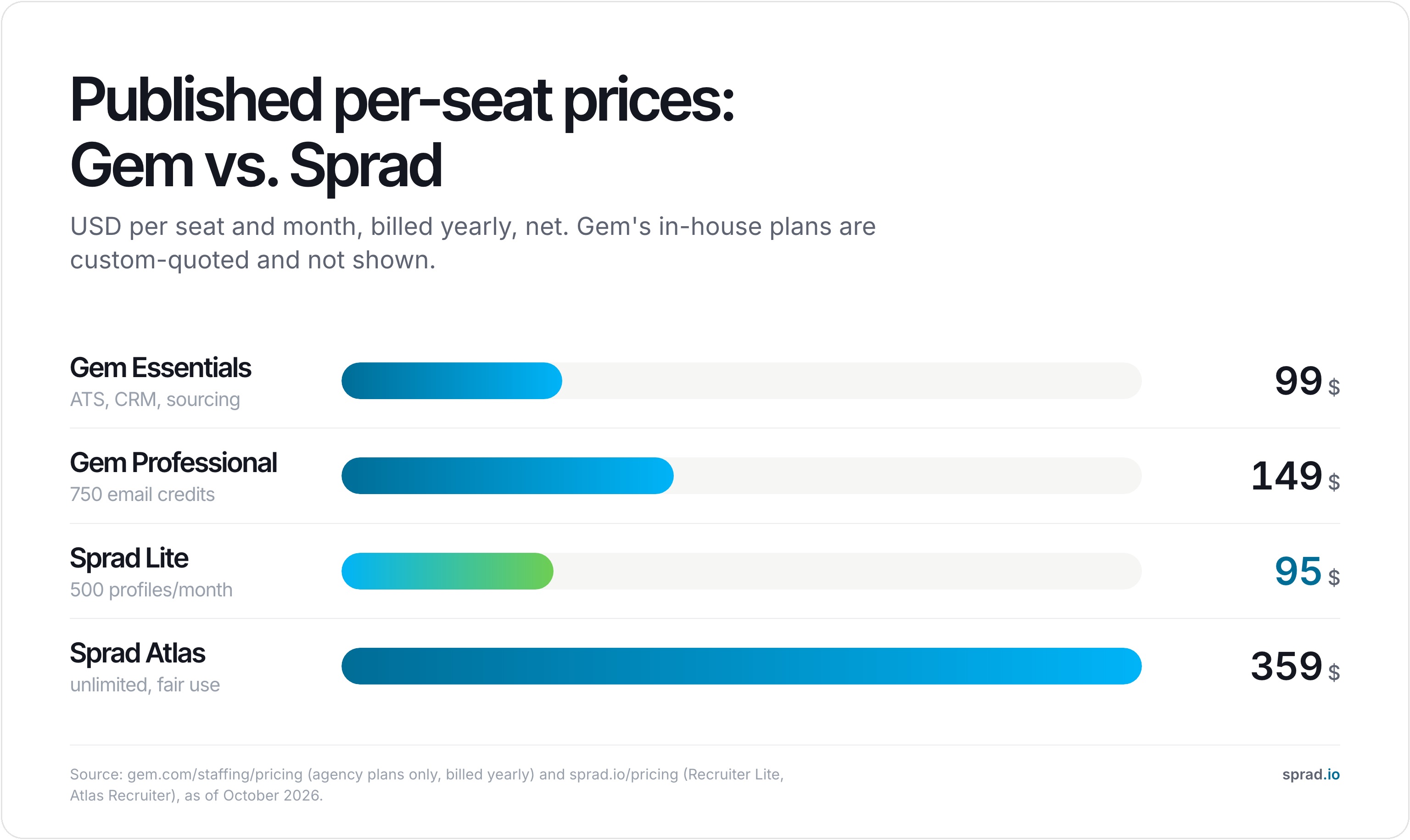
| Recruiting and staffing firms only | Essentials 99 $ per user per month (139 $ monthly); Professional 149 $ (199 $ monthly) | Essentials: up to 3 users, 150 email credits per user. Professional: up to 10 users, 750 credits per user |
| Enterprise (agencies) | Custom | SSO, SOC 2 Type II report, 16+ ATS connectors, API |
Example 1, agency with 5 recruiters: 5 × 149 $ × 12 = 8,940 $ per year on Professional billed yearly (11,940 $ if billed monthly). Note that Essentials caps at 3 users: 3 × 99 $ × 12 = 3,564 $.
Example 2, in-house team with 8 recruiters: there is no list price. Procurement-data platform Vendr reports a median Gem contract of about 24,900 $ per year, with deals between roughly 7,000 $ and 71,000 $ (third-party estimate, not a Gem figure). Spread over 8 seats that is about 260 $ per recruiter per month, an illustration, not a quote.
For comparison, the same 5-person agency on Sprad pays 5 × 79 € × 12 = 4,740 € per year for Recruiter Lite, or 17,940 € on Atlas Recruiter with unlimited deep search and an outreach agent. Teams that search only now and then can start free (100 credits per month) or take Atlas Base at 450 € per year including 5,000 credits, which covers about 50 normal web searches of up to 50 profiles each. Prices net, billed annually, sprad.io/pricing, October 2026.
Which teams Gem fits, and which not
Gem is a good fit if
- you run an in-house team of roughly 10 or more recruiters with a structured funnel and want one system for ATS, CRM, sourcing and reporting;
- most of your hiring happens in the USA, where its email data is strongest;
- you will actually use the analytics, scheduling and sequences, because that is where the price is justified.
Look elsewhere if
- your bottleneck is search quality, not process. A CRM does not find the engineer whose profile never mentions the right keyword;
- you are a solo recruiter or a team of two or three and need a price you can read before talking to sales;
- you hire mainly in the DACH region or the EU. Test email finding with your own candidates and ask for the data processing agreement before you sign (see below).
Europe: what to check before you sign
Sourcing means processing personal data of people who never applied. Under Article 14 of the GDPR you must inform them, in general within one month of collecting their data, and you need a legal basis such as legitimate interest under Article 6(1)(f), documented in a balancing test. A tool does not take that duty away. On the Gem pricing and ATS pages we read, we found no statement on EU hosting or data residency; Gem links a trust center we did not assess. Ask for the data processing agreement, the sub-processor list and the transfer mechanism for data leaving the EU.
The EU AI Act lists AI systems used for recruitment, such as filtering applications or evaluating candidates, as high-risk (Annex III); the European Commission publishes the timeline. In practice: keep a human in the decision, and document how ranking works. More in our guide to sourcing and GDPR.
Gem alternatives compared
| Tool | Best for | Entry price (published) | Channels | Note |
|---|---|---|---|---|
| Sprad | Most matching candidates, broadest toolkit | Free start; Recruiter Lite 79 €/seat/month; Atlas Recruiter 299 € | LinkedIn, email and InMail in one inbox; voice, chat and agent pre-qualification | Every profile checked individually; EU hosting |
| Gem | All-in-one ATS + CRM + sourcing | Custom for in-house teams; agencies from 99 $ per user | Email, InMail, SMS (per Gem blog) | Not part of PeopleSearchBench |
| Juicebox | Plain-language search, small budget | Starter 99 $ per month, billed yearly | Email, LinkedIn | PeopleSearchBench (Recruiting): 65.7 |
| LinkedIn Recruiter | LinkedIn network, InMail | Recruiter Lite 140 $ per month, annual | InMail (30 per month in Lite) | One network; data stays in the LinkedIn account |
| SeekOut | Larger teams, diversity and analytics | Recruit Core 149 $ per month, billed yearly | Enterprise tiers are quote-based | |
| Pin | Agent that automates outreach | Free tier; Solo 100 $ per month, annual | Email, LinkedIn, SMS | Vendor figure: 850M+ profiles |
Prices are those the vendors publish, as of October 2026. More detail: Active sourcing tools compared, Juicebox alternatives, LinkedIn Recruiter alternatives and AI sourcing pricing models. Our neutral profile of the vendor: Gem.
Why Sprad is the first alternative to check
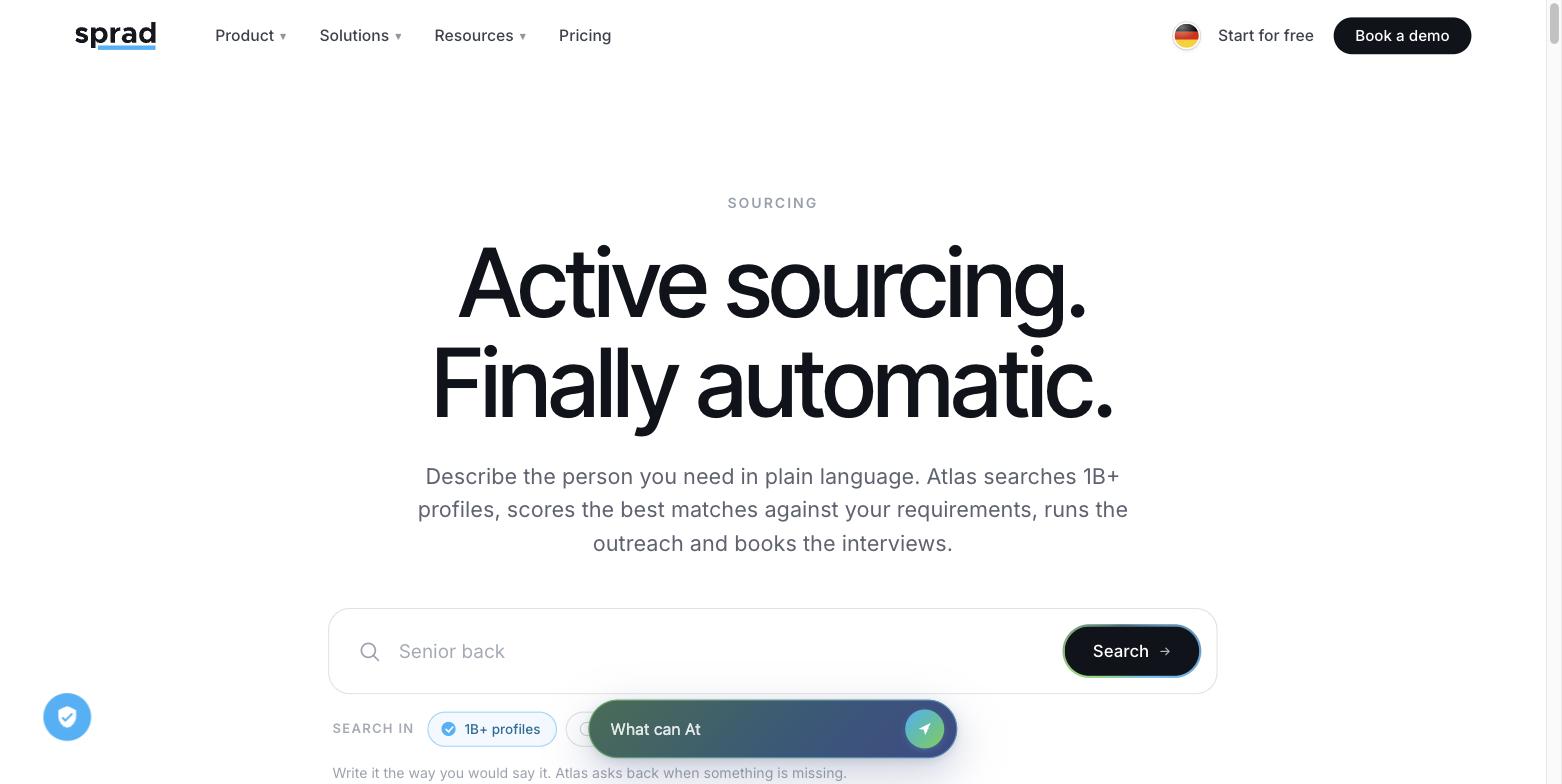
Sprad takes a requirement instead of a Boolean string. Atlas, the sourcing product, checks every profile individually against your requirements rather than running a keyword search, so it also finds people whose profile is thin or lacks the “right” keywords. Each result comes with a reason per requirement.
- Benchmark. In the Recruiting area of the public PeopleSearchBench our own re-measurement gives Atlas 73.5 of 100, converted to the published scale (Lessie 68.2 as published). In recruiting it returns almost always 15 matching profiles per search (14.2 on average in the re-measurement).1 Gem did not take part, so we make no claim about Gem from it.
- LinkedIn and email in one inbox. Automated outreach with follow-ups, InMails from within Sprad, AI templates you can train, and a pitch format for the selling points of the role. Per talent you see the whole conversation, and the system warns you if a colleague already wrote to them.
- One search over all sources: LinkedIn, GitHub, your own talent pool and the networks of your colleagues, in one of the largest profile databases (1B+ profiles worldwide).
- Your data stays yours. After cancelling, the talent network stays free to use, and a full raw-data export is available.
- Experience. Sprad has built recruiting software for 7 years, from start-ups to large enterprises, public bodies and insurers, starting with employee referrals, which is matching profiles to requirements.
Fair limits: no AI call notetaker and no placement reporting yet, no SMS, and the deep search takes a few minutes because far more AI runs per profile. See Active Sourcing.
1 PeopleSearchBench (Recruiting), published by Lessie, October 2026. Other systems' scores as published in the benchmark; Atlas is our own re-measurement with the benchmark's open test procedure, converted to the published scale; not an official entry. Contact data came from the “find email” button. Method and details.
Five mistakes we see when teams buy a recruiting platform
- Buying a CRM to fix a search problem. If your recruiters cannot find enough qualified people, a better pipeline view will not change that.
- Comparing seat prices, not total cost. Add email-finding credits, add-ons, the ATS and the second tool you keep for LinkedIn.
- Signing annually before a pilot. Run one real role through the tool first.
- Ignoring the exit. Ask what remains after cancelling: the network, the notes, an export.
- Skipping the information duty. The Article 14 notice is yours, not the vendor's.
A 30-minute test before you decide
- Pick one open role and write the requirements in plain sentences.
- Run the same role in each tool you shortlist and take the first 15 results.
- Count how many you would really contact. That number matters more than any star rating.
- Add one “hidden candidate”, a person with a thin or differently worded profile, and see who finds them. Our rule of thumb from building a requirement search: if results appear instantly, it is almost always a (semantic) keyword search.
- Check the email hit rate on candidates from your own markets.
FAQ
Is Gem worth it?
For in-house teams with a structured funnel, mostly US hiring and the budget for a custom contract, usually yes. For small teams, search-driven problems or EU-heavy hiring, check a cheaper, search-first tool such as Sprad first.
How much does Gem cost?
In-house teams get a custom quote based on headcount. Startups under 30 employees get six months free, agencies pay 99 $ or 149 $ per user and month billed yearly. A third-party estimate puts the median contract around 24,900 $ a year (October 2026).
Does Gem have a free plan?
No permanent free tier on the pages we read. Startups under 30 employees get six months free; agency plans offer a 7-day trial.
Is Gem GDPR compliant?
We found no EU hosting or data residency statement on Gem's pricing and ATS pages. Ask for the data processing agreement, sub-processors and transfer mechanism, and remember that the Article 14 information duty stays with you.
What is the best Gem alternative?
Sprad, if you want the most matching candidates (every profile checked individually), LinkedIn and email outreach in one inbox, your own talent network and published prices. Juicebox suits plain-language search on a small budget, LinkedIn Recruiter the LinkedIn network.
Gem or LinkedIn Recruiter?
They solve different problems. LinkedIn Recruiter is one network plus InMail; Gem adds ATS, CRM and sequences on top of a multi-source index. Many teams run both, which is where the cost adds up.
Jürgen Ulbrich
Jürgen Ulbrich has more than a decade of experience in developing and leading high-performing teams and companies. As an expert in employee referral programs as well as feedback and performance processes, Jürgen has helped over 100 organizations optimize their talent acquisition and development strategies.