You find DevOps and cloud engineers through public traces of their work (open-source contributions, conference talks, certifications) and reach them on LinkedIn or XING. First decide which job you mean: DevOps, SRE, platform or cloud. The closest US category, computer network architects, had a median pay of $134,050 in May 2025 (BLS Occupational Outlook Handbook, updated August 2026).
The category typically requires five years or more of related experience and is projected to grow 8 % from 2025 to 2035.
Four titles, four different jobs
| Title | Core job | Typical skills to search |
|---|---|---|
| DevOps engineer | Build and run CI/CD, automate delivery between dev and operations | CI/CD, Terraform or similar infrastructure as code, Docker, Linux, scripting |
| Site reliability engineer (SRE) | Keep services reliable: SLOs, monitoring, incident response | Observability, incident management, Kubernetes, Go or Python |
| Platform engineer | Build the internal platform other developers use | Kubernetes, internal developer platforms, golden paths, GitOps |
| Cloud engineer / architect | Design and run workloads on one cloud provider | AWS, Azure or Google Cloud, networking, cost control, security |
Most strong people specialise in one provider; broad multi-cloud experience exists but is rare, so asking for all three clouds shrinks the pool to almost nobody. Pick the one that matches your stack.
Where to find them
| Channel | What you see | How to use it |
|---|---|---|
| GitHub and GitLab | Infrastructure code, Terraform modules, Helm charts, Kubernetes operators, pull requests | Read the code and the issue discussions; contributions to widely used open-source tools show depth. |
| Cloud-native community groups and conferences | Speakers, maintainers, organisers | Check the speaker lists of local meetups and the large cloud-native conferences; ask organisers for introductions. |
| Certification holders | Provider certificates, Kubernetes certificates (e.g. CKA from CNCF and the Linux Foundation) | Certificates prove effort, not fit. Use them as one filter, not the only one. |
| Technical blogs and forums | Post-mortems, how-tos, answers | Great for finding senior people who write about incidents they solved. |
| LinkedIn and XING | Titles, tenure, stack in the headline | Reach and contact; verify depth elsewhere. |
| Referrals | People who already work with the team | Often the fastest route for senior profiles. |
The market is hard on every side. In Bitkom's September 2026 survey, 97 % of companies with open IT positions had difficulty filling them, and 76 % expect the shortage to get worse (Bitkom, 3 September 2026). With active sourcing you also reach engineers who are not looking. Our guide to sourcing bottleneck roles explains how to work when the candidate market is small.
Copy-and-paste search strings
Test each one in your own tool first and replace the bracketed parts.
| Goal | String |
|---|---|
| LinkedIn Boolean, DevOps / SRE | ("DevOps engineer" OR "site reliability engineer" OR SRE OR "platform engineer") AND (Terraform OR Ansible OR Pulumi) AND (Kubernetes OR Docker) AND (AWS OR Azure OR GCP) NOT (intern OR trainee OR junior) |
| LinkedIn Boolean, cloud engineer | ("cloud engineer" OR "cloud architect" OR "infrastructure engineer") AND (AWS OR Azure OR "Google Cloud") AND (networking OR security OR "landing zone") NOT (sales OR "pre-sales") |
| Google X-ray, public LinkedIn profiles | site:linkedin.com/in ("DevOps engineer" OR "platform engineer") (Terraform) (Kubernetes) "[city]" |
| Google X-ray, GitHub profiles | site:github.com "[city]" (devops OR "site reliability" OR "platform engineer") (terraform OR kubernetes) -jobs |
| Plain language, for an AI search | Senior platform engineer in [city or remote], runs production Kubernetes on AWS, writes Terraform modules, has been on call, 6+ years |
Must-haves and nice-to-haves
- Must: the cloud provider you run, infrastructure as code, CI/CD, Linux, experience with production incidents, willingness to join an on-call rota if your job needs it.
- Nice to have: Kubernetes certificates, a second cloud, security tooling, FinOps, compliance experience.
- Make it a must only if it is true: a particular tool. Candidates who know one tool of a category usually learn the next one quickly.
Outreach template
Hi [first name], I came across your [talk / pull request / write-up] on [topic]. We run [short stack description] at [company] and are working on [concrete problem, for example moving deployments to GitOps]. The role is [title], [location/remote], [salary band], [on-call: yes/no and how often]. If a 20-minute chat about the problem sounds interesting, I can send two slots. If not, no worries.
State on-call duty and stack honestly in the first message; it saves everybody a call.
Five questions for the first conversation
- Describe the last production incident you handled. How did you find the cause?
- Design the deployment pipeline for a service like ours. Where would you put tests, approvals and rollbacks?
- How do you manage infrastructure changes safely in a team?
- What did you automate that you regret, and what did you leave manual on purpose?
- How much on-call duty is acceptable to you, and what would make it better?
A scenario like the pipeline design question reveals more than a trivia quiz about tools.
Legal and practical points
- GDPR: when you gather profile data from public sources, inform people under Article 14 within a reasonable period, at the latest within one month (Regulation (EU) 2016/679). See Active sourcing and GDPR.
- Candidates from outside the EU: the German EU Blue Card has a general threshold of €50,700 and a reduced threshold of €45,934.20 for shortage occupations and certain IT specialists in 2026 (Make it in Germany, § 18g AufenthG). The immigration authority decides in each case.
- On-call in Germany: on-call duty touches working-time law (rest periods under § 5 ArbZG) and, where a works council exists, codetermination. Settle it in the contract before the offer.
Pay
US median pay for computer network architects was $134,050 (May 2025, BLS above); network and computer systems administrators, a related but different job, had a median of $99,130, with employment projected to decline 4 % through 2035 (BLS). The BLS has no category called DevOps, so treat these as bounds. For Germany use the Bundesagentur für Arbeit's Entgeltatlas and compare with your own offers in the last twelve months.
How to run this search with Sprad
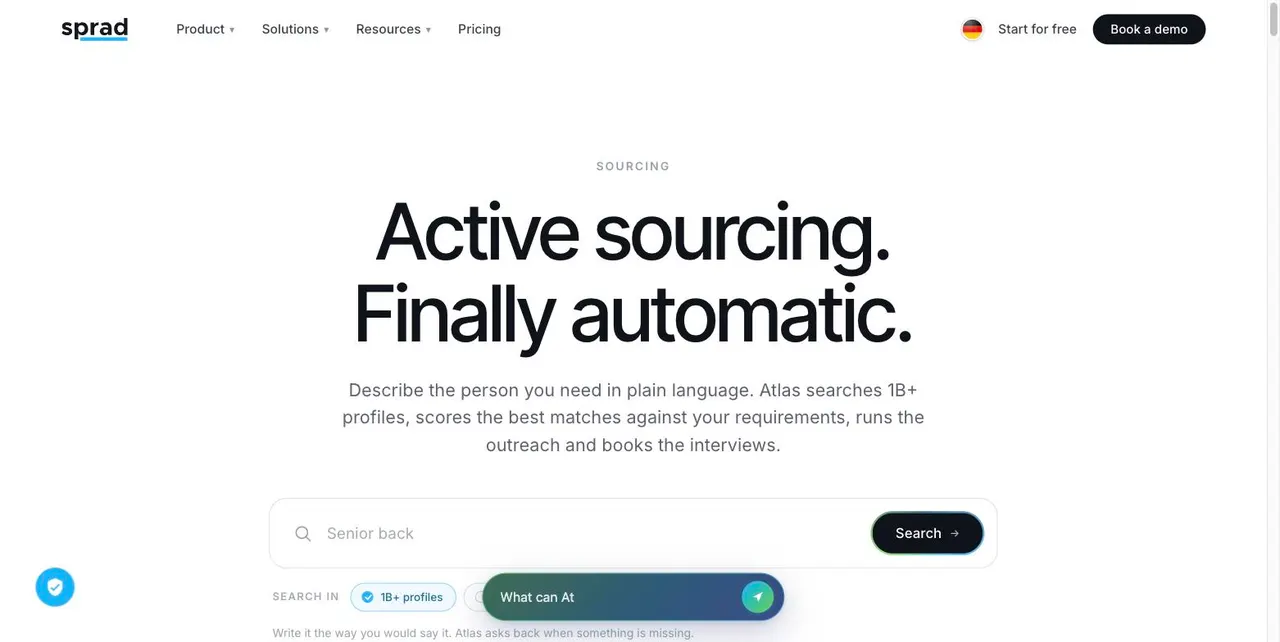
In Sprad Active Sourcing you describe the job in your own words ("runs production Kubernetes on AWS, writes Terraform, has been on call") and mark the must-haves. Atlas searches public profiles and your own pool and checks every profile against each requirement, with a reason. Outreach goes out via LinkedIn and email from one inbox. A voice pre-interview (12 languages, 30 credits per interview) can ask the first two questions above before a recruiter spends time. Everyone you find stays in your talent pool.
A web search costs 2 credits per displayed profile within the budget you set; the free plan includes 100 credits per month and Recruiter Lite costs €79 per seat and month (pricing, checked 9 November 2026). Atlas checks what is on a profile; hands-on skills still need your technical interview.
FAQ
What is the difference between a DevOps engineer and a cloud engineer?
DevOps engineers own the delivery pipeline and automation; cloud engineers design and run infrastructure on a specific provider. In small teams one person does both.
Which certifications matter?
Provider certificates for AWS, Azure or Google Cloud and Kubernetes certificates such as CKA show structured learning. They do not replace evidence of production work.
How do I find DevOps engineers who are not looking?
Use public code and talks to find them, personalise the first message to one concrete piece of work, and state stack, salary and on-call duty up front. See AI sourcing for engineering and tech talent.
Remote or on-site?
State it in the first message. For roles with on-call duty, time zone overlap matters more than the city.
Jürgen Ulbrich
Jürgen Ulbrich has more than a decade of experience in developing and leading high-performing teams and companies. As an expert in employee referral programs as well as feedback and performance processes, Jürgen has helped over 100 organizations optimize their talent acquisition and development strategies.