To hire IT professionals, start by naming the exact role, because the IT market is no longer one market: in Germany the shortage has almost halved in three years, from 149,000 open positions in 2023 to an estimated 79,000 in 2026. Yet 97 % of companies with IT vacancies still report difficulties filling them (Bitkom, 3 September 2026).
Two pictures of the same market
Bitkom and the Bundesagentur für Arbeit (BA) disagree, and both are useful. Bitkom, which surveys companies, sees an easing but a tough market: 31 % of companies receive practically no applications for open IT positions, and the main obstacles are missing German language skills (47 %), insufficient professional qualification (43 %) and lack of knowledge of the newest technologies (33 %). The BA, which analyses registered jobs and job seekers, found no general shortage in software development in its 2025 shortage analysis, with ICT unemployment up from 3.7 to 4.5 % (BA Fachkräfteengpassanalyse 2025).
What this means for a recruiter: for common profiles (generic web or Java development) you will find people but compete on speed and fit; for specialised profiles (cloud, security, data, AI, SAP) you still source actively. Plan by role, not by "IT". For specialised profiles, active sourcing is the main route.
Where to look, by role
| Role | Best places to find them |
|---|---|
| Software developers | Open-source repositories, tech communities, LinkedIn, XING |
| Data scientists and ML engineers | Kaggle, Hugging Face, publications, meetups |
| DevOps, SRE, cloud engineers | Infrastructure code, cloud-native communities, certifications |
| UX and product designers | Portfolios, design communities, LinkedIn |
| SAP consultants | SAP user communities, project histories on LinkedIn and XING, freelancer networks |
| IT administrators, support, security | Local networks, vocational training providers, LinkedIn and XING |
For developers, read AI sourcing for engineering and tech talent; for small candidate markets, sourcing bottleneck roles.
How to hire SAP consultants
"SAP consultant" is a family of jobs, not one: FI/CO (finance), SD and MM (sales and logistics), ABAP development, SuccessFactors (HR) and BTP (integration and extension) are different markets. State the module, the release (ECC or S/4HANA) and the project type (implementation, migration, support) before you search.
- Why demand stays high: SAP has announced that mainstream maintenance for ECC 6.0 ends at the end of 2027, with paid extended maintenance until 2030, so many customers are migrating to S/4HANA. Check the exact terms in your own SAP contract (SAP announcement, February 2020).
- Where they are: in project histories. Search for module + release + project phrases, and ask existing SAP staff for referrals; many consultants work freelance.
- Certification: helpful, not decisive. Practical project experience counts more on the SAP job market.
- Pay: a Robert Half salary overview cited by trade press puts starting SAP consultant salaries above €70,000 and experienced ones well above €100,000 gross a year (ChannelPartner, secondary source, check against your own market).
| Goal | String |
|---|---|
| LinkedIn Boolean, S/4HANA finance | ("SAP consultant" OR "SAP berater" OR "SAP FI" OR "SAP FICO") AND ("S/4HANA") AND (migration OR rollout OR implementation) NOT (sales OR recruiter OR "Account Manager") |
| LinkedIn Boolean, SAP ABAP / BTP | (ABAP OR "SAP BTP" OR "SAP CAP" OR "Fiori") AND ("S/4HANA") NOT (trainee OR student OR "Werkstudent") |
| Google X-ray | site:linkedin.com/in ("SAP consultant" OR "SAP berater") ("S/4HANA") ("FI" OR "CO" OR "SD" OR "MM") "[city]" |
Freelance SAP consultants raise a legal question: is the person really self-employed? In Germany this depends on instructions, integration into your organisation and entrepreneurial risk, and the Clearingstelle of the Deutsche Rentenversicherung can decide under § 7a SGB IV. Clarify it before the first project day.
Legal points for sourcing IT staff in the EU
- Information duty (GDPR Article 14): inform people whose data you collected from public sources within a reasonable period, at the latest within one month (Regulation (EU) 2016/679). See Active sourcing and GDPR.
- Specialists from outside the EU: the EU Blue Card for Germany has a general salary threshold of €50,700 and a reduced one of €45,934.20 for shortage occupations and certain IT specialists in 2026; IT specialists without a degree can qualify if they have at least three years of comparable experience (Make it in Germany, IT specialists, legal basis § 18g AufenthG). The immigration authority decides in each case.
- AI in selection: if you use AI to rank candidates, a person should make the decision. High-risk obligations for recruitment AI under the EU AI Act apply from 2 December 2027 (Regulation (EU) 2026/1744).
A five-step search routine for any IT role
- Name the exact role and write must-haves separately from nice-to-haves. Hard criteria narrow a search; soft ones only re-rank it.
- Pick two proof channels for that role (code, talks, portfolios, project histories) plus one reach channel (LinkedIn or XING).
- Run a string and read ten profiles in full before you scale up.
- Write a message about one concrete piece of their work and include salary band and location.
- Keep everyone in a pool with the reason they were interesting, so the next search starts warm. More on this in talent pool.
How to run this with Sprad
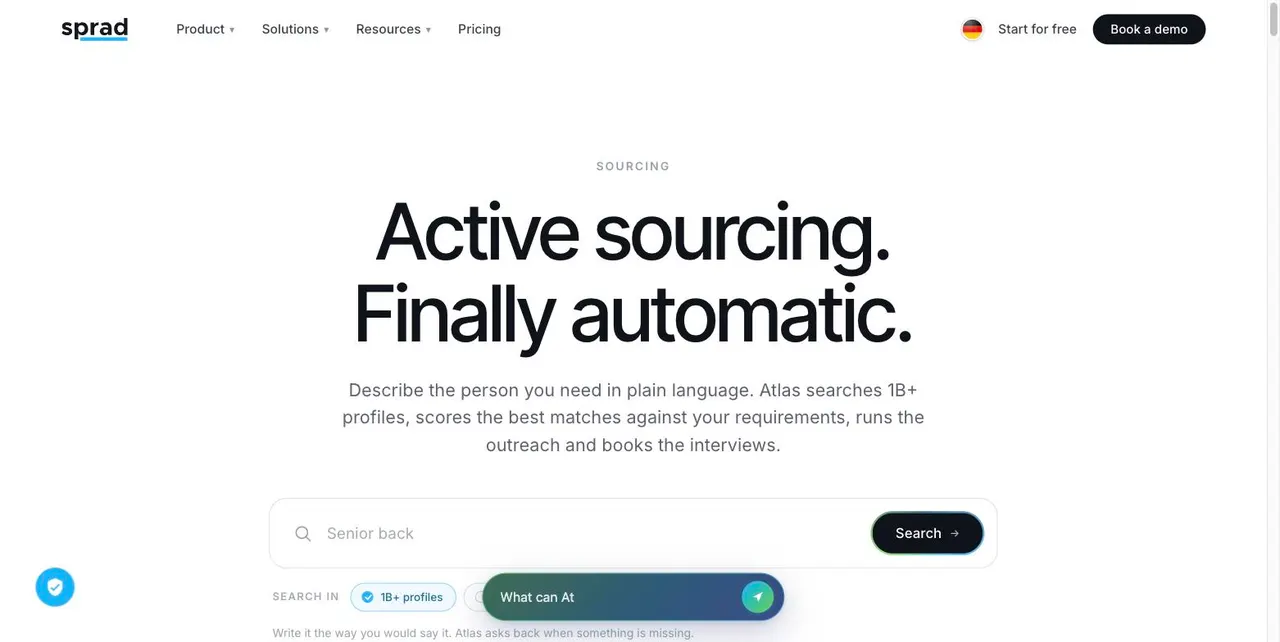
In Sprad Active Sourcing you describe the IT role in your own words, including must-haves such as module, release or stack. Atlas searches public profiles and your own pool, checks each profile against your requirements and shows a reason per requirement. LinkedIn and email outreach run from one inbox, so nobody gets two messages. A voice pre-interview (12 languages, 30 credits per interview) can ask the first questions. Prices: web search costs 2 credits per displayed profile within a budget per run; the free plan includes 100 credits per month; Recruiter Lite costs €79 per seat and month (pricing, checked 9 November 2026). A deep search takes a few minutes because every profile is checked.
FAQ
How do I recruit IT professionals when there are no applications?
Source them actively: find them through public work, personalise the first message and state salary. A job ad alone reaches only people who are already looking.
Is there an IT skills shortage in Germany in 2026?
Both: Bitkom estimates 79,000 missing IT specialists, while the BA's 2025 analysis found no general shortage in software development. The answer depends on the role, which is why you should plan by role.
Where do I find IT specialists from abroad?
Use the same channels in the target country, and plan for the Blue Card, relocation and German-language requirements. Missing German language skills was the most cited obstacle in Bitkom's survey (47 %).
How do I find an SAP consultant?
Name the module and release, search project histories rather than titles, and check the freelance status before engaging.
Jürgen Ulbrich
Jürgen Ulbrich has more than a decade of experience in developing and leading high-performing teams and companies. As an expert in employee referral programs as well as feedback and performance processes, Jürgen has helped over 100 organizations optimize their talent acquisition and development strategies.