Juicebox vs PIN: Juicebox is the stronger pure search tool for a recruiting team, PIN is the more complete one-person workflow from search to booked call. A third option, Sprad Atlas, does not run a keyword search but checks every profile individually against your requirements. In the Recruiting area of the public PeopleSearchBench, Atlas leads with 73.5, ahead of Juicebox's published 65.7 (source note below). Juicebox starts at $99 per seat and month on annual billing, PIN at $100 (Solo, annual), and both search roughly 800 to 850 million profiles.
Source of the benchmark figures: PeopleSearchBench (Recruiting), published by Lessie, October 2026. Other systems' scores as published in the benchmark; Atlas measured with the benchmark's open test procedure. The details are in the benchmark section below and on our benchmark page. Vendor prices and features are from the vendors' own pricing pages, checked on 30 October 2026, and can change.
Juicebox, PIN and Sprad side by side
| Criterion | Juicebox | PIN | Sprad |
|---|---|---|---|
| Data basis | "800 million profiles" from dozens of sources | "850M+ profiles" from dozens of unnamed sources, North America and Europe | 1 bn+ public profiles worldwide, your own talent pool and your employees' networks |
| Type of search | Natural language (PeopleGPT) | Natural language, or one line such as title plus company; PIN asks follow-up questions | Requirements instead of keywords: every profile is checked individually with context; Deep Context search (companies first, then the people who worked there in a given period) |
| Where it searches | Public profile data, see above | Public profile data, see above | One search across LinkedIn, XING, GitHub, your own talent pool and the networks of your employees; your own LinkedIn network can be uploaded |
| Speed | Not stated on the pricing page | Not stated on the pricing page | Quick Search shows first results in about 3 seconds; the deep search takes a few minutes because far more AI runs per profile |
| Automation / agent | Agents as add-on, $199 per agent and month | AI agents included: 1 on Free, 2 on Solo, 2 per user on Professional; three automation levels from co-pilot to full autopilot | Fully automatic agents for outreach and pre-qualification, with an approval option; included in Atlas Recruiter. Voice, video, chat and agent pre-qualification |
| Outreach | Email outreach with AI templates, starts at Starter | Email, LinkedIn and text-message sequences; Free is email only; sends from your Gmail or Outlook | LinkedIn (connection request, message, InMail) and email, automated including follow-ups, in one inbox; AI templates you can train with feedback, ready-made templates and a pitch format; WhatsApp for candidate communication |
| One inbox, one state | Not stated on the pricing page | Not stated on the pricing page | All communication per talent in one place; a warning if someone was already contacted (also for another role or by a colleague); past contacts importable |
| Your data after cancelling | Not stated on the pricing page | Not stated on the pricing page | Talent network with all invited talents stays free, plus free credits to keep searching; full raw-data export, every view exportable |
| Claude / MCP | Limited MCP access | Not stated on the pricing page | Full Claude MCP: start and refresh searches and build your own flows |
| Prices (as of 30 Oct 2026) | Starter $99 per month annual ($119 monthly), Growth $179 annual ($199 monthly), Business custom | Free $0, Solo $100 and Professional $135 per user and month (annual billing), Enterprise custom | Free with 100 credits per month; Recruiter Lite €79 and Atlas Recruiter €299 per seat and month; or credits from €450 per year (Atlas Base, 5,000 credits) |
| ATS | 100+ ATS/CRM integrations, listed under Business | "120+ ATS integrations", add-on on Solo and Professional, included on Enterprise | Own free ATS and CRM; integrations (ATS, HRIS) from 3 Atlas Recruiter seats |
| EU / GDPR | Trust center with GDPR statement and DPA; no hosting region found on the pricing page | SOC 2 Type 2; pricing page names no GDPR, DPA or EU hosting | EU hosting and high data-protection and IT-security standards, built for enterprise, public-sector and insurance customers; applies to Europe and the US |
| Public benchmark (PeopleSearchBench, Recruiting) | 65.7 (published) | Not part of the public benchmark; 0 % in our own test below | 73.5, ahead (see source note above) |
Everything in the Juicebox and PIN columns comes from their pricing pages and trust or home pages; where the pages say nothing, we say so instead of filling it in. For where "800 million" versus "850 million" actually matters, see the next section.
The real difference: who runs the process?
Strip away the feature lists and the two tools answer one question differently: does the recruiter steer the search, or does the tool run the sequence?
Juicebox is built around the search. You describe the profile, check the results, release contact data and export or email. Agents exist, but they are a $199 add-on per agent and month on top of the seat price, so a team that wants two always-on agents on Starter pays $99 + 2 × $199 = $497 per month before extra seats. The tool shines when several people in a team source regularly and want shared seats and credits.

PIN is built around the funnel. Per its home page it "sources, reaches out, follows up and books the calls". You type one line, PIN asks follow-up questions, finds matches, and lets you approve each match and each email before anything is sent, or run on autopilot. Agents are part of the plan, and sequences cover email, LinkedIn and text messages. That fits one recruiter who wants fewer tabs. Its limits are visible too: PIN names no data sources, gives no methodology for its "5x reply rate" or "83 % match acceptance" claims, and states no GDPR or EU hosting on its pricing page.
Which one is cheaper?
On list prices they are close: $99 vs $100 to start, $179 vs $135 for the team tiers (annual billing). The difference is in what is inside. PIN includes agents and multi-channel sequences; Juicebox charges for agents separately. Juicebox Growth covers up to 5 seats, PIN Professional unlimited seats. Both list prices in USD, which matters for European buyers.
The third option: Sprad
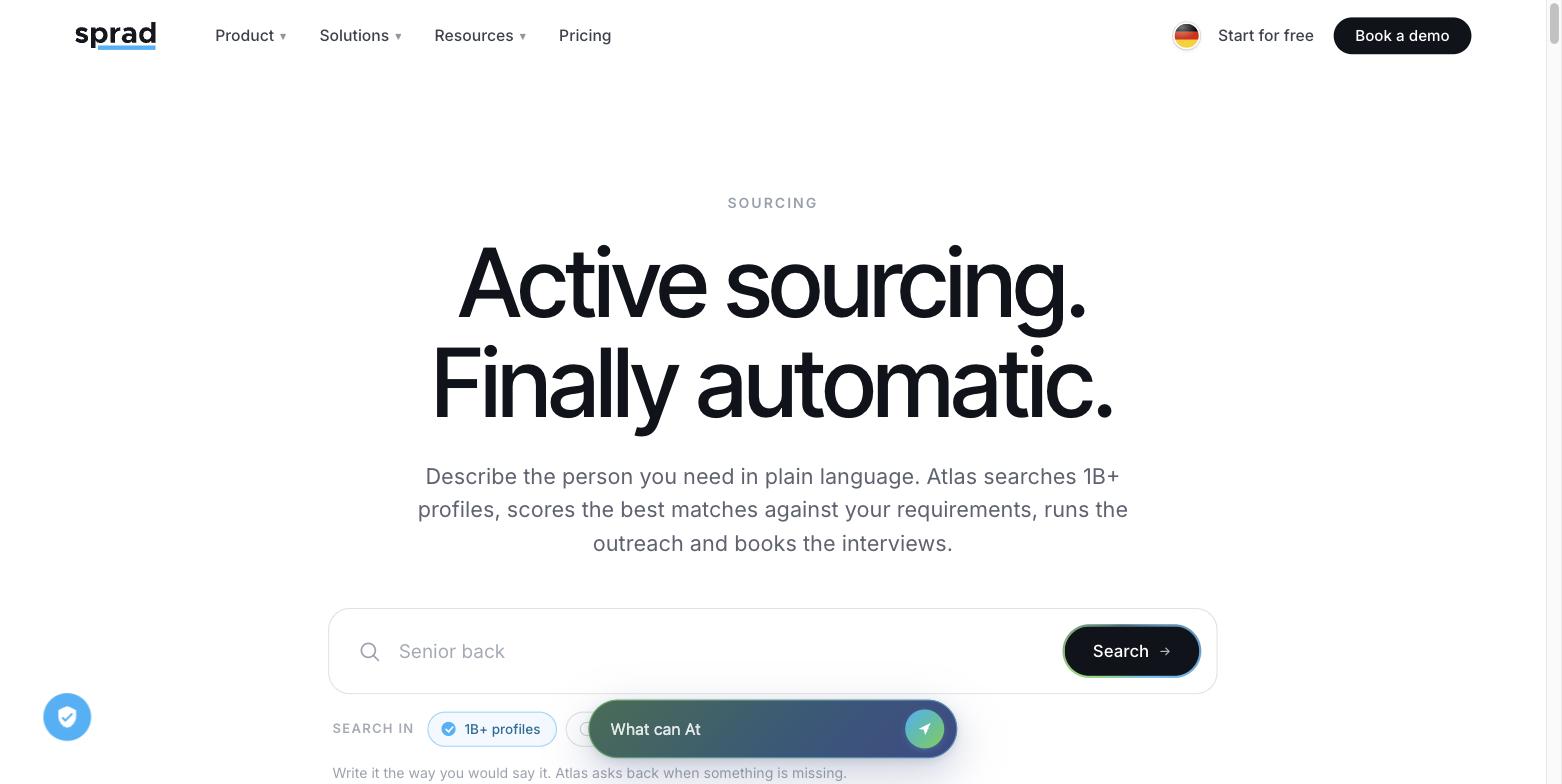
Sprad Atlas approaches the same job differently: sourcing, outreach, pre-qualification and your own talent network in one workspace, with a free plan to start. Sprad has built recruiting software for 7 years, for start-ups as well as large corporations, public-sector clients and insurers, beginning with employee referrals. That is seven years of matching profiles against requirements. Prices are either credits for the whole company (free plan with 100 credits per month; a web search costs a budget of 50, 100 or 300 credits per run, billed at 2 credits per displayed profile) or a flat seat without credits: €79 (Recruiter Lite) or €299 (Atlas Recruiter) per seat and month. Companies that currently pay for separate LinkedIn and XING recruiter licences typically save 30 to 80 %, depending on how many they run today. See sprad.io/pricing and our Active Sourcing page.
What sets it apart, in the order that matters most for a hiring team:
- More suitable candidates: every profile is checked individually against your requirements, with a reason per requirement. That also finds people whose profile is poorly maintained or lacks the "right" keywords.
- Deep Context search: find companies first, then the people who worked there in a given period, for example a CFO who guided a merger, someone who worked at a firm with a specific technology, or who built a start-up through Series A or B.
- LinkedIn and email in one inbox: automated including follow-ups, InMails directly from Sprad or inside sequences (your own InMail allowance can be used). AI templates you can train with feedback, ready-made ones and a pitch format where you store the selling points of the role and get matching messages suggested. In our experience, the combination of email and LinkedIn is what produces the highest reply rates.
- One state per talent: all communication in one place, a warning if someone has already been contacted, no lost context when you switch channels, no double outreach.
- Networks nobody else shows you: upload your own LinkedIn network and see who you are already connected to. In-house teams can let employees share their networks; staffing firms can invite former placements to connect theirs, and then search those networks too.
- Your data stays yours: the talent network and live updates stay free after cancelling, with free credits to keep searching; full raw-data export.
- Claude MCP and compliance: full Claude MCP for your own flows; EU hosting and high security standards because enterprise, public-sector and insurance customers use it.
How to tell real AI search from keyword search
From seven years of matching profiles to requirements we use one rule of thumb: if results appear instantly, it is almost always a keyword search, even when it is called semantic or AI. Judging every profile properly takes time. Three quick checks you can run on any tool:
- Speed: are results there in a second? Then a filter ran, not a review of each profile.
- Reasons: does each result say, requirement by requirement, why the person fits? A score without reasons is a ranking, not a check.
- Hidden fits: does it find people whose profile is thin or phrased differently? Take a role and one requirement that is hard to write as a keyword and see who comes back.
The price of the real check is time: Atlas shows first results from Quick Search in about 3 seconds, while the deep search takes a few minutes because far more AI runs per profile.
What the benchmarks show
PeopleSearchBench is an open benchmark published by LessieAI with 119 real search tasks in four areas, scoring relevance, coverage and usefulness of the data. We use its Recruiting area, where Atlas scores 73.5 and is ahead (Lessie 68.2). In recruiting Atlas returns 15 matching profiles almost every time (14.2 on average).
| System | Recruiting |
|---|---|
| Sprad Atlas | 73.5 |
| Lessie | 68.2 |
| Juicebox | 65.7 |
| Exa | 64.7 |
| Claude Code | 50.5 |
In the Recruiting area Atlas is first with 73.5, 5.3 points ahead of Lessie (68.2); Exa is listed only as a participant of the benchmark. Status October 2026; method on the benchmark page.
A second, own test (15 August 2026): we put the same three hard-to-fill roles through four competing systems and through Atlas: a Senior Backend Engineer in Berlin, a Senior Product Manager in London and a Process Integration Engineer in Eindhoven. Every system that takes free text received the identical prompt; LinkedIn Sales Navigator got the same criteria as filters. The reference set per role is everything the other systems returned, so no system is measured against its own output.
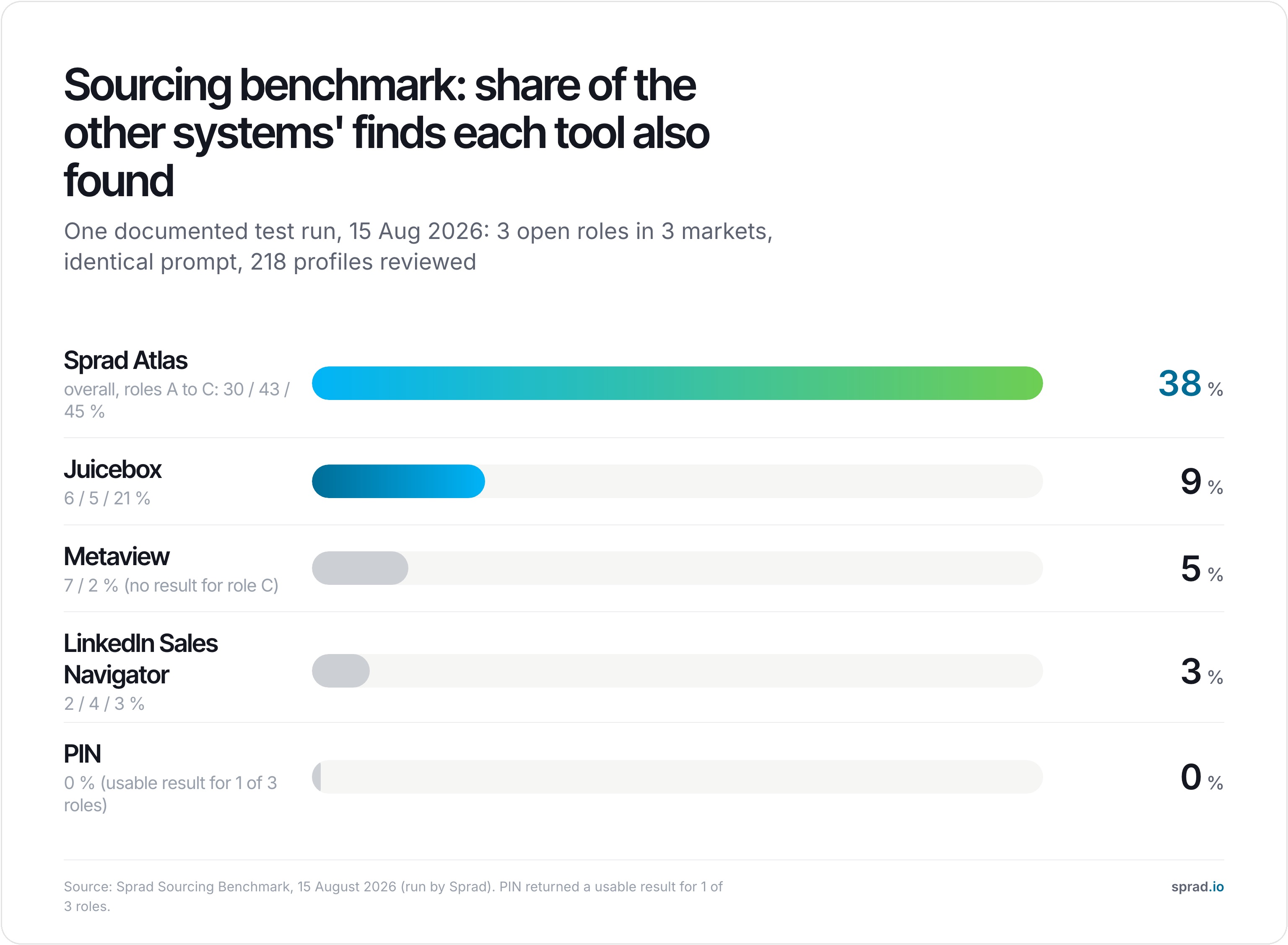
- What it measures: overlap. "Atlas found 38 % of what the others found" does not mean 38 % of all suitable people; most profiles are reached by no system in the field.
- PIN's 0 %: PIN returned a usable result for only one of the three roles (a dash marks missing results), and on that role the overlap was 0 %. That is a reason to run your own test, not proof that PIN is useless.
- Volume check on role A: counted by the same rules, strong matches per run were 17 (Metaview), 12 (Juicebox), 9 (LinkedIn) and 2 (PIN); Atlas' deep research mode produced roughly 147, extrapolated from a sample of 120 profiles.
Where Sprad is not the better choice: there is no AI notetaker for calls and no placement reporting yet (it is in the pipeline), and no SMS channel; Sprad uses WhatsApp for candidate communication, while PIN offers text-message sequences. The deep search takes a few minutes, Atlas Recruiter costs more per seat than some seat tools (Recruiter Lite at €79 is on par with the alternatives), and the smallest plan has no unlimited use, because deeper search costs more AI; flexible credits make up for it. If you only want a lean search for a small team, Juicebox is a focused tool with published prices.
Which one should you choose?
- Solo recruiter, English-language roles, wants outreach on autopilot: start with PIN's free plan and approve each message manually at first.
- Team of two to five that sources every week and wants shared search: Juicebox Growth, and budget the agents separately.
- Most suitable candidates, LinkedIn and email in one inbox, your own talent pool and ATS in the same tool: Sprad, from a free start or €79 per seat. In DACH or EU hiring also compare how GDPR applies to active sourcing: candidates must be informed under Art. 14 GDPR when you take their data from public sources.
- Not sure: run the same role in two tools, with the same prompt, and compare 20 profiles each by hand. That is how our benchmark was built, at a larger scale.
More comparisons: Juicebox vs Metaview, Juicebox vs LinkedIn Recruiter, Juicebox vs hireEZ, Juicebox pricing and the AI sourcing tools category.
FAQ
Is Juicebox or PIN better?
For search depth and teams, Juicebox. For one recruiter who wants search, sequences and scheduling in one flow, PIN. Both vendors publish comparison pages that favour their own tool, so test both on one of your open roles.
Which is cheaper, Juicebox or PIN?
Entry prices are $99 (Juicebox Starter, annual) and $100 (PIN Solo, annual). PIN includes AI agents; Juicebox charges $199 per agent and month on top. Stand 30 October 2026.
Does PIN have a free plan?
Yes: $0, one seat, five contact lookups per week, three candidate searches per day and email-only sequences. Juicebox's free plan is a demo with five one-off contact credits. Sprad also starts free, with 100 credits per month.
Which has the bigger database?
PIN states 850M+ profiles, Juicebox 800 million, Sprad searches 1 bn+ profiles worldwide plus your own talent pool. No number says how many are reachable in your country or how fresh they are, so test your market.
Do they send emails or LinkedIn messages?
Juicebox: email outreach with AI templates. PIN: email, LinkedIn and text-message sequences. Sprad: LinkedIn (including InMail) and email, automated with follow-ups, in one inbox. Juicebox and PIN let you approve before sending.
Are Juicebox and PIN GDPR-compliant?
Juicebox publishes a trust center with a GDPR statement and a DPA, but we found no public hosting region. PIN's pricing page names SOC 2 Type 2 but no GDPR terms. Ask both for a DPA and a sub-processor list before you source EU candidates. Sprad hosts in the EU.
How do I tell real AI search from keyword search?
Instant results are almost always a (semantic) keyword search. A real check of each profile takes longer, and every result comes with a reason per requirement. Test it with a requirement that is hard to write as a keyword.
What is a good alternative to Juicebox and PIN?
Sprad, if you want the most suitable candidates from one search, LinkedIn and email in one inbox, and your own talent pool and ATS in the same tool; see the Juicebox alternatives and our AI sourcing pricing models.
Can I trust your benchmark?
PeopleSearchBench (Recruiting), published by Lessie, October 2026. Other systems' scores as published in the benchmark; Atlas measured with the benchmark's open test procedure. The method is public on the benchmark page, and you can reproduce the idea on your own roles.
Jürgen Ulbrich
Jürgen Ulbrich has more than a decade of experience in developing and leading high-performing teams and companies. As an expert in employee referral programs as well as feedback and performance processes, Jürgen has helped over 100 organizations optimize their talent acquisition and development strategies.