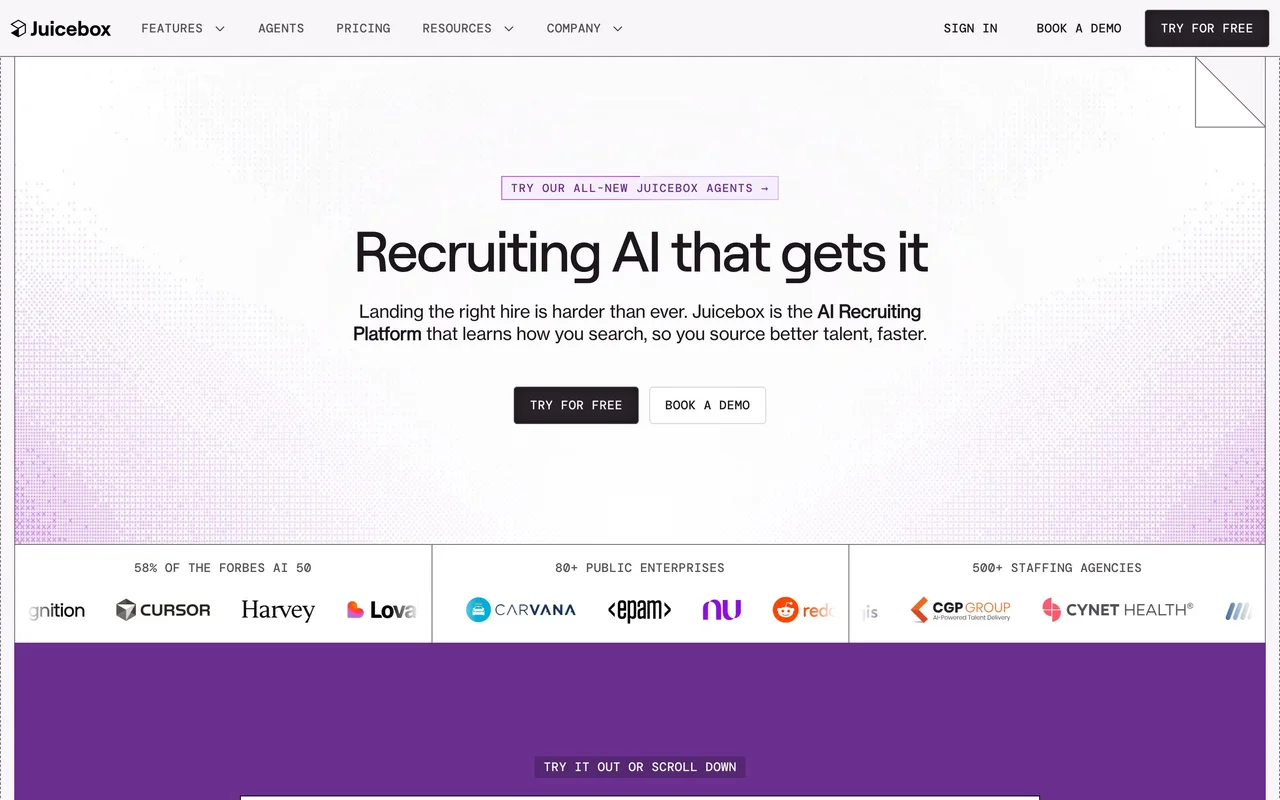
Juicebox is the faster, cheaper start for a small team; SeekOut is the larger, more enterprise-oriented tool; and if you want the most matching candidates and EU hosting, a third option beats both. Juicebox searches in plain language and publishes its prices (from $99 per seat and month on annual billing, Oct 2026). SeekOut claims the bigger index (1 billion+ profiles) and specialist pools, but only its entry tier has a list price ($149 per month, annual). In the public PeopleSearchBench (Recruiting), Juicebox scores 65.7; SeekOut was not tested, so no independent number exists for it. Below: search quality and data sources, what a team of three pays, and what GDPR and the EU AI Act mean for the choice.
Juicebox vs SeekOut vs Sprad: the comparison table
| Juicebox | SeekOut | Sprad | |
|---|---|---|---|
| Search | Plain-language search (formerly PeopleGPT), results quickly | Filters plus AI matching, specialist indexes (technical, cleared, healthcare) | Requirements instead of keywords; every profile checked with a reason per requirement |
| Data sources | Claims 800M+ profiles from 30+ sources (vendor figure) | Claims 1B+ profiles (vendor figure) | LinkedIn, XING, GitHub, your own pool and employee networks; 1B+ profiles worldwide |
| Independent benchmark | PeopleSearchBench (Recruiting): 65.7 | Not tested | PeopleSearchBench (Recruiting): 73.5 (own re-measurement, converted)1 |
| Entry price | Free tier; Starter $119 monthly or $99 annual per seat | Recruit Core $149/month annual ($179 monthly), 3 seats listed, 14-day trial | Free start (100 credits/month); Recruiter Lite 79 € per seat and month |
| Beyond entry | Growth $199 / $179 per seat; AI agent $199 each; Business on quote | Three higher tiers on quote; ATS sync and CRM in the upper tiers | Atlas Recruiter 299 € per seat and month incl. deep search, 10 deep-context searches, one outreach account |
| Outreach | Email outreach; agents as add-on | Outreach and CRM in higher tiers | LinkedIn and email, automated with follow-ups, one inbox with double-contact warning |
| Data hosting | No public EU-hosting commitment found | Security documents public; EU hosting not verified | EU hosting, data processing agreement, enterprise security |
| Honest limit | Limited native talent pool; ATS sync only in Business | Quote-based pricing; dated interface per reviewers | Deep search takes minutes; no AI call notetaker or placement reporting yet; no SMS |
Vendor figures such as profile counts are marketing numbers and not comparable: no provider shows how many of those profiles are current, reachable or contactable. Prices are list prices, net, as of October 2026, from the vendors' pricing pages and sprad.io/pricing; check them before you buy.
Which is better: Juicebox or SeekOut?
It depends on one decision axis: how much process around the search do you need?
- Choose Juicebox if one to five recruiters want to start this week, a published price matters and you do not need ATS sync. Plain-language search gets you a ranked shortlist quickly, and the free tier lets you test with real roles.
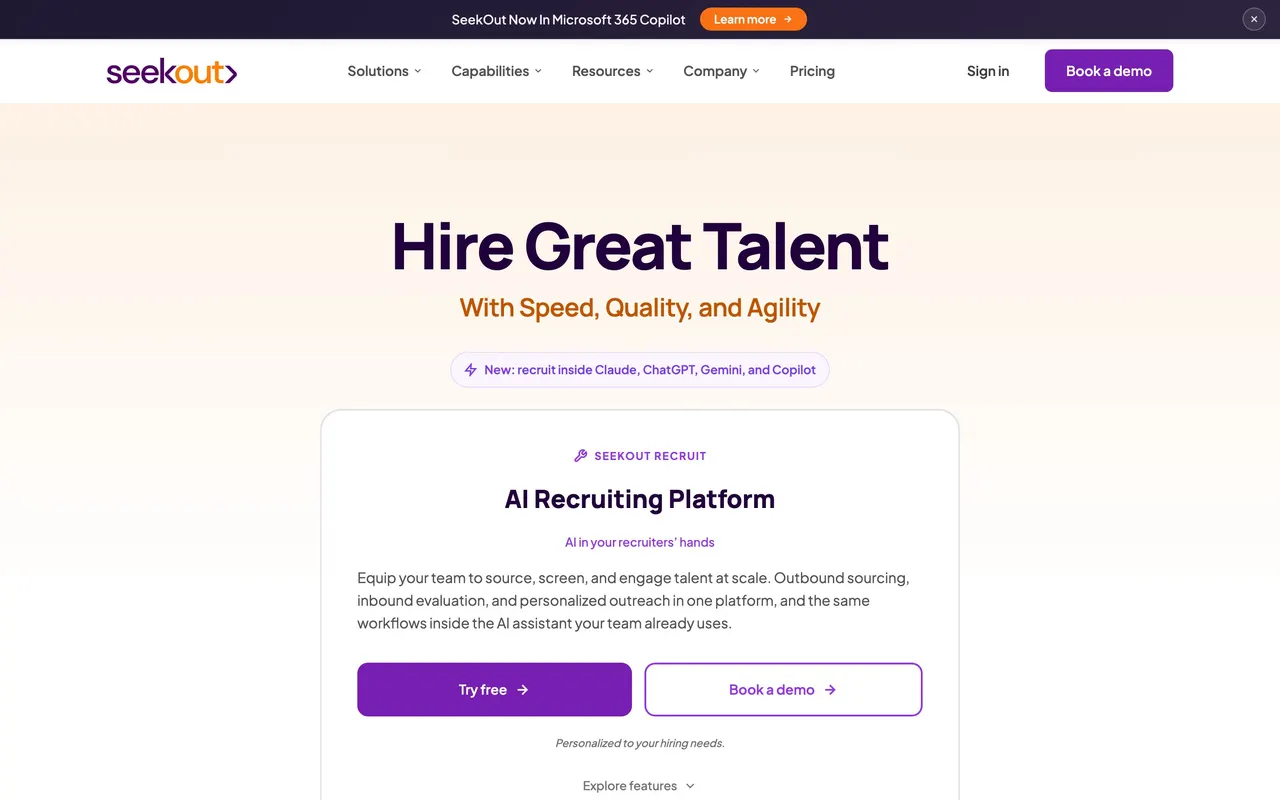
- Choose SeekOut if you hire at scale for technical or specialist roles, need two-way ATS sync and a formal security review, and are prepared to negotiate. Reviewers praise its filters and team features; the most repeated criticism is the price for smaller companies and a slower interface with many filters.
- Look at a third option if match quality per search, EU hosting and one inbox for LinkedIn and email decide for you.
How do search quality and data sources differ?
Juicebox turns a plain-language description into a ranked list. That is fast and works well for common roles. The weakness of any quick search is that similarity is not proof: a profile that contains “M&A” has not necessarily led a deal. Juicebox claims 800 million profiles from 30+ sources including GitHub and research publications. In the public PeopleSearchBench it reached 65.7 in Recruiting.
SeekOut competes on data depth: a larger claimed index and specialist indexes for technical, cleared and healthcare talent. If you search for a security-cleared engineer in the US, that depth is a real argument. Its own comparison pages say it leads on technical data depth, while Juicebox leads on time to shortlist. Both statements come from vendors, and there is no independent test of SeekOut in the benchmark.
What we see in practice after seven years of building recruiting software, starting with employee referrals where matching profiles to requirements is the core problem: bigger index does not mean more usable candidates. What counts is how many of the first 15 profiles you would really contact. Run the same five open roles in both tools, count them, and ignore the profile totals. Rule of thumb: if results appear instantly, it is almost always a (semantic) keyword search, not a check of each profile.
What does each cost for a team of three recruiters?
Assumptions: three recruiters, 12 months, annual billing where offered, list prices, net, October 2026, no negotiated discount, one person working with each seat.
| Option | Calculation | 12 months |
|---|---|---|
| Juicebox Growth (Starter is one seat) | 3 × $179 × 12 (monthly billing: 3 × $199 × 12 = $7,164) | $6,444 |
| SeekOut Recruit Core | $149 × 12 if the price covers the 3 listed seats; 3 × $149 × 12 if it is per user | $1,788 to $5,364 |
| Sprad Recruiter Lite | 3 × 79 € × 12 (≈ $3,420 at $95 per seat) | 2,844 € |
| Sprad credits only | Free plan; a 15-profile shortlist with verified emails ≈ 45 credits ≈ 4.50 € | pay per shortlist |
Three things the table does not show. First, credits. Juicebox Growth includes 1,500 contact credits per seat and month (an email costs 1, a phone number 3), so three seats give 4,500. SeekOut Core lists 500 contact credits and 1,000 exports per month; a team revealing 150 contacts per person already reaches 450, so the cap bites quickly. Second, the seat cap: a fourth recruiter does not fit into Core and moves you into a custom contract, which Vendr's marketplace data puts at a median of about $20,000 a year. Third, the SeekOut price reading: SeekOut's page lists three seats in Core, but some third-party sites read $149 as per user; get this confirmed in writing before you compare.
Sprad worked example: at 4.50 € per shortlist, a Recruiter Lite seat (79 €) pays off from about 17 shortlists per recruiter and month; below that, credits are cheaper. Three recruiters with 10 shortlists each cost about 135 € a month on credits, against 237 € for three seats. Recruiter Lite covers 500 profiles and 50 pool searches per seat; deep search, company search and contact data run on credits. More in Juicebox pricing and SeekOut pricing.
The third option: Sprad
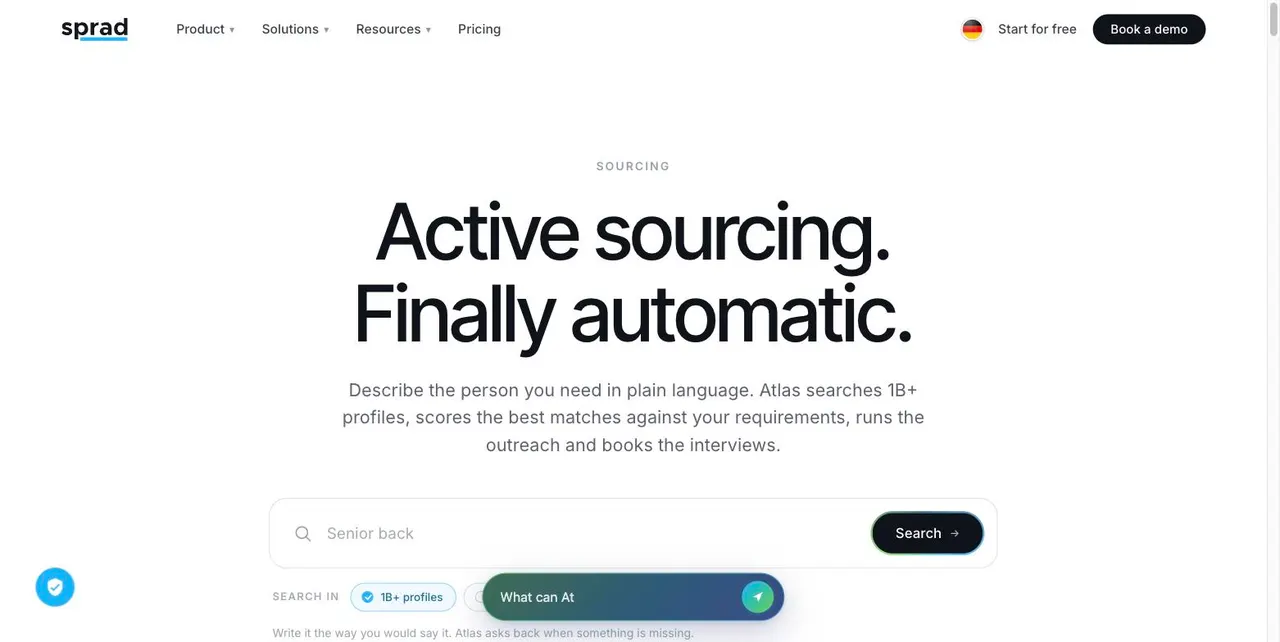
Sprad is the pick when match quality and compliance weigh most. Reasons you can check: (1) Every profile is checked individually against your requirements, with a reason per requirement, which also finds people with poorly kept profiles. (2) One search over LinkedIn, XING, GitHub and your own pool, plus employee networks and your uploaded LinkedIn network, and a deep-context search that first finds companies and then people who worked there in a given period, such as a CFO during an acquisition. (3) LinkedIn and email in one inbox, automated with follow-ups; the system warns if someone was already contacted, even for another role. (4) Benchmark: in the public PeopleSearchBench (Recruiting), Atlas reaches 73.5 in our own re-measurement, converted to the published scale (Juicebox 65.7 as published).1 (5) Price: free start, Recruiter Lite from 79 € per seat and month, flexible credits; 30 to 80 % lower cost than separate LinkedIn and XING licences, depending on what you have today. (6) Your data stays yours: the talent network remains free after cancellation, with a full raw-data export.
Where Sprad is weaker: a deep search takes a few minutes (Quick Search about 3 seconds), there is no AI call notetaker and no placement reporting yet, no SMS channel, and the client CRM for agencies is in beta. Atlas Recruiter costs more per seat (299 €) than some seat tools. See Sprad Active Sourcing.
Which fits EU and GDPR requirements?
This is a decision criterion, not a footnote. If you collect personal data from public profiles, Article 14 of the GDPR requires you to inform the person within a reasonable period, at the latest within one month, and at the latest at first contact if you use the data to reach out. That applies whichever tool you use. The EU AI Act lists AI systems for recruitment and selection, such as filtering and evaluating candidates, as high-risk in Annex III; secondary sources report that application was moved to 2 December 2027, so check the current text. In the US, New York City's Local Law 144 requires a bias audit within the last year, published results and notice to candidates for automated employment decision tools.
What to ask each vendor: Where is candidate data hosted? Is there a data processing agreement and a list of subprocessors? Is candidate data used to train models? How do I fulfil information duties and deletion requests? In our research neither Juicebox nor SeekOut showed a public EU-hosting commitment; aggregator sites call SeekOut GDPR-compliant, but we found no primary document and treat that as unverified. Sprad hosts in the EU, offers a data processing agreement and serves enterprise, public-sector and insurance customers; that applies to Europe and the US. Researchers at the Bern University of Applied Sciences also advise that AI longlists should be reviewed by people before anyone is contacted ({BFH}interview, February 2025). General information, not legal advice. See Active sourcing and GDPR.
What does the benchmark say, and what are its limits?
The PeopleSearchBench is the only open comparison of AI people search platforms: 119 real search tasks in four domains. Scores in the Recruiting area as published: Lessie 68.2, Juicebox 65.7, Exa 64.7, Claude Code 50.5. Atlas reaches 73.5 in our own re-measurement, converted to the published scale, with 14.2 of 15 profiles relevant on average in that re-measurement.1 Note that the benchmark's publisher is itself a listed tool, and SeekOut is not part of it. Our own earlier test (Sprad, 15 August 2026; 38 % matching profiles against 9 % for Juicebox) points the same way but is one documented run, not a benchmark.
How do I decide in one week?
- Pick five real, open roles, two of them hard to fill, and write each as three to five sentences of requirements.
- Run the same roles in each tool and read the first 15 profiles per role. Count how many you would contact.
- Ask for the data processing agreement and hosting region in writing, and the real price for your seat count including credits and ATS sync.
- Calculate the cost per usable profile, not per seat. Typical mistakes: comparing profile totals, ignoring the credit cap, and discovering the seat limit after signing.
FAQ
Which is better: Juicebox or SeekOut?
Juicebox suits small teams that want a fast start and published prices. SeekOut suits larger teams with technical or specialist searches and ATS needs. If match quality and EU hosting matter most, Sprad is the stronger choice in our view.
Is SeekOut more expensive than Juicebox?
At entry level SeekOut Core ($149 per month, annual) can be cheaper than Juicebox Growth for three people, but it has a 3-seat and 500-credit ceiling. Above that, SeekOut is quote-based; Vendr data puts the median deal at about $20,000 a year (October 2026).
Which has more profiles?
SeekOut claims 1 billion+ and Juicebox 800 million+. These are vendor figures; what counts is how many of the first 15 results you would contact.
Is Juicebox or SeekOut GDPR-compliant?
Compliance depends on your use as well as the tool. We found no public EU-hosting commitment for either. Ask for the data processing agreement, hosting region and subprocessors, and meet the information duty under Article 14 GDPR yourself.
What does the team plan cost for three recruiters?
At list prices, Juicebox Growth about $6,444 a year, SeekOut Core $1,788 to $5,364, Sprad Recruiter Lite 2,844 € (annual billing, net, October 2026).
Do they work with XING?
Neither lists XING as a source in our research. Sprad searches LinkedIn, XING, GitHub and your own pool in one run, which matters for hiring in the DACH region.
1 PeopleSearchBench (Recruiting), published by Lessie, October 2026. Other systems' scores as published in the benchmark; Atlas measured with the benchmark's open test procedure. Vendor prices and claims as published by Juicebox and SeekOut and by third-party price trackers, checked October 2026.
Jürgen Ulbrich
Jürgen Ulbrich has more than a decade of experience in developing and leading high-performing teams and companies. As an expert in employee referral programs as well as feedback and performance processes, Jürgen has helped over 100 organizations optimize their talent acquisition and development strategies.