Nebula (nebula.io) is an enterprise AI recruiting platform: it combines candidate sourcing, email and SMS outreach, 50+ ATS integrations and analytics, on a profile base its own pricing table describes as 200M US profiles. Its price list is unclear: the same page shows $250–275 per seat and month and, separately, plans from $1,000 to $10,000 a month. The best alternative depends on what you need: Sprad if you want the most matching candidates (every profile checked individually), LinkedIn and email in one inbox, your own talent network and EU hosting at published prices; Pin or Juicebox for a small budget; SeekOut or Gem if you want deeper filters or a CRM around sourcing. Stay with Nebula if you are a US-focused enterprise team that needs its ATS connections.
What is Nebula, and which Nebula is meant?
Nebula calls itself “the AI-powered talent acquisition platform that unifies candidate sourcing, outreach automation, and talent intelligence into one seamless recruiting workflow” and positions itself for enterprise hiring (industries listed: health and life sciences, technology, retail and operations, professional services). Its pricing page lists AI candidate matching, overnight sourcing and outreach (“AutoSource”), multi-step AI-led email and SMS campaigns, an AI job-description builder, talent analytics and a bias-reduction module.
Do not confuse it with other Nebulas. There is an AI employee platform called Nebula, a language model of the same name from a speech-AI company, and several workforce and cloud products. Pricing or reviews you find for them say nothing about nebula.io. If your search was “nebula ai recruiting” or “nebula sourcing”, this article is the right one.
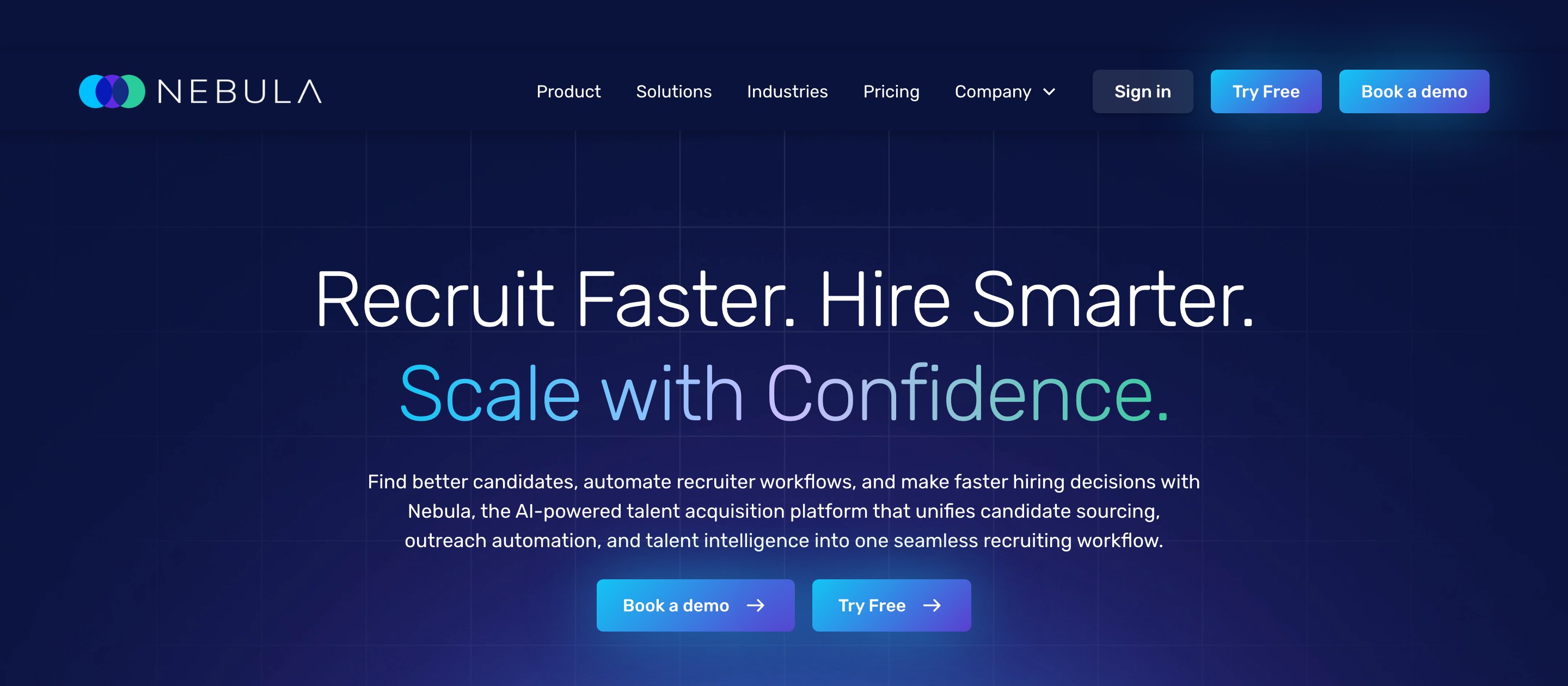
We read the homepage, the product page and the pricing page on 30 October 2026. We found no founding year, location or funding on the About page, no independent review and no published customer case with numbers. That is not proof of anything, but it means almost every claim below is the vendor's own.
Why teams look for a Nebula alternative
These are the reasons that follow from what Nebula publishes, not complaints we collected. Treat them as our reading and test them against your own situation:
- The price is hard to pin down. One table shows per-seat prices, another shows monthly plans with lookup limits, and the word “lookups” is not defined on the page. The next section shows what that means in dollars.
- The profile base looks US-centred. The pricing table speaks of 200M US profiles. If you recruit in DACH or across Europe, a US index will cover fewer of your candidates (an inference from the number, not a measurement).
- No LinkedIn channel found. Outreach is email and SMS. If your candidates answer on LinkedIn, you need a second tool.
- SMS is a legal question, not only a feature. See the law section below.
- Little independent proof. We found no neutral review and no benchmark entry.
What does Nebula cost?
Nebula's pricing page carries two lists that do not match each other. Per seat: Starter $275 per seat and month for one user, Growth $250 per seat and month for up to 10 users, Enterprise+ on request. Per plan: the table below. We read both as of 30 October 2026; the page names no contract term and no set-up fee.
| Plan | Price per month | Lookups per month | Cost per lookup (our calculation) | ATS |
|---|---|---|---|---|
| Starter | $1,000 | 2,500 | $0.40 | Optional add-on |
| Growth | $3,000 | 10,000 | $0.30 | Included |
| Business | $5,000 | 25,000 | $0.20 | Included |
| Professional | $10,000 | 50,000 | $0.20 | Included |
| Enterprise | On request | 125,000 | – | Full suite |
Worked example. A team of 5 recruiters on the Growth seat price pays 5 × $250 × 12 = $15,000 a year. The same team on the Growth plan pays $3,000 × 12 = $36,000 a year for 10,000 lookups. At 15 recruiters the seat list stops at 10 users, so you are in Enterprise+ territory (quote). For comparison, Sprad Recruiter Lite is 79 € (95 $) per seat and month: 5 seats are about 4,740 € (5,700 $) a year, 15 seats about 14,220 € (17,100 $), billed annually, net. Atlas Recruiter is 299 € (359 $): 5 seats about 17,940 € (21,540 $) a year, and it includes unlimited fair-use search, deep search and one automated LinkedIn-and-inbox account per seat. Honest note: Atlas Recruiter costs more per seat than Nebula's seat price; the comparison only holds if you use the outreach and unlimited search it contains.
Who should switch from Nebula, and who should stay?
Stay with Nebula if you are an enterprise team recruiting mainly in the US, you need one of its 50+ ATS connections today, and you are comfortable with email and SMS as your only outreach channels. A switch has its own cost: new ATS wiring, new templates, a new learning curve.
Switch if one of these is true: you recruit in Europe and want XING and LinkedIn in the search; you want outreach on LinkedIn as well as email in one inbox; you want to search your own talent pool and your colleagues' networks together with the web; or you want published prices you can calculate before a sales call. A practical rule from our own work with agencies and in-house teams: do not decide on a demo. Run the same role through two tools and compare the first 20 candidates (see the test below).
Data coverage, GDPR and the law
Whichever tool you choose, three rules apply once you contact people who did not apply. EU: you need a legal basis and must inform candidates at first contact (Regulation (EU) 2016/679, Articles 6 and 14); AI that ranks candidates can count as high-risk under the EU AI Act (Annex III, employment), so check the current application dates. Germany: unsolicited advertising by electronic mail needs consent in principle (§ 7 UWG); have counsel assess whether and how a cold SMS or email to a candidate is allowed. US: texts sent with automated technology fall under the FCC's rules for telemarketing and autodialed messages (47 CFR 64.1200), and New York City requires a bias audit and notice for automated employment decision tools (Local Law 144).
Nebula publishes no hosting location in the pages we read. Ask every vendor where data is hosted, whether your data trains models and whether a data processing agreement is included. Our guide Active sourcing and GDPR has the checklist. This is not legal advice.
Nebula alternatives compared
The table lists Nebula for reference and six alternatives. Prices are vendor-published or from public roundups, as of October 2026; Sprad prices are net of VAT, billed annually.
| Tool | Type | Data / search | Price (public info) | Outreach | EU focus |
|---|---|---|---|---|---|
| Sprad | Search + outreach + talent network | Requirement search over 1B+ profiles (LinkedIn, GitHub), your own pool and employee networks | Free start (100 credits/month); Recruiter Lite 79 €/seat/month (95 $); Atlas Recruiter 299 €/seat/month (359 $) | LinkedIn, email and InMail in one inbox; voice, chat and agent pre-qualification | Yes, EU hosting |
| Nebula | Enterprise TA platform | “200M+” profiles; pricing table says 200M US profiles | $275 / $250 per seat/month or $1,000–10,000/month plans | Email, SMS | Not stated |
| Pin | Agent (Assist/Autopilot) | 850M+ profiles claimed | Free tier; from about 99 $/month (annual) | Email, books calls | Not stated |
| Juicebox | Natural-language search | 800M+ profiles, 30+ sources claimed | Starter 99 $/month annual; agents 199 $ each | Via integrations | Not stated |
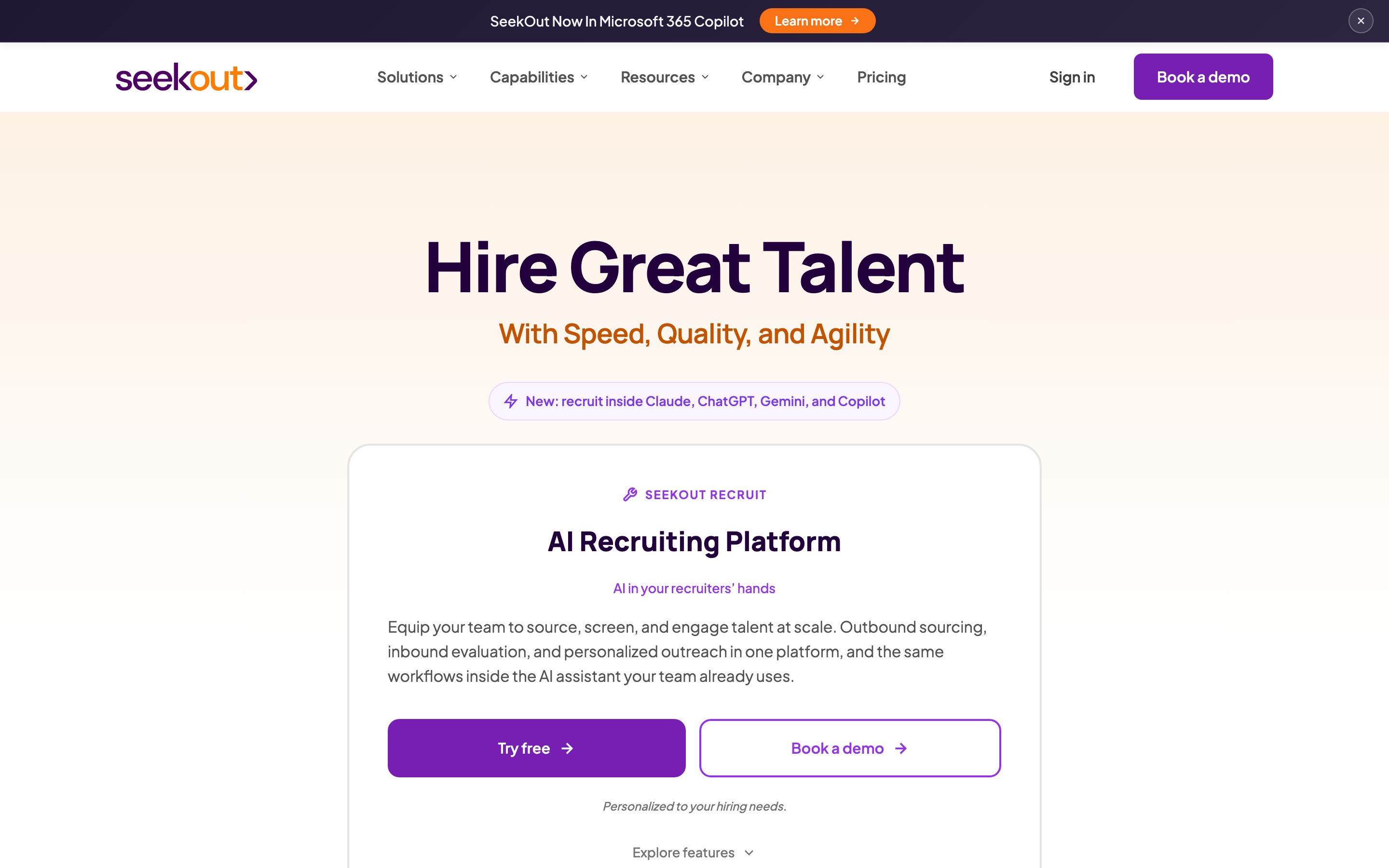
| SeekOut | Talent intelligence | 1B+ profiles claimed | Solo from 149 $/month annual; teams custom | Integrations | Not stated |
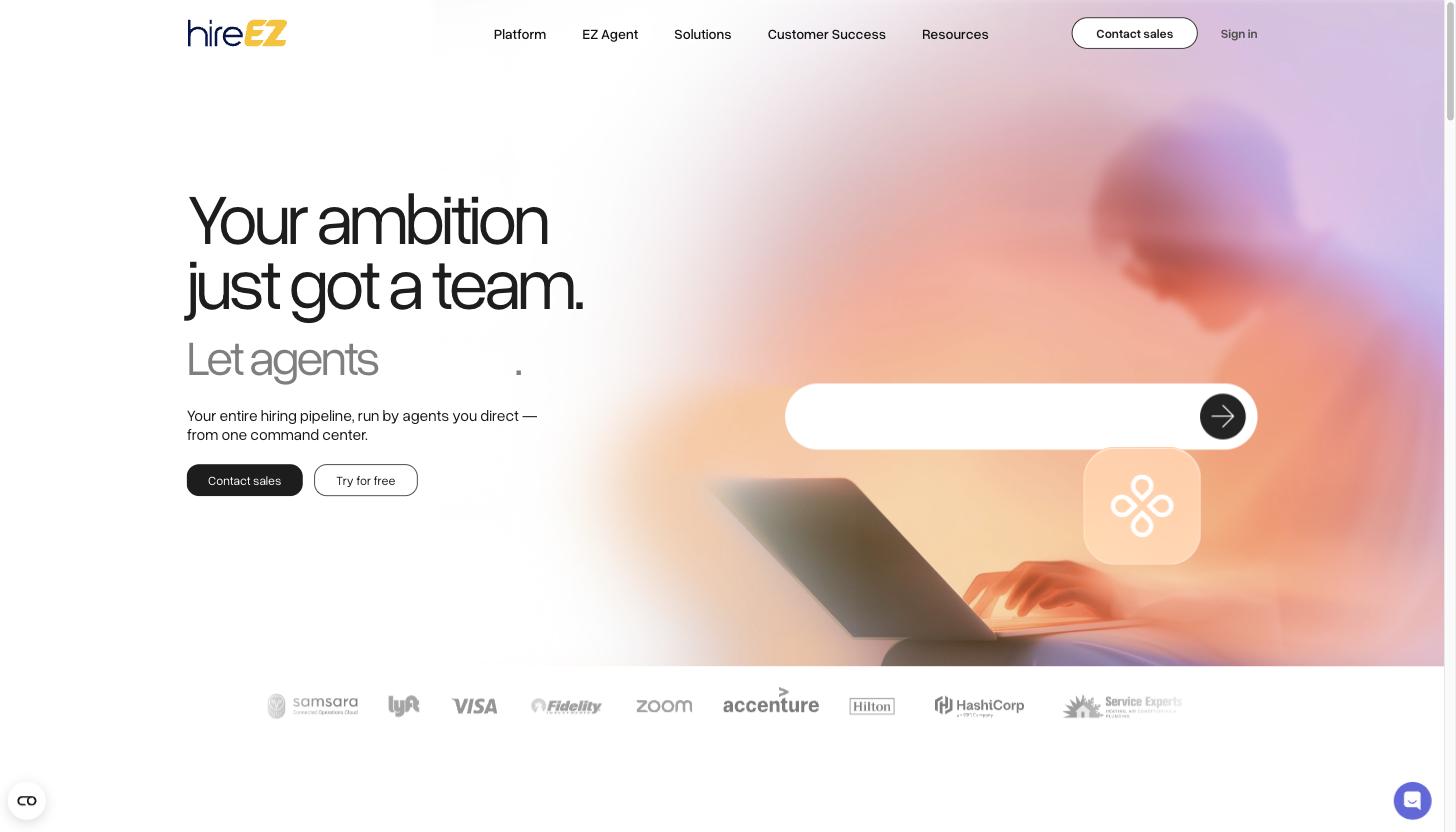
| hireEZ | Sourcing platform | 500M+ profiles claimed | About 169–199 $/month solo; teams custom | Sequences | Not stated |
| Gem | Recruiting CRM + agent | 800M+ profile index plus your ATS | Custom; small-team tier reported from about 130 $/month | Email, InMail, SMS | Not stated |
1. Sprad — the most matching candidates, search and outreach in one tool
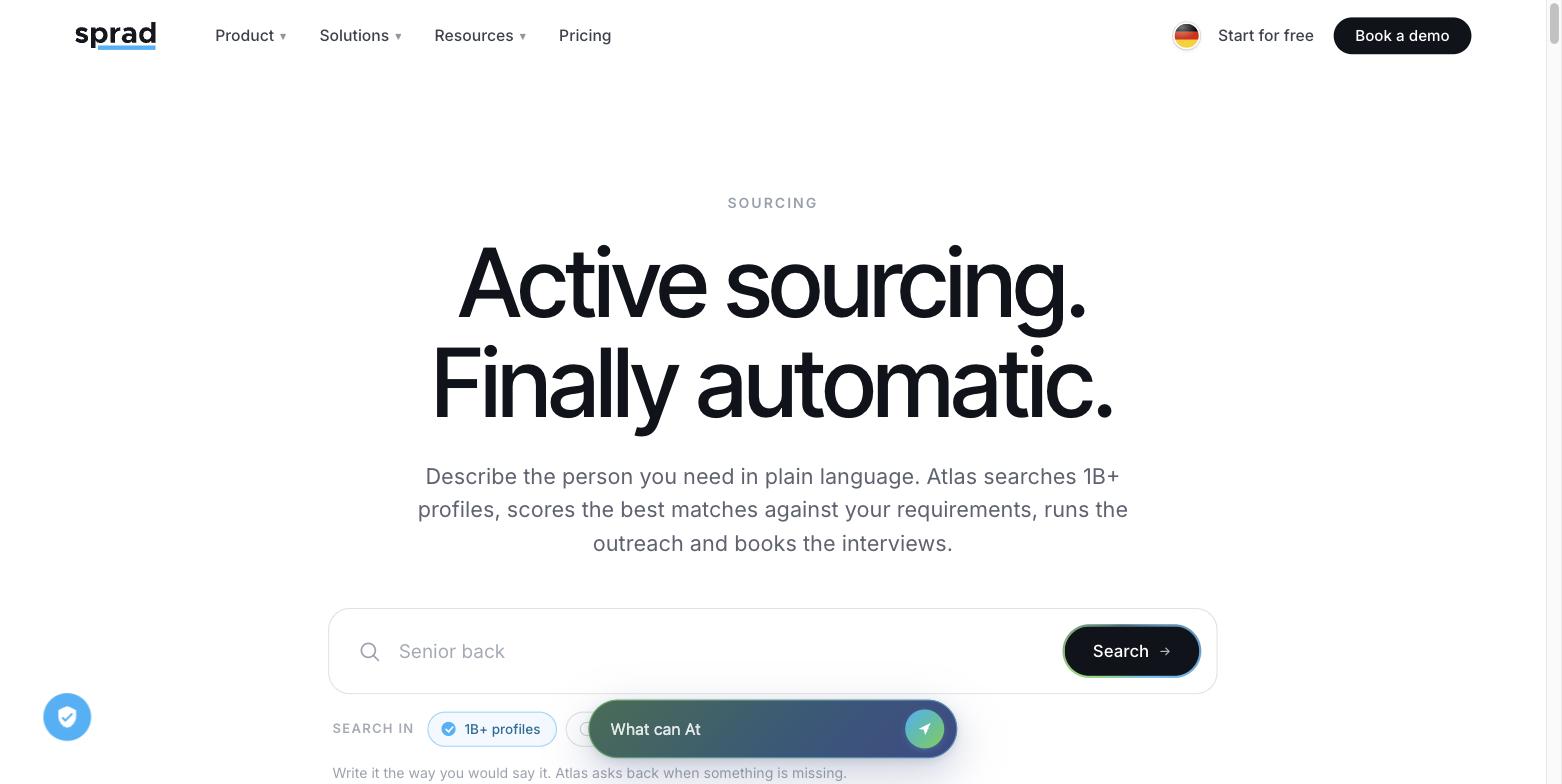
Sprad takes a requirement instead of a Boolean string. Atlas, the sourcing product, checks every profile individually against your requirements instead of running a keyword search, so it also finds people whose profile is poorly maintained or lacks the “right” keywords. Each result comes with a reason per requirement.
- One search over all sources: LinkedIn, GitHub, your own talent pool and the networks of your colleagues, in one of the largest profile databases (1B+ profiles worldwide). Deep Context finds companies first and then the people who worked there in a given period, for example a CFO who led an acquisition.
- LinkedIn and email in one inbox: automated outreach with follow-ups, InMails sent from Sprad (your own InMail allowance can be used), AI templates you can train with feedback, plus a pitch format where you store the selling points of the role. Per talent you see the whole conversation, and the system warns you if someone was already contacted, also by a colleague or for another role.
- Networks nobody else sees: upload your own LinkedIn network, let employees share theirs, or invite former candidates of your agency to connect theirs, then search inside them.
- Your data stays yours: the talent network remains free after cancelling, with free credits to keep searching, and a full raw-data export is available.
- Full Claude MCP to start and update searches and build your own flows, and EU hosting with enterprise-grade data protection and IT security.
- Pre-qualification: voice, video, chat and agent interviews in several languages, and fully automated agents with an optional approval step. Sprad has built recruiting software for 7 years, starting with employee referrals, which is matching profiles to requirements.
Benchmark: in the Recruiting area of the public PeopleSearchBench (119 real search tasks in four areas) Atlas reaches 73.5 of 100 in our own re-measurement, converted to the published scale (Lessie 68.2, Juicebox 65.7 as published). In recruiting it returns almost always 15 matching profiles per search (14.2 on average in the re-measurement).1 In our own test by Sprad (three real roles in three markets, 15 August 2026, one documented run) Sprad returned 38 % of the hits against 9 % for the best competitor in that test. Nebula was not part of either test, so we make no claim about Nebula from them. Plans: sprad.io/pricing. More: Active Sourcing and Sprad for agencies.
1 PeopleSearchBench (Recruiting), published by Lessie, October 2026. Other systems' scores as published in the benchmark; Atlas measured with the benchmark's open test procedure. Contact data came from the “find email” button. Method and details.
2. Pin — agent with a free tier
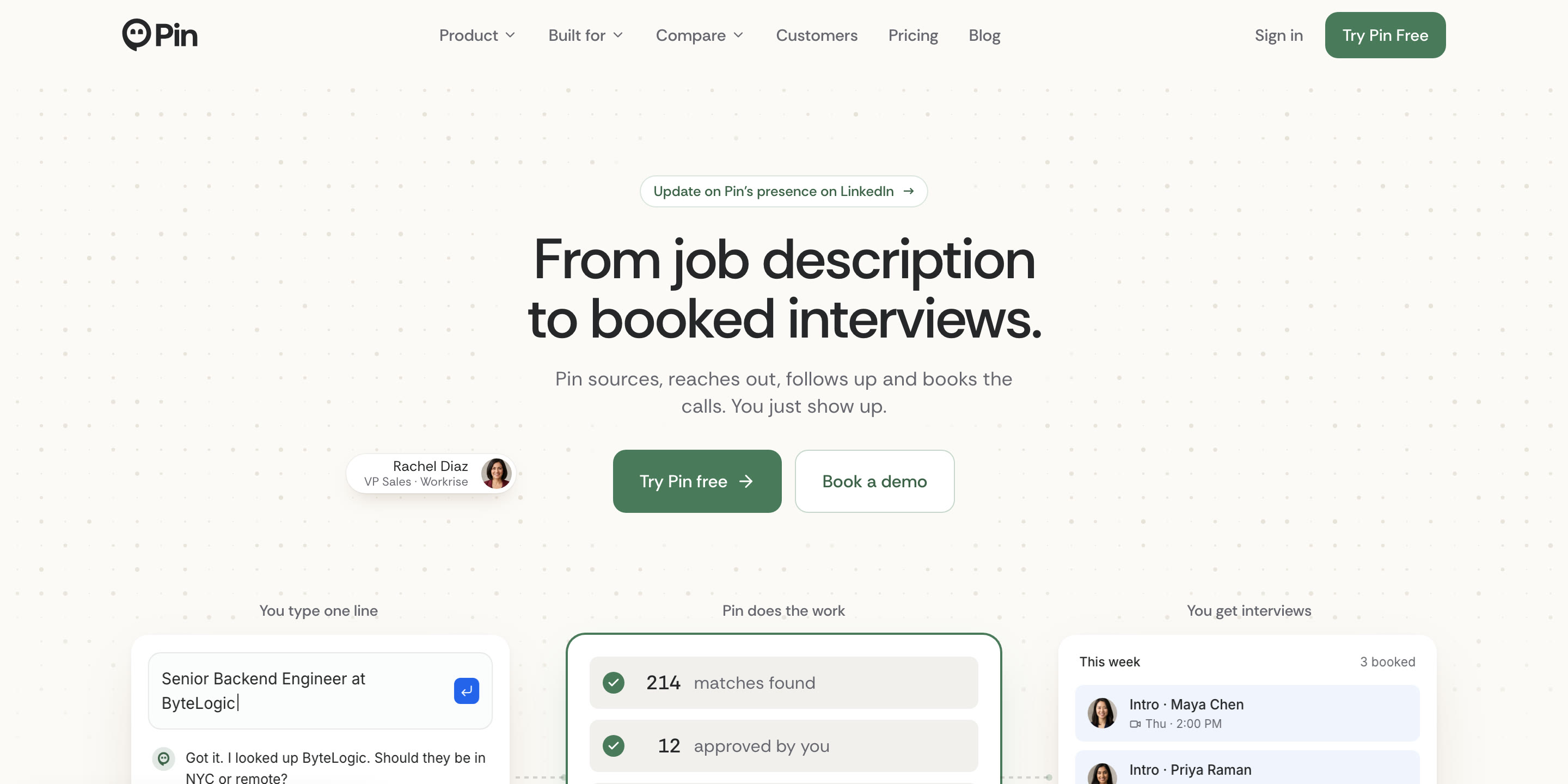
Pin is the closest in concept: an agent that sources, follows up and books calls, with a published free tier and a clearer price list. Its Autopilot runs with approval thresholds and an audit log (vendor description). Pin did not take part in the PeopleSearchBench (Recruiting), so we have no comparable measurement.
3. Juicebox — natural-language search for lean teams
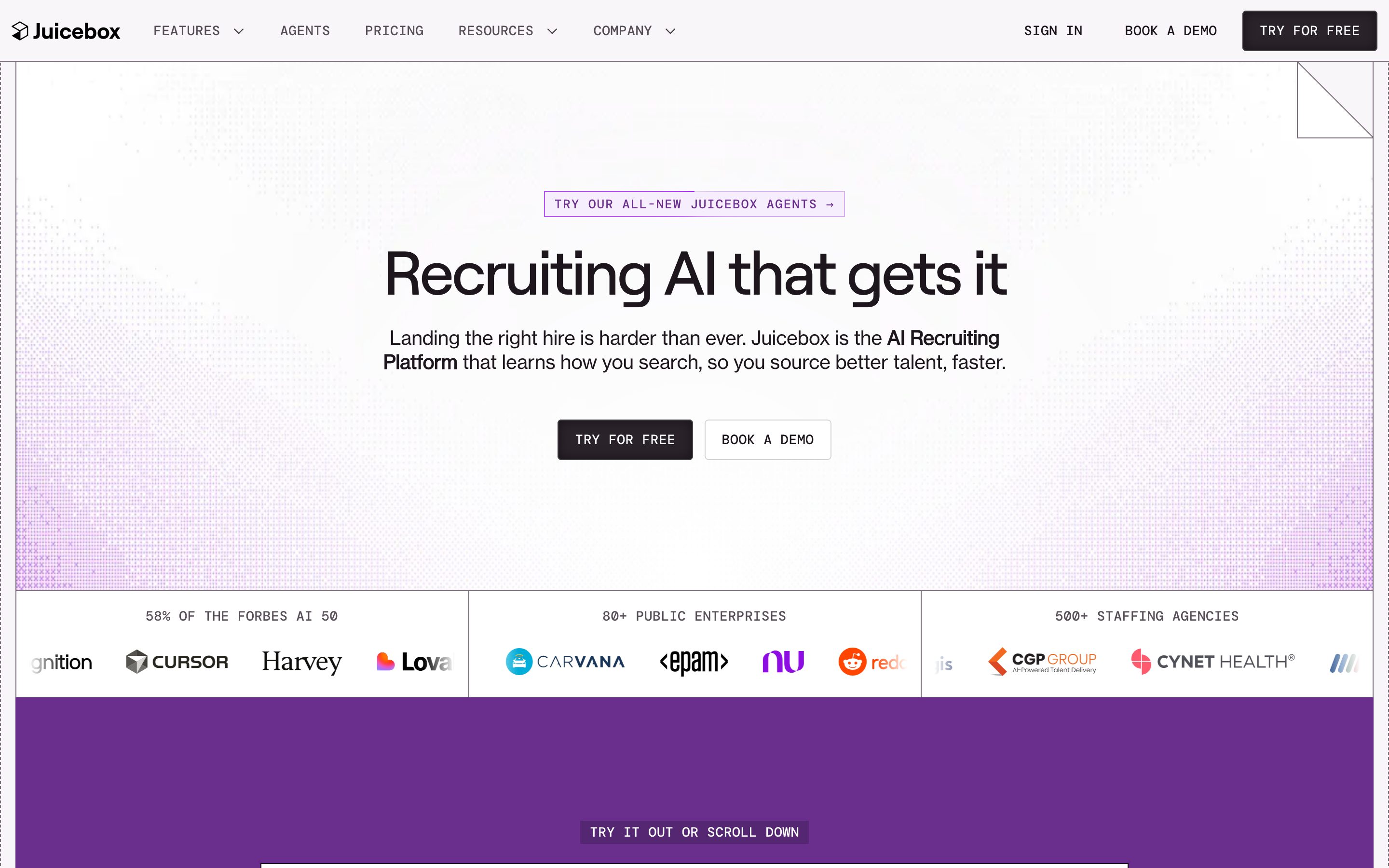
Juicebox publishes its prices and lets you search in plain language. Agents are an add-on. In the Recruiting area of the public PeopleSearchBench it scored 65.7, a solid recruiting result. Details: Juicebox pricing, Juicebox alternatives.
4. SeekOut — deep filters and enterprise reach
See SeekOut alternatives for the long version.
5. hireEZ — sequences and a large filter set
Read the user complaints and alternatives before signing a multi-year deal.
6. Gem — a recruiting CRM with a sourcing agent
Gem searches an 800M-profile index plus past candidates in your ATS and follows up by email, InMail and SMS. Strong if you want the CRM too; more than you need if you only want a sourcing tool.
Which alternative finds more matching candidates?
This is the question that decides the purchase, and the honest answer is: we do not know for Nebula, because it did not take part in the public benchmark we measured against. What we can say is how the benchmark works and how to run your own test. In the Recruiting area of the PeopleSearchBench (119 real search tasks in four areas) the scores are: Atlas 73.5 (our own re-measurement, converted to the published scale), Lessie 68.2, Juicebox 65.7, Exa 64.7, Claude Code 50.5 (as published). Details are in the Sprad section above.
A 20-minute test that works with any tool:
- Pick one open role you know well, with a hard-to-find profile, and write the must-haves in plain words.
- Run it in two tools and look at the first 20 results each.
- Mark every candidate as a clear match, a possible match or a miss, and note whether the tool says why.
- Include one person you already know fits but whose profile is thin, and see who finds them.
Typical mistakes we see: judging by the first three results only, comparing a quick search in one tool with a deep search in another, and ignoring that results appearing instantly usually come from a keyword filter rather than from an AI reading each profile.
How to choose
- US enterprise team with an ATS and an email/SMS-only process: Nebula, after a trial on a real role.
- The most matching candidates, LinkedIn and email in one inbox, XING and your own pool, EU hosting, published prices: Sprad.
- Small budget, solo: Juicebox or Pin's free tier.
- A CRM around sourcing: Gem.
- Deep filters in a larger team: SeekOut or hireEZ.
Our full ranking is in AI sourcing tools compared; more on the market in active sourcing tools compared.
FAQ
What is Nebula AI?
Nebula (nebula.io) is an AI talent acquisition platform for enterprise recruiting with sourcing, email and SMS outreach, ATS integrations and analytics.
How much does Nebula cost?
The vendor's page lists $250–275 per seat and month and, separately, plans from $1,000 to $10,000 a month with lookup limits (as of 30 October 2026). Ask which list applies to you.
What are the best Nebula alternatives?
It depends on the job: Sprad if you want the most matching candidates (every profile checked individually), LinkedIn and email in one inbox, your own talent network and EU hosting; Pin or Juicebox for budget; Gem for a CRM; SeekOut or hireEZ for filters.
Who should switch from Nebula?
Teams that recruit in Europe, need LinkedIn outreach or want published prices. US enterprise teams that depend on its ATS connections can stay.
Does Nebula use LinkedIn?
On the pages we read, outreach is email and SMS; we found no LinkedIn channel.
How do the alternatives compare on GDPR?
Sprad hosts in the EU. For the others we found no published hosting location; ask for it and for a data processing agreement before you sign.
Which alternative finds more matching candidates?
In the Recruiting area of the public PeopleSearchBench, Atlas reaches 73.5 of 100 in our own re-measurement, converted to the published scale. Nebula was not part of it, so test both on a real role.
Sources: vendor websites and public roundups, accessed 30 October 2026; EU legal texts via EUR-Lex; German law via gesetze-im-internet.de; US rules via eCFR and nyc.gov. Competitor figures are the vendors' own claims or third-party estimates and may change.
Jürgen Ulbrich
Jürgen Ulbrich has more than a decade of experience in developing and leading high-performing teams and companies. As an expert in employee referral programs as well as feedback and performance processes, Jürgen has helped over 100 organizations optimize their talent acquisition and development strategies.