Perbility publishes no public price for Helix, its HR suite — not a starting price, not a per-seat number. Every quote runs through a custom offer based on module combination and the customer organization's headcount, as of September 2026 according to Perbility's own product page. For a recruitment agency there's a second issue: Helix isn't built for agency work at all. It's built for companies managing their own 200 to 10,000+ employees, so "real cost per recruiter" simply isn't a metric that exists here.
Perbility's pricing model: two paths, both "on request"
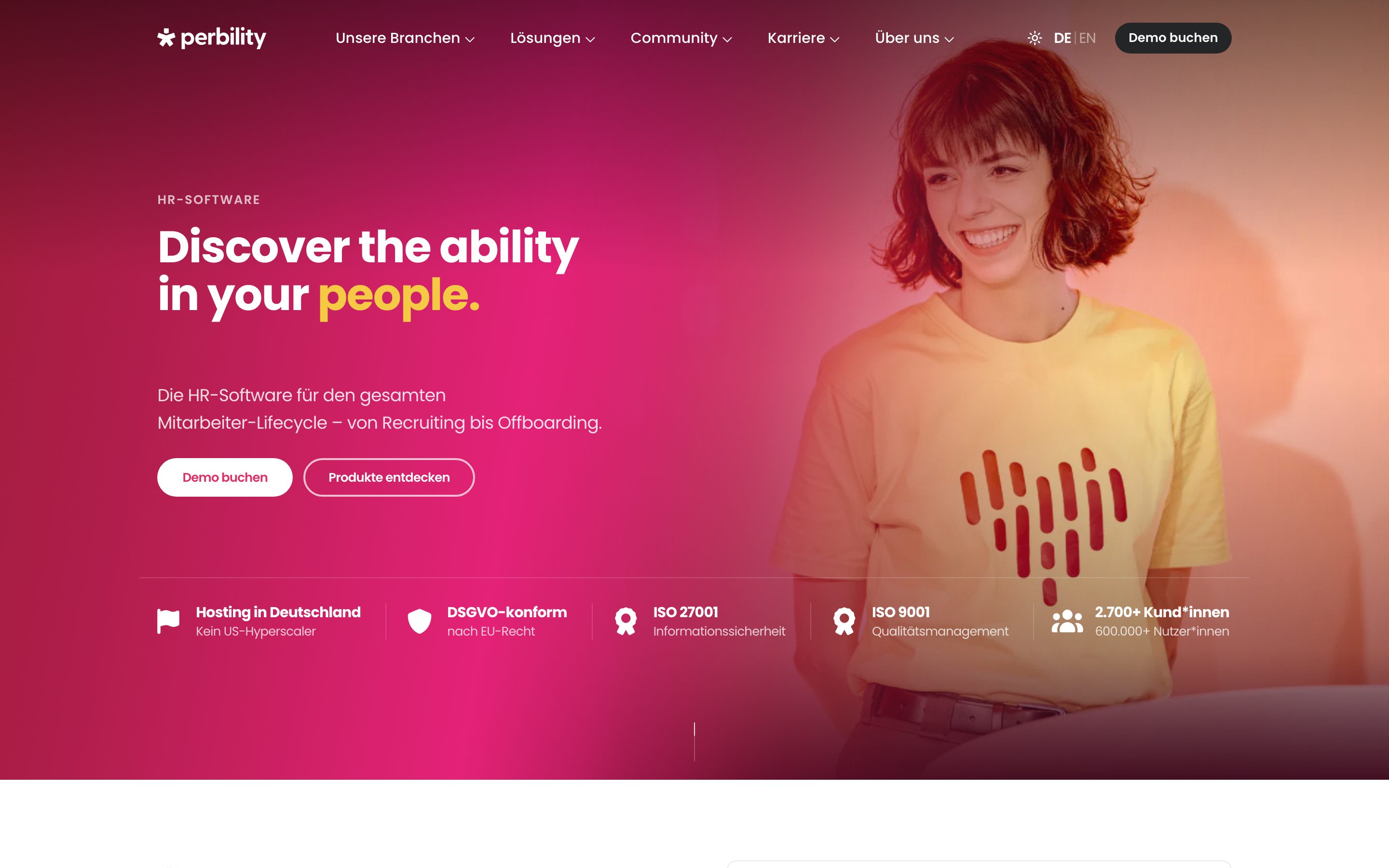
Perbility's own site names two possible billing logics for Helix, without attaching a figure to either one.
| Plan | Price | Model |
|---|---|---|
| Modular model | On request | Custom quote per module combination, depending on company size and feature scope |
| License model | On request | Licensed per user or per functional module |
Both paths end at the same place: you talk to sales or book a demo before seeing a number. Perbility publishes no price list, no self-serve checkout and no freely startable trial anywhere on its site — even its second product for high application volumes, Concludis, shows no price at all and also ends at "book a demo."
What actually drives the quote
Since no number is public, it's worth looking at the factors that move a quote up or down in practice, gathered from Perbility's own product description and independent reviews.
- Module combination. Helix sells HR administration (digital personnel files, time tracking, contract management), applicant tracking, learning and development, performance management and analytics as separately purchasable modules — the more of them in the offer, the higher the bill.
- Organization headcount. Perbility positions Helix for companies with 200 to 10,000 employees, and according to an independent vendor overview, serves more than 2,700 customers and over 600,000 active users overall. The licensing tier scales with the size of the client's own workforce, not with the number of recruiters on a team.
- Industry and compliance load. A notably large share of public reviews comes from the banking sector (Sparkassen, Volksbanken) with 51 to 1,000 employees, where ISO 27001 certification and German hosting are baked into the deal — a factor that tends to push price up, not down.
- Setup and configuration. Several OMR reviews independently mention "relatively high costs without volume discounts" and configuration that takes "considerable time" before the system is running — effort that's rarely broken out separately in the quote.
- No self-serve access. The path to a price starts with a demo call or a callback request, not a sign-up — there's no publicly stated trial period.
Why this is the wrong pricing question for a recruitment agency anyway
Helix is built around the employee lifecycle of a company's own workforce: digital personnel files, onboarding, time tracking, learning and development, performance reviews. For staffing firms, the feature documentation shows no compliance layer for temporary staffing regulations, no shift or deployment planning, and no collective-agreement pay calculation — Perbility's own module list covers none of those three areas. Even Perbility's second product for high-volume hiring, Concludis, is described as targeting international corporate recruiting teams across their own offices in 48 countries — not staffing agencies working shifting client mandates. Anyone searching "Perbility price per recruiter" as an agency is, in practice, comparing two different software categories: an internal HR suite and an agency ATS.
What recruitment agencies actually pay instead
Sprad: a fixed seat price, then only for what happens
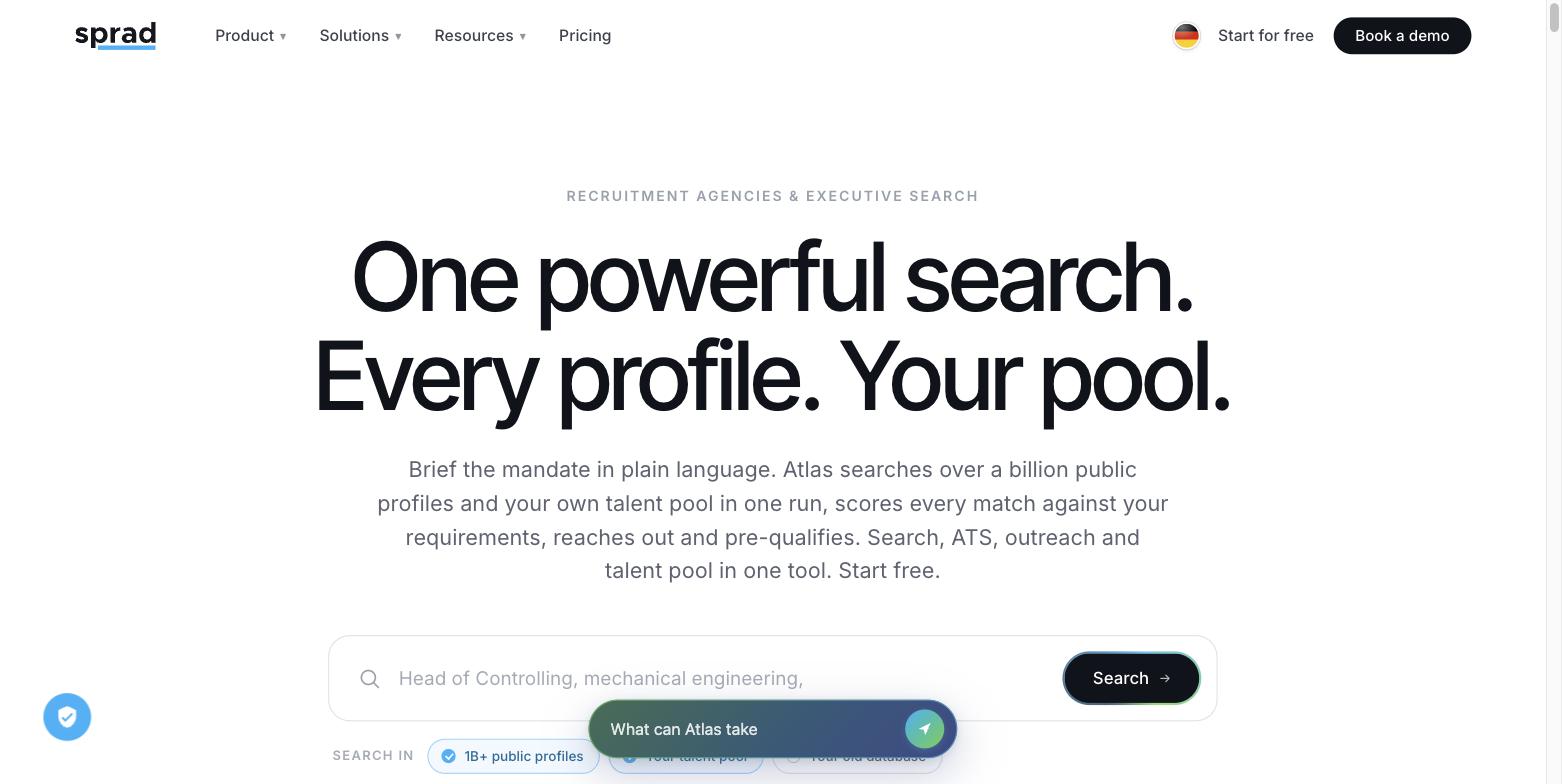
Sprad charges 59 € per recruiter per month for the ATS and a talent pool the agency owns, then bills search, screening and interviews by credit — only when they actually happen. A requirement search checks up to 50 profiles per run and costs 2 credits per profile that passes the check — worst case, 100 credits, but usually much less, since rejected profiles cost nothing. A full CV review costs 3 credits, a 5-minute voice interview costs 30 credits, and 1 credit runs 6 to 8 cents. Every account gets 200 free credits a month, no credit card required. A 5-recruiter team pays 295 €/month as its base (3,540 €/year); a 15-recruiter team pays 885 €/month (10,620 €/year) — on top of that, you only pay for what's actually searched, screened and interviewed. Full numbers: sprad.io/industry/recruitment-agencies.
Coveto: the DACH alternative with real numbers
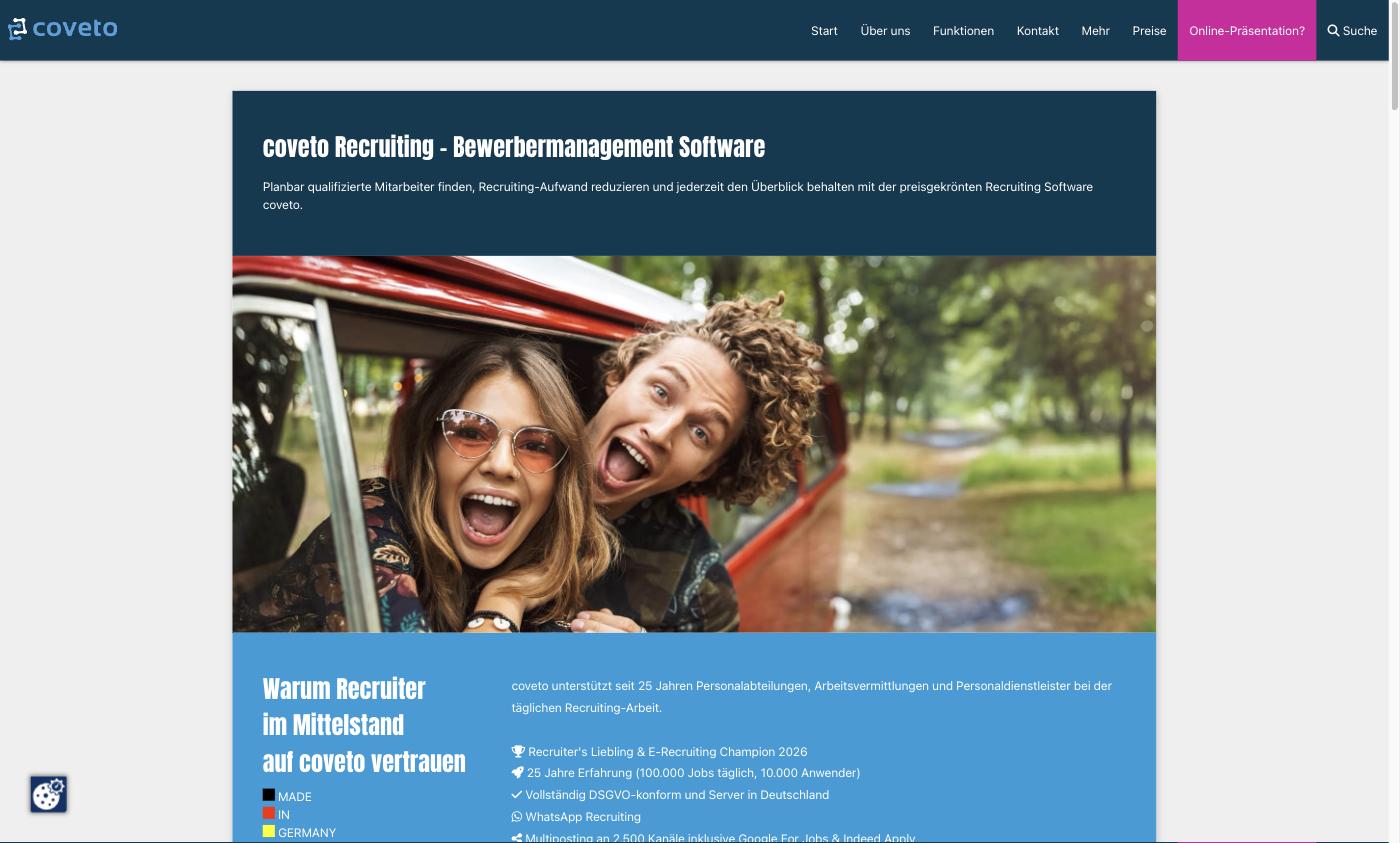
If you specifically want a German applicant-tracking system to compare, Coveto actually publishes prices: 119 €/month for the Starter package (up to 10 jobs, 100 candidates), 218 €/month for the Large package (unlimited, including AI assistant and CRM), and 340 €/month for the Professional package with premium support, per its own pricing page. Like Perbility, Coveto isn't a sourcing tool — candidates come from inbound applications and the company's own pool, not external search — but unlike Perbility, it's transparently priced and explicitly positioned for staffing and recruitment businesses too.
Is Perbility worth it?
For a mid-size or large company that wants to manage its own workforce centrally, from digital personnel files to performance reviews, the investment can pay off — OMR reviews (4.6/5 from 50 ratings) and an eKomi score of 4.8/5 from 4,700 ratings, per an independent vendor overview, point to satisfied users in exactly that segment, mostly in banking. For a recruitment agency or staffing firm, the pricing question barely matters: there's no module for client mandates, deployment planning or external candidate search, and even a cheap quote wouldn't cover what an agency actually does day to day.
FAQ
How much does Perbility cost per month?
Perbility publishes no public price. Both billing models — modular or per license — run through a custom quote after contacting sales, as of September 2026.
Is there a free trial of Perbility?
No. Perbility offers a free live demo, but not a self-startable trial period.
Is Perbility suitable for a recruitment agency or staffing firm?
Barely. Helix has no compliance layer for temporary staffing, no deployment planning and no collective-agreement pay calculation — the core functions a staffing firm needs. It's built for the internal HR management of companies with their own employees, not for mandates with rotating clients.
What's the cheapest alternative with real, public pricing?
Coveto publicly starts at 119 €/month for a basic ATS. Sprad has the lowest base fee in this comparison at 59 € per recruiter, after which you only pay for actual usage.
How many customers does Perbility have?
By its own account and independent overviews, more than 2,700 customers and over 600,000 active users in total, as of September 2026.
Does Perbility offer pricing specific to staffing agencies?
No. Perbility doesn't publicly differentiate by industry, only by module combination and organization headcount — there's no dedicated pricing tier for staffing agencies because the product isn't built for that audience.
The bigger point
The big platforms get more expensive every year, and cancelling one means losing your reach with it — Sprad turns an agency's own network into a candidate source that stays, even after a subscription ends. Requirement search runs across more than 1 billion public profiles and your own pool in a single pass, with a score and reasoning against each criterion, plus ATS, talent pool, LinkedIn outreach and voice pre-qualification in 12 languages, all in one tool, with 200 free credits a month and no credit card. See what that means for your team size at sprad.io/industry/recruitment-agencies.
Jürgen Ulbrich
Jürgen Ulbrich has more than a decade of experience in developing and leading high-performing teams and companies. As an expert in employee referral programs as well as feedback and performance processes, Jürgen has helped over 100 organizations optimize their talent acquisition and development strategies.