Recruiterflow earns strong marks from real users: 4.6 out of 5 across 194 reviews on G2 and 4.7 out of 5 across 332 reviews on Capterra, as of September 2026. Agencies consistently praise its automation and support, and just as consistently flag awkward custom reporting and cumbersome bulk actions — worth knowing before you commit a team to it.
What the ratings actually say
| Platform | Score | Reviews | Sentiment |
|---|---|---|---|
| G2 | 4.6/5 | 194 | Not broken out by star |
| Capterra | 4.7/5 | 332 | 252 five-star, 74 four-star, 6 three-star or below |
On G2, Recruiterflow sits at 4.6/5 from 194 reviews. On Capterra, it scores 4.7/5 from a larger sample of 332 reviews, with a sentiment breakdown of 252 five-star, 74 four-star and only 6 reviews at three stars or below. That distribution — barely 2% of reviewers landing below four stars — points to a genuinely satisfied user base rather than a rating propped up by a handful of enthusiasts.
The gap between the two platforms is worth noting too: Capterra's larger sample (332 reviews versus G2's 194) still lands within a tenth of a point of G2's score, which is a reasonable signal that the rating isn't an artifact of one review site's audience.
What agencies love about Recruiterflow
- Ease of use and customer support. Both G2 and Capterra reviewers name support as a consistently strong point — Recruiterflow shows up in reviews as responsive when something breaks, which matters more for a smaller agency without in-house IT.
- Automation that replaces other tools. The Recipes automation engine is repeatedly credited with letting teams drop a separate Zapier or lemlist subscription — reviewers describe it as one of the few ATS automations that actually gets used, not just switched on and forgotten.
- LinkedIn integration. Reviewers single out the profile-parsing feature — pull up a LinkedIn profile, and Recruiterflow auto-creates the candidate record — as a genuinely time-saving detail rather than a marketing checkbox.
What agencies criticize about Recruiterflow
- Reporting setup is awkward. Building custom dashboards takes real configuration time, and several reviewers describe the process as more fiddly than it should be for a tool this mature.
- Bulk actions and imports are cumbersome. Even with the Chrome extension handling single-profile imports well, moving or updating candidates in bulk is a recurring pain point in both G2 and Capterra reviews.
- Contract paperwork at volume. Reviewers running temp or contract staffing specifically flag limits in how Recruiterflow handles paperwork at scale — a workflow gap rather than a missing feature.
Who Recruiterflow fits — and who it doesn't
Recruiterflow works well for established agencies of roughly 3 to 50 recruiters that want ATS, CRM and automation in one workspace, especially teams whose sourcing already leans on LinkedIn and who want email and SMS sequences without adding a separate tool. Mid-market agencies with a settled workflow — the kind of team that values a support line that answers — are exactly who the reviews describe as happiest.
It fits less well for a solo recruiter or two-person shop, since every plan enforces a 3-seat minimum regardless of team size. It's also a weaker match for contract or temp staffing operations that need deeper payroll and paperwork handling, for reporting-heavy teams that want dashboards to work out of the box, and for any agency whose real bottleneck is finding candidates outside their own database — Recruiterflow's sourcing is LinkedIn-native, not a built-in external search across a billion-plus profiles. And because AIRA, the AI candidate matcher, sits behind the top Enterprise tier at $159/seat/month, an agency evaluating Recruiterflow specifically for AI sourcing should budget for that tier from the start rather than assuming it comes with the base plan.
If Recruiterflow isn't quite right, what to look at instead
Sprad: external search and an owned pool
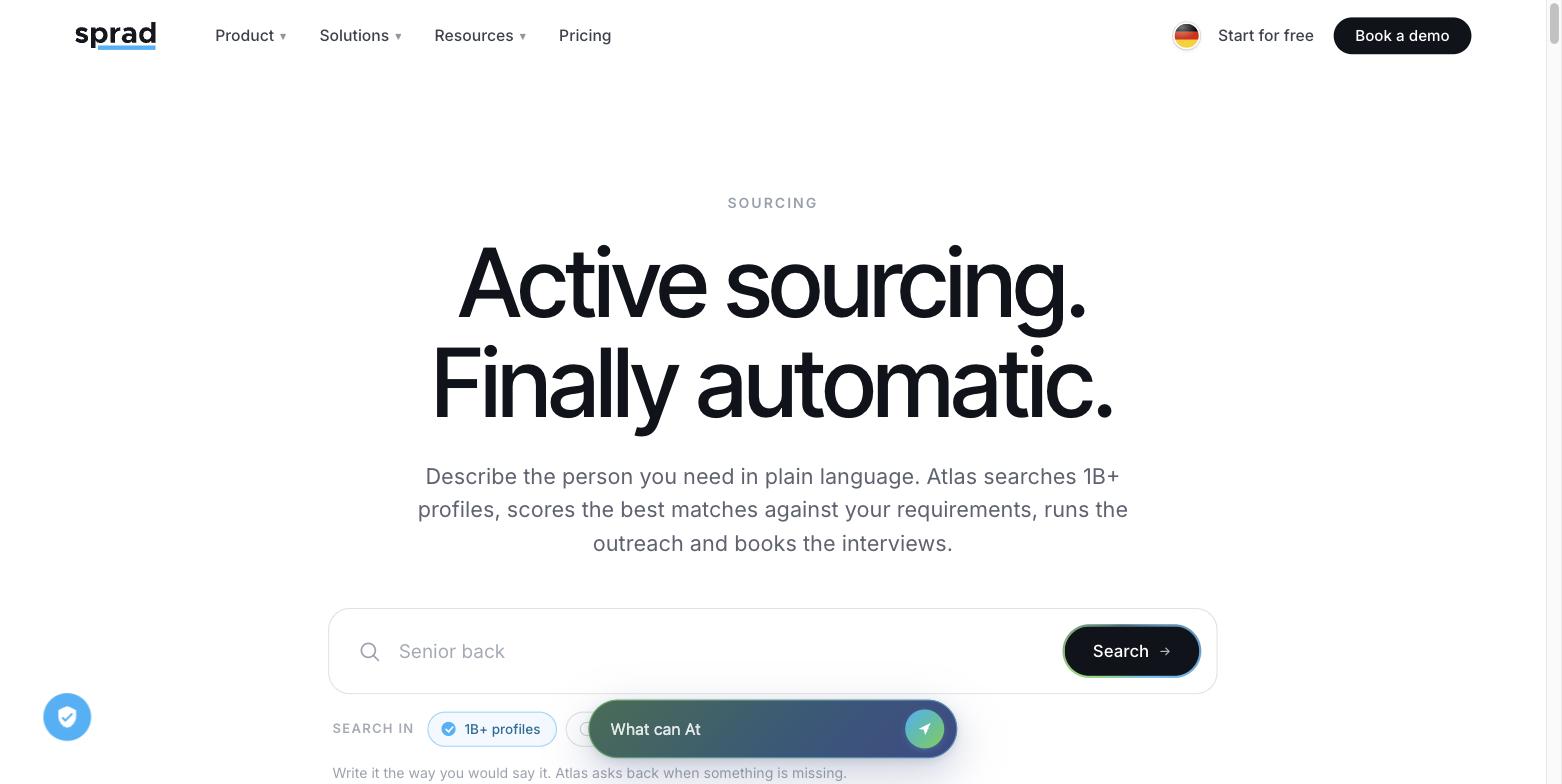
Sprad is worth a look first if the gap you feel is sourcing, not automation: instead of a Chrome extension into LinkedIn, Sprad searches more than a billion external profiles by describing the role in plain language, and every candidate found becomes part of a talent pool your agency owns — not a subscription that disappears if you cancel. Pricing starts at 59 €/recruiter/month for the ATS and a talent pool your agency keeps, with search, outreach and interviews billed only when they happen, plus 200 free credits every month.
For a team whose main complaint about Recruiterflow is "we still can't find candidates outside our own pipeline," that's the more direct fix. See it at sprad.io/industry/recruitment-agencies, and the full breakdown of Recruiterflow's own pricing in our Recruiterflow pricing guide.
Recruit CRM: a closer ATS/CRM swap
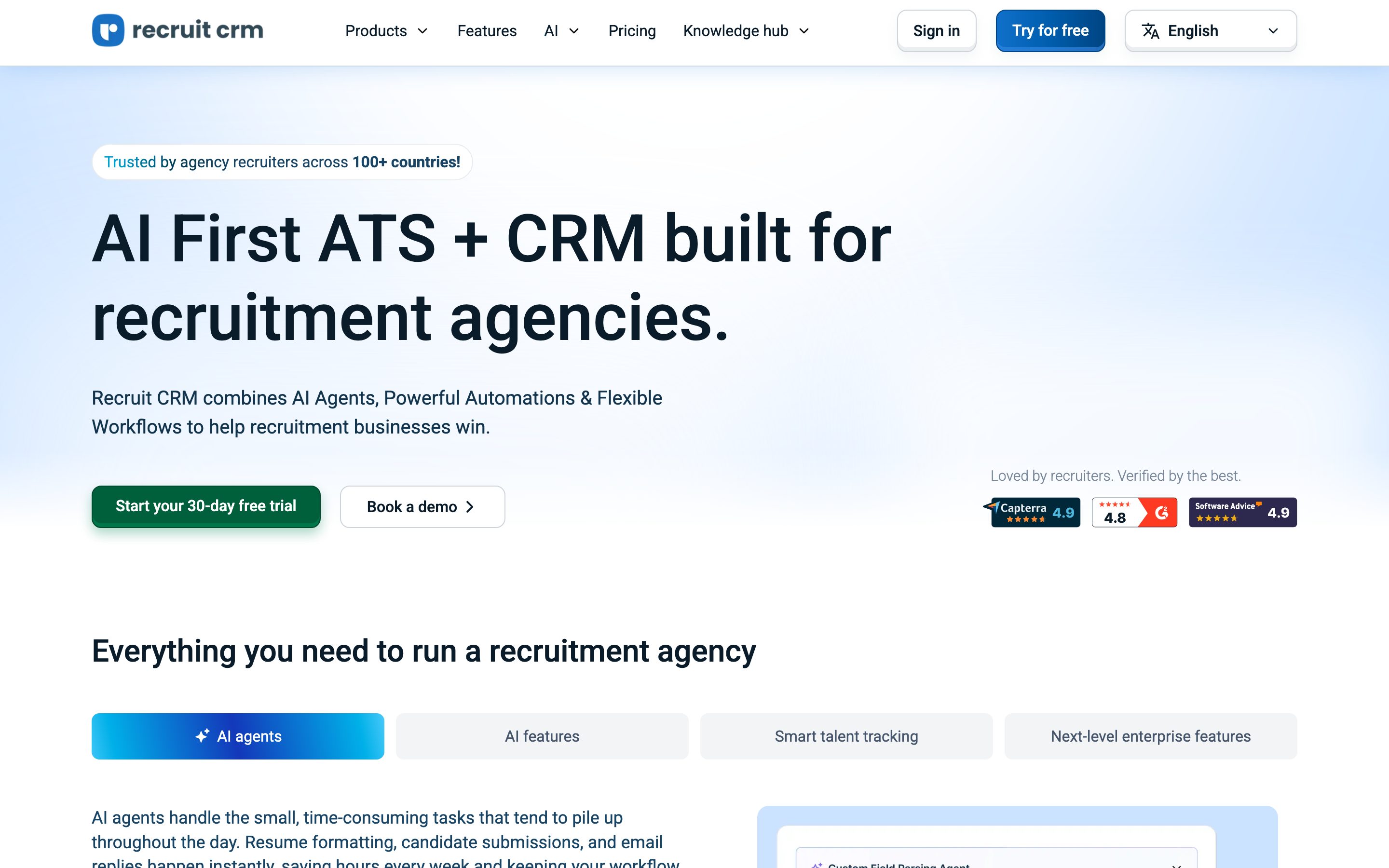
If your actual complaint is the 3-seat minimum rather than sourcing, Recruit CRM (around $95/user/month annually, no published seat floor) is the closer like-for-like swap, though it comes without Recruiterflow's Recipes automation — see how it stacks up against real reviewers in our Recruit CRM reviews roundup. And if reporting is what's bothering you, it's worth checking whether the issue is Recruiterflow's setup process specifically — several reviewers note it improves noticeably once a dashboard is built once and reused, rather than rebuilt per search. A fuller side-by-side of every option sits in our Recruiterflow alternatives comparison.
FAQ
Is Recruiterflow good?
Reviews say yes for its core use case: 4.6/5 on G2 and 4.7/5 on Capterra, with automation and support named as the strongest points, as of September 2026.
What do people complain about most with Recruiterflow?
Awkward custom-report setup, cumbersome bulk actions and imports, and contract-paperwork limits for high-volume temp staffing are the three most consistently repeated criticisms.
Is Recruiterflow worth it for a small agency?
It can be, but the 3-seat minimum on every plan means a solo recruiter or two-person team pays for three licenses regardless — worth weighing against alternatives without a seat floor.
Does Recruiterflow have good LinkedIn sourcing?
Its LinkedIn profile-parsing and Chrome extension are genuinely well-reviewed for pulling profiles into the ATS, but it doesn't include an external search across a broader candidate database the way a dedicated sourcing tool does.
What's a good alternative if I like Recruiterflow's automation but need better sourcing?
Sprad pairs an ATS and owned talent pool with a search across 1B+ external profiles, so sourcing doesn't depend on LinkedIn access alone — worth comparing directly against your current Recruiterflow bill.
Does G2 or Capterra rate Recruiterflow more accurately?
Both point the same direction — 4.6/5 on G2's 194 reviews and 4.7/5 on Capterra's larger sample of 332 — so neither looks like an outlier skewed by a small or unusually happy group of reviewers.
Why the pool you build matters more than the review score
A 4.6-star average is a real signal, but it only measures how a tool behaves while you're paying for it. The question that outlasts any review is what happens to your candidate relationships the day you stop.
Sprad's pitch is built around exactly that gap: your outreach builds a talent pool that stays with your agency, searchable across more than a billion external profiles, starting with 200 free credits a month and no credit card. Compare it for your team size at sprad.io/industry/recruitment-agencies.
Jürgen Ulbrich
Jürgen Ulbrich has more than a decade of experience in developing and leading high-performing teams and companies. As an expert in employee referral programs as well as feedback and performance processes, Jürgen has helped over 100 organizations optimize their talent acquisition and development strategies.