Recruiting in DACH means one language area but three legal systems and three labour markets. What works best is a mix of job ads, active sourcing across LinkedIn, XING and your own talent pool, and employee referrals, plus the country-specific duties: data protection (GDPR, or the Swiss DSG), salary information in Austria, and a vacancy-reporting duty for certain occupations in Switzerland. This guide shows which channels and tools are worth using, which mistakes cost time and money, and what AI changes today.
What does “DACH recruiting” actually mean?
DACH stands for Germany (D), Austria (A) and Switzerland (CH). Companies treat it as one hiring region because the language is shared, but each country has its own rules. Teams routinely hire across borders: a Munich team searches in Salzburg, a Zurich company in Baden-Württemberg.
The market is tight and unemployment is rising at the same time, which is why a job ad alone is no longer enough:
- Germany: the Federal Employment Agency lists 157 occupations with a skilled-worker shortage (previous year: 163). In 2025 about 402,000 positions for skilled workers, specialists and experts were registered on average, roughly half of them in shortage occupations (press release of 2 September 2026).
- Austria: at the end of April 2026 the unemployment rate was 7.5 % according to the AMS, yet employers still report shortages. The qualified people you want are usually not job hunting.
- Switzerland: the 2026 vacancy-reporting duty covers occupations with an unemployment rate of 5 % or more. The share of workers in covered occupations rises from 6.5 % to 10.8 %, with cooks newly added.
In practice the best candidates are employed and respond to direct, well-matched outreach, not to ads. That is what active sourcing is for.
Germany, Austria and Switzerland compared
The table shows where processes must change between countries. It is not legal advice.
| Topic | Germany | Austria | Switzerland |
|---|---|---|---|
| Salary in the ad | No duty today; EU Directive 2023/970 requires pay information before the interview, national law still pending | Required: collective-agreement minimum pay, plus a note if you pay more (§ 9 GlBG) | No duty |
| Vacancy reporting | None | None | Jobs in occupations at 5 %+ unemployment go to the RAV (Job-Room) |
| Data protection | GDPR, BDSG | GDPR, DSG | Own DSG (since 1 Sept 2023) and Art. 328b CO |
| Probation (maximum) | 6 months (§ 622(3) BGB) | 1 month (§ 19 AngG) | 1 month, up to 3 by contract (Art. 335b CO) |
| Notice (employees) | Statutory 4 weeks to the 15th or month-end (§ 622 BGB), longer by contract | 6 weeks to 5 months by tenure (§ 20 AngG) | 1, 2 or 3 months by years of service (Art. 335c CO) |
| Typical networks | LinkedIn and XING | LinkedIn and XING | LinkedIn, XING; French-speaking Romandie |
In Austria a missing minimum pay leads to a warning first and a fine of up to 360 euros for repeat violations (§§ 9 and 10 GlBG). The fine is small, the damage with candidates is not. In Switzerland, probation and notice rules in the Code of Obligations differ, so a German contract cannot simply be reused.
Which channels work in the DACH region?
No single channel is enough. Reliable market-share figures exist only from the networks themselves, so we list strengths and limits from practice instead of reach numbers.
| Channel | Strength | Limit | Best for |
|---|---|---|---|
| Job boards (StepStone, Indeed, karriere.at, jobs.ch) | Active job seekers, fast visibility | Rarely reach employed people | Volume and trade roles |
| Career site | Own brand, own data | Needs traffic from other channels | All roles, target of every message |
| Largest international reach, InMail | Expensive seats, reply rates vary | International and tech roles | |
| Strong with German-speaking professionals and SMEs | Smaller internationally | Regional searches in Germany and Austria | |
| Active sourcing | Reaches passive candidates directly | Time, data-protection duties | Shortage roles, specialists |
| Employee referrals | Strong fit, short path | Needs process and reward | All roles, especially trades |
| Own talent pool | Warm contacts, no media cost | Must be kept current and GDPR-compliant | Recurring demand |
For a tool-by-tool view read the comparison of DACH sourcing tools; LinkedIn and XING are covered in LinkedIn Recruiter vs XING TalentManager. When an ad pays off and when direct outreach does is explained in job ad or active sourcing.
Step by step: how to approach DACH hiring
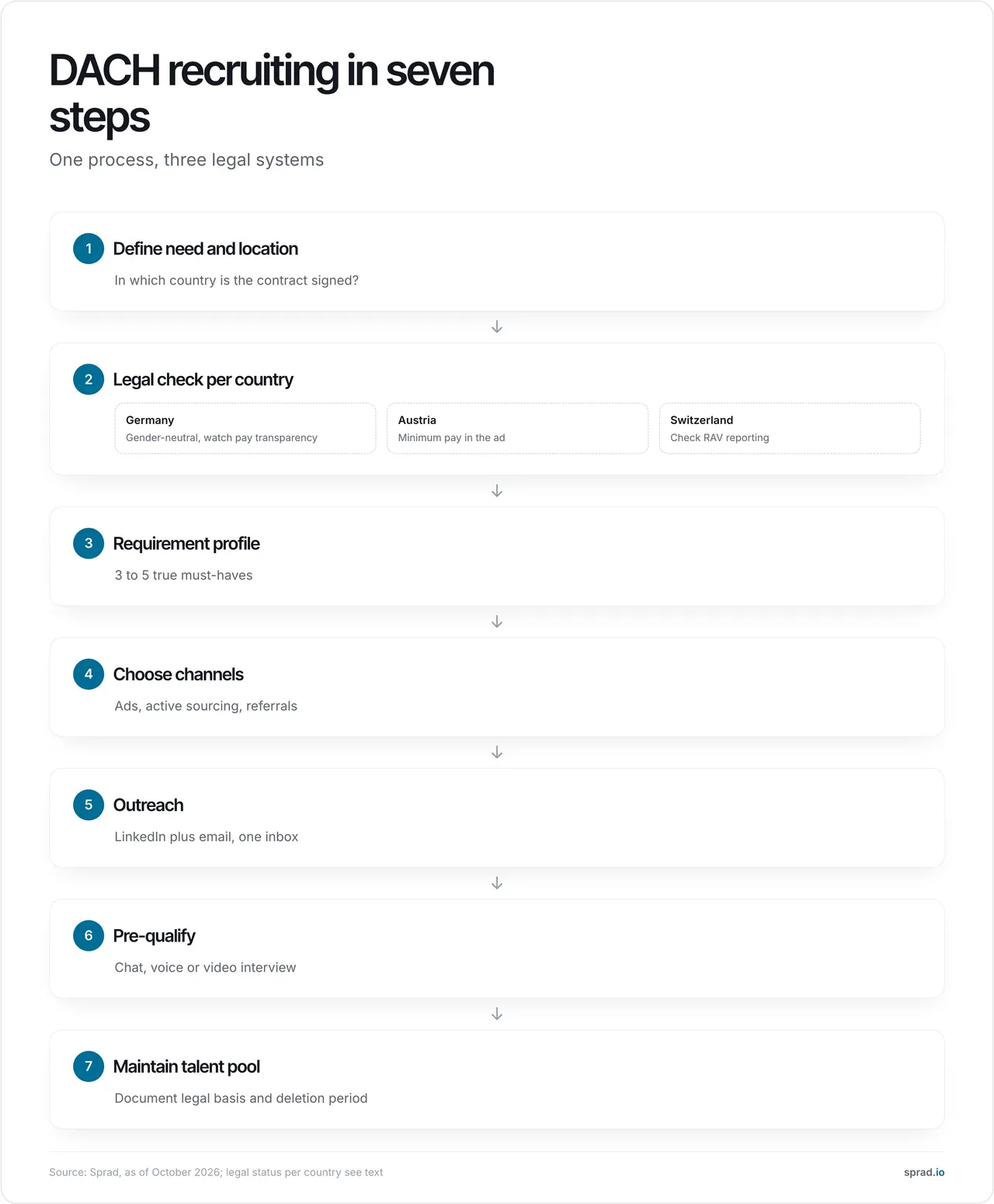
- Define need and location. Where will the person work and in which country is the contract signed? This decides salary information, probation and reporting.
- Legal check per country. Austria: minimum pay in the ad. Switzerland: check on arbeit.swiss whether the occupation is reportable. Germany: write gender-neutral and watch pay-transparency implementation.
- Write the requirement profile. Three to five true must-haves, the rest nice-to-have. The more freely you describe it, the better an AI search works.
- Choose channels. Ads for active seekers, active sourcing for employed people, referrals for fit.
- Reach out on two channels. LinkedIn plus email with follow-up. In our experience this combination gives the highest reply rates, as long as both channels land in one inbox.
- Pre-qualify. A short call or chat/voice interview before the hiring manager invests time.
- Maintain the pool. Good people who do not fit now belong in the talent pool, with a documented legal basis and deletion period.
Data protection and law: what applies to active sourcing?
Looking at profiles in business networks and contacting people means collecting data from a third party. In the EU Article 14 GDPR applies: data subjects must be informed, at the latest at first contact and in any case within one month. The notice names purpose, legal basis (often legitimate interest, Art. 6(1)(f)), source and retention period. A short privacy line with a link in the first message is enough in practice.
- Switzerland: the revised Data Protection Act has applied since 1 September 2023. Art. 328b CO also limits what employers may process about applicants: only data relevant to suitability.
- Pay transparency: Directive (EU) 2023/970 requires that applicants learn the starting pay or range before the interview and bans questions about pay history. The transposition deadline was 7 June 2026; in the sources we checked, Germany had no adopted implementing law as of 30 October 2026. Plan pay ranges now anyway.
- AI use: recruiting AI is high-risk under Annex III of the EU AI Act. After the Digital Omnibus the obligations apply from 2 December 2027. What matters is that humans decide and AI only prepares. More: active sourcing and GDPR and talent pools and retention.
Which tools help with DACH recruiting?
A sensible stack has five building blocks. The fewer systems, the less duplicate work and the lower the data-protection risk.
| Building block | Job | What to check for DACH |
|---|---|---|
| Applicant tracking (ATS) | Applications, process, rejections | German interface, data-processing agreement, works-council readiness |
| Multiposting | Ad on several boards | Local boards: karriere.at for Austria, jobs.ch for Switzerland |
| Sourcing tool | Find and contact candidates | XING coverage, email channel, EU data hosting |
| Talent pool / CRM | Maintain contacts | Legal basis, deletion periods, export |
| Screening and pre-qualification | Selection at high volume | Multilingual, traceable reasoning |
Our approach: Sprad for sourcing, outreach and pool
Sprad has built recruiting software for 7 years, for start-ups up to large corporations, public bodies and insurers, starting with employee referrals, which is matching profiles to requirements. The sourcing product, Atlas, covers the DACH process in one tool:
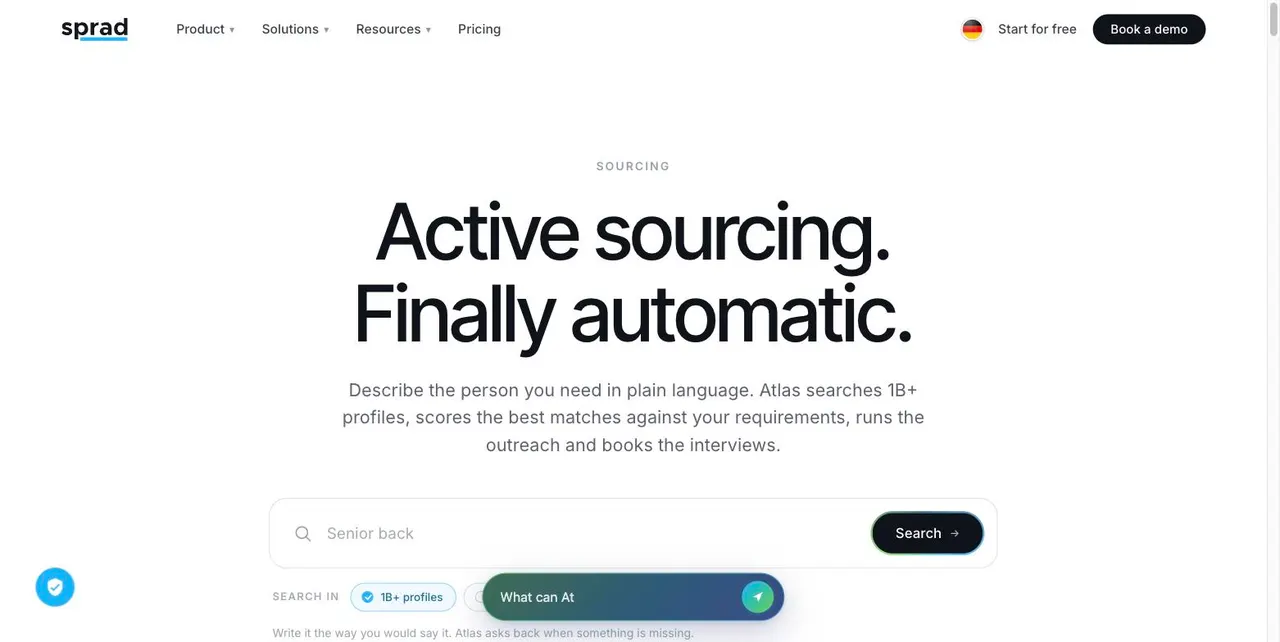
- One search across all sources: LinkedIn, XING, GitHub and your own talent pool, in one of the largest profile databases with over 1 billion profiles worldwide.
- Requirements instead of keywords: Atlas checks every profile individually against your requirements and gives a reason per criterion, so it also finds people with poorly maintained profiles. Rule of thumb: if results appear instantly, it is almost always a keyword search.
- LinkedIn and email in one inbox: automated outreach with follow-ups, InMails sent from Sprad, AI templates, and a warning if a colleague already contacted the person.
- Networks nobody else sees: your own LinkedIn network, your employees' networks and, for agencies, those of former candidates.
- Your data stays yours: EU hosting, high data-protection and security standards, full raw-data export, and the talent network stays free after cancelling.
Benchmark: in the public PeopleSearchBench (Recruiting) Atlas reaches 73.5 out of 100 in our own re-measurement, converted to the published scale (Lessie 68.2, Juicebox 65.7 as published). In recruiting searches it returns almost always 15 matching profiles (14.2 on average).1 Fair limits: no AI call notetaker and no placement reporting yet, no SMS (WhatsApp for candidate communication instead), and the deep search takes a few minutes while Quick Search returns first results in about 3 seconds.
1 PeopleSearchBench (Recruiting), published by Lessie, October 2026. Other systems' scores as published in the benchmark; Atlas measured with the benchmark's open test procedure. Method and details.
Worked example: six shortage roles, three recruiters
Assumptions (not Sprad measurements, replace with your numbers): a team needs about 120 outreach messages per hire in active sourcing: 25 % replies, 40 % of those interested (12 conversations), four finalists, one hire.
- Six roles × 120 messages = 720 messages, or 240 per recruiter.
- Tool cost at Sprad (net, billed annually): three Recruiter Lite seats × 79 € = 237 € per month; three Atlas Recruiter seats × 299 € = 897 € per month with unlimited search (fair use), deep search and one LinkedIn and mailbox account per seat. Prices: sprad.io/pricing, as of 29 October 2026.
- Teams that currently pay separate recruiter licences at LinkedIn and XING save 30–80 %, depending on their starting point.
The bigger lever is the reply rate: each additional percentage point yields about seven extra replies on 720 messages without writing one more. List fit matters more than the seat price.
Common mistakes in DACH recruiting
- One process for three countries. An Austrian ad without minimum pay, a missing RAV report in Switzerland: both avoidable.
- Only one network. LinkedIn-only teams miss professionals who mainly maintain XING, and vice versa.
- Double outreach. Two colleagues write to the same person on two channels. It costs reputation and replies; one shared inbox prevents it.
- Keywords instead of requirements. Boolean strings miss people with unusual titles. Describe what the person must be able to do.
- Data protection as an afterthought. Without an Article 14 notice and a deletion period, a talent pool becomes a risk.
- Neglecting the pool. Stale contacts frustrate; a pool that keeps itself current saves media cost.
What does AI change for DACH recruiting?
AI mainly changes search and pre-qualification. Instead of search strings you describe requirements, AI checks each profile and explains the result. Multilingual voice, video and chat interviews then handle first qualification before a human invests time.
What AI does not replace: the decision, the candidate relationship and local market knowledge. In Switzerland with four national languages and in Austria with collective agreements, market knowledge stays decisive. The AI Act also applies (high-risk duties from December 2027), so document today who decides what.
FAQ
What is the difference between recruiting and active sourcing?
Recruiting covers the whole process from ad to hire. Active sourcing is one part: direct outreach to candidates who are not actively looking. More in What is active sourcing?
Do I have to state the salary in a German job ad?
Not by law today. EU Directive 2023/970 requires pay information before the first interview; national implementation was still pending in the sources we checked. In Austria, minimum pay is mandatory.
Which channels matter most in Austria and Switzerland?
Both use LinkedIn and XING, plus local boards such as karriere.at and jobs.ch. In Switzerland the RAV reporting duty adds on when the occupation is on the list.
Do I need consent for active sourcing?
Not necessarily. Legitimate interest (Art. 6(1)(f) GDPR) often carries it if you inform people under Article 14. For adding someone to a talent pool afterwards, document the legal basis; when unsure, ask your data-protection officer.
Which tool suits sourcing in DACH?
Look for XING coverage, an email channel next to LinkedIn and EU data hosting. Sprad combines these with a search that checks every profile individually. You can start free with 100 credits per month; see active sourcing with Sprad.
What does sourcing software cost?
At Sprad you start free, Recruiter Lite is 79 € per seat and month, Atlas Recruiter 299 € (net, billed annually, as of 29 October 2026). Many other vendors quote on request.
Jürgen Ulbrich
Jürgen Ulbrich has more than a decade of experience in developing and leading high-performing teams and companies. As an expert in employee referral programs as well as feedback and performance processes, Jürgen has helped over 100 organizations optimize their talent acquisition and development strategies.