Talent community software keeps people who might join you later in one searchable place and stays in touch with them until a role opens. In practice you need three things: consent and a retention date per person, one record that holds every message, and a search that reaches beyond people who already know you. Tools differ in where the talents come from, how much they cost and which channels they reach. For recruiters and talent teams who want to search their own network and the open market together, reach talents on LinkedIn and email from one inbox and keep their data after cancelling, Sprad is our top pick. Gem, Beamery, Eightfold, Phenom, Teamtailor, Kula and Manatal fit other situations, and you can compare all eight below. As of October 2026.
What is talent community software, and how is it different from a talent pool, CRM or ATS?
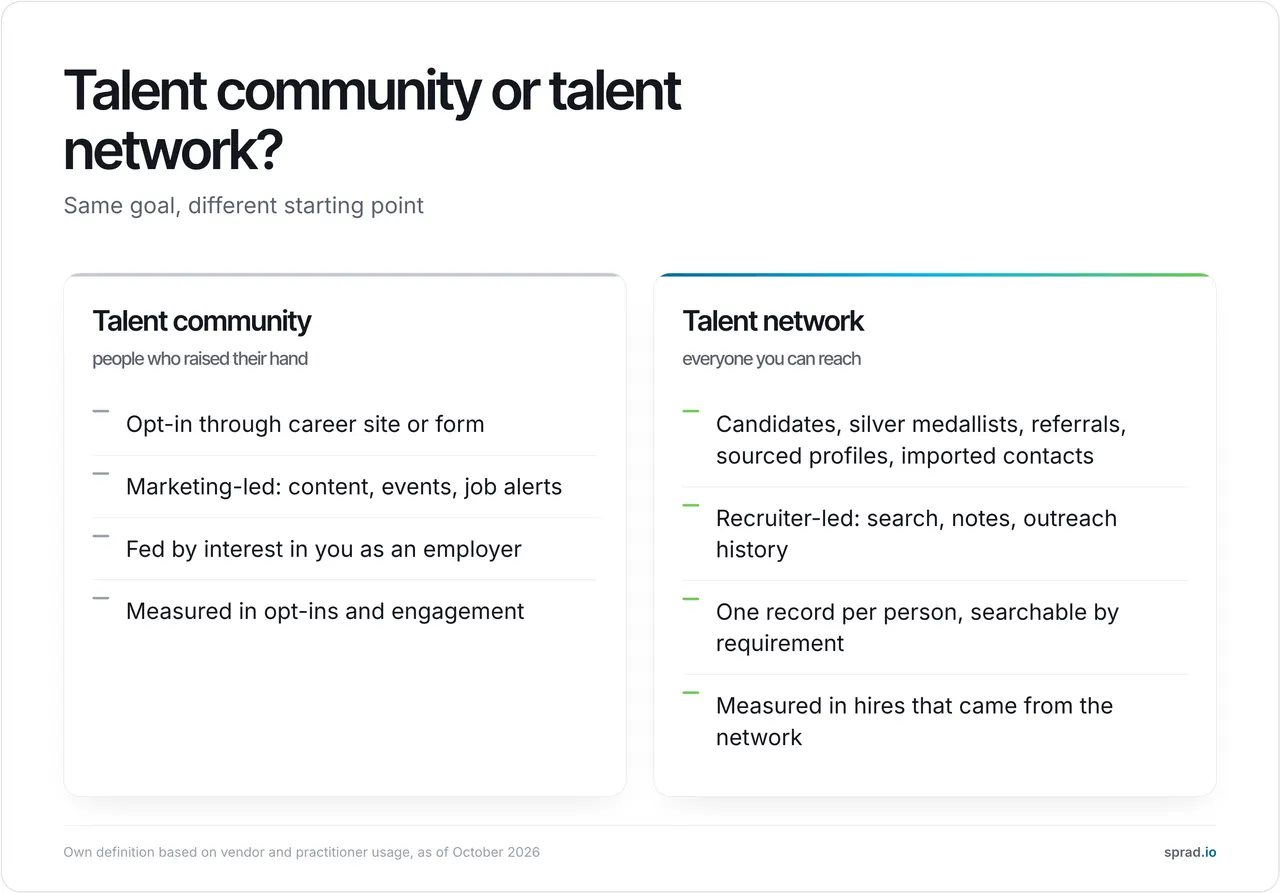
A talent community is a group of people who raised their hand: they signed up on your career site, a form or at an event and want to hear from you. A talent network (or talent pool) is wider: applicants who were not hired, silver medallists, referrals, people you sourced and contacts imported from your inbox or LinkedIn. A talent CRM is the software layer that manages those relationships between applications, and an ATS runs the process for one open role. Our guide Talent pool, ATS or CRM goes deeper; for this comparison the point is simple: if a tool only collects opt-ins, it is a mailing list; if it also lets you search, contact and remember people, it is a talent network.
How we compared the tools
We compared every tool on seven questions that come up in real selections, not against feature counts:
- Where do the talents come from? Only your own data, or also outside profiles?
- Can you search by requirement, or only filter and tag?
- Which channels can you reach talents on, and is the history in one place?
- What does it cost, and is the price public?
- What happens to your data when you cancel?
- Consent, retention and hosting: what supports GDPR work?
- Who is it built for: five recruiters or five thousand employees?
Competitor information comes from vendor pages, vendor FAQs and public roundups, accessed in October 2026; where sources disagree we say so. Figures marked “reported” are third-party estimates.
Disclosure: Sprad publishes this article and is one of the tools compared. Other vendors’ prices and features are as published on their own pages at the time of writing, Sprad’s as of 29 Oct 2026. Where another tool fits a use case better than Sprad, the text says so.
Eight talent community and talent network tools compared
About the order: the profiles below are grouped by use case, not ranked by a score; we did not build a rating scheme. Sprad is listed first where its own functions (a network you can search, reach and keep) are the point of the article. Where another tool fits a use case better, the profile and the at-a-glance box say so.
| Tool | Type | Where the talents come from | Price (public info) | Outreach | EU focus |
|---|---|---|---|---|---|
| Sprad | Network + search + outreach | Own network, employee networks, uploaded LinkedIn network, LinkedIn, XING, GitHub (1B+ profiles) | Free start (100 credits/month, network free); Recruiter Lite 79 €/seat/month; Atlas Recruiter 299 €/seat/month | LinkedIn, email and InMail in one inbox; WhatsApp for candidate conversations; voice, chat and agent pre-qualification | Yes, EU hosting |
| Gem | CRM + ATS + sourcing | Your ATS and database plus a claimed 800M+ profile index | Custom; about 135 $/month small-team tier reported | Email, InMail, SMS | Not stated |
| Beamery | Talent lifecycle platform | Your database, career-site community, internal talent | Quote only | Campaigns | UK vendor, hosting not stated |
| Eightfold | AI talent platform | Your applicants, talent data and employees | Quote only | Candidate engagement | Not stated |
| Phenom | Talent experience suite | Career site, chatbot, own database | Quote only; six figures per year reported | Email, SMS, WhatsApp campaigns | Not stated |
| Teamtailor | ATS + career site + talent pool | Career-site sign-ups and past applicants | Not published; about 229 $/month entry reported | Broadcasts and cohort messages | Swedish vendor, hosting not checked |
| Kula | Recruiting CRM + ATS | Your database plus sourcing | From 4,800 $/year (up to 50 employees) | Multichannel outreach | Not stated |
| Manatal | Recruiting CRM + ATS | Your database, CSV import, social enrichment | 15 / 35 / 55 $ per user and month (annual) | Not stated |
The pattern behind the table: most tools manage the people you already have. Only a few also search outside your database, and fewer still keep email and LinkedIn conversations in one record.
Sprad — a talent network you can search, reach and keep
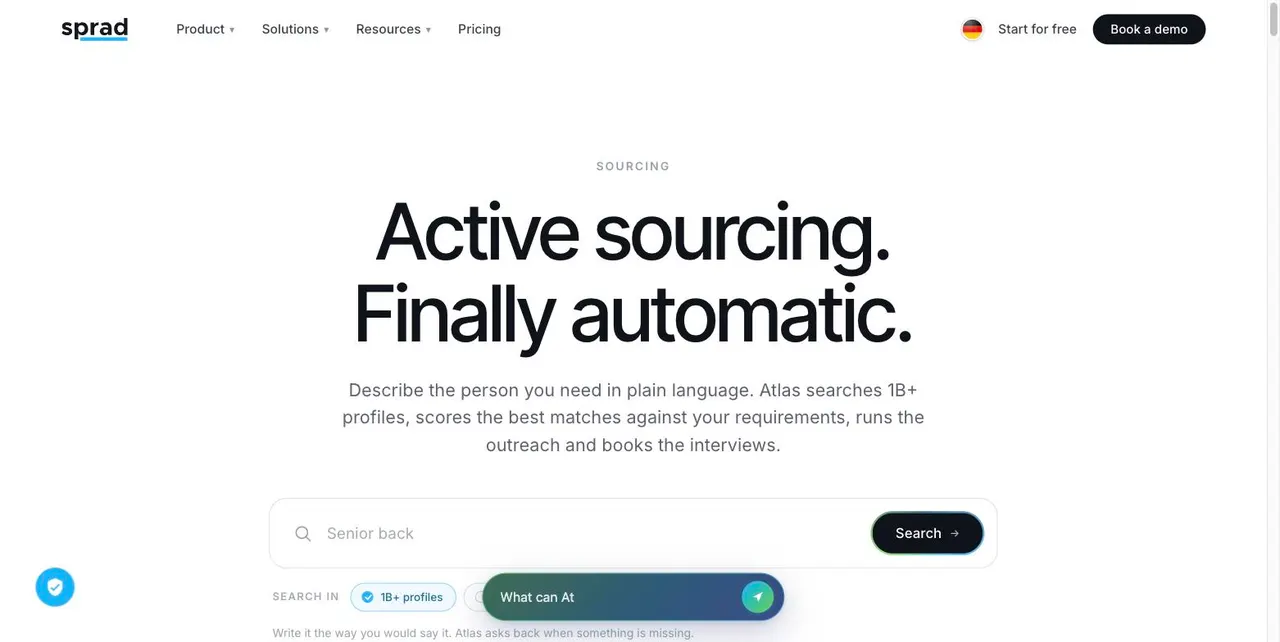
Sprad treats the talent network as the centre of sourcing, not as a mailing list. Atlas, the sourcing product, checks every profile individually against your requirements instead of running a keyword search, so it also finds people whose profile is thin or lacks the “right” keywords. Every result comes with a reason per requirement.
- Networks nobody else sees: upload your own LinkedIn network and search inside it, let employees share theirs, or invite former candidates of your agency to connect theirs.
- One search over all sources: your network, LinkedIn, XING, GitHub and your own pool, with access to one of the largest profile databases (1B+ profiles worldwide).
- One inbox, one record: per talent the whole conversation over LinkedIn and email, InMails from Sprad, and a warning if someone was already contacted, also by a colleague or for another role. Contacts from your mailbox or LinkedIn can be imported.
- Talents get something back: invited talents receive a free job agent (Atlas Career), and you see live who is open to a change and what they are looking for.
- Your data stays yours: the talent network stays free after cancelling, with free credits to keep searching, and all views can be exported as raw data.
- Also included: automated outreach with follow-ups and AI templates, voice, video and chat pre-qualification, a full Claude MCP and EU hosting.
Sprad has built recruiting software for seven years, starting with employee referrals, which is matching profiles to requirements. Benchmark: in the Recruiting area of the public PeopleSearchBench Atlas reaches 73.5 out of 100 in our own re-measurement, converted to the published scale. In recruiting it returns almost always 15 matching profiles per search (14.2 on average).1 Plans: sprad.io/pricing. More: Active Sourcing and Sprad for agencies.
1 PeopleSearchBench (Recruiting), published by Lessie, October 2026. Other systems' scores as published in the benchmark; Atlas measured with the benchmark's open test procedure. Contact data came from the “find email” button. Method and details.
Gem — one system of record for outbound-heavy teams
Gem combines CRM, ATS and a sourcing agent over a claimed 800M-profile index plus your own candidates. Its own community guide is a good practical read: it recommends a named community owner, a short welcome mail with opt-out, roughly 20 % job openings and 80 % useful content, and a monthly rhythm, since quarterly contact is too slow. That is advice to copy whichever tool you pick.
Beamery — talent lifecycle for large employers
Beamery positions itself as a talent lifecycle platform: CRM for external talent plus skills and internal mobility. It makes sense when one skills layer should serve hiring and internal moves. Without a public price, plan for a sales process and compare quotes.
Eightfold — AI matching across applicants and employees
Eightfold is built for large organisations that want AI to match known talent to roles. Public descriptions of the CRM side are thin; ask for a proof of concept on your own data and check how fields map from your ATS and HRIS.
Phenom — experience suite with CRM
Phenom bundles talent CRM with career site, chatbot, campaigns and scheduling. It suits enterprises that want one vendor for the candidate experience. Third-party price estimates conflict, so treat any number as a rough range and ask for a written quote.
Teamtailor — community inside the ATS
Teamtailor is the classic answer for employers that want a career site, an ATS and an opt-in talent pool from one vendor. It collects and nurtures people who come to you; it is not a tool for finding people who have never heard of you.
Kula — CRM and ATS for growing companies
Kula targets companies of roughly 50 to 1,000 employees and publishes an entry price. The figures here come from Kula's own material, so check them against the current price list.
Manatal — the low-cost database
Manatal is the cheapest per-seat route to a searchable candidate database and pipeline, with CSV import. If your need is “get our spreadsheet into a system”, it is enough. If you also want to find people outside your database, you need a sourcing tool next to it.
Which tool suits small teams, which enterprises?
| Your situation | Pick | Why |
|---|---|---|
| 1–10 recruiters, wants to search network and market, reach talents, keep data | Sprad | Free start, network stays free, LinkedIn and email in one inbox |
| Agency with former candidates and their networks | Sprad | Invite former candidates to connect their network, then search it |
| SME that wants career site, ATS and opt-in community together | Teamtailor | Everything in one system, built for inbound |
| In-house team with heavy outbound and an existing process | Gem | CRM, ATS and sourcing in one record |
| Tight budget, database only | Manatal | Published seat prices from 15 $ |
| 5,000+ employees, internal mobility, own IT review | Beamery, Eightfold or Phenom | Suite scope and integrations, quote-based |
For larger teams the decisive factor is one shared state, not features: one profile per talent, no double outreach, networks of employees searchable and data staying in house. That is what separates a network from a collection of personal spreadsheets.
What does it cost? A worked example for four recruiters
List prices as of October 2026, net, per year for four people. Seat prices multiply with headcount; Sprad's credit route is shared by the whole company.
| Option | Calculation | Per year |
|---|---|---|
| Sprad free start (network free) | 100 credits per month included | 0 € |
| Sprad Atlas Base (credits for the company) | 5,000 credits; web search costs 2 credits per profile shown | 450 € |
| Sprad Recruiter Lite | 4 × 79 € × 12 | 3,792 € |
| Sprad Atlas Recruiter | 4 × 299 € × 12 | 14,352 € |
| Manatal Enterprise | 4 × 35 $ × 12 | 1,680 $ |
| Gem small-team tier (reported) | about 135 $ × 12 | about 1,620 $ |
| Teamtailor entry (reported) | about 229 $ × 12 | about 2,750 $ |
| Beamery, Eightfold, Phenom | Quote | on request |
Does a network pay for itself? The average cost per hire was nearly 4,700 $ in the US according to SHRM (April 2022). Assume 20 hires a year and that a maintained network fills 4 of them without a job ad or a new search, saving 1,500 € each (our assumption: ten recruiter hours at 60 € plus 900 € in ads). That is 6,000 € a year, more than every option in the table except the largest seat package. These are assumptions, not measurements; replace them with your numbers.
What should you check for GDPR and EU hosting?
A talent network stores personal data on purpose, so the legal groundwork matters more than the feature list. This is general information, not legal advice. Check these points with every vendor:
| Check | What the law says | Ask the vendor |
|---|---|---|
| Legal basis | Community members opt in (consent, Articles 6 and 7 GDPR); consent must be as easy to withdraw as to give, see the EDPB consent guidelines | Can consent and withdrawal be logged per person? |
| Sourced profiles | People you did not get the data from must be informed, at the latest within one month (Article 14) | Does the tool send or log the information notice? |
| Retention | Storage limitation and erasure (Articles 5 and 17) | Can you set a retention date per person and delete everywhere? |
| Hosting and transfers | Transfers outside the EU need a safeguard (Chapter V) | Where is data hosted, which sub-processors, is a DPA included? |
| Exit | You stay responsible for the data after cancelling | Is there a full raw-data export, and does the network stay accessible? |
| AI ranking | AI that screens or evaluates candidates is high-risk under Annex III of the EU AI Act; a provisional deal of May 2026 would move the date to 2 December 2027, so check the final text | Do humans decide, and is there an audit trail? |
In the UK the same logic applies under UK GDPR and ICO guidance. In the US there is no single law, but California's CCPA covers job applicants. How long you may keep pool data is covered in Talent pools and GDPR, and sourcing rules in Active sourcing and GDPR.
How do you launch a talent network in 30 days?
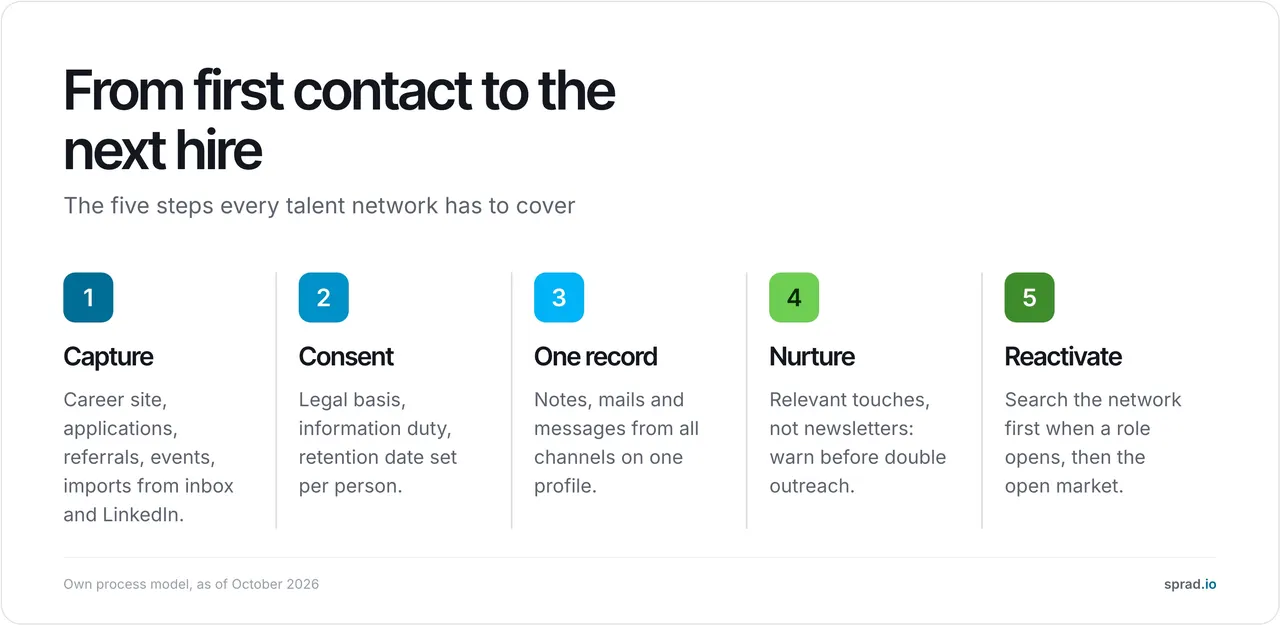
- Week 1, scope and owner. Name one owner, pick two or three roles you hire repeatedly and write the consent text and retention period.
- Week 2, import and tag. Import past applicants who agreed to be kept, silver medallists and referral contacts; tag by role family, region and availability.
- Week 3, one record. Connect mailbox and LinkedIn so every message lands on one profile and double outreach is flagged.
- Week 4, first reactivation. When the next role opens, search the network first and contact five matching people personally.
Typical mistakes we see in practice
- Importing everyone ever. Old applicant data without a purpose and a retention date is a liability, not an asset.
- No owner. A pool without a named person becomes a graveyard within a year.
- Newsletters instead of relevance. Blasting all members teaches them to ignore you; segment by role and send fewer, better touches.
- Several records per person. Without one inbox, two colleagues contact the same candidate for two roles.
- Lock-in. If the tool is cancelled and the network disappears, you built an asset you rent. Ask about exit before you sign.
- Measuring opt-ins. Sign-ups feel good. Hires from the network are the number that justifies the budget.
What should you measure?
Track four numbers: hires from the network (the one that matters), the share of open roles where you searched the network first, the reply rate of network outreach compared with cold outreach, and the share of records with valid consent and a retention date. Opt-ins and email open rates are secondary signals. More on freshness: Keeping talent pools current and Searching talent pools with AI.
Sprad’s own tool in this list is the Talent Network (talent pool software with a free recruiting CRM).
FAQ
What is talent community software?
Software that collects people interested in your company, keeps their data and consent in one place and lets you stay in touch until a role opens. The better tools also let you search the people you collected and reach them from one inbox.
What is the difference between a talent community and a talent pool?
A community consists of people who opted in; a pool also contains people you got through applications, referrals or sourcing. In daily work the two overlap, which is why a tool should handle both with one record per person.
What is the best talent community software?
It depends on the job: Sprad if you want to search your network and the market and keep your data, Teamtailor for an inbound community inside an ATS, Gem for outbound-heavy in-house teams, Manatal for the lowest seat price, and Beamery, Eightfold or Phenom for large enterprises.
Is there free talent network software?
Sprad's talent network is free, including after cancelling, with 100 free credits per month for searches. For the other tools in this comparison we found no free plan.
How many members do you need?
There is no minimum. Gem's guidance targets communities with roughly 350 or fewer opt-ins per month, which a small team can manage by hand. Quality of records and a named owner matter more than size.
Is a talent community GDPR-compliant?
It can be, if members give informed, documented consent, can withdraw it easily and you set a retention period. Sourced profiles need an information notice within one month. The software helps, but the responsibility stays with you.
Can small teams use enterprise tools like Beamery or Phenom?
They can, but the price, set-up and governance effort are sized for large organisations. Most teams under 50 recruiters get further with a lighter tool and a clear process.
Sources: vendor websites, vendor FAQs and public roundups, accessed 30 October 2026; EU legal texts via EUR-Lex. Competitor figures are the vendors' own claims or third-party estimates and may change.
Jürgen Ulbrich
Jürgen Ulbrich has more than a decade of experience in developing and leading high-performing teams and companies. As an expert in employee referral programs as well as feedback and performance processes, Jürgen has helped over 100 organizations optimize their talent acquisition and development strategies.