You connect AI CV screening to an existing ATS through the system's own API, so nothing has to be replaced: the ATS stays your system of record and the screening layer reads applications and returns a ranked shortlist with reasons. Sprad is already connected to Ashby, d.vinci and Personio; any other system with an API, such as Greenhouse, Workday, SAP SuccessFactors, Lever or SmartRecruiters, can be connected through its interface, with the scope clarified per system. One rule matters more than the plumbing: nobody is rejected automatically, every rejection waits for someone on your team (Stand 5 November 2026).
How AI screening plugs into an ATS
There are three common ways. The first is a direct connection through the ATS API: the screening tool reads new applications and CVs, scores them against the job requirements and hands the result back. The second is an export/import route (CSV or ATS export), which works for a first test but is manual. The third is a middleware layer that talks to many systems at once, which is quick to start but adds another processor to your data flow.
Whichever route you choose, four things have to be settled before the first CV is scored: which data leaves the ATS (and which does not), who may read and write what, where results appear for recruiters, and how data is deleted again. Section "Questions for your ATS team" below turns this into a checklist.
What each ATS offers, and where Sprad stands
The table separates two things that are often mixed up: what the system itself offers as an interface (according to the manufacturer's developer documentation, Stand 5 November 2026) and whether Sprad is already connected. "Not documented" means we found nothing reliable, not that the feature does not exist.
| System | Interface offered by the system | Sprad status | Typical route |
|---|---|---|---|
| Ashby | REST-style API, API key with per-module permissions; webhooks | Connected | API |
| d.vinci | Current public documentation not found; older documentation describes REST interfaces for jobs, applications and attachments | Connected | API, scope agreed with the customer |
| Personio | REST API v1/v2; recruiting data readable in v2; webhooks currently only for persons | Connected | API |
| Greenhouse | Harvest API (REST); webhooks; Harvest v1/v2 was announced to be switched off on 31 August 2026, v3 is the successor | Connectable via API | API, webhook |
| Lever | Data API (REST); webhooks for stage changes and new applications; OAuth apps only via the partner programme | Connectable via API | API, webhook |
| SmartRecruiters | Customer API; webhook subscription API; API key or OAuth 2.0 | Connectable via API | API, webhook |
| Workday Recruiting | SOAP web services; OAuth 2.0 via API client; webhooks not documented | Connectable, project-based | API with tenant admin |
| SAP SuccessFactors | OData API for candidates and job applications; role-based permissions | Connectable, project-based | API |
| softgarden | No general customer API for applicant data documented; front-end, apply and assessment APIs only | Clarify in a call | Export/import or partner route |
| Teamtailor | REST (JSON:API); webhooks for candidates and applications | Connectable via API | API, webhook |
Other systems that Sprad's website lists as connection targets, among them iCIMS, JOIN, rexx, onlyfy and concludis, are connectable through the system's interface; the scope per system is clarified in a conversation. We do not claim that a specific function runs natively in any system not listed as connected above. Sprad also offers an open API and webhooks, an MCP connector for Claude and ChatGPT, and free reports and export.
What has to come back into the ATS is its own topic: scores, reasons, status and a trail of who decided. We describe the minimum in what screening results must be written back to the ATS.
Sprad inside your ATS: what the screening does
Sprad's AI CV screening scores every application against the requirements of the job and gives recruiters a ranked list with a short reason per candidate. Candidates choose their own interview slot in a portal, and CV screening, chat interviews and the portal are priced together at 0.49 € per application (Stand 29 October 2026). Voice interviews for every fifth application add 0.20 € per application and video for every tenth adds 0.60 €. Candidates keep control of their data.
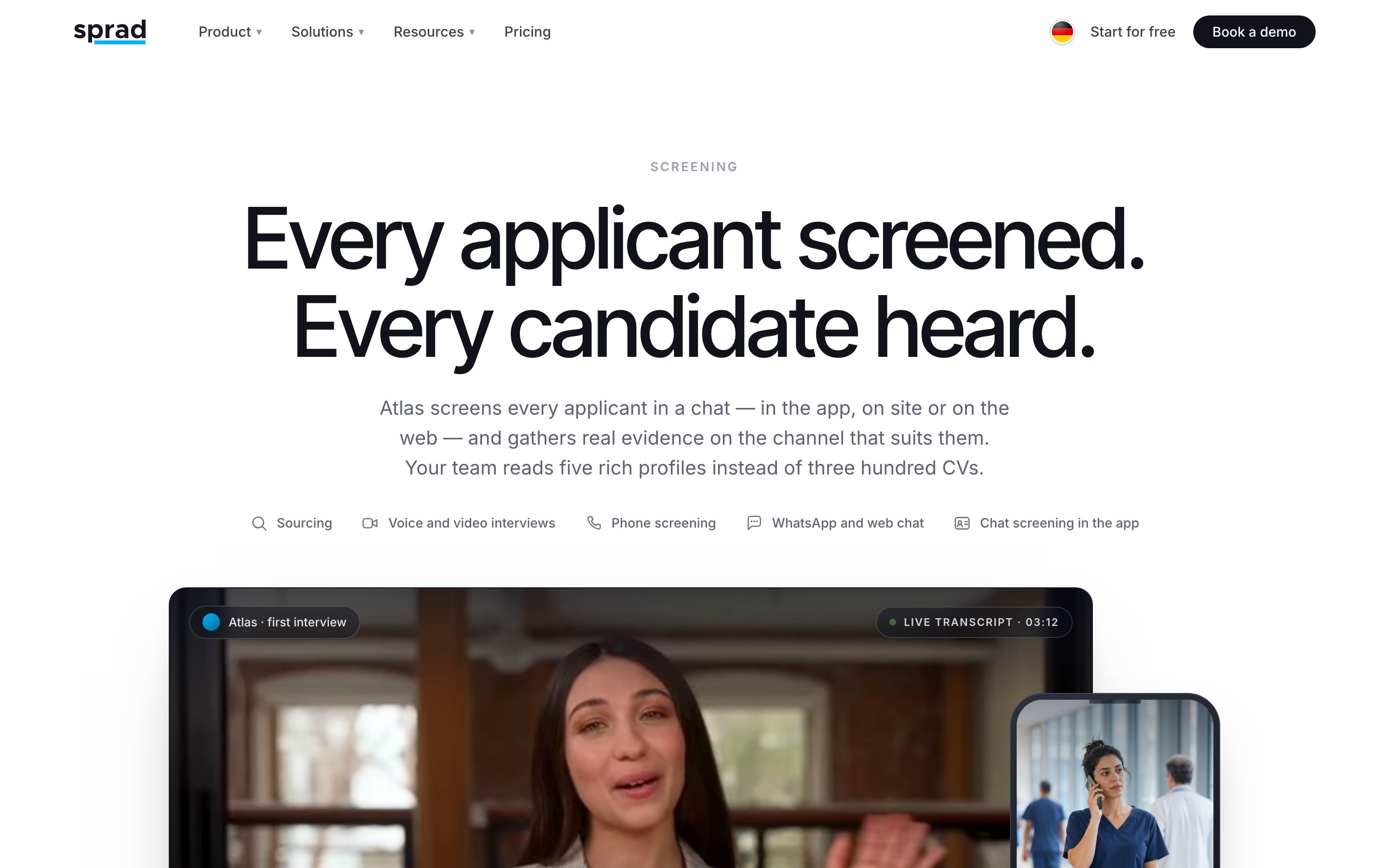
Connecting is part of the setup, not an extra platform. The connection to an ATS costs 100 credits per connection as a licence add-on; in the larger plans (Atlas Base Pro and Max) integrations and data migration are included, and with Atlas Recruiter from three licences Sprad builds the connection. Details are on the pricing page.
A worked example with our assumptions: 2,500 applications a year. At 0.49 € that is 1,225 €. If every fifth candidate also gets a voice interview, the average is 0.69 € per application, so 1,725 € for the year. Add the one-off connection of 100 credits if your plan does not include it. Your own volume, the share of voice interviews and your plan will change these numbers.
Rejection emails from the ATS with AI: who decides?
Nobody is rejected automatically. The AI can prepare a ranking and a draft, but every rejection waits for approval from someone on your team before anything is sent. That is a deliberate design choice, and it is the safest way to meet German and European rules.
- Art. 22 GDPR: a person has the right not to be subject to a decision based solely on automated processing that significantly affects them, and a rejection can be such a decision. A real human review, not a rubber stamp, keeps the decision with people. Whether a specific process qualifies still needs your own legal check. Regulation (EU) 2016/679.
- AGG: the General Equal Treatment Act prohibits discrimination in selection (§ 1 AGG). A rejection that cannot be explained is a risk; a short, documented reason per decision helps.
- Works council: where a works council exists, it has co-determination rights over technical systems that can monitor behaviour or performance (§ 87 para. 1 no. 6 BetrVG), over the planning of work processes involving such systems (§ 90 BetrVG) and over selection guidelines (§ 95 BetrVG). Involve it before the pilot, not after.
In our conversations, data protection is usually a checkpoint, not a blocker, once hosting, retention, deletion and consent are answered concretely. The checklist below is built for that conversation.
Questions for your ATS team and for every vendor
- Data flow: which fields leave the ATS (CV, answers, contact data)? Can we restrict this to what the job requires?
- Rights: which API key or user is used, and does it read only or also write? Can it be limited to selected jobs?
- Deletion: what happens to candidate data in the screening tool when an application is deleted or a retention period ends in the ATS?
- Controller and processor: who is the controller, and is a data processing agreement under Art. 28 GDPR in place? Are there sub-processors?
- Information duties: are candidates told about the AI use (Art. 13/14 GDPR) in the application process?
- Impact assessment: is a data protection impact assessment under Art. 35 GDPR needed for your set-up?
- Works council: is an agreement needed, and who involves the council?
- Human review: who approves rejections, and is the reason documented?
- API limits and changes: are there rate limits, and what happens when the ATS retires an API version?
EU AI Act: what applies and when
AI systems used to select or screen applicants are high-risk under Annex III of the AI Act (Regulation (EU) 2024/1689). According to Regulation (EU) 2026/1744 (Digital Omnibus), the high-risk obligations apply from 2 December 2027. The transparency rules of Art. 50 apply from 2 August 2026 and the prohibitions of Art. 5 since 2 February 2025 (Stand 5 November 2026). Building human approval and documentation in now saves rework later.
CV parsing versus CV screening
Parsing extracts fields from a CV: name, employers, dates, skills. Screening evaluates the substance of a CV against the requirements of a job and explains the result. Most ATS already parse; the gap is usually the matching. We explain the difference in more detail in what AI resume screening can and cannot do, and compare tools in CV screening software.
FAQ
Do I need to replace my ATS to use AI screening?
No. The ATS stays your system of record. The screening layer connects through the ATS's interface and returns results that recruiters see in their normal workflow.
Which ATS can Sprad connect to?
Ashby, d.vinci and Personio are already connected. Any further system with an API can be connected, for example Greenhouse, Workday, SAP SuccessFactors, Lever or SmartRecruiters; the scope per system is clarified in a conversation.
Does the AI reject candidates by itself?
No. Every rejection waits for approval from someone on your team.
What does the connection cost?
100 credits per connection as a licence add-on; included in Atlas Base Pro and Max and, with Atlas Recruiter, from three licences (Stand 29 October 2026).
Do we need the works council?
If your company has one, involve it early. Co-determination under §§ 87, 90 and 95 BetrVG can apply to screening systems.
Is AI screening allowed under GDPR?
Yes, with a legal basis, information duties, a processing agreement and, where relevant, an impact assessment. A human decision on every rejection addresses Art. 22. This is not legal advice; check your set-up with your data protection officer.
What should be written back into the ATS?
At least the score, a short reason, the status and who approved a decision. See our guide.
Our take
Plenty of teams already have an ATS they like and a pile of CVs they cannot read in time. Sprad Screening sits on top of that system rather than replacing it: it scores every application against the job, lets candidates book their own interview, and keeps every rejection in human hands. Screening starts at 0.49 € per application, with a free account of 100 credits per month to test it on a real job. Start with your own open role, check the pricing, and bring your ATS team and works council into the first conversation.
Jürgen Ulbrich
Jürgen Ulbrich has more than a decade of experience in developing and leading high-performing teams and companies. As an expert in employee referral programs as well as feedback and performance processes, Jürgen has helped over 100 organizations optimize their talent acquisition and development strategies.