"AI jobs" are not only jobs for programmers: in Germany, 59 % of job titles that contain "AI" sit outside tech occupations, and you can start in them without coding if you bring domain knowledge, learn to use AI tools well and can show one real result. The realistic entry points are AI operations, project coordination, AI training and evaluation, AI enablement, governance and compliance, and sales or customer success for AI products. Plan on about three months of focused part-time work to get from zero to a first application.
What counts as an "AI job"?
The term covers three different things, and mixing them up is the most common reason beginners aim at the wrong jobs:
- Building AI: machine learning engineers, researchers, data engineers. Coding and maths are mandatory. Not this article.
- Working around AI: product, project, operations, training, legal, governance, sales. The job title often says "AI". No coding needed, but you must understand what models can and cannot do.
- Working with AI: any ordinary job (marketing, HR, finance, nursing admin) where AI tools are part of the daily work. The title rarely says "AI", but employers increasingly ask for the skill.
The numbers differ by definition. Indeed's analysis of titles with "AI" in them (Q1 2026, reported by Euronews on 24 July 2026) found 288 such titles in Germany, up from 72 in Q1 2022, and 4.2 % of all German job titles, up from 0.8 %. PwC's 2025 Global AI Jobs Barometer measures something else, jobs that require AI skills, and reports a 56 % average wage premium for them (up from 25 % a year earlier), with postings requiring AI skills up 7.5 % while total postings fell 11.3 %.
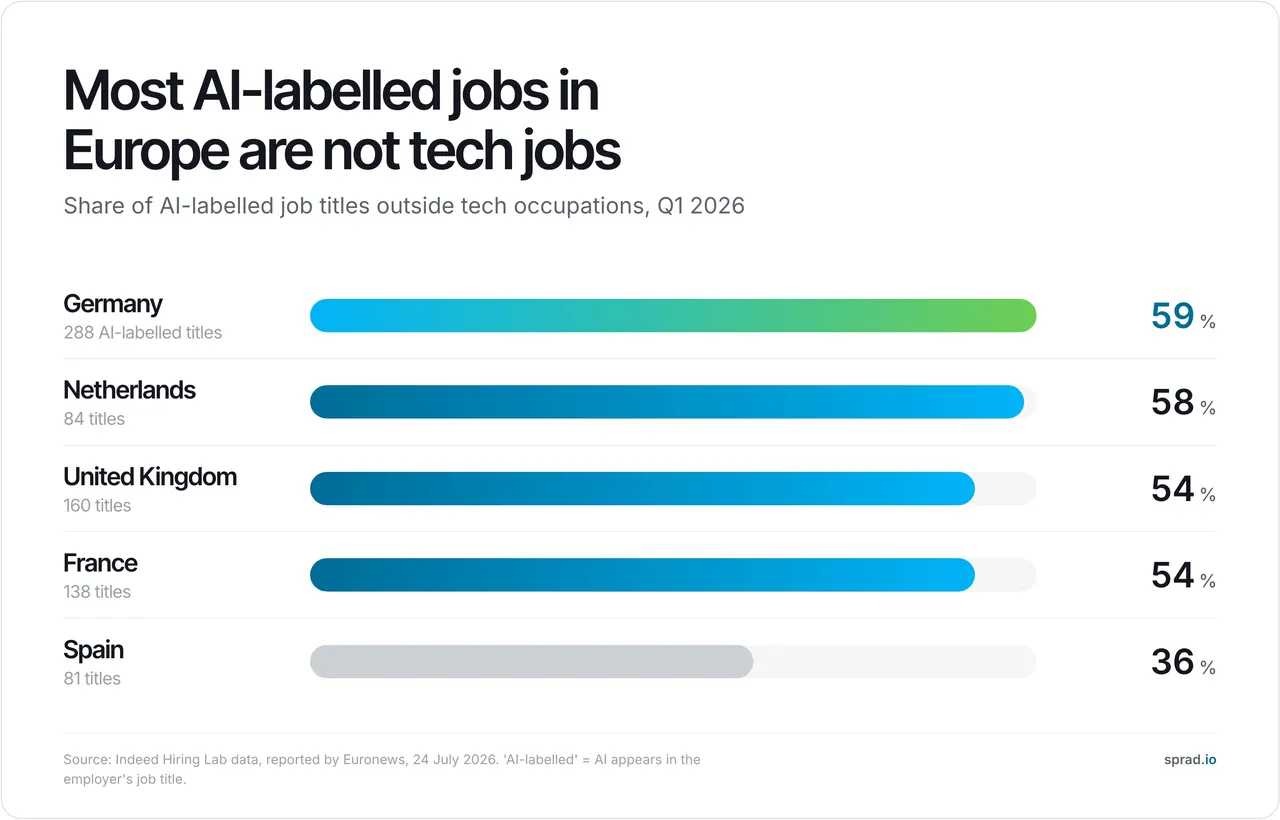
Note the limits: both studies look at job ads, not at how many people get hired, and "AI-labelled" depends on the employer writing "AI" in the title. They show where demand is, not how easy entry is.
Can you really get an AI job without coding?
Yes, for the "around AI" and "with AI" jobs, and the data backs it: in Indeed's count the non-tech share is 59 % in Germany, 58 % in the Netherlands and 54 % in the UK and France. Spain is the exception at 36 %. Examples of non-tech titles in the study include "Legal Counsel, Privacy, Product & AI", "Operations Specialist, AI Enablement" and "Solution Sales Executive, AI, Data and Analytics".
What you cannot skip is competence, not code. The World Economic Forum's Future of Jobs Report 2025 lists AI and big data first among the fastest-growing skills to 2030, followed by networks and cybersecurity and technological literacy. For non-coders that translates into: know how models work in principle, judge their output critically, and apply them to a domain you understand.
Which non-technical AI roles exist, and what do they pay?
There is no official "AI job" category in salary statistics, so pay figures are scarce. The table shows nine roles, with the closest official US figure (BLS, median annual pay, May 2025) where one exists, and German ranges from one career guide where it does not. Treat the guide's numbers as indications, not statistics.
| Role | What you do | Good starting background | Pay signal |
|---|---|---|---|
| AI operations / automation specialist | Map processes, set up no-code automations, measure time saved | Operations, admin, finance, customer support | Closest BLS group, management analysts: $101,860 (+10 % growth 2025-35) |
| AI project or product coordinator | Turn business needs into briefs for the tech team, track delivery | Project management, consulting, product | BLS project management specialists: $102,320 (+7 %); Germany, career guide: about €60,000 to €90,000 |
| AI trainer / evaluator | Rate and correct model answers, write test cases in your field | Teachers, nurses, lawyers, writers, any domain expert | Germany, career guide: €30,000 to €55,000; freelance quality checks from about €15 per hour |
| Prompt and workflow designer | Design, test and document prompts and AI workflows for a team | Writing, support, marketing, HR | Germany, career guide: €50,000 to €90,000 (average about €72,000) |
| AI enablement / training lead | Teach colleagues to use AI tools safely | L&D, HR, teaching | BLS training and development specialists: $69,280 (+11 %) |
| AI governance / compliance analyst | Check AI use against rules and internal policy, document risks | Law, audit, data protection, quality | No reliable public figure yet |
| AI solutions sales / customer success | Explain and sell AI products, onboard customers | B2B sales, account management, support | No reliable public figure yet; usually base plus variable |
| Data-literate analyst | Analyse data with AI-assisted tools, report to decision makers | Controlling, marketing analytics, research | Germany, career guide, data analyst: €60,000 to €70,000. The coding-heavy data scientist: BLS $120,230 (+35 %) |
| AI content / marketing specialist | Produce and quality-check content with AI, keep brand voice | Marketing, editing, communications | No reliable public figure yet |
Sources: BLS Occupational Outlook Handbook, management analysts, project management specialists, training and development specialists, data scientists (wages May 2025, growth 2025 to 2035; all list a bachelor's degree as typical entry education). German ranges: StellenMarkt career guide, 16 July 2025, which is an editorial guide, not official data. The BLS groups are adjacent occupations, not "AI jobs" as such.
Is entry level without experience realistic?
Partly. Almost nobody is hired for "AI experience" alone, because the field is too new. What employers hire is experience in a domain plus proof that you can use AI on real work. A teacher who evaluates model answers on lesson planning, or a controller who automates the monthly report with AI and documents the hours saved, has that proof. A certificate on its own does not.
Be careful with offers that promise high pay for "no experience". Remote data-labelling and "AI training" gigs exist and some are legitimate, but quality varies, many are short project work, and job scams are common: the US Federal Trade Commission reported over 105,000 job-scam complaints for 2024. Never pay to get a job and never buy "equipment" from a new employer.
Step by step: a 90-day plan
This plan assumes about five hours per week alongside a job, so roughly 60 hours in total. That is an assumption, not a promise; faster is possible if you have more time.
| Weeks | Goal | What to do | Result |
|---|---|---|---|
| 1 to 2 | Pick a direction | Choose one role from the table that fits your background. Read 20 job ads for it and note recurring tools and tasks. | A one-page list of required skills |
| 3 to 6 | Learn the basics | Learn how language models work in principle, practise prompting in your own field, and read the NIST AI Risk Management Framework overview if you aim at governance. | You can explain limits (errors, bias, data protection) in plain words |
| 7 to 10 | Build one proof | Solve one real task from your current or past job with AI. Measure before and after (hours, errors, cost). | A one-page case: problem, method, result, what went wrong |
| 11 to 13 | Apply | Rewrite your CV around the case, tailor it to each ad, apply to 10 to 15 roles, ask for internal moves at your own employer. | First interviews |
The most underrated route is your current employer: someone who becomes the "AI person" in their team often moves into a formal role later, with no hiring hurdle.
Which skills and tools should you learn first?
- Prompting with a method: give role, context, task, format and examples; check the answer against facts.
- One no-code automation tool and a spreadsheet at an advanced level.
- Data protection basics: what may go into a public chatbot, and what may not. In the EU, employers must also meet the EU AI Act (Regulation 2024/1689), which is why governance and compliance roles are growing.
- Writing and critical reading: the skill that separates people who use AI well from people who paste its output.
- Basic Python or SQL is optional. It helps with automation and with talking to technical teams, but it is not a gate for the roles above.
Where to find AI jobs in Europe and Germany
Search by task and tool words, not only by "AI": "AI operations", "AI enablement", "AI governance", "prompt", "automation", "KI-Beauftragte", "KI-Manager". Many good roles are posted under a classic title (project manager, trainer, analyst) with AI in the description, so read the text.
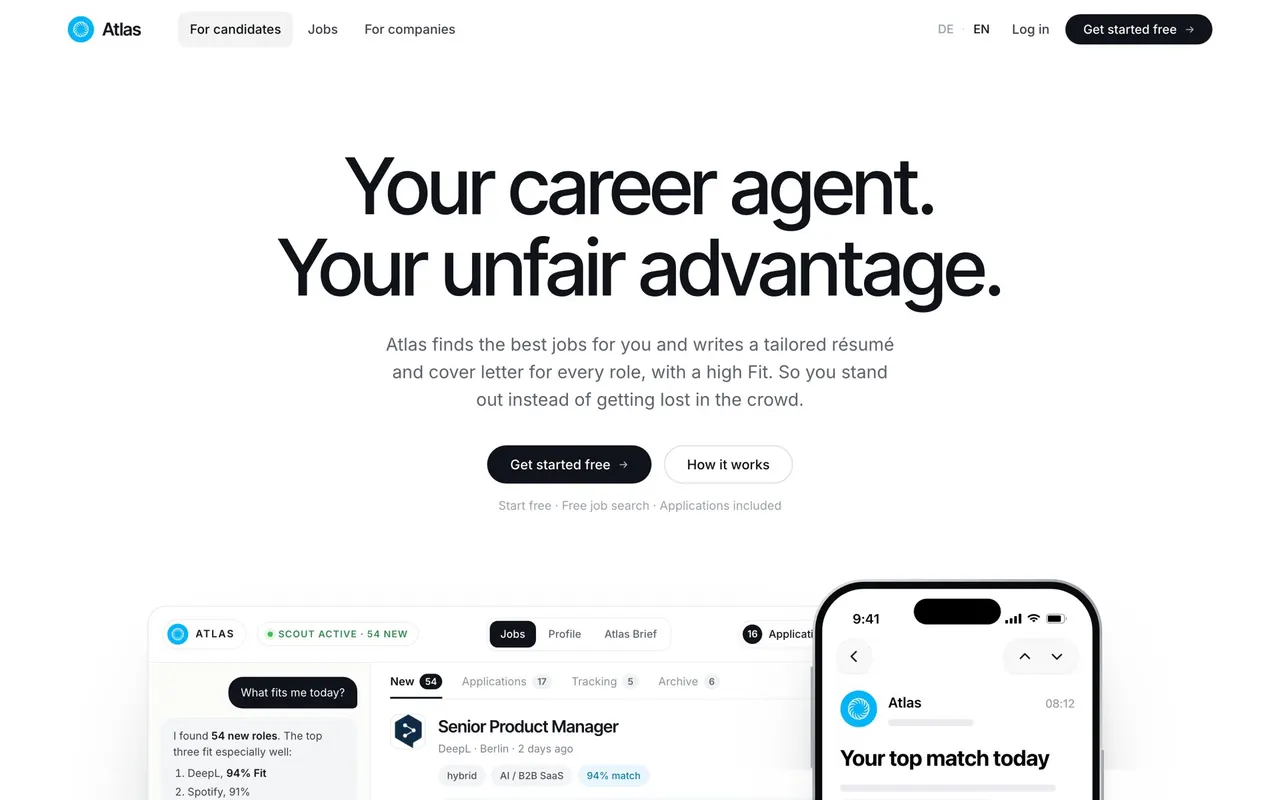
This is where an AI job agent saves time. Atlas Career is free without a limit: you describe the role you want in a short voice conversation, it searches 1.5M+ active jobs straight from employers' career sites (100,000+ in DACH), shows a match score from 0 to 100 with the reasons and writes a tailored CV for every application. You review everything and apply yourself. Tech-adjacent roles such as product, AI and data are bundled on its Builders job page. Atlas is a young product with few independent reviews yet and no native app. Our comparison of the best AI job search tools shows the alternatives.
DACH versus USA: what changes in your application?
In Germany, Austria and Switzerland a structured CV with a photo is still common, certificates and exact dates matter, and a data-protection-aware answer on AI use is a plus. In the US the CV has no photo, is one page, and leads with measurable results. Write the case study from your 90-day plan for both: numbers first, method second. Atlas writes in the language of the ad and follows these conventions. For more on using AI for the application itself, read AI job search tips without spamming recruiters and what an AI career agent is.
Typical mistakes to avoid
- Collecting certificates instead of one result. Recruiters scanning CVs look for proof of work, not course names.
- Aiming at "machine learning engineer" without maths. You will lose to graduates. Choose a role around AI.
- Listing "ChatGPT" as a skill. Name the task and the outcome instead: "cut report preparation from 6 to 2 hours".
- Sending the same CV everywhere. Tailor it to each ad's wording, but never invent experience.
- Trusting "no experience, high pay" offers. See the scam note above.
How does AI itself change the search?
It changes how you search and how you apply. Agents find and rank ads for you, and tools tailor documents. The flip side: employers see more machine-written applications, so a specific, true and measurable case stands out more, not less. Use AI to draft, then check every claim yourself.
FAQ
What does "AI jobs" mean?
Jobs that build AI, jobs around AI (product, project, training, governance, sales) and ordinary jobs that use AI tools. Only the first group needs coding.
Can I get an AI job with no experience?
Rarely with none at all. You need domain experience plus one documented result with AI. Entry-level data-labelling or evaluation work exists, but check pay and legitimacy.
Which AI jobs need no coding?
AI operations, project or product coordination, AI training and evaluation, enablement, governance and compliance, solutions sales and customer success, AI-assisted analysis and content.
Do I need a degree?
The US BLS lists a bachelor's degree as typical for the adjacent occupations above, but employers hiring for AI skills increasingly look at proof of work. Regulated areas such as law need the matching qualification.
How much do AI jobs pay?
US medians for adjacent roles range from $69,280 to $120,230 (BLS, May 2025). A German career guide gives about €30,000 to €90,000 depending on role. PwC reports a 56 % average wage premium for jobs that require AI skills.
Are there AI jobs in Europe and Germany?
Yes. Germany had 288 AI-labelled job titles in Q1 2026, the most in the five European countries Indeed analysed, and 59 % of them were outside tech.
How long does it take to switch?
With about five hours a week, plan roughly three months to a first application and often longer to an offer. That is an estimate, not a statistic.
Is Atlas Career free?
Yes, search, match scores and a tailored CV and cover letter per application are free without a limit. You apply yourself.
Jürgen Ulbrich
Jürgen Ulbrich has more than a decade of experience in developing and leading high-performing teams and companies. As an expert in employee referral programs as well as feedback and performance processes, Jürgen has helped over 100 organizations optimize their talent acquisition and development strategies.