An AI mock interview is a practice interview in which an AI plays the interviewer: it asks questions (ideally based on your CV and the job posting), listens to your spoken answers and tells you what to fix. You can do it for free with the voice mode of a general chatbot or with the free tier of a dedicated practice tool. It works if you answer out loud, use your own real stories and run at least three rounds. It does not replace one practice run with a real person.
What an AI mock interview is, and what it cannot do
A mock interview with AI comes in three forms: a text chat (you type, the AI asks and scores), a voice session (you speak, it answers like an interviewer) and a video session (a practice tool also records your face). Voice is the one that matters, because an interview is a spoken test. Typing a perfect answer and speaking it under pressure are different skills.
What the AI is good at: asking follow-up questions on demand, never getting tired, and spotting structural problems such as a missing result in your STAR story or a two-minute answer to "Tell me about yourself". What it cannot do: know your real career, judge the culture of the company, or feel like a person who is slightly unimpressed. A small 2025 study of AI-driven mock technical interviews with 20 participants found that many rated the simulation realistic and helpful and felt more confident, but the results were self-reported impressions, and flow and timing of the conversation were weak spots (arXiv 2506.16542, 2025). Treat the AI as a sparring partner, not as a judge.
Why practising helps: interviews are more structured than you think
Employers increasingly use structured interviews: the same questions for every candidate, scored against a rubric. In the most cited recent meta-analysis of hiring methods, structured interviews came out first with a validity of .42 for predicting job performance (Sackett et al., Journal of Applied Psychology, 2022). For you this is good news: structured interviews are predictable, so a question bank plus a story bank covers most of them. Nervousness matters too: interview anxiety is a recognised trait that can lower your score even when you would do the job well, and taking mock interviews is one of the coping strategies researchers describe as helpful. Practising is not cheating, it is how you get your real ability onto the scorecard.
How to do an AI mock interview, step by step
Here is the routine we recommend. It takes about four hours spread over five days, which beats one four-hour cram because you sleep between rounds (our estimate, based on 2 rounds of 25 minutes per day plus preparation).
- Day 1, set the scene. Paste the job posting into the AI and ask for the eight requirements that will most likely be tested, plus the five hardest questions for your background. Add your CV so the questions are specific.
- Day 2, build a story bank. Write six real situations in STAR form (situation, task, action, result), each with one number in the result. Six stories can be adapted to most behavioural questions. Our guide on common interview questions and answers shows the skeleton.
- Day 3, first voice round. Start a voice session, answer out loud, do not look at notes. Ask the AI to stop after each answer and rate it against a short rubric (see the table below).
- Day 4, the hard round. Tell the AI to be a sceptical interviewer who asks two follow-ups per answer ("What did you personally do?", "What would you change?"). This is where weak stories break, which is exactly why you do it now and not in the real interview.
- Day 5, one human round. Run one session with a friend, mentor or career coach, and test your setup: camera, microphone, quiet room, time zone.
A prompt that works as the starting point for a voice session:
"You are an interviewer for the role of [job title] at [company]. Here is the job posting and my CV: [paste]. Ask one question at a time and wait for my spoken answer. After each answer, give me a score from 1 to 5 for structure, evidence and length, name one thing to fix, then ask a follow-up. Do not praise by default. Do not write answers for me."
The scorecard: how to judge the AI's feedback
AI feedback tends to be friendly. Use a fixed rubric so that "good" means the same thing in round one and round five.
| Criterion | Target | Typical problem |
|---|---|---|
| Length | 60 to 120 seconds per answer, "Tell me about yourself" 60 to 90 | Three minutes of context before the point |
| Structure | Situation in one sentence, most of the time on your action | "We" instead of "I", no clear owner |
| Result | One number or one concrete outcome | "It went well" |
| Fit to the question | The story shows the competency that was asked | The same story for every question |
| Delivery | Few fillers, pauses instead of "um", clear ending | Trailing off, rushing the last sentence |
Rough calculation with the plan above: 5 days at 2 rounds is 10 rounds. With 6 questions per round you answer 60 questions out loud. Most people give their first strong answer to a question somewhere around the third attempt, so one round is rarely enough.
Which tools and templates help
You do not need to pay to start. The options fall into four groups; free-tier limits change often, so check the current terms before you rely on one (as of October 2026).
| Option | Best for | Free? | Watch out for |
|---|---|---|---|
| Voice mode of a general chatbot (ChatGPT, Gemini, Claude) | Custom role, your CV, any language | Usually a free tier with daily limits | Friendly by default, you must set the rubric and the strictness |
| Google Interview Warmup | Warm-up questions with a transcript of your answer | Free | Fixed question sets, no job posting or CV context |
| Dedicated practice platforms (e.g. Final Round AI, Yoodli, Teal) | Recorded sessions, delivery analytics, speech coaching | Free tiers, capped sessions or reports | Auto-renewing subscriptions; some "interview assistants" are real-time answer copilots, a different thing |
| A human (friend, mentor, career service) | Realistic pressure, body language, honest tone | Free to cheap | Hard to schedule, so use it once at the end |
| Atlas Career | The step before: finding roles and knowing why you fit | Free, no limit | Not an interview simulator (see below) |
Mistakes to avoid
- Practising silently. Reading questions and thinking of answers feels productive and builds almost no fluency. Speak.
- Memorising AI-written answers. They read well and sound unnatural when spoken, and a follow-up question exposes them. Rehearse your own stories from rough notes.
- Practising without the job posting. Generic questions give generic answers. Always give the AI the posting and your CV.
- One round only. The first attempt is the worst one. Plan at least three.
- Believing the compliments. If every answer scores 5 out of 5, change the prompt: sceptical interviewer, score strictly, no praise by default.
- Ignoring the format. A phone screen, a panel and an AI video interview each need different practice.
- Using an answer copilot during the real interview. Many employers prohibit it and some detect it. Practising with AI is accepted, being fed answers live is a risk.
How AI changes interviews: what you should expect
AI now sits on both sides. Candidates practise with it, and employers use it for pre-screening, for example automated voice interviews you take on your own time. Sprad has built recruiting software for seven years, including AI voice interviews for employers, and the pattern is the same each time: there is no person nodding at you, you answer a question on a screen, often with a time limit. Practise exactly that: speak to a microphone with no reaction. Our article on what candidates think about AI interviews covers the candidate side, and what is allowed in the EU covers the employer's limits.
Two rules are worth knowing. In the EU, recruiting AI counts as high-risk under the AI Act, and employers may not use emotion recognition on staff or candidates since 2 February 2025 (Regulation (EU) 2024/1689, Article 5(1)(f)). A practice tool you choose yourself is a different case, but a "confidence score" read from your face is weak evidence either way, so rely on your transcript and rubric. And your practice recording is personal data: check whether the provider trains on it and how to delete it. In the EU you can request erasure under Article 17 GDPR. Do not paste confidential material from your current employer into any tool.
Practise the questions you should not be asked
Some questions are off-limits, such as plans for children, religion or age. In the US, federal law bars employment discrimination on these grounds, as the U.S. Equal Employment Opportunity Commission explains; in Germany the equivalent is the General Equal Treatment Act (AGG). Ask the AI to throw one such question at you and rehearse a calm, short answer that redirects to the job ("I'm happy to talk about how I would handle the workload of this role"). You decide how much to answer.
Where Atlas fits: the step before the interview
Atlas Career is not a mock-interview simulator. It covers the part that makes your practice better: it searches 1.5M+ active jobs straight from employers' career sites, gives every role a match score with reasons and writes a tailored CV for every application. All of it is free with no limit, you review everything and you apply yourself. The reasons behind a match score are a ready-made list of what the employer will probe, and the tailored CV is the document your interview stories must match. Paste the role and the reasons into the practice prompt above and your first question will already be about the right things.
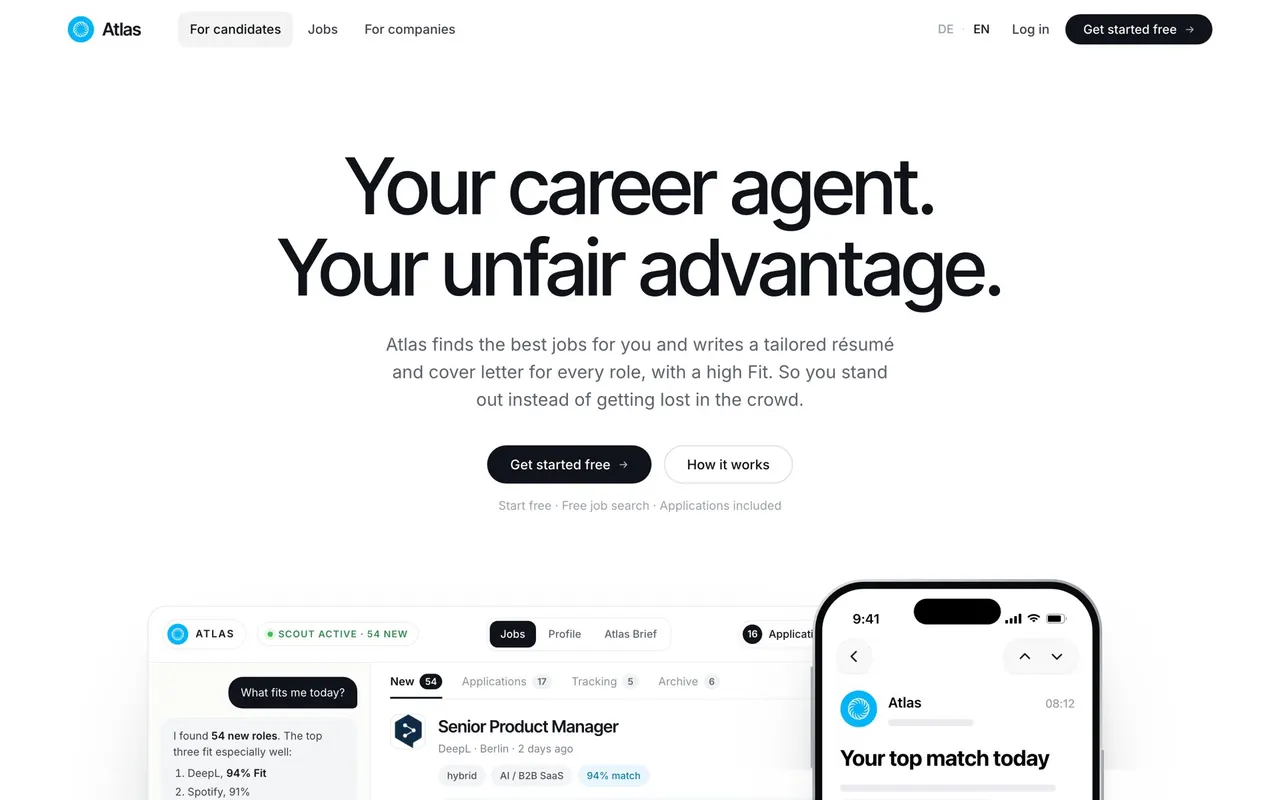
Start with Atlas, or compare it with other tools in our best AI job search tools 2026 and read what an AI career agent is.
FAQ
Is an AI mock interview free?
Yes, the basics are free: voice mode in a general chatbot and Google's Interview Warmup cost nothing, and most dedicated platforms offer a limited free tier. Paid plans mainly add more sessions, recordings and reports. Check the renewal terms before you subscribe.
Is an AI mock interview realistic?
It is realistic for questions, follow-ups and structure, less so for pressure and chemistry. Small studies report that candidates find it helpful and feel more confident, but this is self-reported. Add one human round at the end.
How many mock interviews do I need?
Plan at least three rounds on three different days, ideally five. One round shows your gaps, the next ones fix them.
Can I use AI during the real interview?
Do not. Many employers forbid live AI help, and answers you did not prepare yourself break under follow-up questions. Use AI before the interview, not in it.
Is my practice data safe?
Only as safe as the provider's terms. Check whether recordings are used for training, how long they are stored and how to delete them. In the EU you have a right to erasure under the GDPR.
What should I practise first?
"Tell me about yourself", "Why this company?", three behavioural questions in STAR form, your salary expectation and your questions to the employer. Our guide to common interview questions has all of them.
Sources and dates: studies and regulations linked above, tool categories as of October 2026. Free-tier limits of third-party tools change; we did not verify prices.
Jürgen Ulbrich
Jürgen Ulbrich has more than a decade of experience in developing and leading high-performing teams and companies. As an expert in employee referral programs as well as feedback and performance processes, Jürgen has helped over 100 organizations optimize their talent acquisition and development strategies.