Applying as a career changer (a "Quereinsteiger" in German) works when your CV and cover letter show what you can already do in the new role and explain the switch once, in two sentences. It matters because occupation movers in a Swiss study were contacted about 7% less often than applicants from the field, and 16.4% less often when their background was far from the job. Relevant experience roughly halves that gap. The route: pick a target role, analyse ten real job ads, collect proof, tailor every application and, if the profession is regulated, sort out the qualification first. Figures and legal rules below are as of October 2026, with a focus on Germany, Austria and Switzerland and notes for the UK and US.
What does "applying as a Quereinsteiger" actually mean?
You apply for a job in a profession you did not train in or have not recently practised. Three cases look very different in practice:
- Open lateral entry: sales, customer service, marketing, project coordination, many IT roles. Proof counts, a diploma does not.
- Adjacent role: you move to a job that shares many tasks with your old one, for example from store manager to customer success.
- Regulated profession: nursing, early-years teaching, teaching, electrical trades. You need a qualification or recognised retraining first; the application follows (see the retraining section).
Switching is common. According to the German Institute for Employment Research (IAB), 12% of women and 13% of men worked in a different occupation than a year earlier in 2013, and by 2024 that rate had risen by 10% and 16% in relative terms (IAB-Forum, July 2026). The Swiss analysis by RFBerlin (Research Insight 31/26, August 2026) found that about 70% of applications came from people in a different occupation, and about 63% of hires. Changing careers often works; it just works less often without preparation.
How big is the hurdle? A worked example
The study uses data from Switzerland's public employment service (Job-Room, March to December 2017, over 15 million candidate impressions). It is older and from a neighbouring country, but it is one of the few real measurements. The core values:
| Group | Chance of being contacted vs. incumbents |
|---|---|
| All occupation movers | about 7% lower |
| Distant background, no experience in the target job | 16.4% lower |
| Similar background | 10.9% lower |
| With relevant experience | disadvantage roughly halved |
| Related job, experience and a recognised qualification | about 3% lower |
Take an assumption: if 20 of an insider's 100 applications get a reply, a 16.4% penalty gives about 16.7. To get the same number of replies you would need roughly 20% more applications. Sending more is the wrong lever; better proof and fit is the right one. This is an illustration that reads the study's values as relative, not a Sprad measurement.
Applying as a career changer, step by step
1. Choose a target role and a fallback neighbour role
Pick one main role and one adjacent role. The German Federal Employment Agency's BERUFENET describes tasks, requirements and training routes. Check first whether the profession is regulated.
2. Analyse ten real job ads
This is our most useful practical tip. Sprad has built recruiting software for about seven years and sees applications from the employer side. The most common career-changer mistake is not missing qualifications; it is a CV that does not use the words of the ad. Build a table: requirements from ten ads on the left, your proof on the right. What appears in at least seven ads is a must-have; what appears once is a bonus. Anything without proof is your real gap, and only that is worth a course.
3. Collect proof, not claims
Write each relevant experience as task, action, result, with a number. Example (invented numbers, for illustration only): instead of "responsible for rota and customer complaints", write "scheduled shifts for 14 people and resolved about 30 escalations a month at store level". That speaks customer-success language without adding anything untrue.
4. Build the CV around the target role
Use a combination format: a three-line summary with target role and proof, then skills, then roles in reverse order. Compress old, unrelated jobs to one or two lines. Two pages are normal in Germany, Austria, Switzerland and the UK; the US expects one. A photo is common in DACH but voluntary, and Germany's General Equal Treatment Act (§ 1 AGG) prohibits discrimination on grounds such as age, sex or ethnic origin. Europass offers an EU template. The full structure with a before-and-after example is in our career change resume guide.
5. The cover letter: explain the switch in two sentences
The cover letter is the only place where you explain the move in your own words. Four paragraphs are enough: an opening tied to the job, why the switch (two sentences), one proof with a result, and a close offering a conversation. Example for the second paragraph:
"After eight years running a store, I wanted to remove the causes of customer problems instead of solving them one at a time. Alongside work I completed a customer success certificate and built a complaints dashboard that noticeably reduced repeat requests."
This is a template, not a fact. What matters is the structure: motive, preparation, proof. More samples are in our cover letter template for career changers and entry-level applicants. Drop the word "career changer" from headlines and subject lines; name the target role instead.
6. Close the gap with the smallest tool that works
If step 2 shows a real gap, close it with a certificate, a project or a side job. The next section covers bigger routes.
7. Apply tailored and follow up
Ten tailored applications beat fifty identical ones. Adjust the summary, the first three bullet points and the opening line per ad. After a week, follow up or message someone on the team. This helps changers most, because a person gets the connection explained that a screening grid does not see.
Retraining, further training or just apply?
Not every change needs retraining. In Germany, vocational retraining is meant to qualify people for a different occupation (§ 1(5) BBiG). It can be funded under § 81 SGB III if three conditions hold: the training is necessary to reintegrate you after unemployment (or avert imminent unemployment), the employment agency advised you before it starts, and both course and provider are approved. The agency then issues a training voucher (Bildungsgutschein). So the order is always: get advice first, book second.
| Route | Fits when … | Good to know |
|---|---|---|
| Apply directly | open lateral entry, small gap | Proof and tailoring decide |
| Certificate or course | gap in one tool or topic | book only when several ads ask for it |
| Funded further training | you are unemployed or at risk | § 81 SGB III: advice first, approved provider, voucher |
| Retraining to a recognised trade | regulated or diploma-bound profession | Funded training to a vocational qualification of at least two years: €150 per month Weiterbildungsgeld (§ 87a SGB III) |
| External exam | you worked in the trade for years without a diploma | Admission after at least 1.5 times the training duration (§ 45(2) BBiG) |
Two calculations: for a 24-month funded retraining the Weiterbildungsgeld adds up to €3,600 (24 × €150) if all conditions are met. For the external exam in a three-year trade you need 4.5 years of work (3 × 1.5, our calculation under § 45 BBiG), and the time requirement can be waived in whole or in part if certificates credibly show you can do the job. Whether you qualify is decided case by case by the competent office (employment agency or Jobcenter).
Which mistakes should you avoid?
- Apologising: "Unfortunately I have no experience as …" points at the gap. Name the proof and the target role.
- Explaining the switch repeatedly: once in the summary, once in the letter. More sounds insecure.
- A functional CV without a timeline: it hides dates, and that gets noticed. Combination format is safer.
- Mass applications: same text, 50 ads. Fit is missing exactly where you must prove it.
- Course before ad check: do step 2 first. For funded training also: advice first, application second.
- Inflating experience: it falls apart in the interview. Stronger wording yes, invention no.
- Sending AI text unchecked: it reads smooth and generic, and sometimes contains statements that are not true.
What does AI change for career changers?
AI takes over the legwork: analysing ads for requirements, translating your experience into the target industry's language, adapting documents per job. That matters for changers because every ad stresses something different. What AI cannot do is create qualifications you do not have or invent motives for the switch. Employers use AI too; the EU AI Act (Regulation 2024/1689, Annex III) classes AI systems for recruitment and selection as high-risk, with duties such as transparency and human oversight. Your protection stays simple: every statement must be true, and you decide.
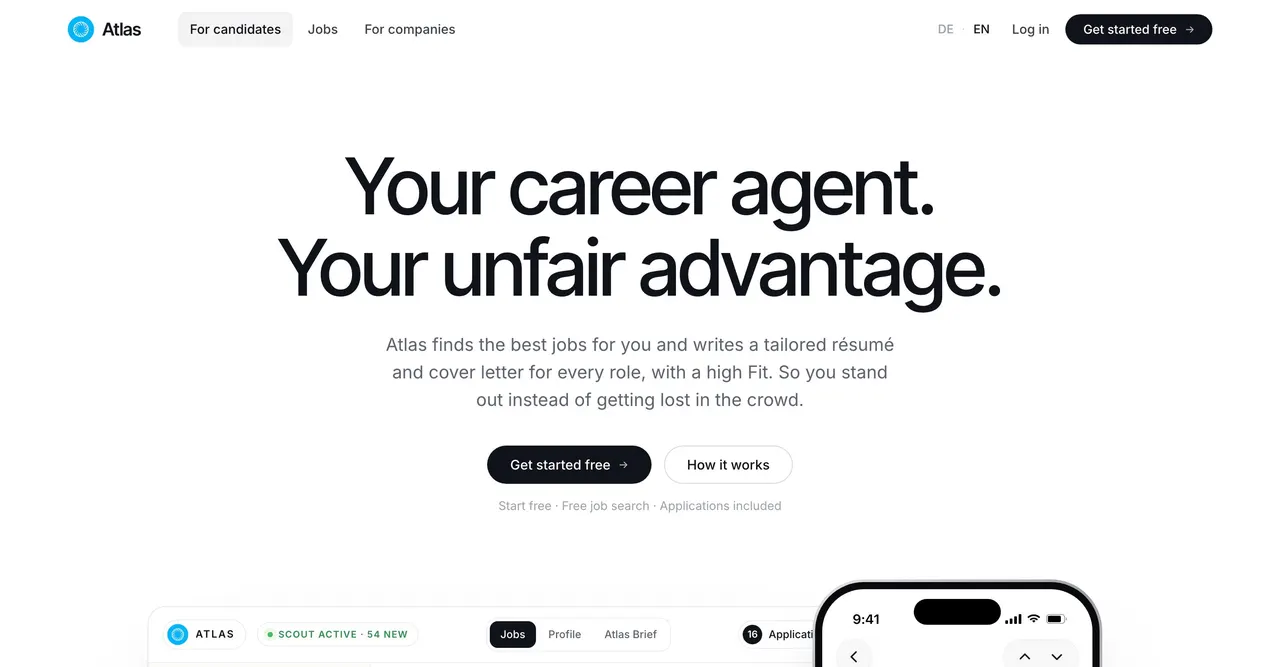
A free option is Atlas Career (atlas.now), built by Sprad in Vienna. Atlas searches more than 1.5 million active jobs straight from employers' career sites, over 100,000 of them in the DACH region, and shows each role a match score from 0 to 100 with reasons. For changers that is step 2 in short form: you see which requirements you meet and where the gap is. For every application Atlas tailors a CV and, on request, a cover letter, in the language and format of the ad. Your career profile is built in a short voice conversation (role, level, salary, location, no-gos), and the search keeps running. It is free with no limits. The boundaries: Atlas sends nothing itself, you review everything and apply directly to the employer, and it replaces neither career counselling nor a missing qualification.
| Aid | Helps with | Limit |
|---|---|---|
| BERUFENET (Federal Employment Agency) | tasks, requirements, training routes | does not list vacancies |
| Europass | CV template to the EU standard | template only, no tailoring per job |
| General-purpose chat AI | wording, rewrites, ideas | knows your jobs and proof only if you paste them; can hallucinate |
| Atlas Career | job search, match score, CV and cover letter per job, free | no substitute for counselling; you review and apply yourself |
| Employment agency career counselling | route, funding, training voucher | appointment needed; funding only if conditions are met |
For more on using AI safely in applications across Europe, see our guide to AI tools for job applications in Europe, and for tailoring a CV to an ad, this post. For healthcare, trades, sales and tech, Atlas has dedicated job portals.
FAQ
How do I apply as a career changer with no experience?
With transferable skills you can prove (task, action, result with a number), a small credential such as a certificate or project, and an adjacent role as your entry point. Analyse ten ads first so you know what is truly required.
How do I explain the switch in a cover letter?
In two sentences: the motive (what attracts you to the new work) and the preparation (what you have already done). Then one proof. No apology, no life story.
Should I use the word "career changer"?
Not in headlines or subject lines. Name the target role. Mention the switch once in the summary and once in the letter.
Do I need retraining?
Only for regulated or diploma-bound professions, or when a real gap shows up in several ads. For open lateral entry, proof and a certificate often suffice. If you may qualify for funding, get advice from the employment agency before you book.
Who pays for retraining?
Under the conditions of § 81 SGB III the employment agency can cover training costs. The Bildungsgutschein certifies the conditions. For a qualification in a trade of at least two years, €150 Weiterbildungsgeld per month is added (as of October 2026).
How many applications should I send?
Ten well-tailored rather than fifty identical ones. With a distant background expect a response rate about a fifth lower (worked example above); proof and fit are what improve it.
How exactly does AI help?
It analyses ads, suggests wording and adapts documents per job. Atlas Career does this free and without limits, with a match score, CV and cover letter per job. You check every statement and apply yourself.
Does AI apply for me automatically?
No. Atlas drafts documents; you review, download and send them yourself. There is no mass application.
Jürgen Ulbrich
Jürgen Ulbrich has more than a decade of experience in developing and leading high-performing teams and companies. As an expert in employee referral programs as well as feedback and performance processes, Jürgen has helped over 100 organizations optimize their talent acquisition and development strategies.