To write a resume, put six blocks in this order: contact details, a two-to-three-line summary, work experience (latest role first, results instead of duties), education, skills and optional extras. Keep it to one page in the US and one to two pages in Germany, Austria and Switzerland. Then build a separate version for each job: match the ad's requirements against your experience, and let AI reword only what you have really done. With the prompts below, tailoring takes about 10 minutes per application.
The structure of a resume: six blocks in this order
Harvard's career services recommend listing headings in order of importance and, within each heading, putting the most recent entry first. The German Federal Employment Agency says the same for DACH: begin with the section that is closest to today. For most job seekers with work experience that gives this order:
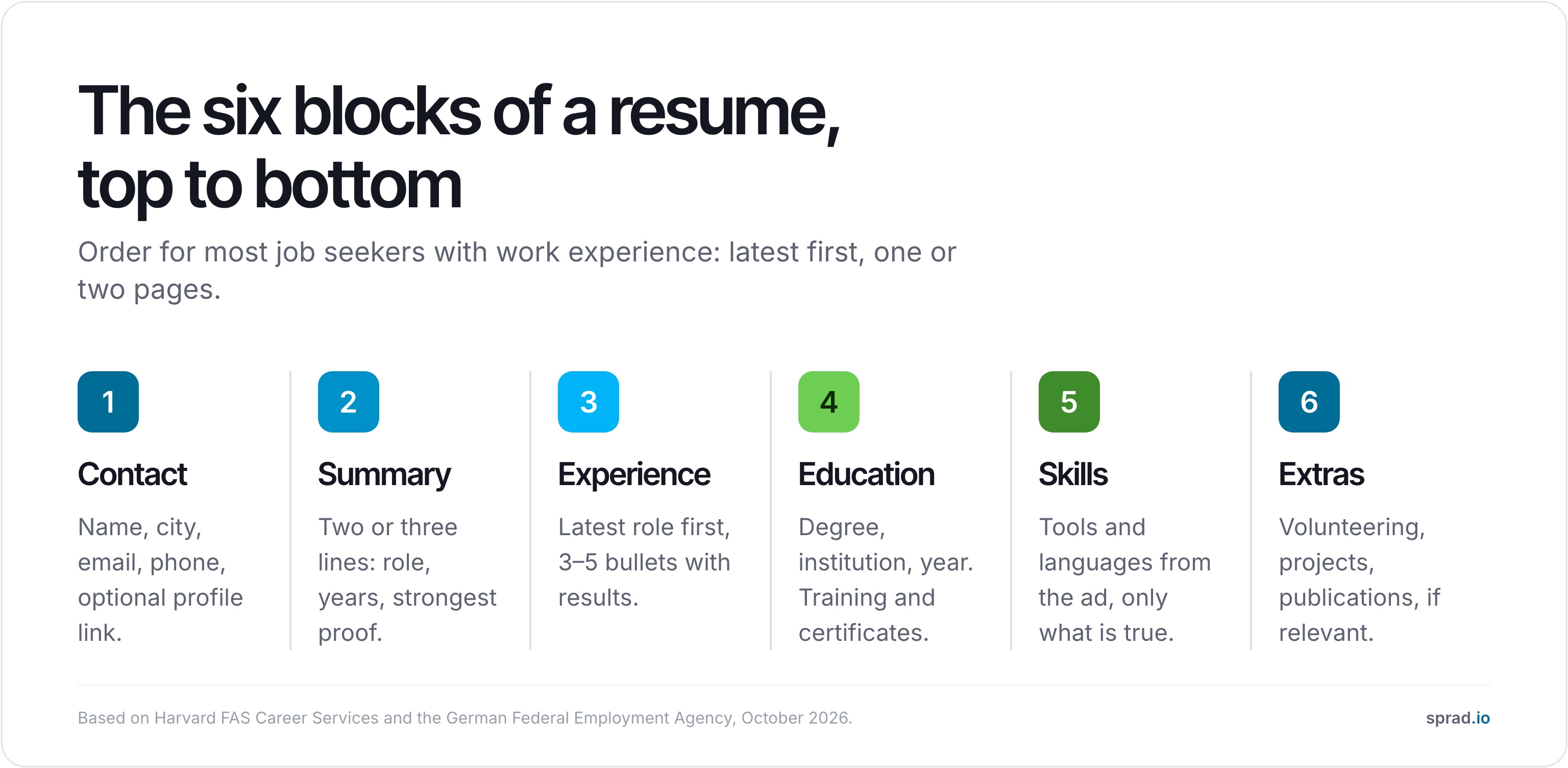
- Contact: name, city, email, phone. A profile link is optional. Email and phone are the minimum, and missing contact details count among the most common mistakes.
- Summary: two or three lines under your name, with your role, your years of experience and your strongest proof. Skip it if you have nothing specific to say. A generic "motivated team player" costs space and adds nothing.
- Experience: role, employer, dates, then three to five bullets per role. This is the block recruiters read first.
- Education: degree, institution, year, plus training and certificates that matter for the ad.
- Skills: tools, methods, languages, in the words the ad uses, and only what you can demonstrate.
- Extras: volunteering, projects, publications, only if they support the application.
Which format? Reverse-chronological is the default
Reverse-chronological (latest role first) suits most people and is what both Harvard and the Federal Employment Agency describe. A skills-based layout only helps if you are changing careers and your job titles say little about what you can do. Even then, keep a dated work history underneath, because employers and ATS software expect one.
How to write the bullets: result first, one number per role
A duty says what the job was. A bullet says what you did and what came of it. A simple pattern: action verb, what you did, result or scale. Harvard advises fact-based, active language: quantify and qualify, and avoid passive phrasing.
The number does not have to be revenue. Team size, caseload, shift pattern, number of customers per day, turnaround time or error rate all work. If you have no exact figure, an honest range ("about 30 customers a day") beats an invented precise one.
Example summary for an experienced nurse: "Registered nurse with six years on a 12-bed intensive care unit. Experience with ventilated patients, renal replacement therapy and onboarding new colleagues in rotating shifts." It names the role, the years and three facts an employer can check.
Why one resume for every job is not enough
A standard resume lists what you did. A job ad asks what you bring to this role. Germany's Federal Employment Agency advises: do not use the same CV for several applications. AI helps with exactly that: it finds the overlaps between the ad and your background in seconds and rewrites bullet points. What is true and what has to go stays your decision.
Step by step: tailor your resume to a job description with AI
Step 1: build a base CV (your "master")
Write one long CV once that contains everything: every role, duties, numbers, training, software, languages. It is raw material and never gets sent as is. The more specific your master, the less the AI has to guess. Add one or two numbers per role: team size, case load, revenue, shift pattern.
Step 2: analyse the job ad
Have the AI break the ad down before it rewrites anything. You want three lists: must-have requirements, nice-to-haves, and the terms the ad uses for tasks and tools (for example "shift work", "CRM", "account planning"). Those terms become your vocabulary, as long as they are true for you.
Step 3: match requirements to your experience
This is the most important step: a table with "requirement, evidence from my master, gap yes/no". Where there is evidence, it moves up in the CV. Where there is a gap, it stays a gap. You do not invent anything; at most you address it in the cover letter.
Step 4: reword without inventing
Now the AI rewrites bullets: stronger verbs, result before task, the ad's wording where it is true. Give it the rule: "Use only information from my CV. If something is missing, ask me or leave it out." Without that rule a language model likes to add plausible-sounding details that never happened.
Step 5: check the format for ATS
Many employers first load applications into an applicant tracking system (ATS). Plain layouts work best: one column, standard headings such as "Experience" and "Education", a standard font, dates like "07/2021 – 03/2024", no layout tables, no text inside graphics. Export as a PDF from a word processor, not as an image. Harvard also advises checking that your formatting survives conversion to PDF. For how to read an ATS score, see our post What is a good ATS score in 2026?. In the end a person usually reads the CV, and a list of buzzwords does not help you there.
Step 6: local conventions and proofreading
US and most English-speaking markets: a resume without photo, date of birth or marital status, usually one page. Harvard's guide says not to include a picture, age or gender. This is standard practice and not a legal rule, so check the employer's instructions.
Germany, Austria, Switzerland: a tabular CV, latest role first, one to two A4 pages. A photo is optional ("no longer a must", says the Federal Employment Agency). Employers must not discriminate on grounds such as age, sex or ethnic origin under the General Equal Treatment Act (AGG, section 1), and a photo shows exactly those traits. If you apply across the Atlantic, see AI for job applications: DACH vs. the US.
Europass is an optional EU format. Many employers accept a normal CV just as well. You can create a Europass CV for free if an employer asks for it.
Gaps: the Federal Employment Agency suggests listing breaks of more than two months and saying what you did in that time. Short, factual, no excuses.
Proofread: check every number, date and tool again. Read it aloud and ask for every line: can I back this up in an interview?
Before and after: an example from nursing
The example is fictional. Mai Nguyen is a registered nurse with six years on an intensive care unit, applying to an ad from the (also fictional) Nordring City Hospital. The ad asks for experience with ventilated patients and renal replacement therapy, shift work and onboarding new colleagues. A specialist ICU qualification is "desirable". Mai does not have one.
| Before (standard CV) | After (for this ad) |
|---|---|
| Nursing care of patients in the intensive care unit | Care for up to four ventilated patients per shift on a 12-bed ICU |
| Documentation and medication | Complete charting in the patient data system, medication and monitoring during renal replacement therapy (CRRT) |
| Teamwork | Onboarded new graduates and colleagues across rotating and night shifts |
| Training: attended courses | Training: ventilation management, ICU hygiene (each with year) |
What happened: the AI added nothing. In her master Mai had noted that she usually looks after four ventilated patients, runs CRRT machines and trains new colleagues. The ad set the order and the wording. The missing specialist qualification is not claimed in the CV. Mai mentions it openly in the cover letter and says she plans a part-time qualification. (The numbers are made up to show the effect.)
Prompt templates for ChatGPT
The three prompts build on each other. Paste your master CV and the ad where indicated. Remove name, address, phone and date of birth first (see the privacy section).
Prompt 1: analyse the ad
Analyse this job ad. List (1) must-have requirements, (2) nice-to-have requirements, (3) terms for tasks and tools used in the ad. Do not read anything into it that is not there. [paste ad]
Prompt 2: match with your experience
Here is my CV: [paste master]. Build a table with the columns: requirement, evidence from my CV (quoted verbatim), gap yes/no. If there is no evidence, write "gap" and suggest nothing.
Prompt 3: reword
Rewrite my CV for this job. Rules: use only information from my CV. Do not invent numbers, tools, titles or degrees. Put the most relevant roles first and lead each bullet with the result. Use terms from the ad only where they are true for me. One page, plain single-column text, latest role first. If information is missing, ask me questions instead of filling it in.
More templates for cover letters and follow-ups are in our collection 75 AI prompts for job applications. Which model suits which task is covered in ChatGPT vs Claude vs Gemini for applications.
Three ways compared
| Way | Cost | Job-specific? | Effort per application | Guard against invention |
|---|---|---|---|---|
| Atlas Career (career agent) | free, no limits | one CV per job, match score with reasons | low: pick a job, review, download PDF | only real experience, phrased more strongly; you review everything |
| ChatGPT yourself | free tier with usage limits, paid plans optional | very flexible if you prompt well | medium: prompts, copying, formatting | only as good as your prompt |
| Resume builders (e.g. Kickresume, Zety, Canva) | building often free, AI features or PDF export often paid (as of October 2026, check the pricing page) | mostly templates; tailoring to the ad varies by vendor | medium to high: re-enter your data | varies |
Each way has strengths: ChatGPT is the most flexible, builders have the nicest templates. If your goal is a separate version for every job, for free, a career agent is the shortest route.
Atlas Career: a CV for every job, no limits
Atlas Career (formerly Atlas Career) is a free AI career agent built by Sprad in Vienna. It searches 1.5M+ active jobs straight from employers' career sites and gives every role a match score from 0 to 100 with reasons. For every job you want to apply to, Atlas writes a tailored CV and, on request, a cover letter, with no limits and no cost. The language follows the ad: with a photo where that is customary in the DACH region, without one for the US. You set up your profile in a few minutes through a voice conversation.
Atlas sends nothing on its own. You review the CV, download it as a PDF and apply directly with the employer. It does not invent facts: Atlas words your real experience more strongly, nothing more. EU hosting, GDPR, never sold, no training of third-party AI models, deletable at any time. You can also start by browsing the job search.

Common mistakes when writing a resume with AI
- Invented skills and numbers. A model likes to add "increased sales by 30%" or a tool you never used. It comes out in the interview, and false claims can cost you the job. Fix: the rule "only information from my CV" in the prompt, plus your own check of every number.
- Keyword stuffing. A block of 30 buzzwords at the bottom helps neither the ATS nor the human. Terms belong in sentences with evidence.
- AI clichés. "Results-driven professional with a passion for…" reads the same in every application. Cut adjectives without proof and replace them with one concrete fact. More in 12 AI job application mistakes.
- One CV, three jobs. If you send the same version everywhere, you missed the point. A short adjustment per job is enough, but it has to happen.
- Layout tricks. Columns, icons, skill bars: they look good in the editor and turn into jumble in an ATS.
- Not proofreading. Put the ad next to the CV at the end and check dates, titles, company name.
Privacy: what not to upload
A CV contains a lot of personal data. German consumer advice from the Verbraucherzentrale says not to enter personal or sensitive data into chatbots. The Hamburg data protection commissioner's checklist on LLM chatbots (November 2023) notes that providers often use inputs for further training and that you can object. Check the data controls of your tool, because settings change. The GDPR's principle of data minimisation (Article 5) is a good rule of thumb for what you share.
- Remove before uploading: name, address, phone, email, date of birth, photo, ID or social security numbers.
- Do not upload: original reference letters, pay slips, internal documents from past employers, patient or customer data.
- Switch off the training option in settings if the tool offers one.
- After rewriting you add your personal details back yourself.
With a dedicated career agent, the provider should state clearly where data is stored and whether it is used for training. Atlas Career names EU hosting, GDPR and no training of third-party AI models.
Checklist before you send
- Latest role first, one to two pages, one column, PDF from a word processor.
- Every bullet starts with an action and ends with a result or a number.
- The ad's key terms appear in sentences, only where they are true.
- Gaps over two months are named briefly.
- Company name, job title and dates match the ad. Personal details are back in.
FAQ
How do I write a resume with no experience?
Lead with education, then projects, internships, volunteering and part-time jobs, each with a concrete result. Harvard's template does the same: education first, then experience and activities. Keep the summary to one line or drop it.
Can I create my CV with AI for free?
Yes. Use the free version of ChatGPT, the free tiers of resume builders, or a career agent like Atlas Career that gives you one CV per job with no limits. With builders, check PDF export and AI features, which are often paid.
How do I tailor my resume to a job ad with AI?
Analyse the ad, match requirements to your experience, move relevant roles up, reword the bullets and proofread. The prompts above give you the workflow.
Can employers tell my CV was written with AI?
Not reliably. What stands out are interchangeable clichés and claims you cannot explain in an interview. Write specifically, with your own numbers, and it is your CV even if AI helped with the wording.
Is an AI-written CV ATS-friendly?
It is if the format is right: one column, standard headings, text rather than graphics, a PDF from a word processor. Whether it lands well in practice is decided by a person.
Should I put a photo on my CV?
In the US, usually not. In Germany, Austria and Switzerland it is common but optional.
How long should a CV be?
One to two pages, according to the German Federal Employment Agency. In the US one page is the usual rule of thumb while your career is short.
What should I not paste into ChatGPT?
Name, address, contact details, date of birth, photo and ID numbers. Replace them with placeholders and add them back after rewriting.
How many tailored CVs can I make?
As many as you like. Atlas Career has no limit; with ChatGPT it depends on your plan.
Sources (as of October 2026): Federal Employment Agency, Lebenslauf · Harvard FAS Career Services, Create a strong resume · AGG · Europass · GDPR.
Jürgen Ulbrich
Jürgen Ulbrich has more than a decade of experience in developing and leading high-performing teams and companies. As an expert in employee referral programs as well as feedback and performance processes, Jürgen has helped over 100 organizations optimize their talent acquisition and development strategies.