Bullhorn suits large, established agencies willing to pay custom Pro/Max pricing for AI features; Crelate suits small, AI-curious boutique agencies that want an assistant built into every plan rather than gated behind an enterprise tier. Neither includes a search across an external candidate database or a talent pool that stays valuable after a candidate moves on — that's the gap a third option, Sprad, is built to close. Figures below are current as of September 2026.
Bullhorn vs. Crelate at a glance
Bullhorn is the legacy full-stack platform with 300+ integrations; Crelate is a modern, AI-native ATS/CRM aimed at 2-20 user boutique agencies. Sprad adds requirement-based external search and a talent pool that survives cancellation — neither Bullhorn nor Crelate has both.
| Criterion | Bullhorn | Crelate | Sprad |
|---|---|---|---|
| Starting price | $99/user/mo (Starter), $165/mo (Core) | $85/mo (Essentials, capped at 2 users), $119/mo (Business, unlimited) | Free start; Recruiter Lite 79 €, Atlas Recruiter 299 €; or pay-per-use credits (100 free/month) |
| Search beyond your own database | Boolean "AI Search" only on Pro/Max (custom quote) | LinkedIn integration for search and enrichment, no external database query | Requirement search across 1B+ external profiles; usage charged in credits |
| Talent pool that survives cancellation | Candidate records exportable, no dedicated re-engagement layer | Standard candidate database, no pool concept | Candidate consent is captured; the agency-owned pool stays with you, with full raw-data export |
| AI matching | Add-on, Pro/Max tier only, custom priced | AI Assistant native on every plan ("AI on every plan, not an upsell") | AI check of every profile against your own written requirements instead of keyword search, with reasoning per criterion; deep-context search by company and time period |
| Outreach | Email sidebar (Core+); sequences not publicly documented | No built-in email sequences for cold outreach | LinkedIn (connection request, message, InMail) plus email, automated with follow-ups and AI templates, in one inbox per candidate |
| CRM depth | Full client CRM (Pro/Max) | Client portals and sales pipeline (Business+) | Client context profile that feeds AI search; full sales CRM is in beta |
| DACH / German | English UI; SOC 2/GDPR, US-based | English only, no German UI | EU-hosted, German-speaking support |
| Migration | Established but reportedly slow onboarding for large setups | Data Sync Service for CRM integrations, priced by volume | Free import of old databases (CSV, spreadsheets) |
Bullhorn profile
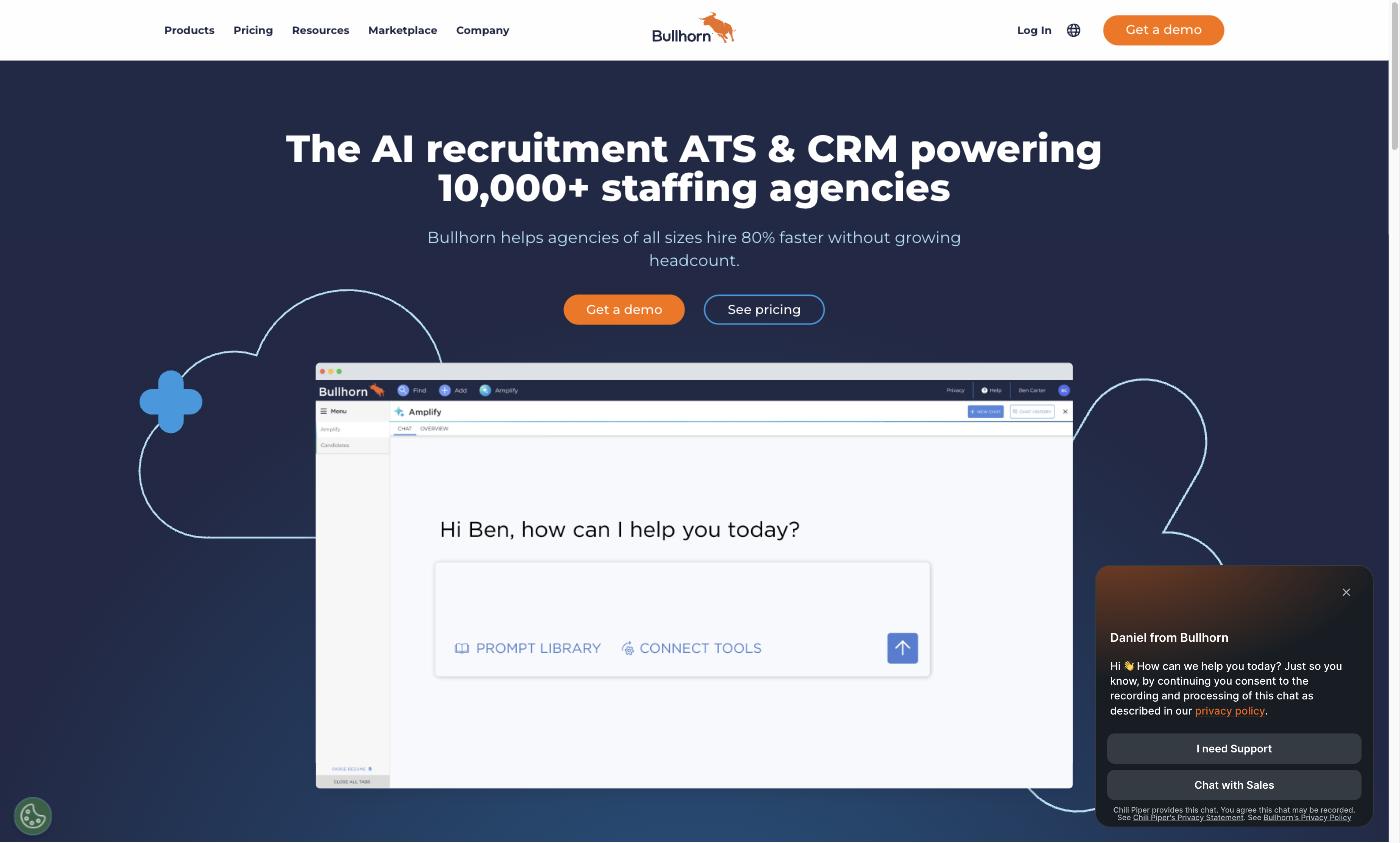
Bullhorn offers the deepest established integration ecosystem in this comparison and suits agencies with complex, mature workflows. Its lower tiers exclude the AI and automation features that often motivate the comparison in the first place.
Crelate profile
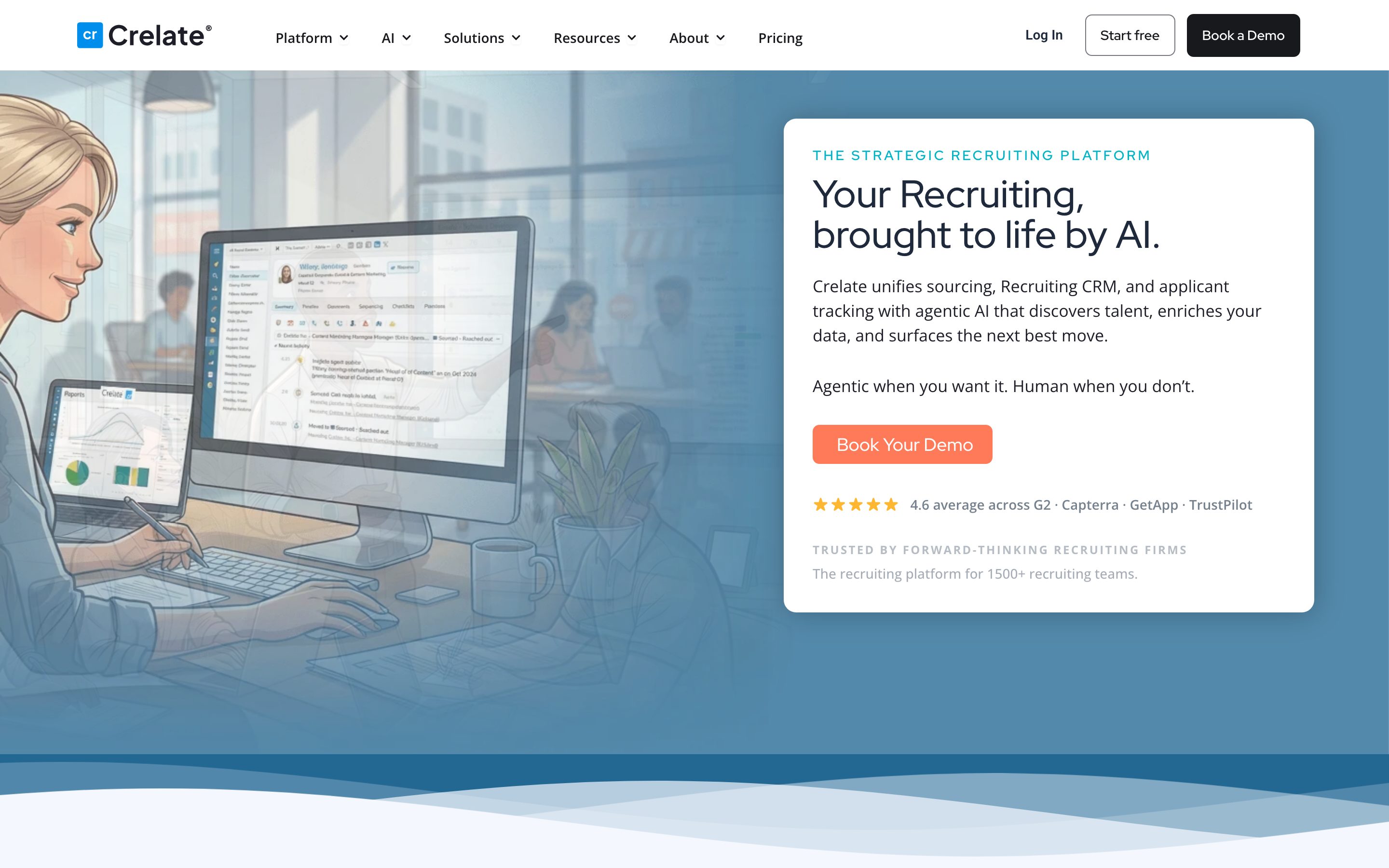
Crelate makes AI assistance easier to buy than Bullhorn and suits configurable boutique workflows. The two-user cap on Essentials and the lack of an external candidate database matter as a team grows.
Where the two actually differ
AI as a gate vs. AI as a default
Bullhorn's AI features — search, automation, analytics, call transcription — sit exclusively behind the custom-quoted Pro or Max tier, according to Bullhorn's pricing page. Crelate's whole pitch is the opposite: its AI Assistant ships on every plan, including the entry-level Essentials tier, which reviewers on G2 (4.4/5, 210 reviews, 90% satisfaction) cite repeatedly as a differentiator. If predictable, included AI matters more to you than raw feature depth, that's a real difference in how the two vendors price the same category of feature.
Crelate's Essentials plan has a catch worth knowing before you sign up
Crelate's cheapest published tier, Essentials at $85/month, caps out at two users and 20,000 contacts — reviewers call this limit "practically unusable" for any agency beyond a two-person team. To get unlimited users and the AI Assistant, you need Business at $119/user/month. Bullhorn has no equivalent user cap on its Starter tier, but its AI features are gated by pricing tier rather than user count — a different kind of restriction, not necessarily a smaller one.
Sourcing depth: LinkedIn integration vs. a Boolean add-on
Crelate's sourcing runs through a LinkedIn integration for candidate search and enrichment — useful, but it's not a search across an independent external database, and Crelate has no email-sequence automation for cold outreach. Bullhorn's Pro/Max "AI Search" is Boolean-based rather than semantic, per third-party comparison research, and it's not included until you pay for the higher tier. Neither gives you a requirement-based search across public profiles outside your own database.
Support consistency: a recurring complaint on both sides
Bullhorn's G2 reviews cite "slow resolution, difficult to reach right team" as a top complaint. Crelate's reviewers report a similar but distinct pattern: "difficulty reaching someone by phone," an inconsistent onboarding and billing experience, and a chatbot some describe as frustrating. Neither vendor's support reputation is a clear reason to pick one over the other — check current reviews before assuming either has fixed this.
The third option: Sprad
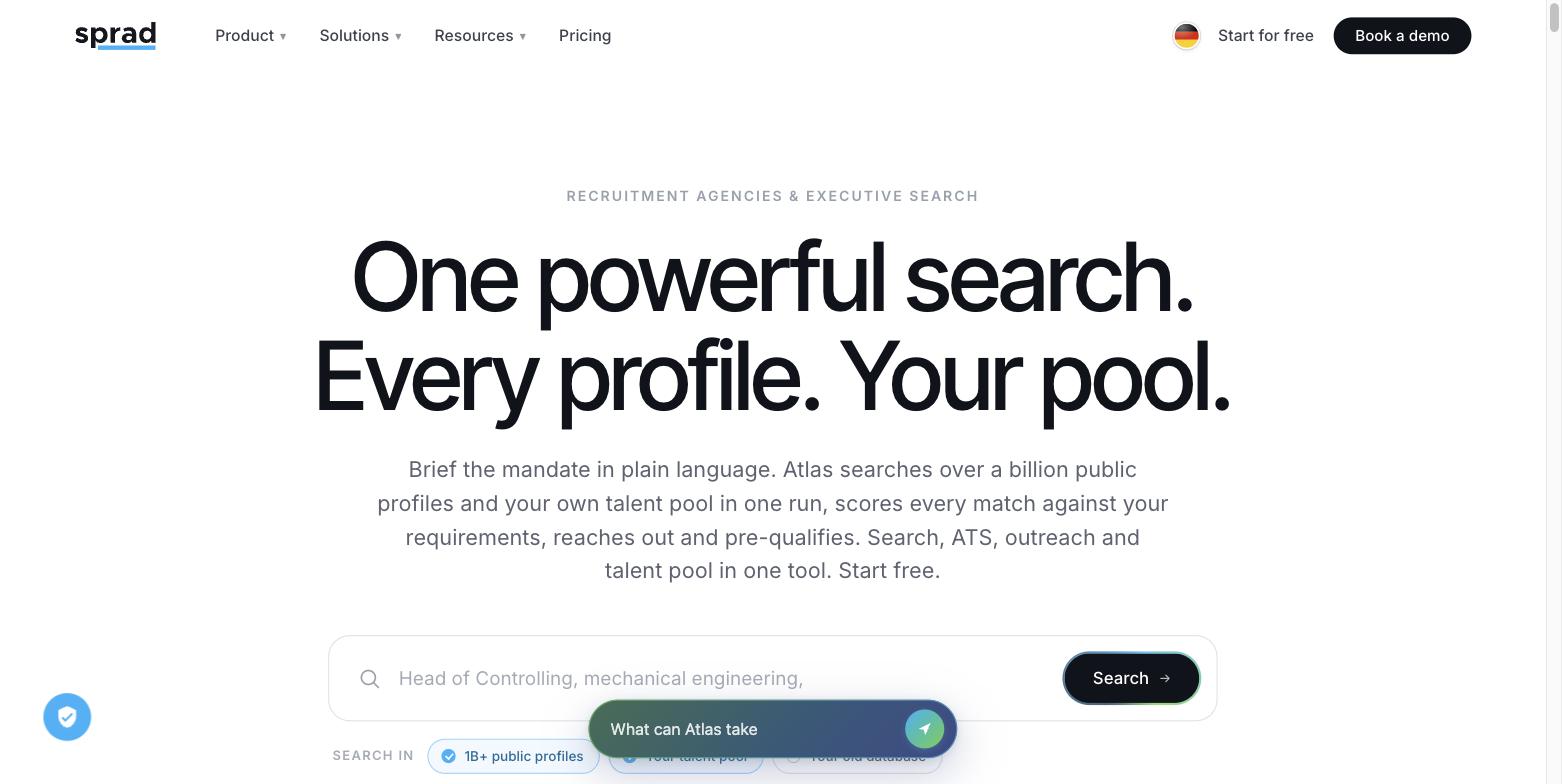
Sprad covers a different decision axis: the ATS and talent pool sit beside requirement-based search across external public profiles and the agency's own records. The ATS and talent pool are free for the whole team; the account includes 100 credits a month (200 in the first month), and sourcing seats cost 79 € (Recruiter Lite) or 299 € (Atlas Recruiter) per seat and month, with other usage charged in credits.
In the recruiting area of the open PeopleSearchBench, four systems have published scores (Lessie 68.2, Juicebox 65.7, Exa 64.7, Claude Code 50.5); our own re-measurement of Atlas, converted to that scale, comes to about 73.5 and is not an entry in the benchmark's table (published by Lessie, October 2026). In our own measurement (Sprad, as of 15 August 2026, method), Atlas found 38 % of the candidates that four other systems found; the best of those came to 9 %.
Beyond the search itself, Atlas searches LinkedIn, XING, GitHub and your own talent pool in one run and contacts candidates on LinkedIn (connection request, message, InMail) and by email, automated with follow-ups and AI templates (trainable with your feedback, ready-made, or the pitch format). Every conversation sits in one inbox per candidate, with a warning if someone was already contacted. Deep-context search finds people by company context, for example a CFO who guided a merger. You can upload your own LinkedIn network, employees can share theirs, and your data stays yours after cancellation, including a full raw-data export. Hosting and security follow EU enterprise standards.
A quick way to tell real AI search from keyword search: if results appear instantly, it is almost always a (semantic) keyword search. A true AI check reads every profile against your requirements, so the deep search takes a few minutes (Quick Search returns first results in about 3 seconds); that is what finds people with sparse or keyword-poor profiles.
Sprad's full client sales CRM is still in beta, so the fit is strongest when sourcing and candidate workflow are the bottleneck.
Which one fits your agency?
- Large agency already running Bullhorn's 300+ integrations: the switching cost usually outweighs the pricing frustration — negotiate the Pro/Max quote instead of migrating.
- 2-15 person boutique agency that wants AI matching included on every plan without paying for an enterprise tier: Crelate's Business plan is a reasonable fit, as long as you don't need external database search.
- Agency of any size that wants sourcing beyond LinkedIn enrichment or Boolean search, without a custom quote: Sprad's credit model and requirement search are built for this exact gap.
- DACH-based agency: neither Bullhorn nor Crelate offers a German interface; Sprad is EU-hosted with German-speaking support.
FAQ
Is Bullhorn or Crelate cheaper?
Crelate's Business plan ($119/user/month) is roughly comparable to Bullhorn's Core ($165/user/month), but Bullhorn's Starter ($99/user/month) undercuts both — as long as you don't need AI features, which are gated to Bullhorn's custom Pro/Max tier while Crelate includes its AI Assistant on every plan.
Does Crelate have an external candidate database?
No. Crelate's sourcing runs through a LinkedIn integration for search and enrichment rather than a native search across an independent external database of public profiles.
What's the catch with Crelate's cheapest plan?
Essentials at $85/month is capped at two users and 20,000 contacts — a limit reviewers describe as impractical for agencies with three or more recruiters, who need the $119/month Business plan instead.
Can I migrate from Bullhorn or Crelate to Sprad without losing candidate data?
Yes — Sprad imports existing databases (CSV exports, spreadsheets) for free, so agencies moving off either tool keep their candidate history.
Does either tool support German-speaking agencies?
Neither Bullhorn nor Crelate publishes a German interface. Sprad is EU-hosted and offers German-speaking support.
A third path worth testing before you commit
AI matching that's genuinely included in your base plan, not an upsell — that's Crelate's whole pitch against Bullhorn, and it's a fair one. But neither tool combines external search with an agency-owned talent pool. Sprad's pricing is built around the opposite idea: your network becomes a talent pool that stays with your agency, searchable across a billion external profiles in the same workspace as your ATS, screening and outreach — starting free with 100 credits a month (200 in the first month).
See what that looks like for your team size at sprad.io/industry/recruitment-agencies.
Jürgen Ulbrich
Jürgen Ulbrich has more than a decade of experience in developing and leading high-performing teams and companies. As an expert in employee referral programs as well as feedback and performance processes, Jürgen has helped over 100 organizations optimize their talent acquisition and development strategies.