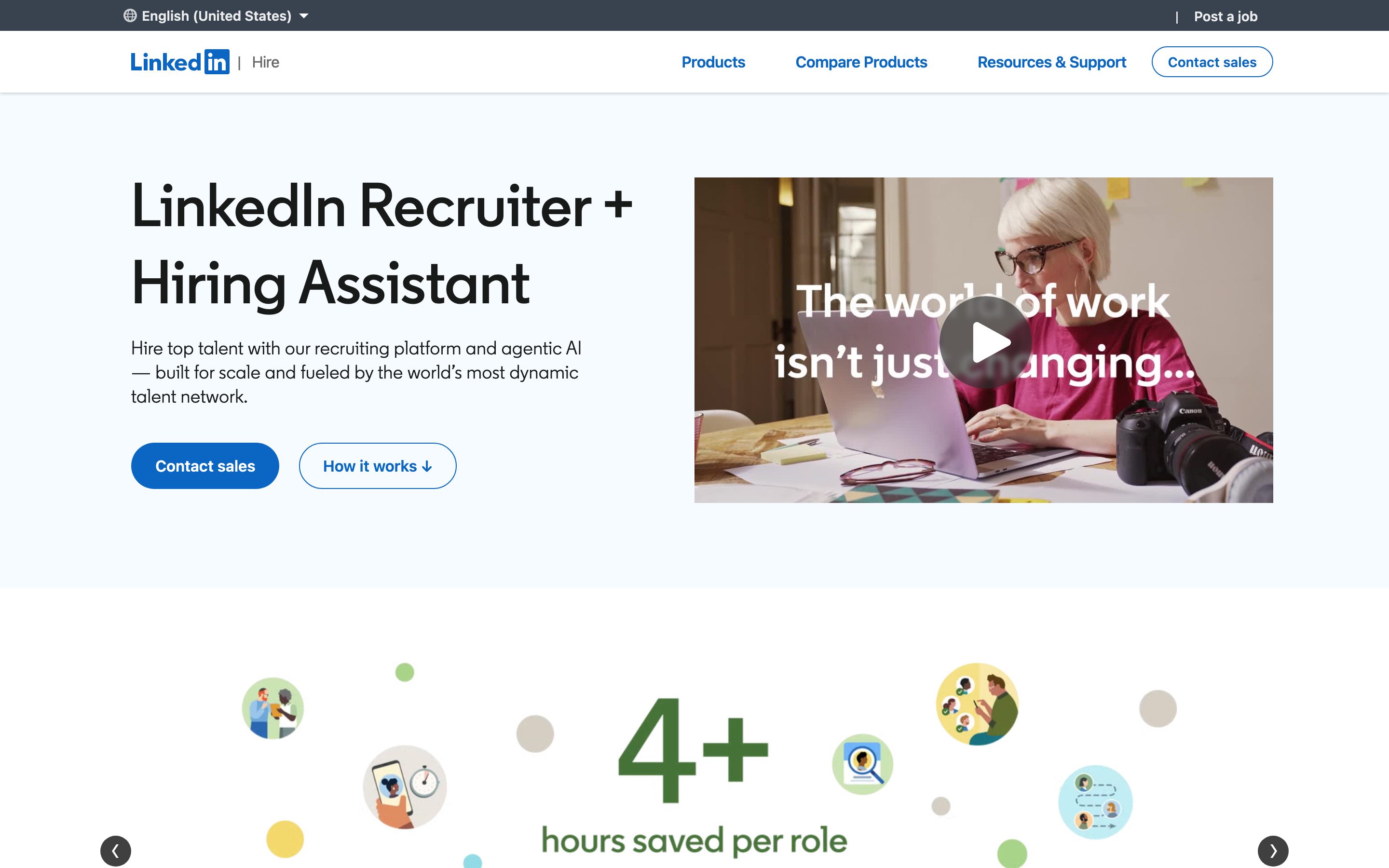
LinkedIn Hiring Assistant is an AI agent inside LinkedIn Recruiter that takes a role through intake, sourcing, evaluation and outreach, and it is sold only as an add-on to a Recruiter seat. LinkedIn publishes no price; the only public figure is a UK public-sector rate card from October 2025 listing £6,350 per licence and year on top of Recruiter itself. It is worth it for teams that already live in Recruiter and source mainly on LinkedIn. If you also need XING, GitHub, email outreach in the same inbox or a price you can read, look at alternatives such as Sprad.
What is LinkedIn Hiring Assistant?
LinkedIn announced the agent in autumn 2024 as its first AI agent for recruiters, first for pilot customers, then globally in English from September 2025. By LinkedIn's own count it had more than 500 charter companies and 8,000 early users after the first year. In April 2026 LinkedIn said its agentic hiring products were on track for $450 million in sales in the coming year (Reuters). That is demand, not proof of quality.
According to LinkedIn's product page (October 2026) the agent works in four stages:
- Intake: it asks questions and learns from your earlier Recruiter activity on similar roles.
- Sourcing: it runs searches across LinkedIn and surfaces candidates from pools you would not normally reach.
- Evaluation: it assesses applicants from LinkedIn and your ATS against your qualifications.
- Outreach and pre-screening: it drafts personalised messages and pre-screens interested candidates.
Recruiters stay in the loop and choose the projects it works on. Languages: English, French, German, Dutch, Spanish, Portuguese and Italian. A second generation, Hiring Assistant 2, is announced for early November 2026, with several features (applicant evaluation, outreach, voice pre-screening, interview scheduling) still labelled “coming soon”.
What does LinkedIn Hiring Assistant cost?
There is no price list and no self-serve checkout; you ask LinkedIn sales. The most reliable public number is LinkedIn's own rate card on the UK Digital Marketplace, listed for G-Cloud 14 on 20 October 2025. It is a public-sector price list, so a private quote in euros will differ, but it shows the structure: you pay for Recruiter first, then the add-on per licence.
| Item | Price (UK public-sector rate card, Oct 2025) | Note |
|---|---|---|
| Recruiter, per seat and year | £8,925 (1–2 seats) to £6,750 (101–250 seats); £8,575 for 3–10, £8,150 for 11–30 | Includes at least 150 InMails per month and licence |
| Hiring Assistant add-on, per licence and year | £6,350 list price | Cannot exceed the number of Recruiter licences |
| Hiring Assistant launch promotion | £2,079 (1–2) down to £1,575 (101–250); £2,000 for 3–10 | 1 Oct 2025 – 30 June 2026; higher capacity tier (800 sourced, 9,000 evaluated candidates) at the lower tier price |
| Hiring Assistant 2 | Not published | Rollout to customers announced for early November 2026 |
Reading note: we read the rate card as one list price of £6,350 for the add-on across all volume tiers and the Recruiter prices as per-seat tiers. Prices net, in pounds, as of October 2025.
Worked example: 5 and 15 recruiters
Assumptions: every recruiter has a Recruiter seat and an add-on licence, the tier price applies to all seats, no discounts.
- 5 recruiters: Recruiter 5 × £8,575 = £42,875; plus add-on at list price 5 × £6,350 = £31,750; total £74,625 per year. With the promotion (5 × £2,000) it was £52,875.
- 15 recruiters: Recruiter 15 × £8,150 = £122,250; plus add-on 15 × £6,350 = £95,250; total £217,500 per year (£150,750 with the promotion).

For comparison, Sprad charges 79 € per seat and month for Recruiter Lite (5 seats: 4,740 € per year) or 299 € for Atlas Recruiter with unlimited searches (fair use), deep search and one LinkedIn and mailbox account included (5 seats: 17,940 € per year, 15 seats: 53,820 €). The currencies differ and the scope is not identical, so read it as an order of magnitude, not a like-for-like quote. More on the base cost: LinkedIn Recruiter pricing.
Costs that are easy to overlook
- The Recruiter seat comes first. The add-on cannot exceed your Recruiter licences, and reviewers report that Recruiter Lite users cannot add it.
- Usage limits. The rate card names capacity tiers (800 sourced and 9,000 evaluated candidates for the higher one) without stating the period. Ask what happens when you hit the cap.
- InMail. Outreach competes with your InMail allowance (at least 150 per month and licence in the rate card). Third-party reviews mention overage charges; LinkedIn does not confirm this in the sources we read.
Is LinkedIn Hiring Assistant worth it? What users say
Honest answer: the evidence is mostly LinkedIn's own. We found no independent measurement of hit quality and no substantial user-review volume. What exists is vendor data, and it moves. At launch LinkedIn said recruiters review 62 % fewer profiles and save more than 4 hours per role; its product page now says 81 % fewer profiles, 66 % higher InMail acceptance and 33 % faster to interview-quality candidates (LinkedIn data, January 2026). Customer quotes such as Siemens or Expedia are self-reported. Treat these as marketing figures until you have measured your own roles.
Strengths
- Lives where your pipeline and InMail already are, so no new login for LinkedIn-first teams.
- Intake from job description and hiring-manager notes, and it learns from your Recruiter history.
- Also evaluates applicants from your ATS, not just new profiles.
- Seven languages including German, human approval at every step.
Limits
- LinkedIn only. It searches LinkedIn and your ATS. In DACH many candidates are mainly on XING or on GitHub; those are invisible to it.
- Recruiter lock-in and no public price. You cannot plan a budget without a sales call.
- New features still “coming soon” in the second generation (voice pre-screening, scheduling).
- Opaque judging. LinkedIn does not publish how the agent scores profiles; verify on your own roles.
- EU details. Third-party reviews report limits on instant outreach for EU-located projects. We could not confirm this in LinkedIn material, so ask in writing before you buy.
Which teams is it right for, which not?
- Right: in-house teams with several Recruiter seats, LinkedIn-heavy roles (tech, sales, management), budget for an add-on, and a hiring process that already runs in LinkedIn and an integrated ATS.
- Not right: agencies and DACH teams that need XING, GitHub and their own talent pool in one search; teams that want email and LinkedIn in one inbox; small teams that need a published price; anyone who wants to try before talking to sales.
Which alternatives fit better?
Three paths: keep Recruiter and skip the add-on (see LinkedIn Recruiter alternatives), add a multi-source AI sourcing tool, or replace the stack. The comparison:
| LinkedIn Recruiter + Hiring Assistant | Sprad | Open-web AI sourcing tools (e.g. Juicebox) | |
|---|---|---|---|
| Where it searches | LinkedIn members and your ATS | One search over LinkedIn, XING, GitHub and your own talent pool, 1B+ profiles | Open web, index differs by tool |
| How profiles are judged | Agent evaluates against your qualifications | Every profile checked individually, reason per requirement; Deep Context (company first, then people) | Mostly ranking over an index |
| Outreach | Drafted messages and InMail inside LinkedIn | LinkedIn + email + InMail in one inbox, automated follow-ups, warning on double contact | Mostly email |
| Pre-qualification | Basic screening questions; voice screening "coming soon" | Voice, video, chat and agent pre-qualification, WhatsApp on request | Rare |
| Price | No public price; Recruiter seat plus add-on | Free start; Recruiter Lite 79 €/seat/month; Atlas Recruiter 299 €; flexible credits | Published from about 99 $ per month |
| Your data after cancelling | Stays inside LinkedIn's account | Talent network stays free; full raw-data export | Varies |
| Benchmark measurement | None found (vendor figures) | PeopleSearchBench (recruiting): 73.5 of 100 (own re-measurement, converted)1 | Juicebox published 65.7 in recruiting |
1 PeopleSearchBench (Recruiting), published by Lessie, October 2026. Other systems' scores as published in the benchmark; Atlas is our own re-measurement with the benchmark's open test procedure, converted to the published scale; not an official entry. We did not test Hiring Assistant itself. Method and details.
Why Sprad is the first alternative to look at
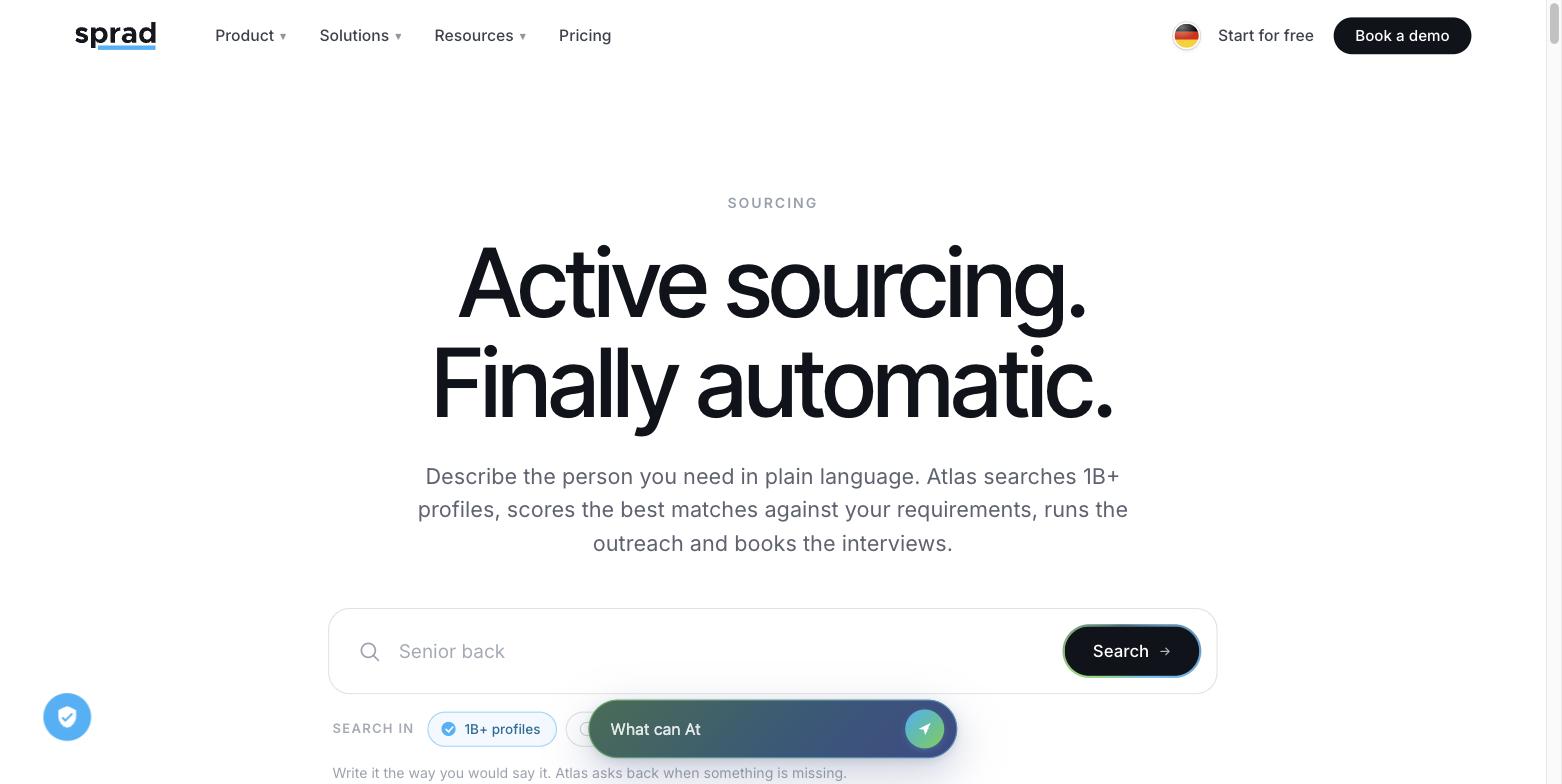
Sprad has built recruiting software for 7 years, starting with employee referrals, which means matching profiles to requirements. Its sourcing product, Atlas, takes a free-text requirement instead of Boolean strings and checks every profile individually. That is the practical difference to a keyword search: if results appear instantly it is almost always a semantic keyword filter. Atlas Quick Search returns first results in about 3 seconds; the deep search takes a few minutes because far more AI runs per profile.
- Most matching candidates: in the recruiting area of the public PeopleSearchBench our own re-measurement gives Atlas 73.5 of 100, converted to the published scale.1 In recruiting it returns almost always 15 matching profiles (14.2 on average in the re-measurement).
- Deep Context: finds companies first, then people who worked there in a given period, for example a CFO who led an acquisition or someone who took a start-up through Series A/B. A one-company LinkedIn filter cannot express that.
- LinkedIn and email in one inbox: automated outreach with follow-ups, InMails from Sprad, and a warning if a colleague already contacted the person. Per talent you see the whole conversation.
- Your data stays yours: the talent network stays free after cancelling, with a full raw-data export; flexible credits instead of rigid seat load. Compared with separate LinkedIn and XING licences, teams save 30–80 % depending on what they pay today.
Fair limits: no AI call notetaker, no placement reporting, no SMS (WhatsApp for candidate communication instead), and the deep search takes minutes. Plans: sprad.io/pricing; product: Active Sourcing.
How to test it in two weeks (and typical mistakes)
- Pick three real open roles (one easy, one niche, one senior) and run them in both tools.
- Count the first 15 results and note how many you would contact. That is your hit rate, not LinkedIn's percentage.
- Measure time to shortlist including your corrections.
- Track reply rate per channel (InMail, email, both).
- Write down the full cost including seats, add-on and caps.
Typical mistakes we see: judging by vendor percentages, forgetting that the add-on needs a Recruiter seat, ignoring XING-only candidates in DACH, and letting an agent send outreach without a documented human approval step.
GDPR and the EU AI Act
Sourcing and evaluating candidates processes personal data under the GDPR (Regulation (EU) 2016/679); you must inform people you contact and have a legal basis. AI systems used to recruit or evaluate candidates can count as high-risk under Annex III of the EU AI Act (Regulation (EU) 2024/1689). The safe pattern with any agent, LinkedIn's or ours: a human decides, the AI prepares and explains. More: Active sourcing and GDPR. This is not legal advice.
FAQ
Is LinkedIn Hiring Assistant worth it?
For LinkedIn-first teams with several Recruiter seats it can save sourcing time, but the evidence is LinkedIn's own and the cost is high (£6,350 per licence list price on top of Recruiter). Test on your own roles first.
How much does LinkedIn Hiring Assistant cost?
No public price. A UK public-sector rate card lists £6,350 per licence and year (October 2025), with a £1,575–£2,079 promotion that ended 30 June 2026.
Can I use it without LinkedIn Recruiter?
No. LinkedIn sells it as an add-on to Recruiter, and the rate card limits add-on licences to the number of Recruiter licences.
Does it work in German?
Yes, LinkedIn lists English, French, German, Dutch, Spanish, Portuguese and Italian; availability varies by feature.
Does it search XING or GitHub?
No. LinkedIn describes searches across LinkedIn plus your ATS. A multi-source search such as Sprad covers LinkedIn, XING, GitHub and your own pool.
What is LinkedIn Recruiter AI?
“LinkedIn Recruiter AI” is not an official product name. In practice people mean Hiring Assistant, the AI agent sold as a Recruiter add-on, and the search features inside Recruiter itself.
Which alternative is best?
Sprad if you want the most matching candidates (every profile checked individually), LinkedIn and email in one inbox and a published price; Juicebox for a small solo budget.
In short: LinkedIn plans keep getting more expensive and cancelling means losing your reach; with Sprad your own talent network stays yours. Atlas searches LinkedIn, XING, GitHub and your pool, checks every profile and starts free. See Active Sourcing and pricing.
Jürgen Ulbrich
Jürgen Ulbrich has more than a decade of experience in developing and leading high-performing teams and companies. As an expert in employee referral programs as well as feedback and performance processes, Jürgen has helped over 100 organizations optimize their talent acquisition and development strategies.