A candidate sourcing strategy is a written plan for how you find, approach and qualify people who are not applying yet. It answers six questions: which role, which talent pools, which channels, who writes to whom, with which message, and which numbers tell you it works. Without it, sourcing is ad-hoc searching that depends on whoever has time. With it, you can predict how many people you must contact to land the hire, and fix the weakest step instead of guessing.
What does a sourcing strategy mean in practice?
Sourcing is the proactive part of recruiting: you go to candidates instead of waiting for applications (the split is explained in sourcing vs recruiting). A strategy turns that into a repeatable system per role family. In Germany the pressure is structural: the Federal Employment Agency lists 157 occupations with a skills shortage for 2025 (163 a year earlier), and roughly half of all reported vacancies fall into them (BA press release of 2 September 2026). For those roles the best people are rarely on the market, so you have to reach them.
In practice a strategy has three layers: targeting (who, where), approach (channel, message, timing) and learning (what you measure and change). The seven steps below cover all three.
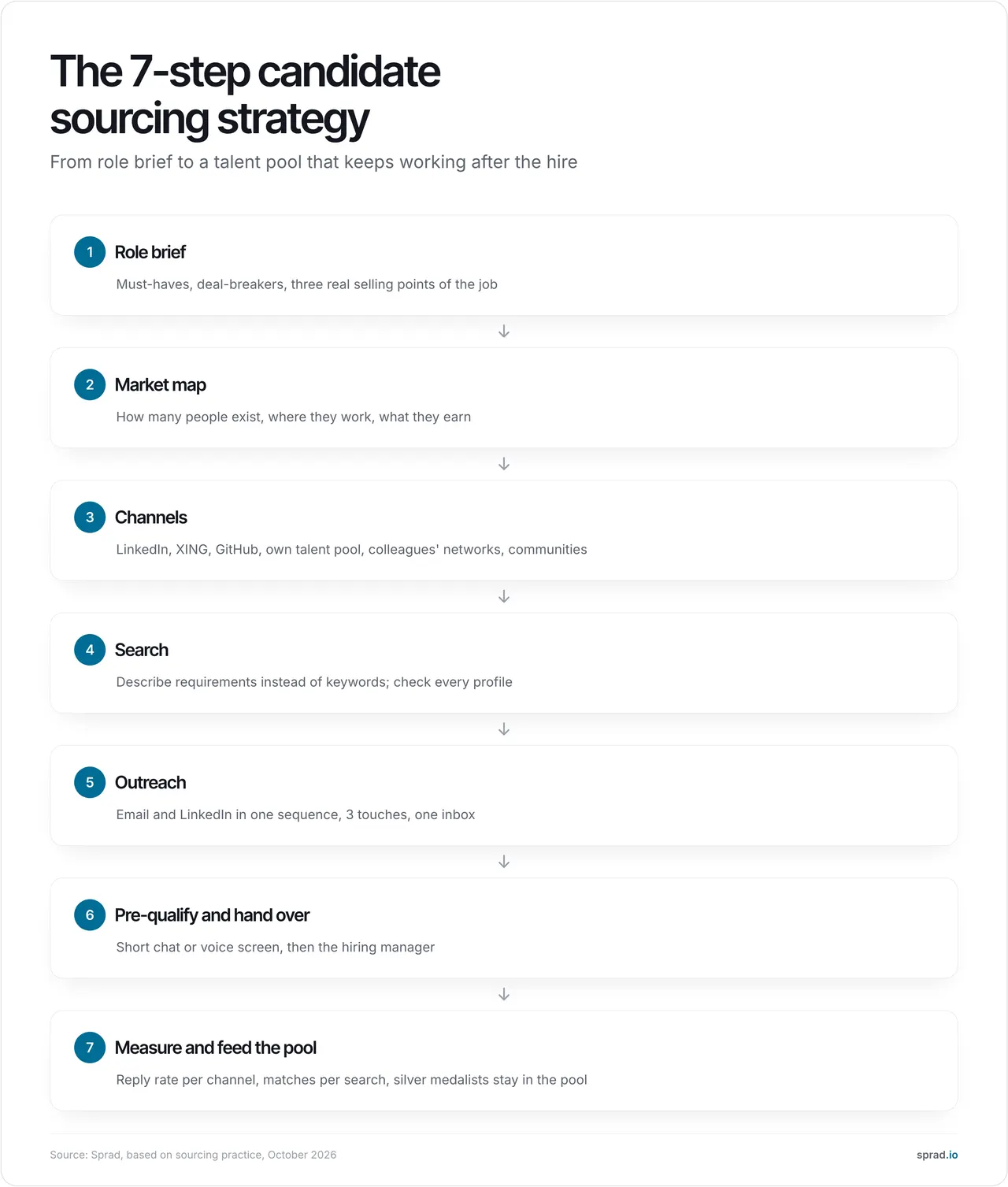
How do I build a sourcing strategy step by step?
1. Write a role brief that a search can use
List three to five must-haves, the deal-breakers and the nice-to-haves, and add three real selling points of the job beyond salary (scope, team, tech, flexibility). Hiring managers usually give you a job title; you need requirements. "Senior backend engineer" is a title; "has run a payment service above 1,000 requests per second and led at least two juniors" is a requirement. A thin brief is the most common reason for a bad shortlist.
2. Map the market before you search
Estimate how many people fit, where they work and what they earn. If only 300 people in your region qualify, you need a slow, personal approach and a talent pool; if 30,000 qualify, volume and automation pay off. Also decide the geography early: a remote role in the EU changes both pool size and the legal basis (see the compliance section).
3. Choose channels on purpose
One channel is a single point of failure. Mix active channels (you contact) with passive ones (they find you):
| Channel | Best for | Watch out |
|---|---|---|
| Professionals worldwide, especially in the US and UK | Connection and InMail limits; profiles are often outdated | |
| German-speaking professionals, trades, sales, public sector | Smaller outside DACH; separate licence in most tools | |
| GitHub and communities | Developers, data and open-source profiles | Contact details are rarely public; tone must be technical |
| Your own talent pool | Past applicants, silver medalists, earlier placements | Needs consent and regular refresh; decays without upkeep |
| Colleagues' networks | Warm introductions, highest reply rates | Needs an easy way for staff to share their network |
| Referrals | Culture fit and retention | Slow to build; does not replace sourcing |
A tool that searches several sources at once saves the tab-switching; see multi-source sourcing beyond LinkedIn.
4. Search by requirements, not only keywords
Boolean strings still work for narrow titles (cheat sheet), but they miss people whose profile does not contain your words. Describe the requirements in plain language and have every profile checked against them. A practical test: if results appear instantly, it is almost always a (semantic) keyword filter, not a check of each profile. Real profile checking takes minutes for a deep search, because it reads far more per profile.
5. Approach in sequences, on two channels
One message rarely gets an answer. A Lever study reported by HR Dive in 2018 found that roughly half of all responses arrived after the first contact and nearly all by the third, so plan three touches over about two weeks. Combine email and LinkedIn in one sequence: some people ignore InMails but read email, and vice versa. Keep every touch short, name one concrete reason you picked this person, and state one selling point from your brief. Most teams lose reply rate not on the first message but because follow-ups are manual and get dropped.
Two rules save embarrassment: keep one inbox per talent so nobody writes to the same person twice from different tools, and never send the same text to everyone.
6. Pre-qualify before the hiring manager sees anyone
A short chat or voice screen (five to ten minutes) checks availability, salary range and the one or two must-haves a profile cannot show. It protects the hiring manager's time and gives candidates a faster answer. Hand over a shortlist with a reason per candidate, not a list of links.
7. Measure and keep the pool alive
Track four numbers per role: matches per search, reply rate per channel, interested per reply and interviews per hire. Everyone who was good but not hired stays in your talent pool with a note; next quarter that pool is your cheapest source.
A worked example: how many people must you contact?
Assumptions (ours, replace them with your own data): you want 3 hires, you need 4 qualified interviews per hire (12 in total), 50 % of interested people pass pre-qualification, 40 % of repliers are interested, and the reply rate over the whole sequence is 15 %.
- 12 interviews / 0.5 = 24 interested people
- 24 / 0.4 = 60 repliers
- 60 / 0.15 = 400 people to contact
The reply rate moves the result most: at 10 % you need 600 contacts, at 20 % only 300. Published reply-rate benchmarks come mostly from tool vendors and range widely, so measure your own after the first 100 messages. If 30 % of the profiles you look at match, 400 contacts mean reviewing about 1,330 profiles. At three minutes each that is about 67 hours of screening by hand. With a tool that checks each profile and shows only matches, the same 400 matches cost 800 credits in Sprad (2 credits per shown profile), about 80 € at the list price of 0.10 € per credit (as of 30 October 2026). The time you save is the real gain.
Which tools and templates help?
You need three layers: a place to search (LinkedIn Recruiter, XING TalentManager or an AI sourcing tool), a place to manage and reach out (ATS or CRM, plus sequences) and a talent pool you own. A comparison of the options is in active sourcing tools compared. As a template, copy this plan per role family:
| Field | Example entry |
|---|---|
| Role and target date | Backend engineer (Go), start 1 March, 3 hires |
| Must-haves / deal-breakers | Production Go experience; no pure consulting background |
| Selling points (3) | Own a service end to end; 4-day week option; fully remote in the EU |
| Pool size estimate | About 2,500 profiles in DACH, 9,000 in the EU |
| Channels and owner | LinkedIn + email (recruiter), GitHub (tech lead), own pool (coordinator) |
| Sequence | Day 1 LinkedIn, day 4 email, day 10 short follow-up |
| Targets | 400 contacts, 15 % replies, 12 interviews |
| Review date | After 100 messages: adjust message and channel mix |
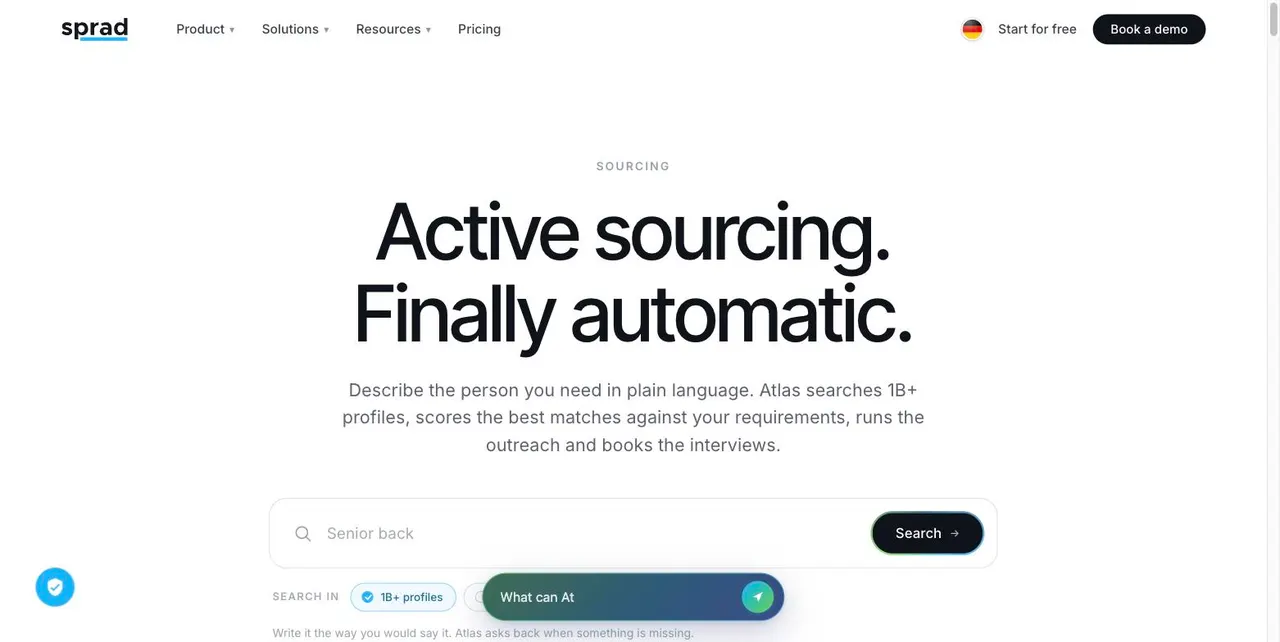
Where does Sprad fit? Atlas, the sourcing tool from Sprad, searches LinkedIn, XING, GitHub and your own talent pool in one go, checks every profile against your requirements and gives a reason per requirement. Outreach runs over LinkedIn and email, automated with follow-ups, InMails and trainable AI templates, in one inbox per talent with a warning if a colleague already wrote to the person. In the Recruiting area of the public PeopleSearchBench, Atlas reaches 73.5 out of 100 in our own re-measurement, converted to the published scale.1 Sprad has built recruiting software for seven years, starting with employee referrals, which is the same matching problem. You can start free with 100 credits per month; Recruiter Lite is 79 € per seat and month, Atlas Recruiter 299 € (billed annually, net, as of 30 October 2026, current prices).
Honest limits: Sprad has no AI call notetaker and no placement reporting yet, no SMS (WhatsApp for candidate communication instead), and a deep search takes a few minutes while Quick Search answers in about three seconds. 1 PeopleSearchBench (Recruiting), published by Lessie, October 2026. Other systems' scores as published in the benchmark; Atlas measured with the benchmark's open test procedure. Method: PeopleSearchBench at Sprad.
Which mistakes should I avoid?
- Starting with the search, not the brief. The shortlist can only be as good as the requirements.
- Relying on one channel. One platform change or limit stops the whole pipeline.
- One message, no follow-up. Most replies come on touch two or three.
- Writing to the same person twice. It happens in every team with more than one recruiter and two tools; use one inbox.
- Judging a tool by its demo search. Run one of your own open roles and count how many results you would actually contact.
- Forgetting the pool. Silver medalists without a note are lost within months.
- Ignoring the legal basis. See the next section.
How does AI change sourcing, and what about the law?
AI shifts three steps: search moves from keywords to requirements, outreach can run as an automated sequence with an approval option, and pre-qualification can happen by chat or voice before a recruiter spends time. What does not change is accountability: a person decides.
In the EU, sourcing processes data of people who did not apply. That usually rests on legitimate interest (Article 6(1)(f) GDPR, see the EDPB guidelines 1/2024) and carries an information duty under Article 14: you must inform the person within a reasonable period, at the latest one month after obtaining the data, or at the first contact if you use it to write to them, and honour objections. The EU AI Act (Regulation 2024/1689) classifies AI used to filter or evaluate applicants as high-risk; the obligations were postponed to 2 December 2027 by the Digital Omnibus, so check the current status. Plan for human review and documentation now. This is orientation, not legal advice. More in active sourcing and GDPR and what to delegate to automation.
FAQ
What does "sourcing strategy" mean?
It is a documented plan for finding and approaching candidates who are not applying: target profile, talent pools, channels, outreach sequence, owners and the numbers you track.
What are the main steps of a sourcing strategy?
Role brief, market map, channels, search, outreach, pre-qualification and handover, then measuring and feeding the talent pool.
Which tools or templates should I use?
Use a sourcing tool for search, an ATS or CRM for tracking and a talent pool you own. The plan template above fits one page per role family.
How many times should I contact a candidate?
Plan three touches over about two weeks, on two channels. Vendor studies differ on exact rates, so test your own.
What is the difference between active and passive sourcing?
Active sourcing means you contact people directly; passive sourcing means building a talent pool and employer visibility so candidates come to you. A strategy uses both.
Which mistakes should I avoid?
No brief, one channel, no follow-ups, double outreach, no pool upkeep and no legal basis. Details are in the list above.
How does AI change sourcing?
It replaces keyword matching with requirement-based checks of each profile, automates sequences and pre-qualification, and makes documentation and human review more important, not less.
Jürgen Ulbrich
Jürgen Ulbrich has more than a decade of experience in developing and leading high-performing teams and companies. As an expert in employee referral programs as well as feedback and performance processes, Jürgen has helped over 100 organizations optimize their talent acquisition and development strategies.