The best free recruiting CRM in 2026 depends on what has to stay free: the pipeline, the talent database or the sourcing itself. Most free plans cap one thing: Zoho Recruit and Breezy HR allow one active job, HubSpot's free CRM 2 users and 1,000 contacts, Pin 20 lookups a month. Sprad is the one in this comparison that keeps the CRM, pipeline, career site and talent network free for the whole team with no job cap, and adds 100 credits a month (200 in the first month) for AI sourcing. Prices and limits below are as of October 2026; vendors change free tiers often, so confirm on their pages before you commit.
What counts as a free recruiting CRM?
A recruiting CRM manages relationships with people before and between applications: a talent pool, notes, stages, and follow-ups with people who were not right yet. An ATS manages the applications for an open job. Many tools mix both, which is why searches for “free ATS” and “free recruiting CRM” overlap (details in our guides on ATS vs CRM and talent pool vs ATS vs CRM). “Free” also means four different things:
- Free forever, with a cap: Zoho Recruit, Breezy HR. Useful, but capped on jobs.
- Free open source: OpenCATS. No license fee, but you run it.
- A free general CRM: HubSpot. You build the recruiting process yourself.
- Free credits: Sprad, Pin, Juicebox. You pay with usage, not with seats.
For ATS-only options see the best genuinely free ATS; for sourcing-only tiers what free AI sourcing tiers actually do. This guide asks a narrower question: which free tool gives you a pool you can keep and a way to fill it?
Disclosure: Sprad publishes this article and is one of the tools compared. Other vendors’ prices and features are as published on their own pages at the time of writing, Sprad’s as of 29 Oct 2026. Where another tool fits a use case better than Sprad, the text says so.
Seven free recruiting CRM and sourcing tools compared
About the order: the profiles below are grouped by use case, not ranked by a score; we did not build a rating scheme. Sprad is listed first where its own functions (a free CRM with no job cap that also finds people) are the point of the comparison. Where another tool fits a use case better, the profile and the at-a-glance box say so.
| Tool | Type | What is free (October 2026) | Where free stops | Finds new people? |
|---|---|---|---|---|
| Sprad | CRM + sourcing + outreach | CRM and pipeline with unlimited jobs, career site, talent network, whole team; 100 credits a month (200 in month one) | Credits (a quick run starts at 50); outreach agent not bookable on free; accounts released in waves | Yes: LinkedIn, XING, GitHub, your own pool |
| Zoho Recruit | ATS + CRM | Candidate management, email, interview scheduling | 1 active job per recruiter license | No |
| Breezy HR | ATS | 1 active position, unlimited users | Second position needs a paid plan | No |
| HubSpot free CRM | General CRM | 2 users, 1,000 contacts | No recruiting features, contact cap | No |
| OpenCATS | Open-source ATS | No license fee, self-hosted | Hosting, security and GDPR are yours | No |
| Pin | AI sourcing | 20 lookup credits a month | Allowance, no pool or pipeline | Yes |
| Juicebox | AI sourcing | Usage-based tier, no time limit | Search and contact limits | Yes |
How do they differ in price, data and outreach?
Price differences hide in the caps, not the headline. Data differs in what you can take with you. Outreach differs most: only the three sourcing-capable tools find new people at all, and only Sprad combines that with a pipeline you keep. We run four checks on any free plan:
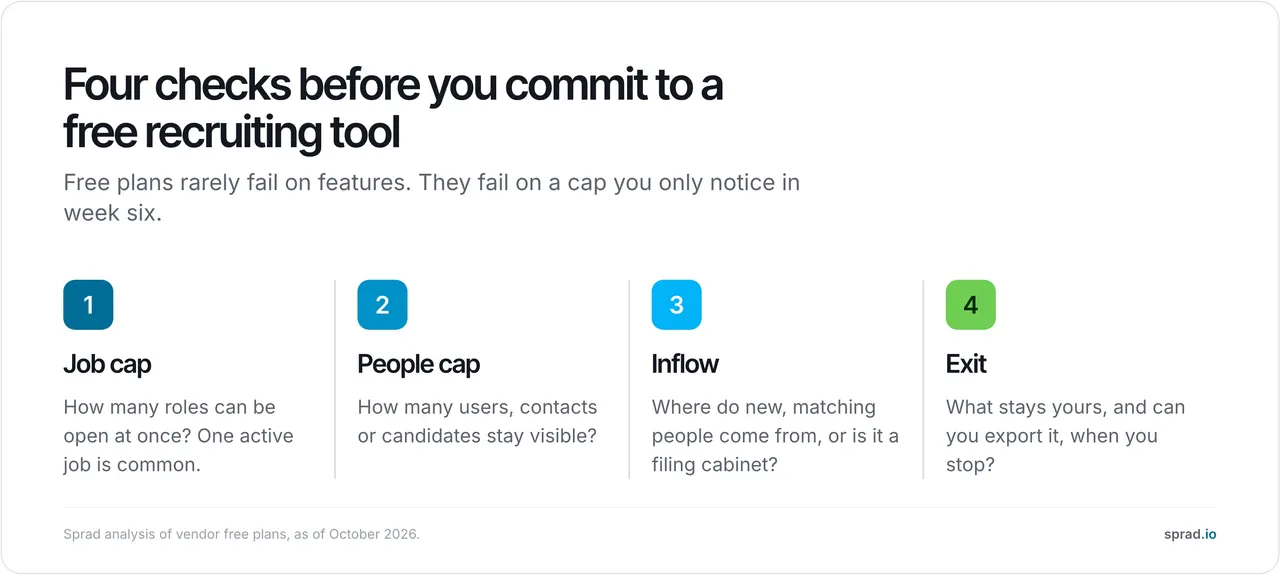
- Job cap. One active job is common. If you hire for two roles at once, you are already on a paid plan.
- People cap. HubSpot stops at 1,000 contacts, and a sourced pool passes that within a few searches.
- Inflow. A CRM without a way to find new people is a filing cabinet. Free CRMs store; they do not search.
- Exit. Ask what remains if you cancel. At Sprad the talent network stays free after you stop, with free credits to keep searching and every view can be exported.
Sprad: the free CRM that also finds people
Sprad has built recruiting software for 7 years, starting with employee referrals, which is matching profiles to requirements. Its sourcing product Atlas takes a requirement instead of a Boolean string and checks every profile individually instead of running a keyword search, so it also finds people whose profile is poorly maintained. Results come with a reason per requirement. One search covers LinkedIn, XING, GitHub and your own talent pool; outreach goes out over LinkedIn and email from one inbox, and the system warns you if a colleague already contacted someone. Invited talents get a free job agent, so the pool shows who is open to a move.
In the public PeopleSearchBench (Recruiting) Atlas reaches 73.5 in our own re-measurement, converted to the published scale (Juicebox 65.7 as published); in recruiting it returns almost always 15 matching profiles per search (14.2 on average).1 The honest limits: no AI call notetaker and no placement reporting yet, no SMS (WhatsApp for candidate communication instead), and deep search takes a few minutes because far more AI runs per profile (Quick Search takes about 3 seconds). More on Active Sourcing.
Zoho Recruit: a solid free ATS for one role
Zoho Recruit combines applicant tracking with CRM functions, which makes it the closest classic match to the search. The catch is the cap: with one active job per free recruiter license, a second concurrent role pushes you to a paid plan (Standard lists 10 active jobs per license). It does not search for people outside your database.
Breezy HR: simple, with one position
Breezy is easy to roll out and allows unlimited users, which suits hiring managers who just review candidates. Before you use it as a pool, check the visibility rule for older candidates in the vendor's current terms.
HubSpot free CRM: flexible, but you design the process
If your company already runs on HubSpot, candidates can live as contacts with a deal pipeline per role. You then build stages, consent tracking and reporting yourself, and the 1,000-contact cap comes quickly once you import sourced profiles.
OpenCATS: free software, not free operation
OpenCATS suits teams with their own IT. The licence is free; the work is not: updates, backups, access control and deletion routines are your responsibility, and so is the GDPR documentation.
Pin and Juicebox: free sourcing, no pool
Both let you try AI search without paying. Neither is a CRM: results do not become a managed pool with stages, notes and consent. Treat them as a test of search quality, then compare on one real role. Details: free AI sourcing tools.
What does free really cost? Two calculations
Calculation 1: the job cap. A team of three recruiters with six open roles. On a plan with one active job per license you cover three roles at most; the other three need a paid tier. “Free” ends when the second role opens, which is usually in the first month.
Calculation 2: credits. On Sprad, a web search is billed at 2 credits per displayed profile, never more than the run budget. A quick run (50 credits) shows up to 25 profiles. Finding a business email costs 1 credit, charged only if one is found. One role per month: a quick run plus emails for all 25 profiles is at most 75 credits, which fits inside the 100 free credits and leaves 25 for a pool search. Above the free plan, Atlas Base (450 € a year) lowers the price to 0.09 € per credit, so a shown profile costs 0.18 €. Recruiter Lite at 79 € a month includes 500 profiles and 50 pool searches; at those list prices it becomes cheaper per profile once you review more than about 440 profiles a month (79 € ÷ 0.18 €). Assumptions: list prices excl. VAT, annual billing, credits used only for profiles.
Which tool suits small teams, which enterprises?
- Solo recruiter or founder with one role: Zoho Recruit or Breezy HR cover the pipeline; add a sourcing free tier if you need candidates.
- Small team or agency with several roles: job caps hurt first. A CRM without a job cap plus sourcing credits (Sprad) avoids the upgrade at role number two.
- Enterprise or public sector: free tiers are trials. What matters is hosting region, data processing agreement, role-based access and integrations. For larger teams, one shared pool prevents double outreach and keeps one profile per talent; Sprad serves enterprise and public clients with EU hosting.
GDPR, EU hosting and AI rules: what to check
A talent pool is personal data, and sourced profiles are data you did not collect from the person. Check these points before you import anything:
- Inform people. If you collect data from a third source, GDPR Art. 14 requires you to tell the person within a reasonable time and at the latest within one month, or at the first contact.
- Limit storage. Art. 5(1)(e) allows storage only as long as needed; Art. 17 gives people the right to deletion. Your tool needs real deletion and export, not only a hidden flag.
- Rejection periods. Under § 15(4) AGG a discrimination claim must be made within two months. Many German employers therefore keep rejected applications for about six months; that is common practice, not a statutory figure.
- UK. The ICO's recruitment guidance treats people found through a talent search as candidates, so the same duties apply.
- US. New York City's Local Law 144 requires a bias audit and notice before an automated employment decision tool is used.
- EU AI Act. AI used to filter or evaluate candidates is high-risk under Annex III. The Digital Omnibus moved the stand-alone obligations from 2 August 2026 to 2 December 2027 (law-firm analysis). A delay is not a repeal: keep humans in the decision.
Ask every vendor where data is hosted and for a data processing agreement. Sprad hosts in the EU with enterprise-grade data protection and IT security, and AI prepares decisions while people take them.
Typical mistakes with free recruiting tools
- Starting without an exit. If you cannot export everything, the pool is rented, not owned.
- Importing contacts without a legal basis or notice. A big import feels productive and creates the biggest GDPR gap.
- Building a pool with no inflow. After three months the same 200 people go stale.
- Closing jobs to stay under the cap. It works on paper and hides your real pipeline from the team.
- Contacting people twice. With LinkedIn in one tool and email in another, the same talent gets two openers. One inbox per talent prevents it.
Our pick, and a short checklist
Pick by the first cap you will hit. If you need one role tracked, a free ATS is enough. If you need a pool you keep and a way to fill it, Sprad is first on our list for a concrete reason: the CRM has no job cap, sourcing credits are included, and the pool stays yours after you stop. The price story is simple: Sprad starts free, and Recruiter Lite costs 79 € per seat and month. Plans and credits are listed on sprad.io/pricing.
- How many roles are open at once, and what is the job cap?
- Does the free plan find new people, or only store them?
- Can you export everything and delete on request?
- Where is the data hosted, and is there a data processing agreement?
- What happens to the pool when you cancel?
The free CRM and talent pool in this comparison is the Sprad Talent Network.
FAQ
Is there a completely free recruiting CRM?
Yes, with limits. Free plans exist, but each caps jobs, contacts or searches. Sprad is free for the whole team with no job cap; AI searches use the 100 free monthly credits.
Can I use HubSpot, Notion or Excel as a recruiting CRM?
For a handful of candidates, yes. Beyond that you rebuild stages, consent tracking and deletion by hand, and none of them finds new people.
What is the difference between a free ATS and a free recruiting CRM?
An ATS tracks applications for open jobs. A CRM keeps relationships with people between jobs. Zoho Recruit and Sprad cover both sides in different ways.
How many candidates can I source for free with Sprad?
At 2 credits per displayed profile, the 100 free monthly credits show up to 50 profiles, up to 100 in the first month (200 credits). Finding emails costs extra credits.
Is a free recruiting tool GDPR compliant?
That depends on how you use it, not on the price. Check hosting, a data processing agreement, deletion and export, and inform people you source (Art. 14).
1 PeopleSearchBench (Recruiting), published by Lessie, October 2026. Other systems' scores as published in the benchmark; Atlas measured with the benchmark's open test procedure. Contact data came from the “find email” button. Method and details.
Jürgen Ulbrich
Jürgen Ulbrich has more than a decade of experience in developing and leading high-performing teams and companies. As an expert in employee referral programs as well as feedback and performance processes, Jürgen has helped over 100 organizations optimize their talent acquisition and development strategies.