GitHub recruiting means finding developers through their public profiles, repositories and contributions on GitHub. You search GitHub's user search with filters such as language:, location: and followers:, judge skill by merged pull requests and code reviews rather than stars, and contact people through the channel they published themselves. GitHub's Acceptable Use Policies bar using information from the service for unsolicited emails, so scraping addresses from commits is not a safe shortcut. Stack Overflow no longer offers a recruiting product: Jobs and Developer Story were shut down on 31 March 2022.
What is GitHub recruiting, and when does it work?
GitHub recruiting is a sourcing channel for software roles. It works best when the role is tied to a concrete technology (Rust, Go, Kubernetes, a framework) and when the people you want leave visible traces: repositories, pull requests to open-source projects, issue discussions. It works poorly for roles where the work happens behind a company firewall and nothing is public, which is true for a large share of senior engineers.
That is the first limit to plan for. A GitHub search shows you the developers who publish, not all developers. For a complete picture you combine it with LinkedIn, XING and your own talent pool.
How do you search GitHub for developers?
GitHub's user search accepts qualifiers you can combine. These are documented in GitHub's search documentation (status: November 2026):
| Qualifier | What it does | Example |
|---|---|---|
| type:user | Only people, no organisations | type:user |
| language: | Main language of the person's repositories | language:rust |
| location: | Free-text location from the profile | location:berlin |
| followers: | Number of followers, ranges allowed | followers:>10 |
| repos: | Number of public repositories, ranges allowed | repos:5..100 |
| created: | Account creation date | created:<2020-01-01 |
| in:email | Searches public email fields; domain search is blocked for privacy reasons | see the legal section before using it |
Three strings to copy:
- language:rust location:berlin followers:>10 repos:>5 type:user
- language:go location:germany repos:5..100 type:user
- language:typescript location:vienna followers:>5 type:user
Because location: is free text, run the variants too: "Berlin", "Berlin, Germany", "Deutschland". A Google X-Ray string such as site:github.com "Berlin" "Rust" -inurl:issues finds profiles whose bio mentions what you want. For the general method, see Boolean search vs natural-language search.
How do you tell a strong developer from a popular one?
Stars and followers measure popularity, not ability. We recommend checking in this order:
- Merged pull requests to projects other people maintain: someone else judged the code good enough.
- Code reviews and issue discussions: how the person explains and argues.
- Recent activity in the right language: the last 12 months, not a repository from 2016.
- Maintained repositories: releases, answered issues, a README a stranger can follow.
Red flags: forks without changes, only tutorial repositories, a profile with activity that stopped years ago. A GitHub profile also says nothing about whether the person wants to move, so the first message has to earn the reply.
Is it allowed to email developers you found on GitHub?
This is the point most guides skip. There are two separate rules.
GitHub's own rules. Section 7 of GitHub's Acceptable Use Policies ("Information Usage Restrictions") says information from the service, whether scraped, collected through the API or obtained otherwise, may not be used for spamming, including sending unsolicited emails to users, and may not be sold to recruiters, headhunters or job boards (status: November 2026; we do not link GitHub, read the policy on GitHub's docs). Commits carry the author's configured email address, and developers regularly report cold emails built from them. Treat commit emails as off limits for sourcing.
The law, for Germany and the EU. If you collect personal data without asking the person, Article 14 GDPR requires you to inform them, within a reasonable period and at the latest one month later (Art. 14(3)(a)), or at the latest at the first contact if you use the data to contact them (Art. 14(3)(b)). Your legal basis is usually legitimate interest (Art. 6(1)(f)) with a documented balancing test. Cold email to a person is also subject to § 7 UWG in Germany. Details are in contacting candidates by email: what GDPR and German law allow. This is general information, not legal advice.
In practice: use the contact route the developer published (website, contact form, LinkedIn link, a public "hire me" address), say where you found them, say why, and offer an easy opt-out.
What should the first message say?
Hi Anna, I read your pull request that added streaming support to the parser in the open-source project X. We are looking for a Rust engineer for our data platform in Berlin (remote within Germany possible, salary range in the job ad). I found your profile on GitHub; I will only keep your details for this one enquiry and delete them if you are not interested. Would a 15-minute call next week be worth it? Tom
It names a specific contribution, the role, the salary range, the source of the data and the retention. More templates are in recruiter outreach email templates.
What does GitHub sourcing really yield? A worked example
The numbers below are assumptions for illustration, not measurements; replace them with your own after the first week.
| Step | Assumption | Result |
|---|---|---|
| Profiles from the search | one string, first pages | 100 |
| Relevant after reading activity | 20 % | 20 |
| With a published contact route | 40 % | 8 |
| Replies | 25 % | 2 |
Two replies from 100 profiles can still be a good outcome for a rare skill, but it costs reading time per profile, which is why many teams automate the screening step.
What about Stack Overflow recruiting?
Stack Overflow announced in January 2022 that it would shut down Jobs and Developer Story on 31 March 2022, saying talent acquisition was not an area where it had a strong competitive advantage. There is no recruiting pool to buy there any more. It remains useful as research: a developer's answers in a tag show how they think and explain. The Stack Overflow Developer Survey 2025 (more than 49,000 responses from 177 countries, Germany 8.6 % of respondents) found that 84.2 % of respondents use Stack Overflow and 66.9 % use public GitHub as community platforms. That is a survey sample, not the developer population.
Compare the channels:
| Channel | What you see | Contact route | Limit |
|---|---|---|---|
| GitHub | Code, contributions, languages | Published website or links only | Only developers who publish; AUP bars email scraping |
| Stack Overflow | Answers, tags, reputation | Whatever the profile links to | No recruiting product since 2022 |
| Career history, employers | Connection request, message, InMail | Seat cost, InMail limits | |
| Career history in DACH | Message, TalentManager | Smaller outside DACH | |
| Your own talent pool | People you already know | Direct, with consent | Only as good as its upkeep |
How does Sprad fit in?
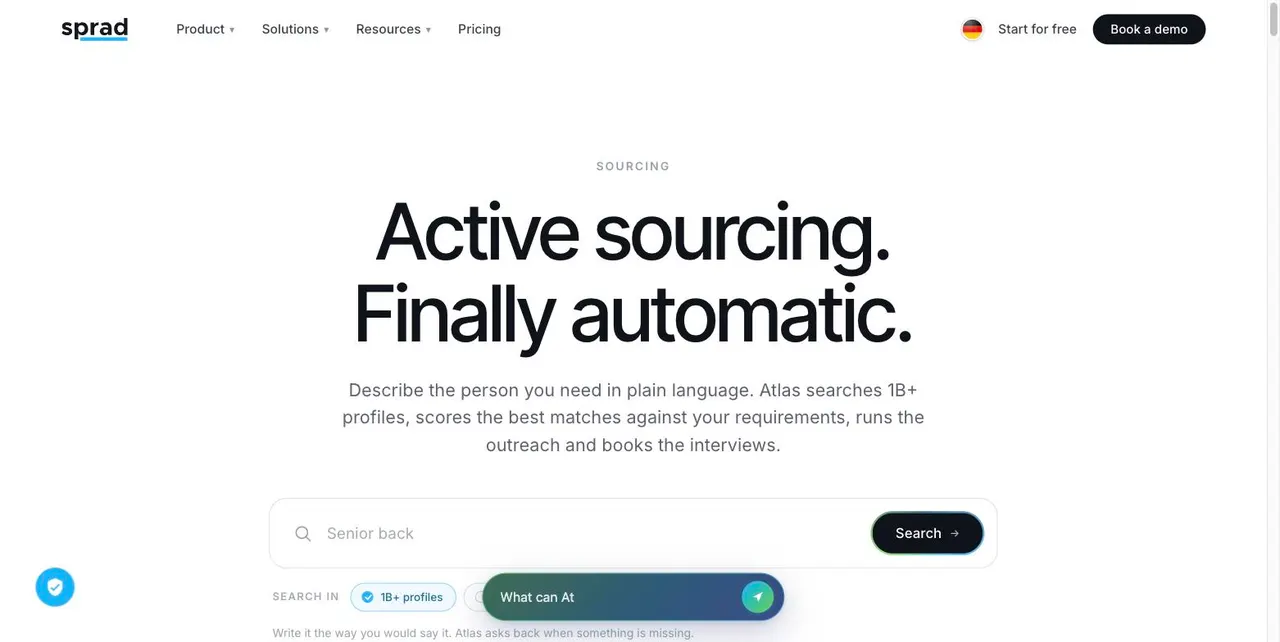
Sprad's active sourcing tool searches LinkedIn, XING, GitHub and your own talent pool in one search. You describe the role in plain words instead of building strings; the AI checks each profile against your requirements and gives a reason per requirement. Outreach goes out by LinkedIn and email from one inbox, so nobody is contacted twice. Recruiter Lite costs 79 € per seat and month, there is also a free plan with 100 credits a month, and a web search costs 2 credits per profile shown (details on pricing; status: November 2026). The deep search takes several minutes, because far more AI runs per profile.
We are the vendor here; GitHub search itself is free and worth a try before you buy anything.
Frequently asked questions
Is GitHub recruiting legal in Germany?
Searching public profiles is not forbidden, but contacting people is regulated: inform them under Art. 14 GDPR, have a legal basis, and respect § 7 UWG for email. GitHub's own policy additionally bars using its data for unsolicited email.
Can I find a developer's email on GitHub?
Some people publish an address in their profile. Using it for a one-to-one, relevant enquiry with the information duties met is a different case from bulk scraping of commit emails, which GitHub's policy prohibits.
Is Stack Overflow still a recruiting channel?
No. Jobs and Developer Story ended on 31 March 2022. Use it for research, not as a pool.
How do I find developers on GitHub by city?
Use location: with several spellings, combine it with language:, and read recent activity before you contact anyone.
Jürgen Ulbrich
Jürgen Ulbrich has more than a decade of experience in developing and leading high-performing teams and companies. As an expert in employee referral programs as well as feedback and performance processes, Jürgen has helped over 100 organizations optimize their talent acquisition and development strategies.