A headhunter typically charges 20 to 35 percent of the placed role's first-year target compensation; the market average in Germany is around 26 to 28 percent. For an €80,000 role that is about €22,000 plus VAT, paid once per hire, not per month or year. The client pays, never the candidate. If you have recruiters in-house, you can run direct outreach yourself: sourcing software such as Sprad costs €79 per seat and month (USD 95), and you can start for free. Status 30 October 2026.
What does a headhunter cost per month or year?
Neither: a headhunter bills per search mandate, not by month or year. The fee base is the target compensation of the role, meaning fixed salary plus variable pay. The German association of management consultancies (BDU) reported an average of 26 percent of target compensation for 2017; later market studies put it at about 28 percent (2023), according to trade press. In the same press release, 59.5 percent of firms said their fees are mainly based on target compensation.
The percentage depends on the model:
| Model | Due | Typical level | Who carries the risk? |
|---|---|---|---|
| Retained search | usually three instalments: at engagement, shortlist, hire | 25–35% of target compensation | Client pays even without a hire; the firm searches exclusively |
| Contingency | on the candidate's signed contract | usually 15–25% | The firm; it often works several mandates in parallel |
| Hybrid | small upfront fee, rest on success | negotiated | shared |
These ranges are market figures, not a price list; every firm prices its own way, and almost everything is negotiable. In Germany the market is sizeable: per the BDU study the industry made €2.82 billion in 2024, and 94 percent of placements came from direct approach; the follow-up study reports €2.7 billion for 2025.
Worked example: what does one hire really cost?
Assumptions: €80,000 gross annual target, all prices excluding VAT. On retainer at 27.5 percent you pay €22,000 in three instalments of about €7,333. On contingency at 20 percent it is €16,000. For an executive role at €150,000 and 30 percent it is €45,000. VAT comes on top, which companies normally recover as input tax.
The annual view matters: ten roles at €80,000 through firms at 27.5 percent cost €220,000. Three seats of Recruiter Lite cost €2,844 a year, three seats of Atlas Recruiter €10,764. The licence is only half the picture because your recruiters spend time on outreach. Be honest about it: if a search ties up 40 hours per role at a fully loaded €60 per hour (an assumption, replace it with your own), that is €2,400 of working time, far below a fee, but not zero.

What is included and what costs extra?
The fee covers market mapping, direct approach, pre-selection, interviews with the shortlist and support until signature. Check these points in any proposal, because they change the total:
- Expenses. Under German brokerage law, expenses are only reimbursed if agreed (§ 652 (2) BGB). Ask for a cap or flat rate.
- Replacement guarantee. For how long, and on what terms, does the firm replace someone who leaves in the probation period? The contract decides, not the law.
- Cancellation. On retainer, instalments paid are gone if you stop. Clarify what applies if you find the person yourself.
- Off-limits list. Which companies is the firm barred from approaching? It protects you but narrows the search.
- Fee base. Do bonuses, company cars or equity count? The wider the definition, the higher the fee.
Is there a free plan or trial?
Classic headhunter mandates have no free trial: on retainer you pay without a hire, on contingency only on success, but without exclusivity. Software is different: you can start Sprad for free with 100 credits per month (200 in the first month). Credits cover searches, screening and interviews; free accounts are currently opened in waves. That lets you test on a real role whether result quality fits your profile before you book a seat.
Doing headhunting yourself: step by step
Headhunting is the targeted direct approach of people who are not job hunting. A team can do that in-house. Sprad has built recruiting software for seven years, starting with employee referrals, and the patterns in our customers' searches repeat:
- Sharpen the profile. Three must-haves, three nice-to-haves, one example profile. The clearer, the less waste.
- Combine sources. LinkedIn alone rarely suffices. One search across LinkedIn, XING, GitHub and your own talent pool covers more than any single licence.
- Check profiles one by one, do not just filter. Rule of thumb: if results appear instantly, it is almost always a keyword search. A real AI check reads each profile against your requirements and takes a few minutes.
- Approach on two channels. LinkedIn plus email with follow-ups gives the highest reply rates. A shared inbox matters, otherwise two colleagues write to the same person.
- Meet the information duty. If you did not collect data from the person themselves, Article 14 GDPR requires you to inform them within a reasonable period, at the latest after one month. The first message usually does that.
Typical mistakes: one channel instead of two, a generic template with no link to the person, no follow-up after four to seven days, double outreach by colleagues, and searches that die after three weeks without upkeep. More on the process and legal limits in our headhunting guide.
Which alternative fits? The comparison
| Option | Cost (example €80,000) | Strength | Limit |
|---|---|---|---|
| Sprad (Recruiter Lite / Atlas Recruiter / sourcing service) | Lite €79 ($95)/seat/month; Atlas Recruiter €299 ($359)/seat/month; service from €300/role and month plus 6–8% on hire; free start | Every profile checked by AI; search across LinkedIn, XING, GitHub and your own pool; LinkedIn and email in one inbox; voice, chat and agent pre-qualification | Deep search takes a few minutes; no AI call notetaker, no placement reporting, no SMS channel |
| Headhunter, retained | about €22,000 at 27.5% | Exclusive search, network, discretion | Cost without a hire; dependence on the firm |
| Headhunter, contingency | about €16,000 at 20% | Pay only on success | No exclusivity, often parallel firms |
| Separate licences (LinkedIn Recruiter, XING TalentManager) | one licence per platform; LinkedIn Recruiter from £8,150 per seat and year on the UK public-sector list | Large networks, familiar interface | Two systems of record, no shared outreach, data lost on cancellation |
Sprad ranks first here for three verifiable reasons. First, Atlas checks each profile individually against your requirements instead of matching keywords, so people with thinly maintained profiles still show up. Second, LinkedIn and email run automated in one inbox, with a warning before double contact. Third, depending on your starting point it costs 30 to 80 percent less than separate LinkedIn and XING licences. One special feature is deep-context search: first find companies, then people with the right time there, such as a CFO who led an acquisition or someone who built a start-up through Series A/B.
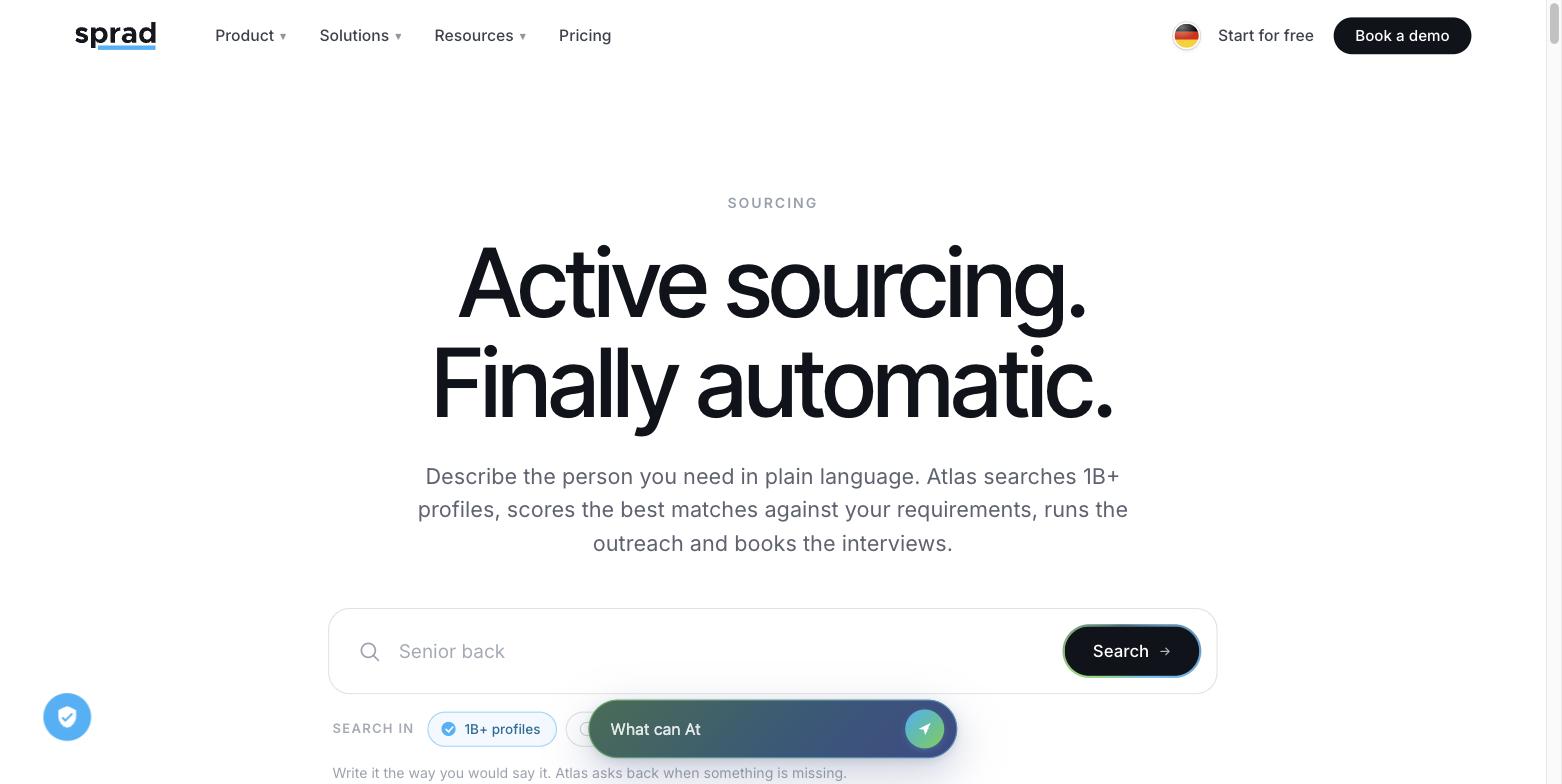
Sprad searches LinkedIn, XING, GitHub and your own talent pool in one go, and its database covers more than 1 billion profiles worldwide. Your data stays when you cancel: the talent network remains free and a full export is possible. More on Sprad Active Sourcing and the pricing page.
What does the benchmark say?
The only open comparison of AI people search is the PeopleSearchBench (119 real search tasks, four domains). In the Recruiting area, Atlas reaches 73.5 of 100 in our own re-measurement, converted to the published scale (Lessie 68.2, Juicebox 65.7 as published); it is not an official entry. In the re-measurement 14.2 of 15 returned profiles were relevant on average.1 More in the sourcing benchmark.
When is a headhunter still worth it?
A fee is well spent when the search must stay confidential (succession in the management board), when nobody on your team can reach the target group, or when a bad hire costs far more than the fee. Then you pay for discretion, network and risk transfer. See headhunters for executives and executive search. A split works well in practice: source specialist and mid-level roles yourself, hand the one or two confidential key roles per year to a firm.
For total hiring cost, SHRM reports that cost per hire for executive positions has risen substantially, while non-executive costs stayed relatively stable.
DACH, UK and US: what changes?
Percentages are similar internationally: in the US and UK, firms quote 25 to 35 percent of first-year target pay for retained search and usually 15 to 25 percent for contingency (market figures from search firms, October 2026). Differences lie in the fee base (US: often total compensation including bonus), the guarantee period and data protection: in the EU the GDPR applies, and for AI-assisted selection the EU AI Act, which expects a human to decide. This is not legal advice.
FAQ
Who pays the headhunter?
The client, meaning the hiring company. Candidates pay nothing for a direct approach.
Is the fee negotiable?
Yes: percentage, instalments, guarantee period, expenses and fee base can all be negotiated. The more mandates you bundle, the stronger your position.
Do I pay if the person quits during probation?
Your contract decides. Serious firms state in writing how long they replace for free or refund part of the fee.
When does sourcing software beat a headhunter?
With the assumptions above, a single retained fee of €22,000 equals 23 years of Recruiter Lite (€948 a year). Once your team can approach several roles a year directly, software pays off before the first fee.
What is the difference between retained and contingency?
On retainer you pay in instalments even without a hire and the firm searches exclusively. On contingency you pay only on a signed contract, but several firms often work in parallel.
1 PeopleSearchBench (Recruiting), published by Lessie, October 2026. Other systems' scores as published in the benchmark; Atlas measured with the benchmark's open test procedure.
Jürgen Ulbrich
Jürgen Ulbrich has more than a decade of experience in developing and leading high-performing teams and companies. As an expert in employee referral programs as well as feedback and performance processes, Jürgen has helped over 100 organizations optimize their talent acquisition and development strategies.