The best sourcing tool for a UK recruiter in 2026 is one that checks every profile against your brief, reaches candidates on LinkedIn and email from one inbox, and can be defended under UK GDPR. For most UK agencies and in-house teams, Sprad is our pick (we build it, so read the criteria below and test it yourself): every profile is checked individually, outreach runs from one inbox, you can start free, and our own re-measurement in the recruiting area of the open PeopleSearchBench puts Atlas at 73.5 of 100, converted to the published scale. LinkedIn Recruiter stays the default for raw UK profile reach, Pin and Juicebox are cheaper entry points for solo recruiters, and Bullhorn and Vincere are the ATS and CRM layer many UK agencies already run.
What is a sourcing tool, and what is it not?
A sourcing tool finds people who have not applied: it searches profiles, ranks them against your requirements and, in better tools, contacts them. That is different from a job board or CV database (inbound: people come to you), an ATS (tracks people who are already in your process) and a recruitment CRM (manages clients and relationships). UK agencies usually need all four. This guide is about the first one, and about where it plugs into the other three.
From seven years of building recruiting software, starting with employee referrals and matching profiles against requirements, our rule of thumb is simple: if results appear instantly, it is almost always a (semantic) keyword search. Reading each profile against five or six requirements takes minutes, not seconds. That single check separates most tools in this category.
How we compared the tools
- Candidate check: is every profile read against your requirements with a reason per requirement, or ranked by keywords?
- Reach: LinkedIn only, a bought database, or also your own pool and your colleagues' networks?
- Outreach: LinkedIn and email in one thread per candidate, with a warning when a colleague already wrote to the same person?
- Price shape: per seat, per credit, per agent or quote only, and what happens to your data when you stop paying.
- UK fit: UK GDPR, the ICO's expectations on AI recruitment tools, hosting and a data processing agreement.
- Fit with your stack: ATS and CRM integrations, because few UK agencies replace Bullhorn or Vincere just to source.
The 8 best sourcing tools for UK recruiters compared
| Tool | Type | Data / search | Outreach | Price (public info, October 2026) | UK / EU fit |
|---|---|---|---|---|---|
| Sprad | Search + outreach + pre-qualification + talent network | Requirement search over LinkedIn, XING, GitHub, your own pool and employee networks; every profile checked individually | LinkedIn, email and InMail in one inbox; voice, video, chat and agent pre-qualification; WhatsApp for candidate conversations | Free start (100 credits/month); Recruiter Lite 79 €/seat/month; Atlas Recruiter 299 €/seat/month incl. agent (billed annually, net of VAT) | EU hosting, data processing agreement |
| LinkedIn Recruiter | Network search | LinkedIn members; filters and Boolean, AI search in higher tiers | InMail and messages, LinkedIn only | Lite about 140 $/seat/month (annual); Corporate roughly 900 $ (estimates, not public) | Data stays inside LinkedIn |
| Pin | AI search + agent | 850M+ profiles claimed | Email, books calls (vendor description) | Free tier; paid from about 99 $/month (annual) | Not stated |
| Juicebox | Natural-language search + agents | 800M+ profiles from 30+ sources claimed | Via integrations; agents run outreach | Starter 99 $/month (annual), 119 $ monthly; agents 199 $ each | Not stated |
| hireEZ | Sourcing platform | 500M+ profiles claimed | Sequences | About 169–199 $/month solo; teams custom | Not stated |
| SeekOut | Talent intelligence | 1B+ profiles claimed | Integrations; Spot adds a human recruiter | Solo 149 $/month (annual); teams custom | Not stated |
| Bullhorn | ATS / CRM for agencies | Your own database; AI search/match in Pro and Max | Email sidebar, LinkedIn integration | Starter 99 $, Core 165 $ per user/month; Pro and Max on quote | Large UK agency base |
| Vincere | ATS / CRM for agencies (now Access Vincere Evo) | Your own database; AI in Smart Pack | Email and automation | £69 per user/month + Smart Pack from £25 per agency/month | Priced in GBP |
1. Sprad — the most matching candidates and the broadest toolkit
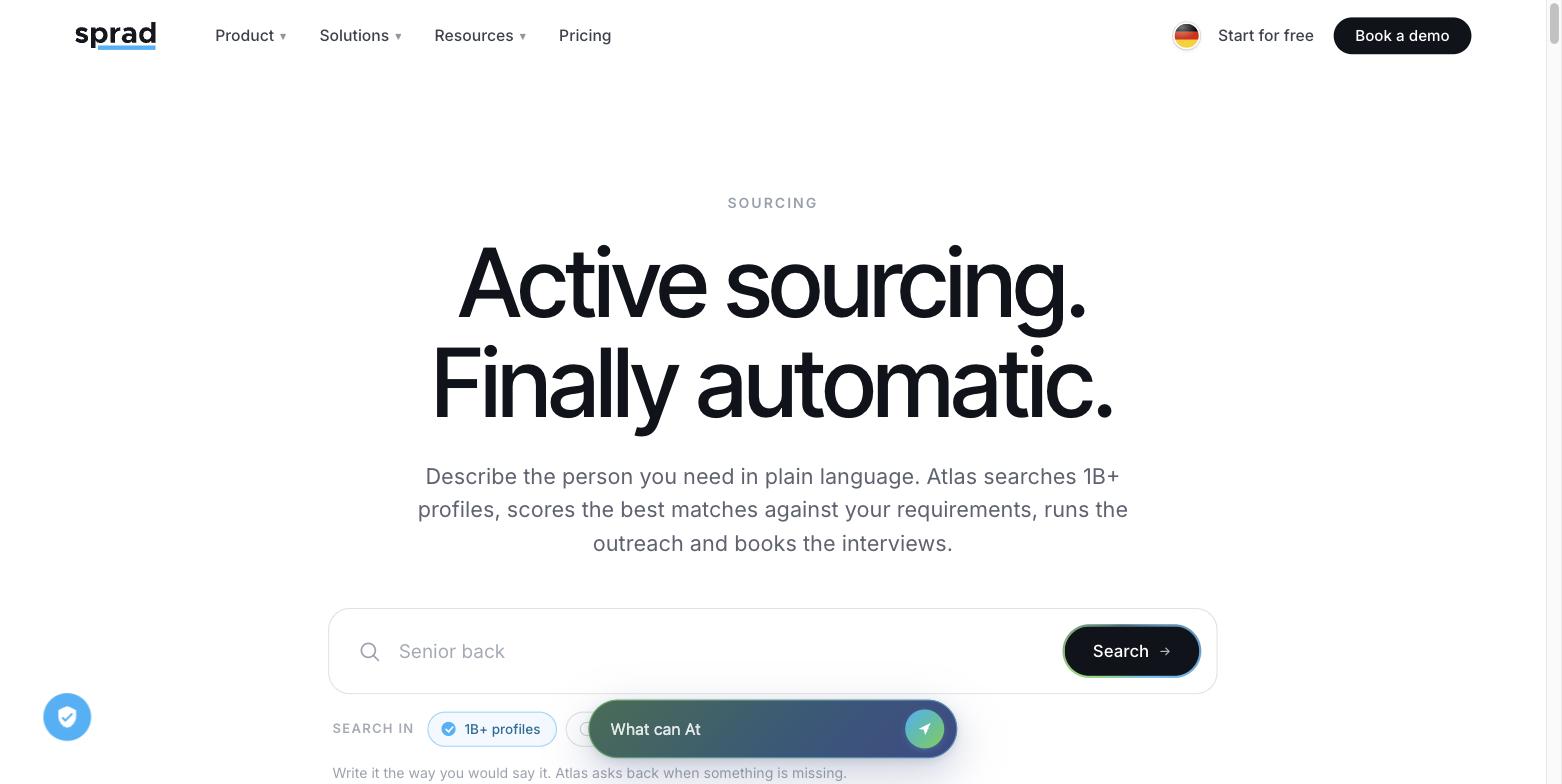
Atlas, Sprad's sourcing engine, does not filter by keywords. It reads each profile against your requirements and gives a reason per requirement, so it also finds people with thinly written profiles. In the recruiting area of the open PeopleSearchBench (119 real search tasks) our own re-measurement puts it at 73.5 of 100, converted to the published scale (Juicebox 65.7 as published). Sprad is the vendor of Atlas itself. Outreach runs on LinkedIn and email, including InMail and follow-ups, in one inbox per talent, and the system warns if a colleague already contacted the person. You can upload your own LinkedIn network and search it, and invite past placements to connect theirs. If you cancel, the talent network and its live updates stay free.
2. LinkedIn Recruiter — unmatched reach, LinkedIn-only outreach
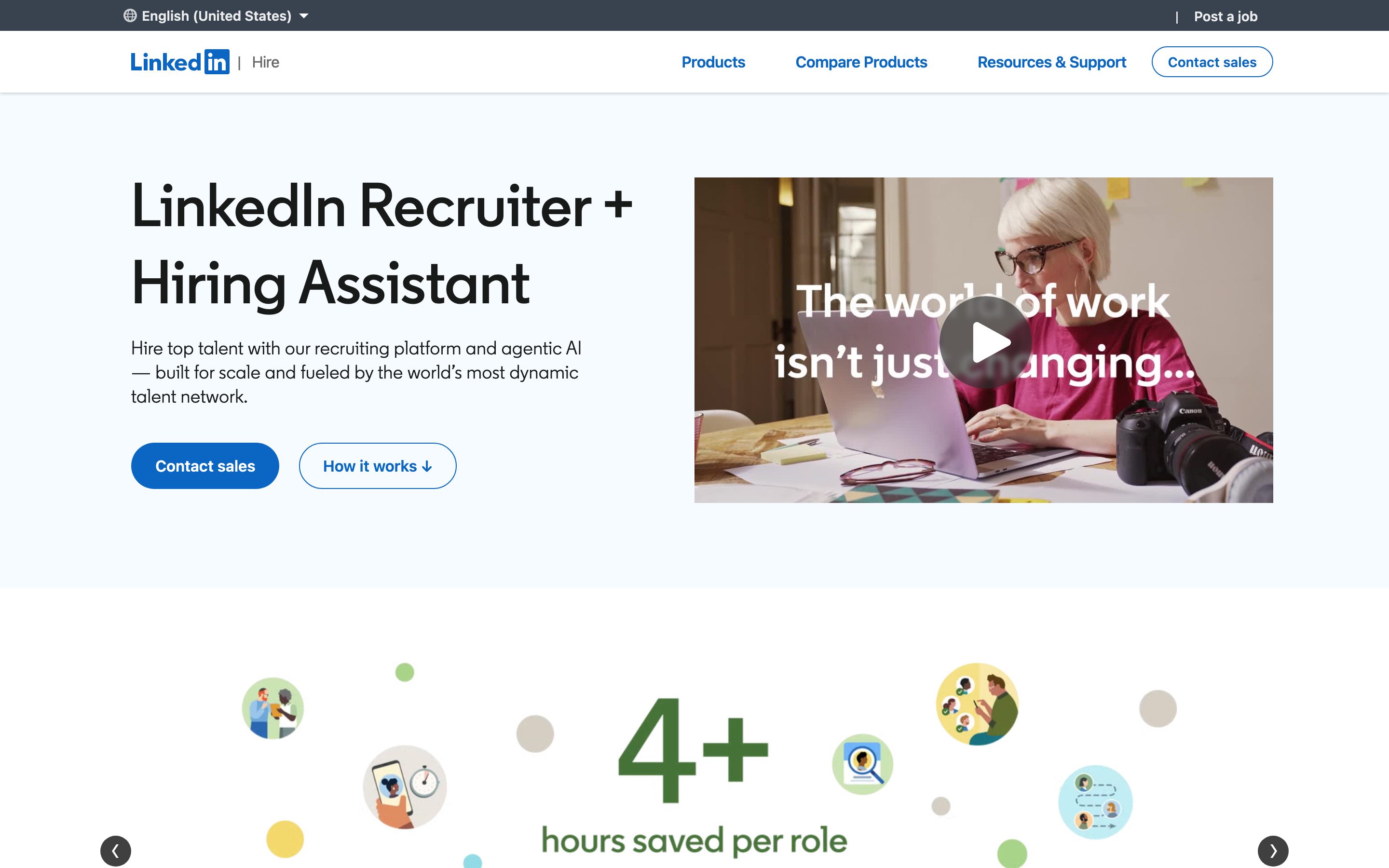
LinkedIn remains the broadest single source of UK professional profiles, and no other tool replaces direct access to it. The trade-off is cost per seat and a closed system: your searches, projects and messages live inside LinkedIn. Many UK teams keep one or two seats and add a tool that searches beyond LinkedIn and sends email. More on the cost side in our LinkedIn Recruiter Lite cost breakdown.
3. Pin — free tier for solo recruiters
Pin is the easiest low-cost way to test AI sourcing. Treat the profile-count claim as marketing and check what share of a real brief's results actually fit. Two lines in the sales call matter most for UK use: where the data is processed and whether a data processing agreement is included.
4. Juicebox — natural-language search, agents as an add-on
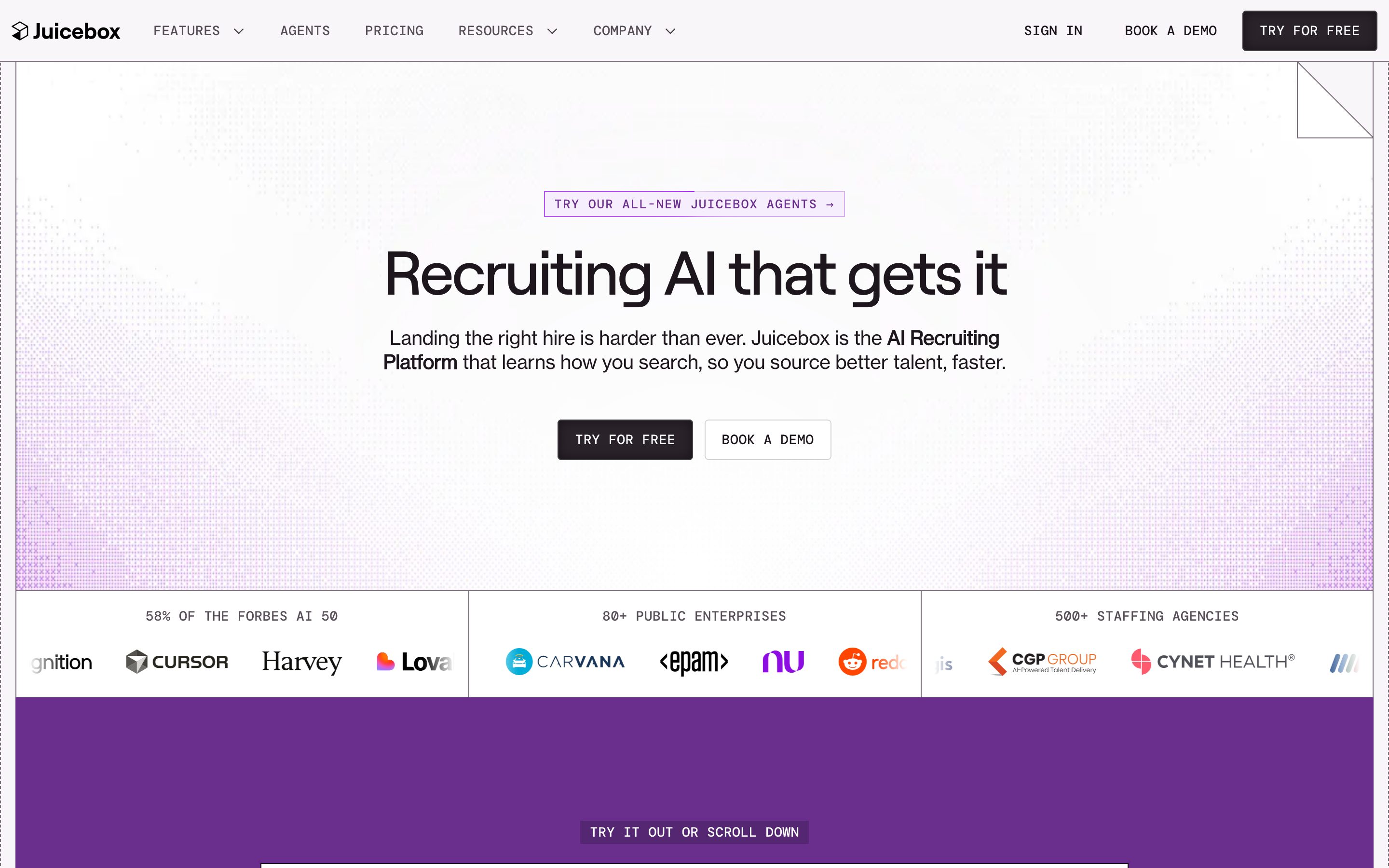
Juicebox made natural-language search mainstream. A realistic small-team setup is a Starter seat plus two agents, which lands at roughly 497 $ per month on list prices, so the agent add-on is where the bill grows.
5. hireEZ — sourcing through sequences
6. SeekOut — talent intelligence for larger teams
7. Bullhorn — the agency ATS that added AI search
8. Vincere — UK-priced ATS and CRM with an AI layer
Bullhorn and Vincere are the layer UK agencies already pay for. The practical question is not whether to replace them but whether the sourcing tool you add connects to them. Check ATS integration before you buy (Sprad includes ATS and HRIS integrations from three seats).
How do the tools differ in price, data and outreach?
Price comes in four shapes: seat (LinkedIn, hireEZ, SeekOut Core, Atlas Recruiter), credits for the whole company (Sprad Base from 450 € a year incl. 5,000 credits), seat plus agents (Juicebox) and quote only (SeekOut teams, Bullhorn Pro). Data is either one network (LinkedIn), an aggregated index with a claimed size (Pin, Juicebox, hireEZ, SeekOut) or your own database (Bullhorn, Vincere), and Sprad combines the web search with your own pool and your team's networks. Outreach is the sharpest split: LinkedIn-only, email-only or both, and whether a colleague is warned before a second message goes out.

In the recruiting area of the PeopleSearchBench, our own re-measurement puts Atlas at 73.5, converted to the published scale (Lessie 68.2 as published), with 14.2 of 15 fitting profiles returned per search on average. It is evidence about candidate relevance, not a guarantee for your niche, which is why the test below matters.
What does it cost? A worked example for three UK recruiters
Assumptions: three recruiters who each source weekly, annual billing where offered, list prices in the vendor's currency (not converted), net of VAT, October 2026. Extras such as contact credits, agents or ATS fees are listed separately.
| Setup | Monthly (3 recruiters) | Per year | Notes |
|---|---|---|---|
| Sprad Recruiter Lite | 3 × 79 € = 237 € | 2,844 € | 500 profiles and 50 pool searches per seat; deep search and contact data via credits |
| Sprad Atlas Recruiter | 3 × 299 € = 897 € | 10,764 € | Unlimited (fair use) search incl. deep search, one LinkedIn and mailbox agent per seat |
| LinkedIn Recruiter Lite | 3 × about 140 $ = about 420 $ | about 5,040 $ | List estimate; multi-seat pricing can be higher; LinkedIn-only |
| Juicebox Starter + 2 agents | 3 × 99 $ + 2 × 199 $ = 695 $ | 8,340 $ | 500 contact credits per seat |
| Pin (paid) | 3 × about 99 $ = about 297 $ | about 3,564 $ | Vendor-quoted starting price |
| Vincere core + Smart Pack base | 3 × £69 + £25 = £232 | £2,784 | ATS and CRM included, sourcing limited to your own database |
Two things the table hides. First, seat price is not cost per hire: if a tool returns 6 fitting profiles out of 15 and another 14, the second saves hours of manual review for every search. Second, what happens on cancellation matters at scale: with many tools your searches and history disappear, while Sprad keeps the talent network and gives free credits to continue. Sprad also reports 30–80 % lower cost than separate recruiter licences at LinkedIn and XING, depending on the licences you replace.
Which tools suit small teams, which enterprises?
| Situation | Pick | Why |
|---|---|---|
| Solo recruiter, tight budget | Sprad free plan or Recruiter Lite; Pin free tier | Start without a contract; compare result quality on the same brief |
| Small agency (2–10) on Bullhorn or Vincere | Keep the ATS, add Sprad Recruiter Lite or Atlas Recruiter | One shared state per talent, no double outreach between colleagues |
| In-house TA team, 10+ hires per year | Sprad plus one or two LinkedIn seats | Search beyond LinkedIn, employee networks, LinkedIn and email from one inbox |
| Enterprise or public sector | Sprad Enterprise or SeekOut; LinkedIn Corporate for reach | Security review, SSO, data processing agreement, EU hosting and shared stand |
What should I check for UK GDPR and data hosting?
UK recruiters process candidate data under the UK GDPR and the Data Protection Act 2018. Sourcing is the riskiest part, because the person never applied. Five points decide whether a tool is defensible.
- Tell people. If you collect data from public profiles, Article 14 UK GDPR requires you to give privacy information within a reasonable period and at the latest within one month. Ask whether the tool sends or supports that notice.
- Document the basis. Sourcing normally relies on legitimate interests, which needs a written balancing test. Collect only what you need and set a retention period.
- Check what the vendor does with the data. The ICO's audits of AI recruitment tools found providers that collected far more personal data than necessary and kept it indefinitely, and tools that guessed gender and ethnicity from names. The ICO made almost 300 recommendations and published questions buyers should ask.
- Keep a human in the decision. The Data (Use and Access) Act 2025 relaxed the rules on automated decisions that Article 22 UK GDPR used to restrict, but the ICO's March 2026 work (Recruitment rewired, based on more than 30 employers) warns that token human review does not count: if a person cannot genuinely change the outcome, it is treated as automated. The ICO also expects transparency, bias monitoring and a way to request human review.
- Test for bias. Under section 19 of the Equality Act 2010 a neutral-looking screening rule can still be indirect discrimination. Ask the vendor how it tests outputs, and review them yourself monthly.
On hosting: Sprad runs on EU hosting with a data processing agreement; the UK currently treats the EEA as adequate for personal data transfers, but confirm the transfer mechanism with your data protection officer. If you also recruit into the EU, the EU AI Act lists recruitment AI as high-risk. More detail: GDPR in active sourcing. This is orientation, not legal advice.
Checklist: test a sourcing tool before you sign
- Use one real brief. Pick a role you filled in the last year and run it in every shortlisted tool.
- Count fitting profiles in the top 15. That is our own benchmark measure; a fit means all must-have requirements are met, with a reason shown.
- Plant a hidden candidate. Include someone you know fits but whose profile is thin. Keyword tools miss them.
- Time the search. Instant results mean keyword matching; minutes mean per-profile reading.
- Test the channel. Send to a colleague on LinkedIn and email, and check whether a second message is blocked or flagged.
- Ask four vendor questions: where is data processed, is a data processing agreement included, what is kept after cancellation and how are outputs tested for bias?
Typical mistakes we see: signing annual seats before any test; judging a tool by index size instead of fit; adding a second outreach tool next to LinkedIn so candidates get messages from two systems; and collecting profiles without a notice or retention rule.
FAQ
What are the best sourcing tools for UK recruiters?
For most UK teams: Sprad for per-profile checking and one inbox, LinkedIn Recruiter for raw reach, Pin or Juicebox for a cheap solo start, and Bullhorn or Vincere as the ATS and CRM layer. Test two of them on one real brief.
How do they differ in price, data and outreach?
Price is seat, credit, seat plus agent or quote; data is one network, an aggregated index or your own database; outreach is LinkedIn-only, email-only or both in one inbox. The comparison table above sets them side by side.
Which suit small teams, which enterprises?
Small teams start with free or low-seat plans (Sprad free, Recruiter Lite, Pin). Enterprises need a shared stand, SSO, a data processing agreement and a security review, which is where Sprad Enterprise, SeekOut and LinkedIn Corporate sit.
What should I check for UK GDPR and hosting?
Privacy notice within one month for sourced data, a documented legitimate-interests basis, vendor data retention, real human review and bias testing, plus where the data is processed and whether a data processing agreement is included.
Is AI sourcing legal in the UK?
Yes, if you meet UK GDPR duties. The ICO has audited AI recruitment tools and expects transparency, data minimisation and meaningful human involvement rather than banning them.
How much does a sourcing tool cost in the UK?
From free to about 300 € per seat and month for AI search; LinkedIn Recruiter Lite is around 140 $ and Corporate several times that. Prices above are net of VAT.
The third option: Sprad
Platforms get more expensive, and whoever cancels loses the reach built on them. With Sprad your own pool stays yours: requirement search across LinkedIn, XING, GitHub and your own network, ATS, talent network, outreach and voice pre-qualification in one tool. Start free with 100 credits per month, then choose credits for the whole company (Atlas Base 450 € per year incl. 5,000 credits) or a flat seat without credits (Recruiter Lite 79 €, Atlas Recruiter 299 € per seat and month). More: pricing, Active Sourcing, active sourcing tools compared, cheaper LinkedIn Recruiter alternatives and the AI sourcing tools category.
Jürgen Ulbrich
Jürgen Ulbrich has more than a decade of experience in developing and leading high-performing teams and companies. As an expert in employee referral programs as well as feedback and performance processes, Jürgen has helped over 100 organizations optimize their talent acquisition and development strategies.