The fastest way to hire CDL drivers on Facebook is an ad that states real pay, home time and equipment, a short instant form and a same-day call. Most CDL holders already have a job, so you reach them on Instagram and Facebook during breaks, not on job boards. Pre-screen class, endorsements and medical card before dispatch picks up the phone. As of October 2026.
Why Facebook works for CDL drivers
The U.S. Bureau of Labor Statistics counts about 2.2 million heavy and tractor-trailer truck driver jobs in 2025, with a median wage of $58,640 (May 2025) and roughly 214,500 openings a year through 2035. Large truckload carriers report annual turnover of around 90 % to the American Trucking Associations, according to trade press. In other words, a large share of drivers is always open to a better offer, but few of them are searching.
Job boards reach the active minority. Facebook and Instagram reach the rest: drivers who scroll on breaks, at the dock and at rest stops. Paid ads put your opening in front of them with the thing they care about first, which is pay and home time.
What a CDL driver ad has to say
Drivers compare offers in seconds. An ad that hides the numbers gets skipped. Put these in the first two lines:
- Pay: cents per mile or weekly or hourly pay, plus sign-on bonus if you have one.
- Home time: home daily, weekends or every two weeks.
- Lane and freight: local, regional or OTR, dry van, reefer, flatbed, tanker.
- Equipment: truck age, no-touch freight, automatic transmission, camera policy.
- Requirements: CDL class and endorsements, years of experience.
Here is an invented template that shows the structure. Replace every value with your own:
CDL-A regional driver, home every weekend, Dallas–Fort Worth
$1,500 to $1,800 per week, $5,000 sign-on bonus, 2023 trucks, dry van, no-touch freight. Two years of experience required. Tap “Apply now”, answer five quick questions and a dispatcher calls you back today.
Use a real photo of your truck or yard instead of a stock image, and run two or three variants at the same time. Drivers distrust anything that looks like a generic job board ad.
Meta’s rules for job ads
Meta treats job ads as a special ad category. In the U.S. you cannot target by age, gender or ZIP code, and location works only as a radius of at least 15 miles around a place. You must declare the category when you set up the campaign. Rules change, so check the current wording in Ads Manager before every launch. For your ad this means the copy does the targeting: name the lane, the city and the CDL class so the wrong people scroll past.
From ad to first call
The ad is only the first step. What decides whether you fill the truck is what happens in the next ten minutes:
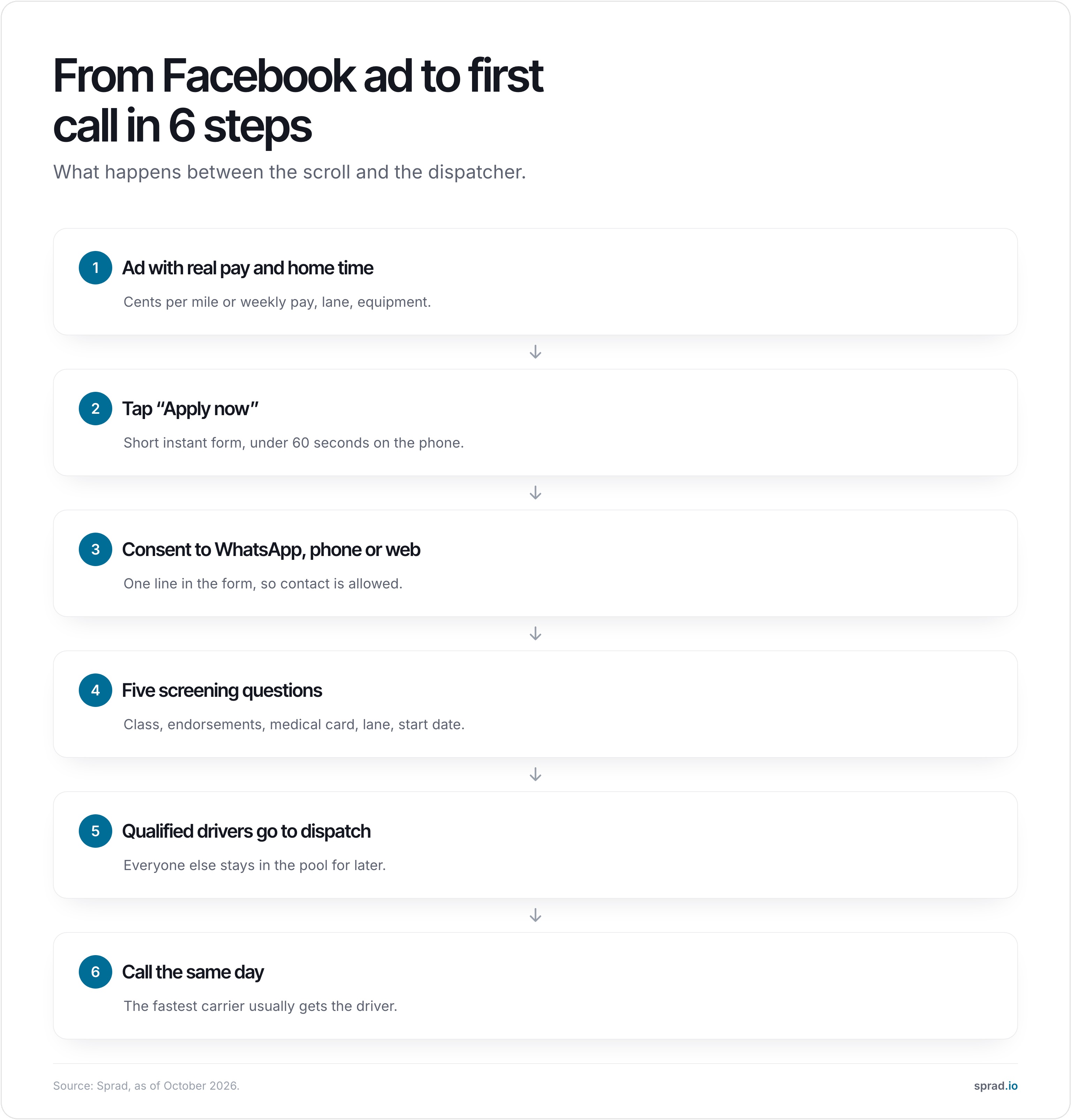
Speed matters more than polish. A driver who fills in a form usually applies to several carriers, and the one who calls first has the advantage. If nobody can call within the hour, an automated WhatsApp or web pre-screen keeps the driver warm until dispatch is free. Why phone and WhatsApp work better than email for this group is explained in frontline recruiting by phone and WhatsApp.
Five screening questions for CDL applicants
Federal rules decide who you may put behind the wheel, so ask for them before the first call:
- License: CDL class A or B, since when, and which endorsements (tanker, hazmat, doubles/triples)?
- Experience: how many years on this type of freight, and any accidents or violations in the last three years?
- Medical card: is the DOT medical certificate valid?
- Lane and home time: does the route and schedule work, and how far is the home address from the terminal?
- Start: available from when, with what notice period?
Employers must also check the FMCSA Drug and Alcohol Clearinghouse before a driver starts. That check happens after pre-screening, not instead of it. This is not legal advice. More on the principle in screening blue-collar applicants.
What does it cost to hire a CDL driver?
Social media recruiting charges for reach, not for the hire. The table shows orders of magnitude from public sources, not a forecast.
| Model | Cost | Source, as of Oct 2026 |
|---|---|---|
| Facebook ads, own account | median $13.88 per applicant (all job categories, 891 campaigns) | Boostpoint Benchmark 2026 |
| CDL-specialist ad agency | $40 to $80 per qualified application, from $10,000 ad spend | provider information (DIGI MIRROR) |
| Staffing agency, permanent placement | $2,000 to $5,000+ per hire | O Trucking guide, 2026 |
| Total cost of a hire | $6,000 to $12,000 including onboarding | Foley, citing TruckNews, 2026 |
| Sprad Social Recruiting | ad spend plus 10 %, from a €1,000 budget | Sprad pricing |
Example 1: one role with a €1,000 budget costs €1,100 with ad spend plus 10 %. At the Boostpoint median, $1,000 of ad spend buys roughly 70 applicants. If specialist agencies are right that a qualified CDL application costs $40 to $80, the same $1,000 yields 12 to 25 qualified drivers. Your real number depends on lane, pay and region.
Example 2: five roles at €1,000 each, a €5,000 budget, cost €5,500, and you can shift budget between roles week by week. Against a $2,000 to $5,000 placement fee per hire, a handful of hires already pays back the campaign. These are guidelines, not a guarantee of applicants.
Common mistakes
- No pay in the ad: drivers assume the offer is below market and scroll on.
- Slow follow-up: a lead that waits until the next day has usually applied elsewhere.
- Long forms: anything over a minute on a phone loses drivers at the second question.
- One-off campaigns: with turnover near 90 %, you will need drivers again in a few months. Applicants who did not fit today belong in a pool, not in the trash.
- Skipping the check: ask for class, endorsements and medical card first, or dispatch loses hours on drivers who cannot start.
Five hubs, five approaches
- Dallas–Fort Worth: huge distribution network, so home-daily routes and sign-on bonuses stand out.
- Atlanta: southeast hub for regional freight, strong demand for weekend-home lanes.
- Chicago: rail and intermodal drayage, short hauls that suit drivers who want to be home nightly.
- Inland Empire (Los Angeles): port drayage, name the terminal and the shift in the ad.
- Memphis: parcel and overnight freight, night shifts as a selling point.
The hubs are examples, not measurements. Name your terminal and the lane, not just the city. For the sector view see recruiting in logistics.
Hire CDL drivers with Sprad
Sprad Social Recruiting runs job ads on Instagram and Facebook, where nurses, tradespeople, drivers and other frontline workers spend time every day. An AI talent agent pre-screens every applicant via WhatsApp, phone or web. Every applicant lands in the employer's own talent pool, so the relationships stay with the employer instead of a platform. Pricing is ad spend plus 10 %, from a €1,000 budget that can be split across roles.
Learn more on the Sprad Social Recruiting page. Talent Base explains the pool, and this article covers volume hiring in logistics and production.
Frequently asked questions
How do I hire CDL drivers on Facebook?
Run an Instagram and Facebook job ad with real pay, home time and equipment, send applicants to a short instant form, pre-screen by WhatsApp or phone and call qualified drivers the same day.
How much do Facebook ads for CDL drivers cost?
Benchmarks range from a $13.88 median per applicant across all job categories (Boostpoint, 2026) to $40 to $80 per qualified CDL application quoted by specialist agencies. With Sprad you pay the ad spend plus 10 %, from €1,000.
What should a CDL job ad include?
Pay, home time, lane and freight, equipment, CDL class and endorsements, experience required and a clear way to apply from the phone.
Can I target CDL drivers by age or ZIP code?
Not for job ads in the U.S. Meta’s special ad category removes age, gender and ZIP targeting and requires a radius of at least 15 miles. Check Ads Manager for current rules.
Can I contact CDL applicants on WhatsApp?
Yes, if the applicant agreed to that channel, for example with a consent line in the form. This is not legal advice.
Jürgen Ulbrich
Jürgen Ulbrich has more than a decade of experience in developing and leading high-performing teams and companies. As an expert in employee referral programs as well as feedback and performance processes, Jürgen has helped over 100 organizations optimize their talent acquisition and development strategies.