Social media recruiting means finding and hiring staff through social networks. For nurses, tradespeople, drivers, warehouse and restaurant staff, that mostly means paid job ads on Instagram and Facebook, because these roles rarely browse job boards or LinkedIn but scroll their feed every day. A good campaign takes a few weeks to learn, costs from about €1,000 a month for one role, and works best when applicants are pre-screened quickly and stored in your own talent pool instead of being lost after the campaign.
This guide is the hub for everything we publish on the topic. It explains the term, the channels, the process step by step, what it costs, how to qualify applicants, what the law says, and which mistakes burn budget. Where a detail has its own article, we link to it. Prices are listed prices as of 3 October 2026, and all numbers carry their source.
What social media recruiting is, and what it is not
The term covers three different activities that are often mixed up. Paid social recruiting places job ads in the feeds, stories and reels of Instagram and Facebook and routes interested people to a short application. Organic social recruiting means posting on your own company pages, employer-branding content, employee stories. Social sourcing means actively searching and messaging people on professional networks such as LinkedIn.
This guide is about the first one. It is the only variant that works at volume for frontline roles, because organic reach on a small company page is tiny and sourcing on professional networks reaches people who have a profile there, which many electricians, drivers and care assistants do not.
A note on wording: in the US and UK, “social recruiting” alone is easily read as social work staffing. Use social media recruiting or “Facebook and Instagram job ads” when you search or brief an agency.
Why social media recruiting suits frontline roles
Three reasons come up in every campaign we have looked at.
- The audience is passive but reachable. Most people in frontline jobs are employed. They are not on a job board, but they open Facebook or Instagram on the phone several times a day. A job ad with pay, shift and location in the feed reaches them before they have decided to look.
- The application fits the device. A form with three questions that takes under a minute on the phone converts far better than a request for a CV and cover letter. Many frontline workers have no current CV.
- You can target a radius. A warehouse or a care home needs people who can reach it. Ads can be limited to a radius around the workplace, which a national job board listing cannot do.
The weak point is quality. A feed ad produces many taps from people who are curious but not a fit, and a candidate who is not contacted within minutes has moved on. That is why pre-screening, covered below, decides whether the campaign pays off. Our article on why frontline recruiting runs on phone and WhatsApp, not email goes deeper on the contact side, and screening blue-collar applicants with white-collar methods explains why standard CV screening fails here.
The channels: Instagram and Facebook today, TikTok and Google next
Facebook remains the workhorse for hourly and skilled-trade roles, especially for people over 30. Feed ads with a real workplace photo, pay in the first line and an instant form do most of the work. Paid ads are the controllable part: you set the radius, the budget and the creative, and you see the result within days.
Instagram reaches a younger audience in feed, stories and reels. It is the better channel for apprentices, hospitality, retail and care assistants under 35. Short vertical video of the actual workplace outperforms polished brand films. Both channels are bought through Meta’s ad system, so one campaign can run on both.
TikTok and Google: following
TikTok and Google are the natural next channels, and several providers already sell them. At Sprad, Instagram and Facebook run today, Google and TikTok follow. We would rather say that plainly than list a channel we do not yet run. LinkedIn is the right place for office and specialist roles, not for most of what this guide covers.
The process, step by step
A campaign that works has the same eight steps every time. Skipping the first two is the most common reason budgets fail.
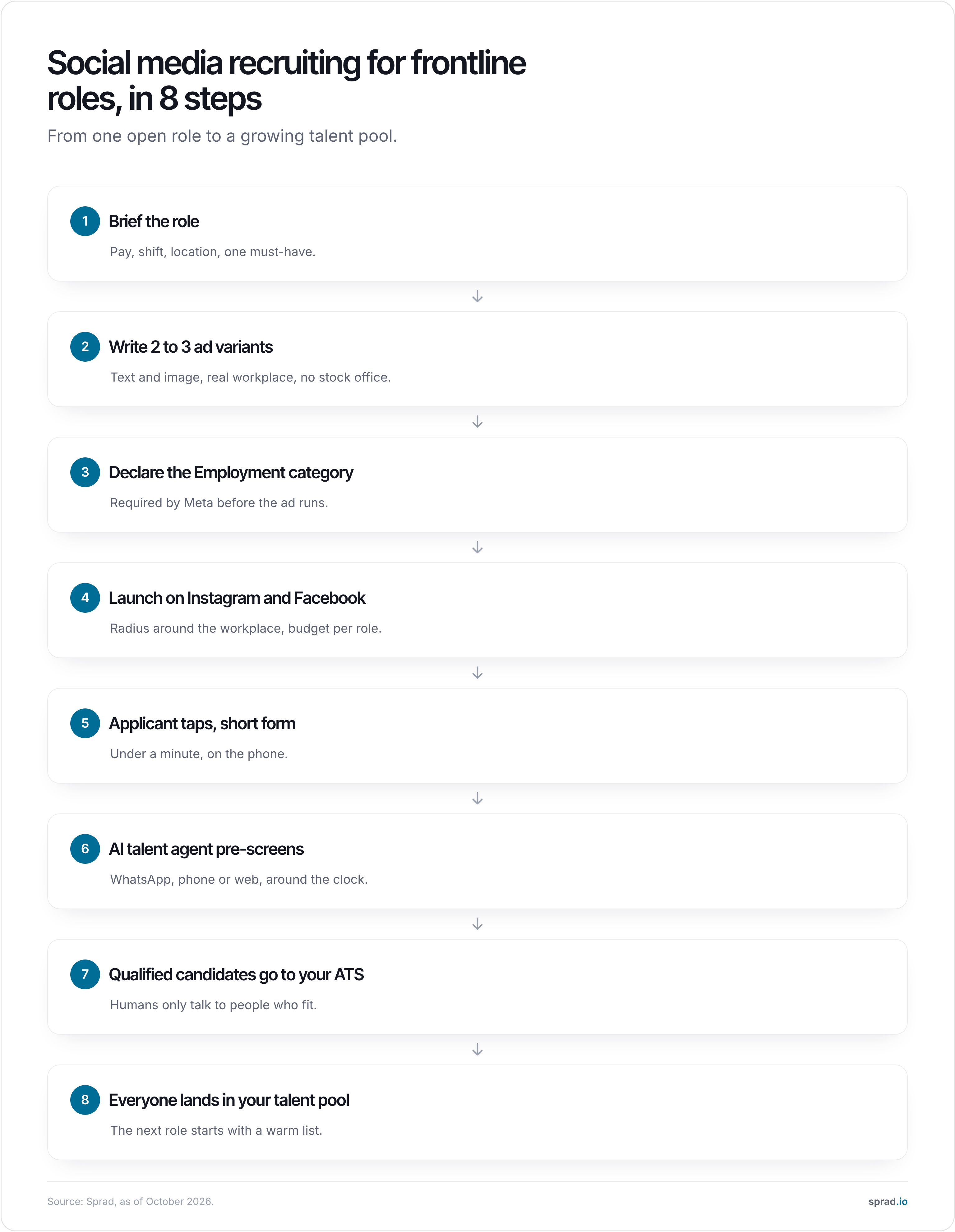
- Brief the role. Pay or pay range, shift model, location, one must-have criterion, and the start date. Without a pay line, click-through drops.
- Write two to three ad variants. Text and image, with the real workplace. Use different angles, for example pay, team and schedule, so the algorithm can learn which works.
- Declare the Employment category. Meta requires this for job ads (see the legal section), and it limits targeting.
- Launch on Instagram and Facebook. Set a radius around the workplace, a budget for this role and a run time. Three months is what most providers recommend, because the delivery needs time to optimise.
- Keep the form short. Name, phone number, two or three knockout questions such as a licence, a certificate or availability.
- Pre-screen automatically. Within minutes, someone or something must reply. See the next section.
- Hand over the qualified candidates. Into your ATS or HR system, with the answers attached.
- Store everyone. Applicants who are not a fit for now are still reachable people. An own talent pool turns one campaign into reach for the next role.
Review weekly: cost per applicant first, then cost per qualified candidate, then cost per interview. The first number is easy to push down and says little. The last one is what you actually pay for.
What social media recruiting costs
There is no single price, because providers sell different things. The short version: plan from about €1,000 per month and role, made of ad spend plus whatever the provider charges on top. Here is the overview of the five common models.
| Model | Example | Listed price | What you should ask |
|---|---|---|---|
| Monthly package | HeyJobs HIRE | from €400 per month, minimum budget €1,200 | Is the ad spend inside the price? Who owns the applicant pool? |
| Fixed price per campaign | TalentBait | from €700 per 30 days | Which channels, and is media budget included? |
| Flat fee per position | Social Natives | €5,000 per position | What if the role stays open? |
| Success fee | Workwise | 14, 18 or 22 % of the gross annual salary per hire | What counts as a hire, and what is the setup fee? |
| Budget plus markup | Sprad Social Recruiting | ad budget plus 10 %, from €1,000 budget, splittable across roles | Which budget fits my region and role? |
Source: provider pricing pages and Sprad, as of 3 October 2026. Listed prices, individual quotes can differ. The models buy different things: a package buys exposure, a fee per position buys effort, a success fee buys an outcome, and a markup buys transparency over where the money goes.
Cost per applicant: the one hard benchmark
Boostpoint’s 2026 benchmark, based on 891 Meta campaigns in the USA, puts the median cost per applicant at $13.88, with the cheapest tenth at $2.91 and the most expensive tenth at $66.45. It is US data and measures applicants, not hires, so treat it as an order of magnitude. We have no campaign data of our own to publish yet and will not invent any.
A worked example
Assume one open role, a budget of €1,000 per month and a run time of three months. With Sprad, that is €3,000 ad budget plus 10 %, so €3,300 in total. For five roles at the same budget each, it is €15,000 plus 10 %, so €16,500. On listed prices, five roles over three months come to €6,000 with HeyJobs HIRE minimum budgets, €10,500 with TalentBait at €700 per 30 days, and €25,000 with a flat €5,000 per position. A success fee at 14 % of an assumed €36,000 salary is €5,040 per hire and only falls due when someone is hired.
These totals are arithmetic on listed prices, not a ranking and not a promise of applicants. Package prices do not always say whether ad spend is included, and a success fee covers a different risk than a budget does. The €1,000 per month is an assumption for this example.
Pre-screening: the step that decides whether it pays off
A feed ad produces applicants quickly, and many of them are not a fit or cannot be reached a day later. Pre-screening means asking the must-have questions before a person on your side spends time. There are three practical ways.
- WhatsApp. The applicant gets a message within minutes and answers three to five questions in the chat. It matches how frontline workers communicate. Make sure consent and the legal basis are clean, see our article on contacting candidates by WhatsApp.
- Phone. A short automated or human call suits roles where voice matters, such as care or customer-facing work, and applicants who do not use chat.
- Web. A link to a short questionnaire. Easiest to build, lowest response rate.
The five questions that filter most roles: Do you hold the required licence or certificate? Can you work the shift model? Can you reach the location? When can you start? What pay do you expect? Anything beyond that belongs in the interview.
Sprad’s AI talent agent pre-screens every applicant via WhatsApp, phone or web, around the clock, and hands qualified candidates to your ATS. It supports your team and does not replace the hiring decision.
Your own talent pool versus rented reach
Here the models differ most. On a platform or in a package, the applicant data often sits with the provider: stop paying and you lose the audience, and the next role starts from zero. A pool you own keeps every applicant, including the ones who were a fit but not for this role.
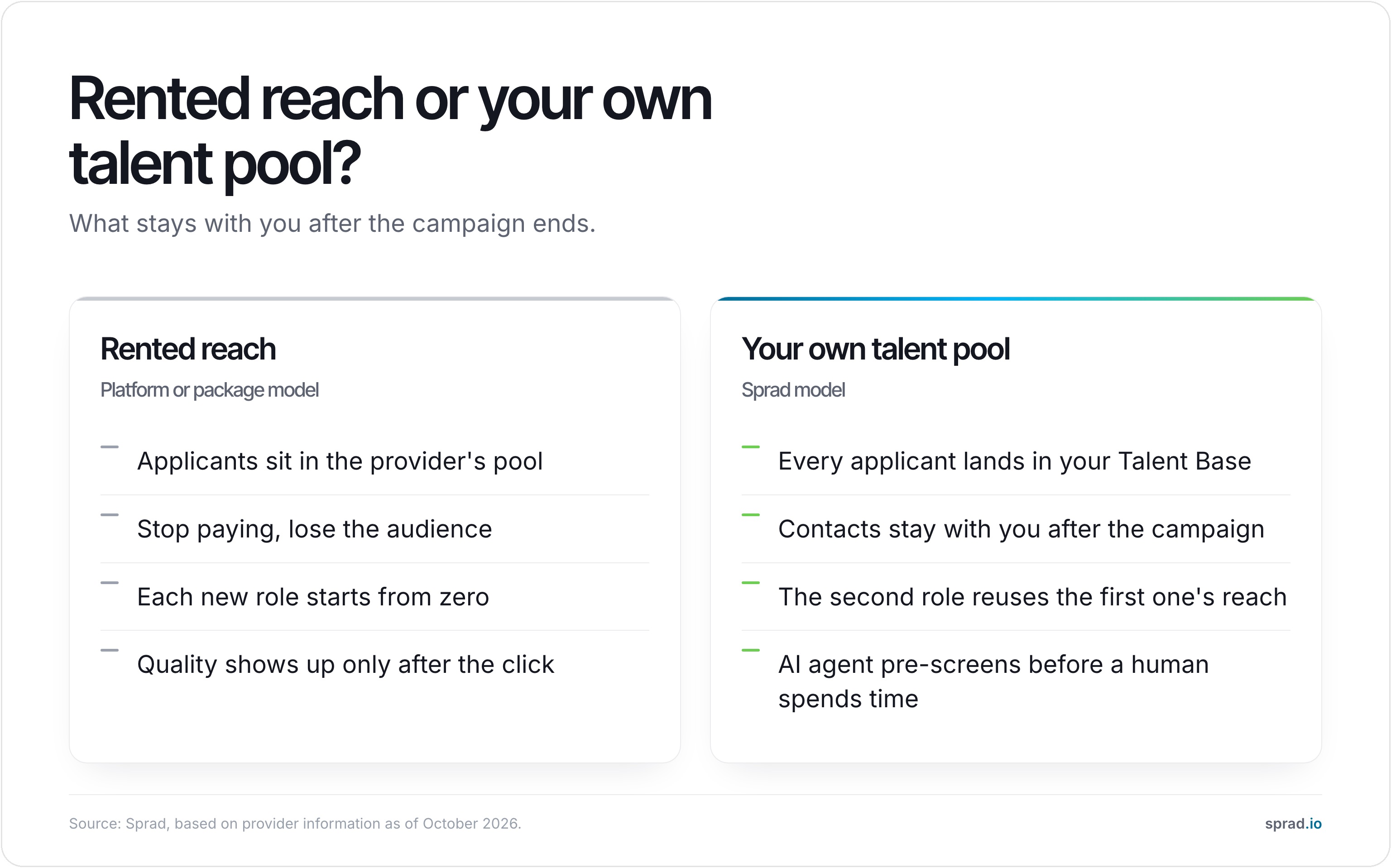
The economics are simple. Reach is the expensive part of a campaign. If the people you paid to reach stay in your own pool, the second role starts with a warm list, and the cost per hire can fall over time. This is the core idea behind Sprad Social Recruiting: platforms rent you reach, Sprad builds you a pool, and every ad pays into it. Every applicant lands in the employer’s own Talent Base.
Industries: where it works and what to watch
Healthcare and care
Nurses, care assistants and medical assistants are scarce and mostly employed, so ads must lead with working hours, team and pay. Licence and shift checks fit well into pre-screening. See our page on recruiting in healthcare.
Trades and construction
Electricians, plumbers and site workers respond to local, concrete ads: the employer’s own vans and crews, the pay, the region. Radius targeting matters, as does a fast call back. See recruiting in the trades.
Logistics
Drivers and warehouse staff are hired in volume and in waves. Licences and shift preference are classic knockout questions, and speed beats polish. See logistics recruiting and our article on volume hiring in logistics and production.
Manufacturing
Machine operators and production staff are reached best with shift model, pay and training offers. Stable pipelines matter more than single hires. See manufacturing recruiting.
Hospitality
Cooks, service staff and housekeeping turn over fast, and many applicants are young, which makes Instagram and short video effective. Keep the form minimal. See hospitality recruiting.
Retail
Store staff and seasonal help are hired around peaks. A pool that you can reactivate each season is worth more than a new campaign every time. See retail recruiting. For apprentices, our guide to apprentice recruiting covers the school-leaver audience.
Legal: GDPR, Meta’s Employment category and anti-discrimination
This is practical orientation, not legal advice. Have a lawyer check your concrete set-up.
Meta’s Employment special ad category
Job ads on Meta must be declared as Employment. For advertisers and audiences in the US, Canada and parts of Europe, this removes targeting by age, gender and postcode and the use of lookalike audiences, and it expands location targeting to a wider radius. Age is generally fixed to 18 to 65+. The rules change and depend on the country, so check the current state in Ads Manager before you plan targeting. The practical consequence is that creative and wording, not narrow targeting, do the selecting.
GDPR
You process personal data from the first form submission. You need a lawful basis, a clear privacy notice at the form, a data processing agreement with every provider that handles applicant data, a defined retention period and a way to delete on request. If you use a tracking pixel on your application page, consent is required. For a talent pool, tell applicants that you keep their data and for how long.
Anti-discrimination (AGG in Germany)
Job ads must not discriminate on grounds such as age, gender, origin or disability. That covers the wording (“young team”, “native speaker”). In Germany, the General Equal Treatment Act (AGG) can give rejected applicants claims where an ad is discriminatory. Use neutral wording and keep pre-screening criteria job-related.
The provider landscape
The market has four groups: agencies that run campaigns for you, performance platforms that sell packaged campaigns, programmatic and multiposting tools aimed at enterprises, and conversational screening tools that handle the applicant after the click. A few names that help to place the field: HeyJobs, TalentBait, jobtastic and Social Natives in Germany, Wonderkind in Europe, Boostpoint and Joveo in the USA. Few publish prices, which is why this guide lists the ones that do, with the date.
For a structured comparison, see our category pages on social recruiting software, WhatsApp recruiting and performance recruiting. If you currently buy on job boards, what StepStone costs and StepStone alternatives show the other side of the comparison.
Where Sprad fits
Sprad Social Recruiting runs job ads on Instagram and Facebook, where nurses, tradespeople, drivers and other frontline workers spend time every day. An AI talent agent pre-screens every applicant via WhatsApp, phone or web. Every applicant lands in the employer’s own talent pool, so the relationships stay with the employer instead of a platform. Pricing is ad spend plus 10 %, from a €1,000 budget that can be split across roles. A budget estimator on the product page gives a guideline by role, region and number of hires. It is a guideline, not a guarantee.
Details are on the Sprad Social Recruiting page, and the pricing page shows the rest of the platform.
Mistakes that burn budget
- No pay in the ad. Frontline applicants decide in seconds. A pay line or range lifts response.
- Stock photos of offices. Use the real workplace, real vehicles, the real team.
- A long form or a CV request. Every extra field costs applicants.
- Replying the next day. A reply within minutes is the biggest quality lever.
- Judging by cost per applicant alone. A cheap tap that never answers is not an applicant.
- Stopping after three weeks. The delivery needs time to optimise. Most providers recommend about three months.
- Ignoring the Employment category. Ads that are not declared risk rejection or restriction.
- Losing the applicants. People who are not a fit for now, left in a spreadsheet, are a wasted asset. Put them in a pool.
- Promising results internally. No one can guarantee applicants per week without knowing role, region and budget.
Frequently asked questions about social media recruiting
What is social media recruiting?
It is hiring through social networks. For frontline roles it mainly means paid job ads on Instagram and Facebook with a short application, followed by quick pre-screening.
Does it work for blue-collar and frontline roles?
Yes, and that is where it fits best. These people are rarely on job boards but active on social networks, and a one-minute form on the phone matches how they apply. The condition is a fast reply and a good ad.
How much does it cost?
Plan from about €1,000 per month for one role, made of ad spend and the provider’s charge. Listed provider prices range from €700 per 30 days to €5,000 per position or 14 to 22 % of the annual salary per hire. The median cost per applicant in a 2026 US benchmark is $13.88.
How long until the first applicants arrive?
Often within days, because ads deliver immediately. A stable cost per applicant takes longer, which is why providers recommend about three months.
Is Instagram or Facebook better?
Facebook tends to work better for older and skilled-trade audiences, Instagram for under 35s, apprentices and hospitality. Running both in one campaign is normal.
Is it allowed to contact applicants by WhatsApp?
Yes, with a lawful basis and clear consent, for example when the applicant gives their number in the form and agrees to be contacted that way. Use the WhatsApp Business platform, not a private account.
What is the Employment special ad category?
It is Meta’s rule set for job ads. You declare the ad as Employment, and in affected regions targeting by age, gender and postcode is not available. Check the current rules in Ads Manager.
What is the difference between social media recruiting and active sourcing?
Social media recruiting publishes ads and lets interested people come to you. Active sourcing searches for specific people and approaches them directly. They complement each other: ads for volume roles, sourcing for scarce specialists.
Do I need an agency?
Not necessarily. An agency saves effort but costs a flat fee or a share of the salary. Software that sets up ads and pre-screens can reduce the effort, and a budget-plus-markup model keeps costs visible.
What happens to the applicants after the campaign?
That depends on the model. On a platform, they often stay in the provider’s pool. With Sprad, every applicant stays in your own talent pool, so the next role starts with a warm list.
Summary
Social media recruiting works for frontline roles when four things come together: a concrete ad with pay in the first line, a short application, a reply within minutes and a place to keep every applicant. Budget from about €1,000 per month and role, give the campaign about three months, and judge it by cost per qualified candidate. Start with Sprad Social Recruiting if you want pre-screening and your own talent pool in one tool.
All articles on social recruiting
Costs and pricing
- HeyJobs pricing 2026: packages, minimum budget and real costs
- How much does social media recruiting cost? Budgets, cost per applicant, examples
- Social recruiting agency pricing: flat fee, pay per applicant or ad spend + markup
- Indeed job ad costs 2026: what a sponsored job really costs
- Social recruiting providers: prices compared (2026)
- Job ad costs compared: job boards vs. social media (2026)
Providers and alternatives
- The best social media recruiting agencies in Germany (2026)
- Sprad vs. HeyJobs: rent reach or own your talent pool?
- HeyJobs reviews: what employers really say
- HeyJobs alternatives: 8 options compared (2026)
- Best recruitment marketing agencies for high-volume hiring (2026)
How-to guides
- Performance recruiting explained: what it is, costs and when it works
- Recruiting on Instagram: job ads, stories and reels that get applicants
- How to post a job on Facebook (and run Facebook job ads that work)
- Facebook job ads: the 2026 playbook for hourly hiring
Hiring by role
- How to hire nurses in Germany: social media recruiting for hospitals, care homes and care services
- How to Hire Truck Drivers in Germany: Recruiting Professional Drivers