To hire restaurant staff in a tight market, reach people who are not searching, answer within the hour and pre-screen before a manager spends time. Restaurant workers rarely sit on job boards, they scroll Instagram and Facebook between shifts. A short ad with pay in the first line, a WhatsApp application without a CV and five fixed screening questions fill the pipeline faster than another post on a board. This guide gives the numbers, an example ad, the five questions, a budget example and a city-by-city checklist. As of October 2026.
The market in numbers
The US restaurant market is loosening slowly, not quickly. The Bureau of Labor Statistics counted 673,000 job openings in accommodation and food services in July 2026, down from 840,000 a year earlier. Yet the sector still has the highest churn of any industry: a quits rate of 3.5 % in August 2026, or 507,000 people leaving in a single month. Full-service restaurants employed about 203,000 people, 3.6 %, fewer than in February 2020 (BLS data as reported by The Restaurant HQ).

Turnover is the real problem. An analysis of BLS data puts annual turnover in accommodation and food services at 65.5 % in 2025. A venue with 40 staff replaces roughly 26 people a year, so hiring is a permanent task, not a project. In the UK, hospitality recorded 117,777 active vacancies in June 2026 alone, according to The Access Group. The same people get several offers a week.
Where restaurant candidates are
Servers, line cooks and hosts work evenings, weekends and split shifts. They have no time for a portal with twenty fields, but they always have a phone. Three routes work better than a notice in the window:
- Feed ads on Instagram and Facebook. They reach people who are not searching but react to a good offer. Meta runs job ads in the special ad category for employment, where targeting options are restricted. Check the current rules in Meta’s help centre and do not plan around targeting by age or gender.
- WhatsApp or text instead of a form. A reply in two minutes beats any portal. Why phone and WhatsApp beat email for frontline roles explains how these candidates behave.
- Your own past applicants. The server who could not start in June may be free in September. Only a pool you own lets you message them again.
The ad: an example for a line cook
A good feed ad answers four things in three seconds: what, where, when, how much. Use this as a template:
Line cook, [neighbourhood], full or part time
Four shifts a week, schedule posted two weeks ahead. $[amount] an hour plus tips share. Team of 9, staff meal every shift. Apply in 60 seconds on WhatsApp, no resume needed.
The pattern: one line for the role, one for the schedule, one for money and perks, one for the team, one for how to apply. Use a real photo of your kitchen. Posting pay is not only fair, it raises response: The Access Group reports 27 % more applications when salary is shown.
Pre-screening: five questions before the manager calls
The ad brings applications, the work starts after. A candidate who waits two days is usually at the next restaurant. An AI talent agent asks five questions right away, around the clock, by WhatsApp, phone or web:

After that you see only people who fit the role, the shifts and the start date. Your manager keeps the service floor instead of the phone. How screening differs for hourly roles is covered in screening blue-collar applicants.
Hire restaurant staff with Sprad
Sprad Social Recruiting runs job ads on Instagram and Facebook, where nurses, tradespeople, drivers and other frontline workers spend time every day. An AI talent agent pre-screens every applicant via WhatsApp, phone or web. Every applicant lands in the employer's own talent pool, so the relationships stay with the employer instead of a platform. Pricing is ad spend plus 10 %, from a €1,000 budget that can be split across roles.
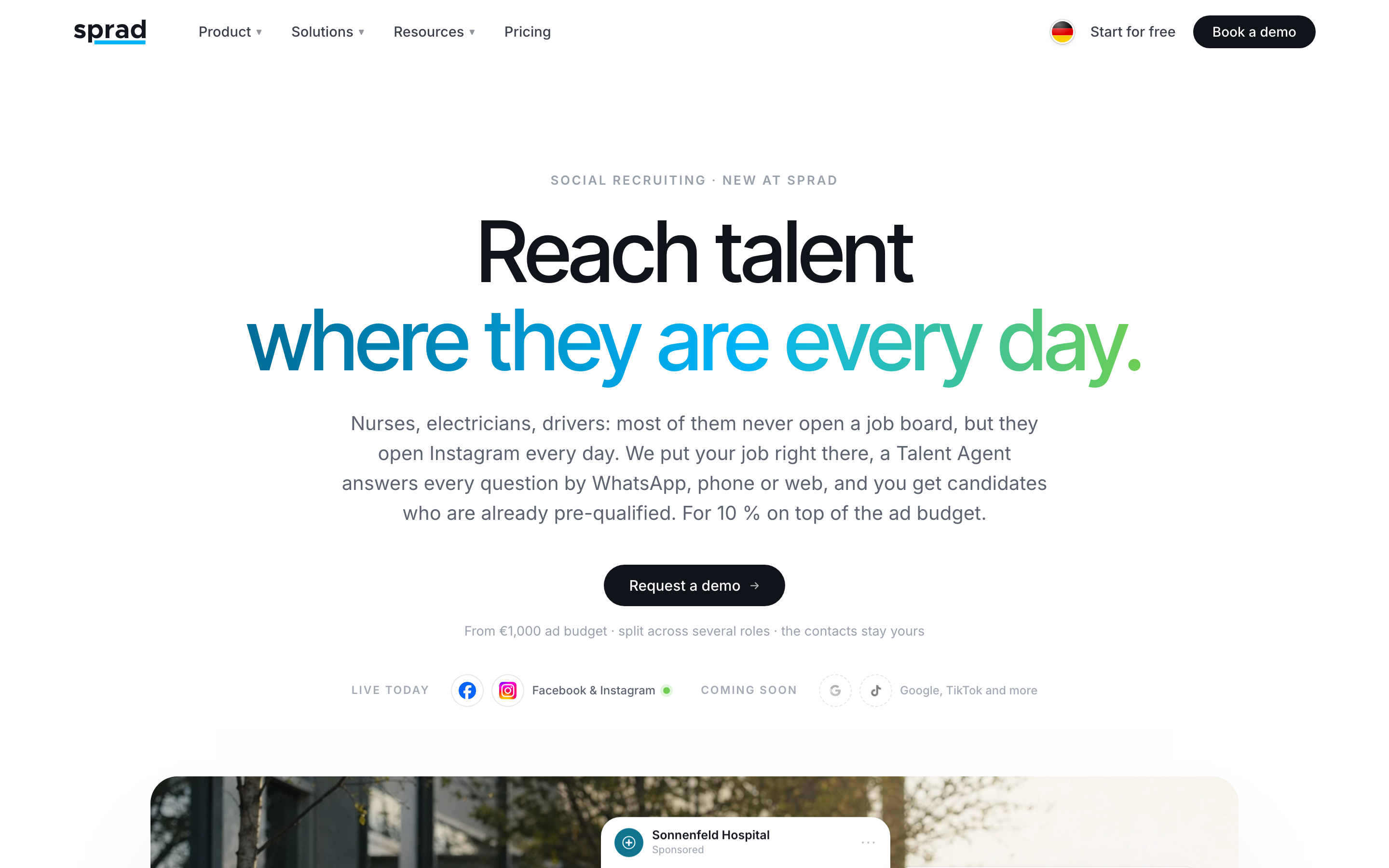
For restaurants the pool matters most: the people who were not right in spring may be right for the autumn menu. See Sprad Social Recruiting, the Talent Base and the hospitality industry page.
Budget example
Ad spend plus 10 % makes the maths simple. These figures are arithmetic, not a forecast and not a guarantee of applicants.
| Case | Ad budget | Fee (10 %) | Total |
|---|---|---|---|
| One restaurant, 1 role (line cook) | €1,000 | €100 | €1,100 |
| One restaurant, 3 roles (cook, server, host) | €3,000 | €300 | €3,300 |
| Group of 4 venues, 6 roles | €5,000 | €500 | €5,500 |
As an orientation from the US, the Boostpoint benchmark 2026 shows a median of $13.88 per applicant on Meta across all job categories. Treat it as an order of magnitude, not a promise. Divide your budget by your own cost per qualified applicant to see how many interviews to expect. The budget can shift between roles every week.
Five markets, five angles
- New York: highest wages and most competition, lead with pay and a predictable schedule.
- Los Angeles: multilingual teams, run the ad in English and Spanish.
- Miami: strong seasonality, say clearly whether the job runs year round.
- Chicago: long winters and weekend peaks, name how weekend shifts are shared.
- London: many part-time and student candidates, state the hours and the right-to-work check up front.
These are starting points, not measured results. Your own campaign data replaces them after the first two weeks.
Common mistakes
- Hiding the pay: fewer applicants, and the wrong ones.
- Answering the next day: candidates have already moved on.
- Long forms: three to five questions, readable on a phone in a minute.
- Starting only when someone quits: the search then begins at the most expensive moment.
- Throwing applicants away: every “not now” is a future hire if you keep the contact.
Frequently asked questions
How do I hire restaurant staff when nobody applies?
Stop waiting for applications and go to where people are: Instagram and Facebook ads with pay in the first line, a WhatsApp application without a CV, and a reply within the hour.
How much does it cost to hire restaurant staff?
In-house hiring costs about £3,000 to £6,000 per hire in the UK according to The Access Group, agencies up to 20 % of first-year salary. With ad spend plus 10 %, a €1,000 budget costs €1,100.
Where can I find restaurant staff fast?
Use social media ads, referrals from current staff and your own list of past applicants. Job boards work for people who are actively searching, which is a minority.
How do I reduce turnover?
Recruiting and retention go together. Show real schedules and pay, tell people what the job is like in the ad, and screen for shifts, so people are not hired into a schedule they cannot keep.
Is it legal to message applicants on WhatsApp?
Only with their consent, which the application form should ask for. Rules differ by country, so check them before you start.
Jürgen Ulbrich
Jürgen Ulbrich has more than a decade of experience in developing and leading high-performing teams and companies. As an expert in employee referral programs as well as feedback and performance processes, Jürgen has helped over 100 organizations optimize their talent acquisition and development strategies.