The fastest way to hire cooks and servers in Germany is social media recruiting: an ad in the Instagram or Facebook feed, an application over WhatsApp without a CV, and a quick pre-screening before your head chef spends time. People who search actively use job boards. Most hospitality workers do not. They react to an offer that fits their hours and pay, and they answer on their phone. This guide covers the German restaurant labour market in numbers, where your candidates are, an example ad, five pre-screening questions and a budget example.
The German restaurant labour market in numbers
Hospitality is not a shrinking market, but a hard one. In March 2026 the German Federal Employment Agency (BA) counted about 1.09 million employees under social security in hospitality, 0.7 % more than a year earlier. At the same time only 18,785 vacancies were registered with the BA in May 2026, about 21,000 fewer than in May 2019. That does not mean less demand: many businesses hire through notices, referrals and social media without using the agency.
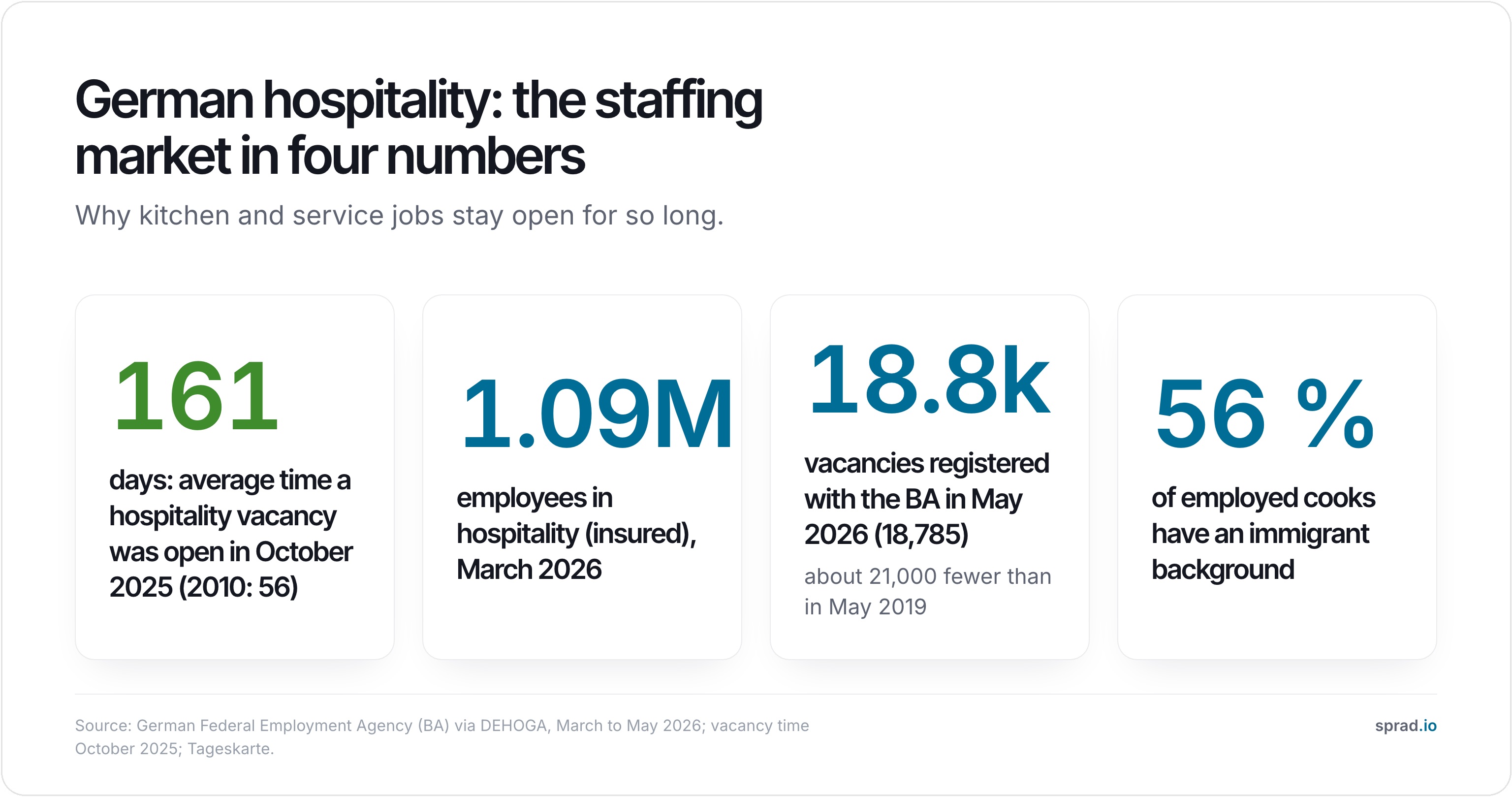
Two numbers change how you search. First, duration: in October 2025 a registered hospitality vacancy was open for 161 days on average, a record for October, against 56 days in 2010. Second, who works in the kitchen: about 45 % of hospitality employees hold a foreign nationality, and 56 % of employed cooks have an immigrant background. If you only run ads in German, you ignore a large part of the market. The share of restaurants affected by staff shortages fell from 40 % in April to 26.7 % in October 2025, but it is still high.
Where your candidates are
Cooks and servers work evenings, weekends and split shifts. They have no time for a portal with 20 required fields. According to a trade-press analysis (hogapage, November 2025), 37 to 48 % of hospitality workers consider changing jobs, and blue-collar candidates expect an answer within 24 hours. Three routes work better than a notice in the window:
- Feed ads on Instagram and Facebook. They reach people who are not searching but react to a good offer. Meta runs job ads in the special ad category “Employment”, where targeting options are restricted. Check the current rules in Meta's help centre before you start and do not plan around targeting by age, gender or postcode.
- WhatsApp instead of a form. A reply in two minutes beats any portal. How frontline candidates behave is covered in frontline recruiting by phone and WhatsApp, and the volume hiring guide shows the process for high applicant counts.
- Ads in more than one language. With around 45 % foreign employees, a version in your kitchen's language, such as English, Turkish or Ukrainian, can open a new pool. How much it brings only your campaign shows.
The ad: an example for a cook
A good feed ad answers four questions in three seconds: what, where, when, how much. Cooks spot filler like “varied tasks” immediately. As a template:
Cook (m/f/d) for our restaurant in [city], full-time or part-time
Two days off a week, no split shifts. Rota published three weeks ahead. [Amount] € plus tips and staff meals. Team of 6, open kitchen, onboarding with the head chef. Apply in 60 seconds on WhatsApp, no CV.
The pattern: one line role, one line hours, one line money, one line team, one line how to apply. A real photo of your kitchen beats stock. For servers, swap the kitchen for tips, shift model and team: “Fixed rota, tips shared fairly” says more than “friendly team”.
Pre-screening: five questions before your head chef picks up the phone
The ad brings applications, the work starts after. In hospitality many candidates decide within days, and someone who has no reply after two days has usually gone to the next restaurant. A Talent Agent therefore asks five questions at once, around the clock, via WhatsApp, phone or web:

After that you only see applicants who match role, hours and contract. That saves the phone calls between lunch service and dinner prep. More on the sector is on the hospitality industry page.
Sprad Social Recruiting for restaurants
Sprad Social Recruiting runs job ads on Instagram and Facebook, where cooks, servers and other frontline workers spend time every day. An AI talent agent pre-screens every applicant via WhatsApp, phone or web. Every applicant lands in your restaurant's own talent pool. In hospitality that matters: the cook who cannot move today but would in spring, and the summer extra, stay in your pool instead of disappearing into a platform.
Budget example
Sprad charges ad spend plus 10 %, from a €1,000 budget that can be split across roles. We recommend three months. The following figures are plain arithmetic, not an applicant promise:
| Example | Ad spend (3 months) | 10 % fee | Total |
|---|---|---|---|
| Restaurant, 1 cook | €1,000 | €100 | €1,100 |
| Inn, 3 roles (cook, 2 servers) | €3,000 | €300 | €3,300 |
| Restaurant group, 5 roles at 3 sites | €6,000 | €600 | €6,600 |
How many applications come out depends on region, ad and role. As a US reference, the Boostpoint 2026 benchmark gives a median of $13.88 per application on Meta campaigns, a figure that does not apply to German restaurants. Use your own number: budget divided by cost per qualified applicant gives the interviews you can expect. The budget planner on the product page gives a guide value, never a guarantee.
Cities: what matters
Restaurants are local, and commute decides. Plan ads for a radius around the venue:
- Berlin: heavy competition and many international teams, so languages and a clear offer such as two fixed days off count.
- Munich: high rents, so staff meals, travel allowance or housing are strong arguments.
- Hamburg: lots of evening and event work, so shift models without split shifts stand out.
- Cologne and Düsseldorf: dense restaurant scene and short distances, a cook can switch easily, so the faster reply wins.
- Holiday regions (coast, Alps, lakes): seasonal staff often need housing, put it in the first line.
These are starting points, not measurements. Your campaign shows which message works.
FAQ
How do I find cooks and servers quickly in Germany?
With a feed ad on Instagram and Facebook that names hours, pay and team, an application over WhatsApp without a CV and a reply the same day. The 161-day vacancy time is partly down to candidates waiting too long.
What does social media recruiting for restaurants cost?
With Sprad you pay ad spend plus 10 %, from a €1,000 budget that can be split across roles. Other models charge flat fees or commissions. For classic job boards, see StepStone costs and pricing.
Does this work for part-time staff and mini-jobs?
Yes. Name hours and times exactly (“Saturday and Sunday, 6 hours”). Pre-screening asks for scope and availability first.
What about apprentices?
Use a different tone, because teenagers and parents read differently. Apprentice recruiting and training marketing helps.
How long should a campaign run?
We recommend three months. People in hospitality often decide to switch only after a few weeks, and an ad needs time to reach them.
Sprad Social Recruiting in short
Sprad Social Recruiting runs job ads on Instagram and Facebook, where nurses, tradespeople, drivers and other frontline workers spend time every day. An AI talent agent pre-screens every applicant via WhatsApp, phone or web. Every applicant lands in the employer's own talent pool, so the relationships stay with the employer instead of a platform. Pricing is ad spend plus 10 %, from a €1,000 budget that can be split across roles. See how Sprad Social Recruiting works.
Jürgen Ulbrich
Jürgen Ulbrich has more than a decade of experience in developing and leading high-performing teams and companies. As an expert in employee referral programs as well as feedback and performance processes, Jürgen has helped over 100 organizations optimize their talent acquisition and development strategies.