The fastest way for a retailer to hire store staff is to stop waiting for people to search and meet them where they already are: an ad in the Instagram or Facebook feed that names shifts and pay, an application by text or WhatsApp without a résumé, and a short pre-screening before a store manager spends any time. This guide is for employers, not for job seekers looking for a retail job. It covers the retail hiring market in numbers, how to build the ad, five pre-screening questions, a budget example and what to adjust by city.
The retail hiring market in numbers
Retail never stops hiring, because the job turns over constantly. According to the US Bureau of Labor Statistics (BLS), retail sales workers held about 4.27 million jobs in 2025, including roughly 4.0 million retail salespersons. The median pay was $17.10 an hour ($35,560 a year), and no formal credential is required. Employment is projected to show little or no change through 2035, yet BLS expects about 550,600 openings every year, mostly from people moving to other jobs or leaving the workforce.

In plain terms: the number of stores barely grows, but every year a large share of the workforce has to be replaced. You are not hiring once. You are refilling a pipeline, with extra peaks before the holidays and at the start of summer. And because the entry bar is low, your competition is every hourly employer nearby: restaurants, warehouses, delivery, other stores.
Where retail applicants are, and how they apply
Many store applicants are students, parents returning to work, career changers and people with a second job. They look at their phone between shifts and will not fill in a 20-field portal. Three routes work better than a classic posting:
- Feed ads on Instagram and Facebook. They reach people who are not searching today but would react to a better schedule or a closer store. Meta treats job ads as a special ad category called employment, with restricted audience options in the US and the EU. Check the current rules in Meta's business help centre before you start, and do not plan around targeting by age, gender or ZIP code. A radius around your store is the targeting that matters.
- Text or WhatsApp instead of a form. The store that answers first usually wins. Name, shifts and area are enough to start a conversation. See frontline recruiting by phone and WhatsApp, not email.
- Your own team's referrals. Staff know who is looking. A referral link in the team chat, next to the ad, costs almost nothing.
For orientation on cost, the Boostpoint 2026 social job advertising benchmark reports a median of $8.58 per applicant for retail and corporate campaigns on Meta, with the middle half between $3.72 and $17.76. Across all 891 frontline campaigns in the data set the median was $13.88. These figures describe applications, not hires, and they come from a vendor's own campaigns, so treat them as a rough range and measure your own.
The ad: a worked example for a store
A good feed ad answers a store applicant's questions in three seconds: what, where, when, how much. Skip phrases like "dynamic team" and be concrete. As a template for a shop or a small chain:
Sales associate, part time or full time, store on Main Street
You choose your shifts, with fixed weekends off every second week. Employee discount, paid training, $[amount] an hour from day one. Team of eight, a manager who knows your name. Apply in 60 seconds by text, no résumé.
The pattern: one line for the role and place, one for the schedule, one for the money, one for the team, one for how to apply. A real photo of your own store and team beats stock imagery. Name the pay in the ad, because for hourly workers the number is the first filter, and in several US states and cities pay ranges in job ads are now required anyway.
Five pre-screening questions before a manager spends time
Most applicants are fine, and a few clearly are not a fit, for example because the shifts do not match. Five short questions sort them without a call. An AI talent agent can ask them by WhatsApp, phone or web at any hour, so the applicant who writes at 10 pm gets an answer at 10 pm and not on Thursday.

Write down the minimum answers in advance, for example "weekends needed" or "must be able to close". The first reply then tells you who goes to the store manager today and who stays in the pool for the next opening. Right-to-work checks and any age rules for your products come after this step, not before, and depend on your state.
Sprad Social Recruiting for retail
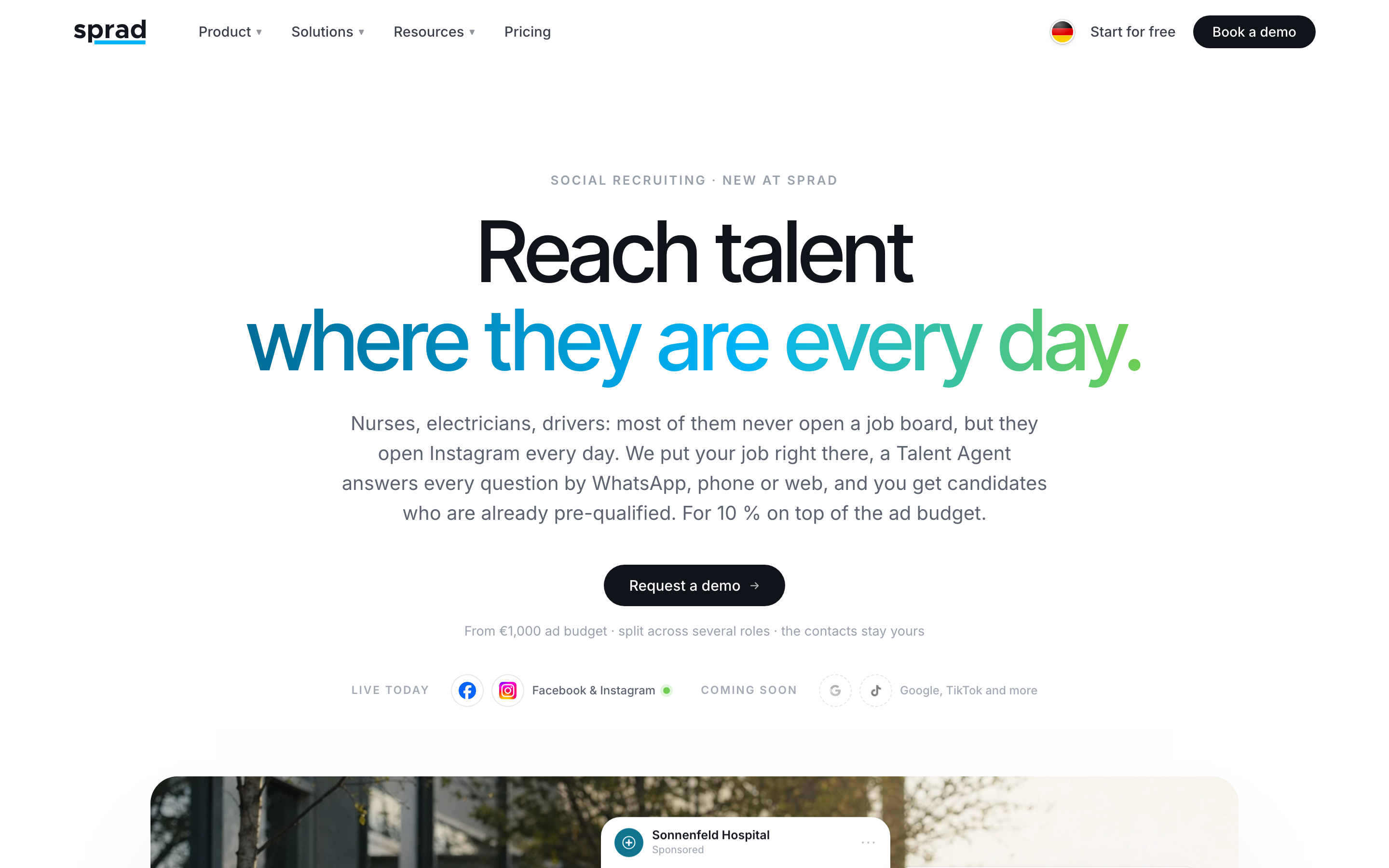
Sprad Social Recruiting runs job ads on Instagram and Facebook, where store staff spend time every day. The AI Talent Agent pre-screens every applicant via WhatsApp, phone or web. Every applicant lands in your own talent pool. In retail this is the point: the good applicant who could not start before the holidays, or the seasonal worker you want back next year, stays in your pool instead of disappearing on a platform. More on the retail use cases on the retail page.
Budget example
Sprad charges ad budget plus 10 %, from a €1,000 budget that you can split across roles, with three months recommended. The figures below are plain arithmetic, not a promise of applicants:
| Example | Ad budget (3 months) | 10 % fee | Total |
|---|---|---|---|
| Single store, one sales role | €1,000 | €100 | €1,100 |
| Regional chain, 3 roles (sales, register, stockroom) | €3,000 | €300 | €3,300 |
| Chain with 5 locations in a seasonal peak | €6,000 | €600 | €6,600 |
To estimate applicants, divide budget by your cost per applicant, then multiply by the share that passes pre-screening. As an illustration only: at $8.58 per applicant, $1,000 of ad spend buys about 116 applications. If one in four passes your five questions, that is roughly 29 conversations. Your real cost per applicant will differ by region and ad. The budget planner on the product page gives a guide value, never a guarantee.
Cities: what to adjust
Retail hiring is local, and the commute decides. Run ads in a radius around the store and adapt the message:
- Dallas and Fort Worth: a sprawling metro, so name the neighbourhood and the highway exit instead of just the city.
- Atlanta: many applicants rely on MARTA and buses, so say how far the store is from a stop.
- Phoenix: summer heat shapes shift preferences, so evening shifts and indoor work are strong lines.
- Chicago: transit-heavy and competitive, so pay and shift flexibility need to be visible in the first line.
- Orlando: tourism creates seasonal peaks that overlap with yours, so plan the campaign earlier than the peak.
These are starting points, not measurements. Your campaign shows which message works.
Common mistakes
- Asking for a résumé when the job does not need one.
- Leaving the pay out of the ad.
- Replying after two days. An applicant who wrote on Tuesday has often accepted another offer by Thursday.
- Starting the campaign when the peak has already begun. Plan three to four weeks ahead.
- Throwing away applicants who were not ready this time instead of keeping them in a pool.
FAQ
How do I hire retail staff quickly?
Run a feed ad on Instagram and Facebook that names shifts, pay and place, accept applications by text or WhatsApp without a résumé, and answer the same day.
Where do I find retail employees?
The common channels are job boards, employee referrals, in-store signs and social ads. Social ads reach people who are not searching, and a talent pool keeps the ones who are not ready yet.
What does social media recruiting for retail cost?
With Sprad you pay ad budget plus 10 %, from €1,000, split across roles. For the market range per applicant, see the Boostpoint benchmark above.
How do I pre-screen retail applicants without a phone call?
Ask five short questions by WhatsApp, text or web: shifts, commute, experience, role fit and start date. Set minimum answers before the campaign starts.
Can I message applicants on WhatsApp?
Someone who contacts you after your ad made the connection themselves. Outreach to people who did not contact you has tighter rules that differ by country and state, so ask your counsel. This is not legal advice.
Sprad Social Recruiting in short
Sprad Social Recruiting runs job ads on Instagram and Facebook, where nurses, tradespeople, drivers and other frontline workers spend time every day. An AI talent agent pre-screens every applicant via WhatsApp, phone or web. Every applicant lands in the employer's own talent pool, so the relationships stay with the employer instead of a platform. Pricing is ad spend plus 10 %, from a €1,000 budget that can be split across roles. See how Sprad Social Recruiting works.
Jürgen Ulbrich
Jürgen Ulbrich has more than a decade of experience in developing and leading high-performing teams and companies. As an expert in employee referral programs as well as feedback and performance processes, Jürgen has helped over 100 organizations optimize their talent acquisition and development strategies.