To hire warehouse workers at volume, stop treating each opening as a separate search. Build one always-on pipeline: a clear offer with pay and shift in the first line, Instagram and Facebook ads that reach people who are not on job boards, a one-minute mobile application, and an instant pre-screen that shows your shift leads only people who can work your hours. This guide is for employers, such as distribution centres, 3PLs and e-commerce fulfilment sites, and not for people looking for a warehouse job. As of October 2026.
The market in numbers
The US Bureau of Labor Statistics counts about 6.9 million jobs for hand laborers and material movers in 2025. It projects roughly 904,200 openings a year through 2035, most of them replacement openings from people who leave the occupation. The work needs no formal education and one month or less of on-the-job training, so every employer in a region competes for the same pool. The median pay was $18.38 an hour in 2025, and schedules often include nights and weekends.

Turnover is where volume hiring is won or lost. Industry analyses that cite BLS data put annual warehouse turnover at roughly 43 to 49 %, against about 30 % across all industries, and well-run sites report 15 to 25 %. Those are estimates from secondary sources, not an official statistic, but the direction is consistent: a 200-person site with 45 % turnover replaces about 90 people a year, more than seven a month, before any peak season adds to it.
The BLS also notes that these occupations have some of the highest injury rates of any job, with sprains and strains from lifting. That is worth saying plainly in the ad. Applicants who know the physical demands in advance leave less often in week one.
Plan for volume, not for single hires
Single openings reward the best job post. Volume rewards the best system. Three habits separate sites that fill 20 positions in two weeks from those that scramble:
- Work backwards from the start date. If 20 people must start on 1 November, applications must come in by early October, because pre-screening, paperwork, a background check and onboarding take time. Allow four to six weeks.
- Divide by your own conversion. Hires needed, divided by the share of pre-screened applicants who actually show up on day one, gives the number of conversations you need. If, as an assumption you replace with your own data, one in four pre-screened applicants starts, 20 hires need about 80 conversations.
- Keep the pool. Seasonal workers from last year, applicants who were not needed in spring and good no-shows are your cheapest candidates in autumn. That only works if their contact data stays with you, not with a job board.
Where warehouse workers are, and what Meta lets you target
Warehouse workers are on their phones between shifts. Ads in the Instagram and Facebook feed reach them while they scroll, not while they search. Three practical points:
- Job ads are a special ad category. According to Meta's rules, employment ads in the US and several other regions have limited targeting: the age range is fixed, gender cannot be selected, location targeting works by radius instead of postal code and lookalike audiences are unavailable. Check the current rules in Meta's Business Help Centre and do not build your plan around demographic targeting.
- You target through the message. Pay, shift and site in the first line attract the right people better than any audience setting. Say "second shift, $[amount] an hour, 10 minutes from Exit 4" and the radius does the rest.
- The application must work on a phone. A lead form or a WhatsApp link beats a career-site form that asks for a CV. See frontline recruiting by phone and WhatsApp, not email.
An ad that works: a worked example
Answer what, where, when and how much in the first three lines. This is a template with placeholders, not a real posting:
Warehouse associate, second shift (2 pm to 10:30 pm)
$[amount] an hour, paid weekly, overtime in peak season is optional. 15 minutes from [town], free parking, paid forklift training. Apply in 60 seconds from your phone, no resume needed.
Use a real photo of your dock or your break room instead of stock imagery, and run two or three versions with different lead lines, for example pay, shift and training. Replace the creative every two to three weeks, because the same audience gets tired of the same ad.
Pre-screening: five questions before a supervisor spends time
Shift leads should not read 300 forms. A talent agent can ask five questions at once, at any hour, via WhatsApp, phone or web, and hand over a summary of everyone who fits.
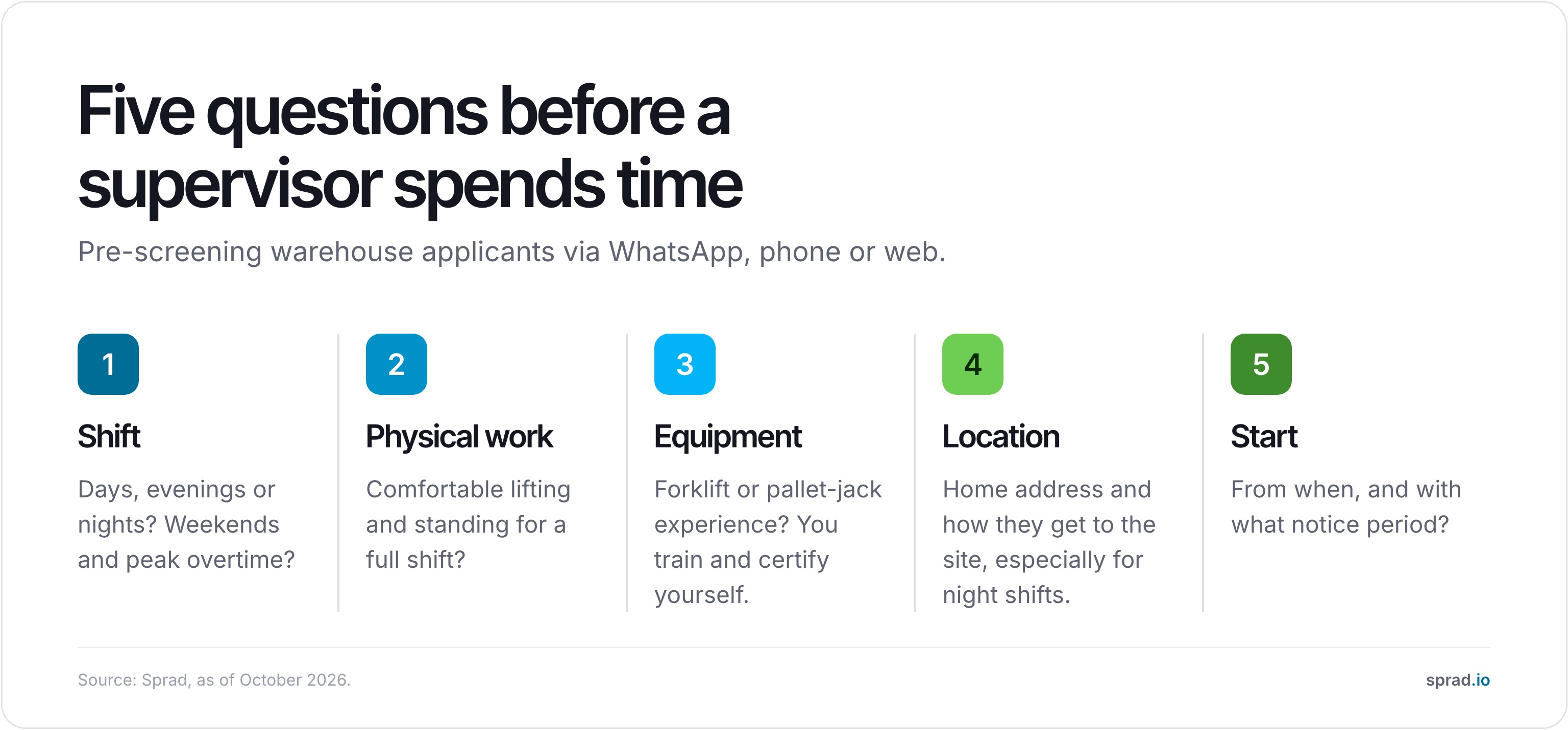
Keep every question job-related. In the US, forklift operators must be trained and evaluated by their employer, so ask about experience, not about a certificate, and let a person check right-to-work documents and run any background check you use. This is not legal advice.
Staffing agency or your own pipeline?
| Route | Speed | Cost | Who owns the contact |
|---|---|---|---|
| Staffing agency or temp pool | days | markup on every hour worked, ask for it in writing | the agency |
| Job board | weeks | per post or per click | the board |
| Employee referral | weeks, hard to plan | bonus per hire | you |
| Social media ads with pre-screening | days to launch | ad spend plus a platform or tool fee | you, if the tool stores applicants in your pool |
Most sites use a mix: agency workers to cover this week, a pipeline for the permanent and seasonal core. The column that changes over time is the last one. Every applicant who lands in a pool you own lowers the cost of the next peak.
Sprad Social Recruiting for warehouse and logistics employers
Sprad Social Recruiting runs job ads on Instagram and Facebook, where nurses, tradespeople, drivers and other frontline workers spend time every day. An AI talent agent pre-screens every applicant via WhatsApp, phone or web. Every applicant lands in the employer's own talent pool, so the relationships stay with the employer instead of a platform. Pricing is ad spend plus 10 %, from a €1,000 budget that can be split across roles.
For warehouse sites this means the seasonal worker who finished in January is still in your talent pool in September. Read more about recruiting in logistics and volume recruiting in logistics and production.
Budget example
Sprad charges ad budget plus 10 %, from a €1,000 budget that you can split across roles, with three months recommended. Prices are in euros. The figures are plain arithmetic, not a promise of applicants:
| Example | Ad budget (3 months) | 10 % fee | Total |
|---|---|---|---|
| One site, ongoing replacement hiring | €1,000 | €100 | €1,100 |
| One site, peak push with three role types | €3,000 | €300 | €3,300 |
| Three sites in one region | €6,000 | €600 | €6,600 |
How many applications this yields depends on region, ad and pay. For orientation, the Boostpoint 2026 benchmark of 891 Meta campaigns puts the median at $13.88 per application and warehouse and production roles at about $9.83. Those are US figures and not a forecast for your site. Divide your budget by your own cost per qualified applicant to estimate conversations.
Where to adjust: regions
Commute decides in warehouse work, so run ads in a radius around the site and adapt the message. These are starting points, not measurements:
- Inland Empire and Dallas-Fort Worth: very large distribution clusters, so many employers advertise the same shifts. Lead with pay, paid training and shift flexibility.
- Atlanta and Columbus: strong logistics hubs where night shifts are common. Name the commute and parking in the ad.
- Midlands (UK): a dense belt of distribution parks. Stress shift patterns and the hourly rate, and state the site clearly because public transport is limited.
Hiring warehouse workers with Sprad
Sprad runs your warehouse job ads on Instagram and Facebook, where pickers and forklift drivers spend time between shifts. The Talent Agent checks shifts, start date and licences by WhatsApp, phone or web, and every applicant lands in your own talent pool for the next peak season. You pay ad spend plus 10 %, from a €1,000 budget. See how Sprad Social Recruiting works.
Frequently asked questions
How do I hire warehouse workers fast?
Cover this week's gap with an agency or temp pool, and run Instagram and Facebook ads with pay and shift in the first line for the permanent hires. Pre-screen every applicant by WhatsApp, phone or web, so shift leads only meet people who can work your hours.
Where can I find warehouse workers?
On job boards, through employee referrals, via staffing agencies, at job fairs and on Facebook and Instagram, where people who are not actively searching spend their breaks.
How much does it cost to hire a warehouse worker?
It depends on region, pay and channel. Agencies charge a markup on each hour, boards charge per post or click. With Sprad you pay ad budget plus 10 %, so a €1,000 budget costs €1,100. Compare cost per qualified applicant, not cost per click.
How do I reduce warehouse turnover?
Be honest about the physical work and the schedule in the ad, publish a stable shift pattern and answer applicants within hours. Hiring quality starts with the pre-screen.
Is this about finding a warehouse job?
No. This guide is for employers who need to hire warehouse staff. Job seekers are better served by a job board or the employer's career page.
Jürgen Ulbrich
Jürgen Ulbrich has more than a decade of experience in developing and leading high-performing teams and companies. As an expert in employee referral programs as well as feedback and performance processes, Jürgen has helped over 100 organizations optimize their talent acquisition and development strategies.