To hire warehouse workers in Germany quickly, advertise where shift workers already are, on Instagram and Facebook, and let them apply by WhatsApp instead of sending a CV. The German warehouse market is not short of people but of time to select them: almost four unemployed helpers compete for every open helper vacancy, yet shifts stay empty because the commute, the shift or the forklift licence does not fit. This guide covers the market numbers, how to build an ad, five screening questions and budget examples for one to five roles.
The market in numbers
Warehouse work is a helper market. According to a KOFA/IW study, an average of about 236,000 unemployed helpers in transport and logistics occupations faced only about 63,000 open helper vacancies between July 2023 and June 2024. Vacancies for unskilled and semi-skilled staff rose 16 % in a year to the highest level since 2020, driven by online retail. For helpers in postal and delivery services they jumped 66.7 % to roughly 21,200.
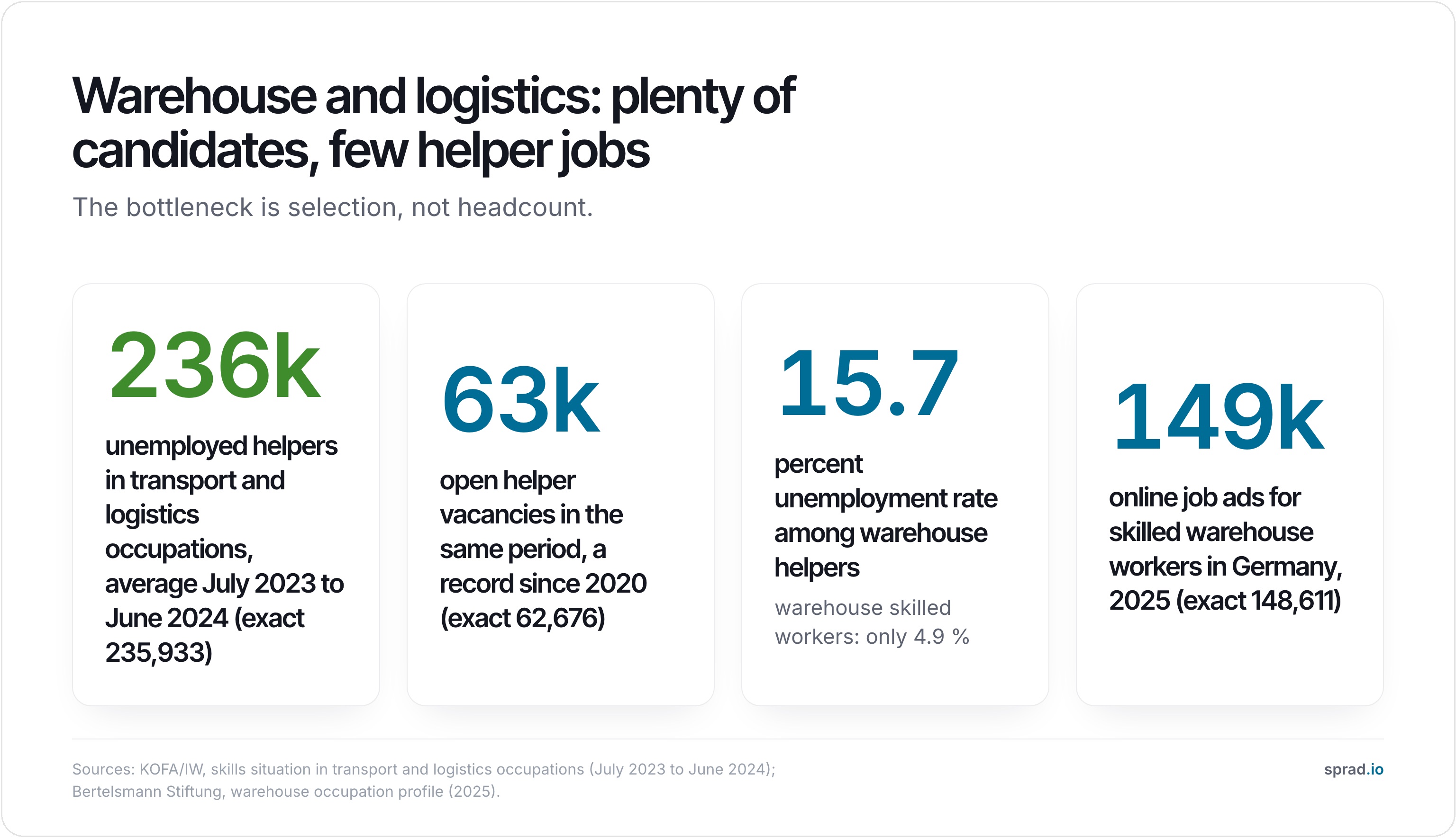
The Bertelsmann Stiftung puts the occupation-specific unemployment rate in warehousing at 15.7 % for helpers but only 4.9 % for skilled workers. For 2025 it counts about 148,600 online job ads for skilled warehouse workers, on average 4.8 skilled vacancies per unemployed person. Two consequences: for helper roles you need reach and speed, for skilled roles (warehouse logistics specialists) you need people who already have a job. A listing on a job board, seen only by active seekers, delivers neither.
Turnover adds pressure. In a Quinyx trend study (2023), 44 % of surveyed warehouse staff were thinking about quitting, mainly because of stress and poor work-life balance. People ready to move respond to a better offer in their feed even if they never browse job boards. Since January 2026 the statutory minimum wage is €13.90 per hour, so pay alone rarely sets your ad apart. Shift pattern, commute and premiums do.
Where your candidates are
Warehouse staff work early, late or night shifts, do not carry a laptop and do not write cover letters. Three routes beat a classic job listing:
- Feed ads on Instagram and Facebook. They reach people who are not looking but react to a shorter commute or better shifts. Meta handles job ads in its special ad category “employment”, where targeting options are restricted. Check the current rules in the Meta help centre before you start and do not plan around targeting by age, gender or postcode.
- WhatsApp instead of forms. Large German logistics employers have moved to WhatsApp applications, where a chatbot collects the required details step by step, according to trade press. How frontline candidates behave is covered in frontline recruiting by phone and WhatsApp; whether outreach is permitted is explained in contacting candidates via WhatsApp.
- The location as an argument. In a warehouse the commute matters more than in an office. Name the transit link, parking or shuttle in the ad. More on volume roles in recruiting in logistics and production.
The ad: an example for a warehouse operative
A good feed ad answers four questions in three seconds: what, where, when, how much. Skip “competitive salary” and be specific. Use this as a template:
Warehouse operative (m/f/d), picking, early shift 6 am to 2 pm
Fixed shift, no rotating chaos. Hourly pay from €[amount] plus premiums, permanent contract. Free parking at the gate, shuttle from the station in 10 minutes. No forklift licence? We train you if needed. Apply in 60 seconds by WhatsApp, no CV.
The pattern: one line for role and shift, one for reliability, one for pay, one for the commute, one for how to apply. A real photo from your warehouse beats stock imagery. Anyone driving industrial trucks in Germany needs instruction and written authorisation from the employer under accident-prevention rules, so sort that out before deployment (not legal advice).
Pre-screening: five questions before anyone spends time
The ad brings applications, the work starts afterwards. An applicant who has heard nothing after two days has usually applied to another warehouse. A Talent Agent therefore asks five questions immediately, around the clock, via WhatsApp, phone or web:

You then see only applicants who match shift, site and qualification, and your shift lead stops phoning people who never fit. How to screen helpers and skilled staff differently is covered in blue-collar screening, industry background on the logistics industry page.
Sprad Social Recruiting for warehouse and logistics
Sprad Social Recruiting runs job ads on Instagram and Facebook, where warehouse staff, drivers and other frontline workers spend time every day. An AI talent agent pre-screens every applicant via WhatsApp, phone or web. Every applicant lands in your company's own talent pool. In a warehouse this matters most: the applicant who does not fit today but is needed for the autumn peak stays in your pool instead of disappearing on a platform.
Budget example
Sprad charges ad spend plus 10 %, from a €1,000 budget that can be split across roles. Three months is the recommended run. The figures below are pure arithmetic, not a promise of applicants:
| Example | Ad spend (3 months) | 10 % fee | Total |
|---|---|---|---|
| Retail warehouse, 1 picker role | €1,000 | €100 | €1,100 |
| Logistics centre, 3 roles (early, late, forklift driver) | €3,000 | €300 | €3,300 |
| Fulfilment site before peak season, 5 roles | €5,000 | €500 | €5,500 |
How many applications this produces depends on region, ad and shift. As a US reference, the Boostpoint 2026 benchmark reports a median of $13.88 per application on Meta campaigns, a figure that does not apply to German warehouses. Use your own: budget divided by cost per qualified applicant gives the number of conversations. The budget tool on the product page gives a guide value, never a guarantee.
Cities: what to watch
Warehouses are local markets and travel time decides. Plan ads for a radius around the site:
- Hamburg: port, handling and retail warehouses compete for the same people, shift reliability is the strongest argument.
- Rhine-Ruhr: a dense logistics landscape with inland ports, short moves between employers, so state premiums and transit links.
- Leipzig and Halle: large hubs and fulfilment centres, where night shifts deserve their own offer.
- Rhine-Main: many commuters, so the ad should state travel time and parking.
- Stuttgart region: supplier and retail warehouses, high living costs make commuter support an argument.
These are starting points, not measured values. Only your campaign shows which message works.
Frequently asked questions
How do I hire warehouse workers quickly in Germany?
Run a feed ad on Instagram and Facebook that states shift, pay and commute, let people apply by WhatsApp without a CV and answer the same day. For helper roles, response time decides.
What does social media recruiting for warehouses cost?
With Sprad you pay ad spend plus 10 %, from a €1,000 budget that can be split across roles. For a comparison with a classic job board see StepStone costs and prices.
Does it work for seasonal staff?
Yes, if you start early. Launch the ad several weeks before the peak so screening and onboarding have time, and keep suitable applicants in your pool for the next season.
Must applicants hold a forklift licence?
Not necessarily. What matters is that instruction and written authorisation are in place before they operate an industrial truck. Ask about the licence during pre-screening and offer training if needed. This is not legal advice.
Can I message warehouse candidates on WhatsApp?
People who contact you after seeing your ad have started the conversation themselves. Proactive outreach is subject to stricter rules, explained in WhatsApp and the law.
Sprad Social Recruiting at a glance
Sprad Social Recruiting runs job ads on Instagram and Facebook, where nurses, tradespeople, drivers and other frontline workers spend time every day. An AI talent agent pre-screens every applicant via WhatsApp, phone or web. Every applicant lands in the employer's own talent pool, so the relationships stay with the employer instead of a platform. Pricing is ad spend plus 10 %, from a €1,000 budget that can be split across roles. See how Sprad Social Recruiting works.
Jürgen Ulbrich
Jürgen Ulbrich has more than a decade of experience in developing and leading high-performing teams and companies. As an expert in employee referral programs as well as feedback and performance processes, Jürgen has helped over 100 organizations optimize their talent acquisition and development strategies.