The best way to hire data scientists is to find them through their work instead of waiting for applications: public projects, competition results, publications and talks show what a candidate can really do. In the US the median data scientist earned $120,230 in May 2025 and employment is projected to grow 35 % between 2025 and 2035, with about 24,800 openings a year (U.S. Bureau of Labor Statistics, Occupational Outlook Handbook, page updated August 2026).
What are you actually hiring? Four profiles behind one title
"Data scientist" covers very different jobs. Before you search, decide which profile the team needs; a wrong guess is the most common reason a search returns people nobody wants to interview.
| Profile | Typical titles to search | Proof of work you can find |
|---|---|---|
| Analytics-leaning (insights, experiments) | data scientist, product data scientist, decision scientist | SQL and experiment-design write-ups, dashboards, talks at product or analytics meetups |
| Applied ML (models in production) | machine learning engineer, applied scientist, ML scientist | public repositories, model cards, serving or MLOps work |
| Research-leaning | research scientist, research engineer | papers, preprints, conference talks, open datasets |
| GenAI / LLM | AI engineer, LLM engineer, NLP engineer | fine-tuning or evaluation projects, open-source contributions, model hubs |
Where to find data scientists (and what each channel shows)
| Channel | What you see | How to use it |
|---|---|---|
| Title, employer, skills, tenure | Good for reach, weak for proof. Combine with a portfolio channel. | |
| Kaggle | Competition and notebook history, public tiers | Useful for modelling skill; says little about production work or teamwork. |
| Hugging Face and GitHub | Models, datasets, repositories, commit history | Best signal for applied ML and GenAI; read the code, not the star count. |
| arXiv, Google Scholar, conference programmes | Authors, affiliations, topics | For research-leaning roles; contact through the institutional page or a professional network. |
| Meetups, PyData-style events, university labs | Speakers and organisers | Small, local and warm; ask the organiser for an introduction. |
| Employee referrals | People who already know the team | Slowest to scale, highest trust. |
The pool is not small. The Bureau of Labor Statistics counts about 275,600 data scientist jobs in the US in 2025. The problem is not headcount but relevance: most of those people are not looking, and most profiles do not match your problem. That is why active sourcing with precise criteria beats more volume.
Copy-and-paste search strings
Test every string in your own tool first; search engines and platforms change how they treat operators. Replace the bracketed parts.
| Goal | String |
|---|---|
| LinkedIn Boolean, applied ML | ("data scientist" OR "applied scientist" OR "machine learning engineer") AND (Python) AND (PyTorch OR TensorFlow OR XGBoost) AND (production OR deployment OR MLOps) NOT (intern OR trainee OR student) |
| LinkedIn Boolean, analytics-leaning | ("data scientist" OR "product data scientist") AND (SQL) AND ("A/B test*" OR experiment* OR causal) NOT (intern OR junior) |
| Google X-ray, public LinkedIn profiles | site:linkedin.com/in ("data scientist" OR "applied scientist") (Python) (SQL) "[city]" |
| Google X-ray, GitHub profiles | site:github.com "[city]" ("machine learning" OR "data science") "available" -jobs |
| Plain language, for an AI search | Senior data scientist in [city or remote, time zone], 5+ years, has shipped a recommendation or forecasting model to production, Python and SQL, experience with experiments |
Boolean strings reward exact titles, but titles for this role vary a lot by company. For a comparison of both approaches see Boolean search vs. requirement search.
Must-haves and nice-to-haves: set them honestly
The most frequent mistake we see in searches is writing everything as a nice-to-have. Hard criteria narrow a search; soft criteria only re-rank it. Decide before you start.
- Must: the profile you chose above, solid Python and SQL, statistics fundamentals, one shipped project with a business result, working language of the team.
- Nice to have: a specific cloud platform, a specific framework, industry knowledge, publications, a graduate degree.
- Often wrongly demanded: a PhD for applied roles, ten years of experience in a field that is only five years old, every tool in the stack.
Outreach template
Data scientists ignore generic messages. Name one concrete piece of work, one concrete problem, and one concrete next step. Under 100 words.
Hi [first name], I read your write-up on [specific project or model]. Particularly the way you handled [specific detail]. We are building [one-sentence problem] at [company], and it is the same class of problem. The role is [title], [location/remote], salary band [range]. If you are open to a 20-minute call about the problem, not the job, I can send two time slots. If not, no worries at all.
Include the salary band, because candidates in this market compare before they reply.
Five questions for the first conversation
- Which of your projects had the most measurable effect, and how did you measure it?
- Tell me about a model you took from notebook to production. What broke?
- When did a simple baseline beat your complex model, and what did you do?
- How do you explain a result to someone who does not trust numbers?
- What problem would you want to work on in the next two years, and what would make you say no to ours?
Pay and market, with sources
US median pay for data scientists was $120,230 in May 2025 (BLS, see above). For Germany the Bundesagentur für Arbeit publishes median pay in its Entgeltatlas, grouped by occupation aggregates; check the aggregate that matches your profile instead of trusting a single salary-portal number. On demand: in Bitkom's September 2026 survey, 12 % of companies with open IT positions were looking for AI specialists, and 97 % of companies with IT vacancies reported difficulties filling them (Bitkom, 3 September 2026, 853 and 602 companies surveyed).
Legal points when you source in the EU
- Information duty: if you collected a person's data from a public source, Article 14 GDPR requires you to inform them within a reasonable period, at the latest within one month, or at the first contact if you use the data to contact them (Regulation (EU) 2016/679). Details in Active sourcing and GDPR.
- Hiring from outside the EU: Germany's EU Blue Card has a general salary threshold of €50,700 and a reduced one of €45,934.20 for shortage occupations and some IT specialists in 2026 (Make it in Germany, legal basis § 18g AufenthG). Whether a specific role qualifies for the lower threshold is decided by the immigration authority.
- Rules for the US and other countries differ; ask your legal team before you run a campaign across borders.
How to run this search with Sprad
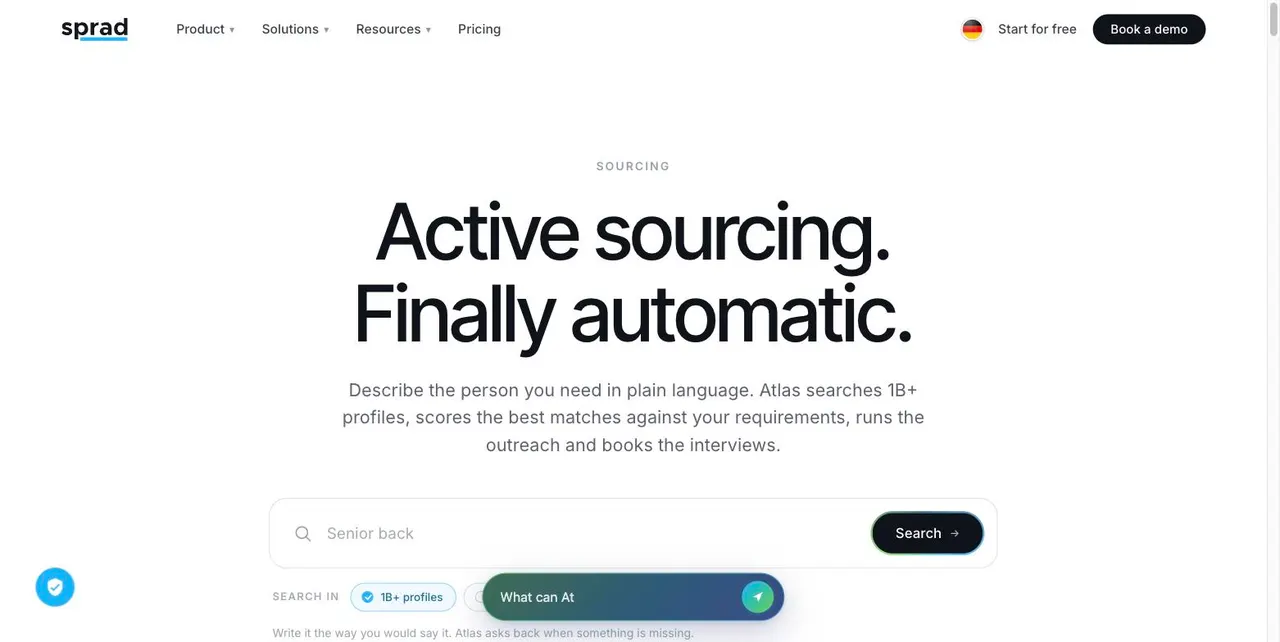
With Sprad Active Sourcing you describe the role in your own words, including must-haves, and Atlas searches public profiles and your own talent pool, then checks each profile against your criteria and shows the reason per requirement. Messages go out through LinkedIn and email from one inbox, so a candidate is not contacted twice. A voice pre-interview (12 languages, 30 credits per interview) can ask the first questions above before you spend time. Everyone you reach stays in your talent pool.
A web search costs 2 credits per displayed profile within a budget you set per run (50, 100 or 300 credits); the free plan includes 100 credits per month. Recruiter Lite is €79 per seat and month. Current prices are always on the pricing page (checked 9 November 2026). A deep search takes a few minutes because every profile is checked; a quick search takes seconds.
FAQ
How long does it take to hire a data scientist?
There is no reliable public figure that applies across companies, so plan from your own pipeline. The steps that cost the most time are a vague profile at the start and a long take-home assignment at the end; both are within your control.
Should I post a job ad or source actively?
Do both for analytics-leaning roles, source actively for applied ML, research and GenAI roles. Our comparison job ad or active sourcing explains the trade-off.
Is a PhD required for a data scientist?
For research roles usually yes; for applied and analytics roles a bachelor's degree is the typical entry requirement according to the BLS. Ask for proof of work instead of a degree.
What is the difference between a data scientist and a data analyst?
Analysts report and explain what happened, mostly with SQL and dashboards. Scientists build models and experiments that predict or decide. The same person can do both at a small company, which is why the title alone tells you little.
Jürgen Ulbrich
Jürgen Ulbrich has more than a decade of experience in developing and leading high-performing teams and companies. As an expert in employee referral programs as well as feedback and performance processes, Jürgen has helped over 100 organizations optimize their talent acquisition and development strategies.