Boolean search vs. requirement search comes down to one question: do you know the exact keywords your ideal candidate would type into their own profile, or do you know the role? Boolean search — the AND/OR/NOT strings recruiters build on a professional network — finds people who use your vocabulary. Requirement search reads a plain-language description of the role against full candidate profiles and finds people who fit it, whether or not they ever typed your keywords.
A public benchmark ran three real open roles through both approaches, and the gap between what each one actually surfaces is bigger than most recruiters expect.
What Boolean search actually does
Boolean search treats a candidate search like a database query: ("backend engineer" OR "software engineer") AND Go AND Kubernetes AND Berlin NOT junior. It's the logic behind a professional network's Boolean search field, its sales-prospecting filters, and old-school "X-ray" search on Google. It has worked for two decades because it's precise: if you know exactly which words describe the role, Boolean gives you transparent, reproducible control over the result set.
Where it breaks down
The precision is also the limit. Boolean logic is only as good as the vocabulary of the people you're searching for, and job titles are messier than search strings assume — a candidate who led a cloud migration for a 200-person engineering org may never have typed "DevOps" or "senior" anywhere on their profile, so a string built around those two words never sees them. On top of that, the platforms add their own friction.
According to a breakdown published by a recruiting-tech blog, the leading professional network doesn't support wildcards, requires every operator in uppercase, and caps Boolean strings at roughly 2,000 characters — while Indeed's handling of NOT and parentheses produces inconsistent results, forcing recruiters to rebuild the same logic differently on every platform. The same source notes a familiar plateau: after building a third "perfect" string, most recruiters keep surfacing the same 80% of already-sourced candidates, because Boolean searches profile by profile instead of reasoning about what a profile means.
- Vocabulary mismatch: a real skill described in different words than the ones in your string is invisible to it.
- Platform limits: no wildcards and mandatory uppercase operators on the leading professional network, a roughly 2,000-character cap, inconsistent NOT/parentheses handling on other job boards.
- One string per platform: a working Boolean string has to be rebuilt from scratch for a different job board, a European professional network, or an ATS's own search.
- Diminishing returns: refining the string mostly reorders the same pool instead of widening it.
What requirement search does instead
Requirement search takes a plain-language description of the role — the way you'd brief a colleague, not a database — and evaluates full candidate profiles against it, criterion by criterion, instead of matching on keywords alone. Some natural-language sourcing tools are built explicitly around this idea, marketing themselves as a Boolean replacement: describe the role in a sentence, get matches, without building a string first. Sprad's requirement search works the same way over more than a billion external profiles: you describe the role once, and every profile is checked against each of your criteria individually, with a note on why it did or didn't qualify — so a candidate who calls their cloud work "infrastructure modernization" still surfaces, because the system is reasoning about the work, not scanning for two specific words.
For a tool-by-tool breakdown of the natural-language camp, see our natural-language sourcing tools comparison.
We ran three roles both ways
This isn't a hypothetical. Sprad's own sourcing benchmark, published 15 August 2026, put the same three open roles through five systems: Atlas's requirement search, three other free-text sourcing tools, and one filter-based system with no free-text search of its own — its criteria were translated into filters instead, the closest real-world equivalent to a Boolean/keyword approach. The systems are named individually in the table below.
The reference set for each role is the union of everything the other systems found, deduplicated; a system is never measured against its own results. In total, 218 profiles were reviewed across three roles: a Senior Backend Engineer in Berlin, a Senior Product Manager in London, and a Process Integration Engineer in Eindhoven.
| System | Search approach | Share of the other systems' finds |
|---|---|---|
| Atlas (Sprad) | Free-text requirement search | 38% |
| Juicebox | Free-text (NLP) | 9% |
| Metaview | Free-text | 5% |
| LinkedIn Sales Navigator | Filters (same criteria, no free text) | 3% |
| PIN | Free-text | 0% |
Atlas covered 38% of everything the other four systems found combined — roughly four times the next-best result. That doesn't mean the other systems are worthless: the honest reading, stated on the benchmark page itself, is that the majority of profiles in the reference set were found by no system at all. The gap between approaches is real, and so is the gap to complete coverage.
The ASML case: one filter query, one narrow answer
The clearest illustration sits in the Eindhoven role. The filter-based system found 18 of its 19 hits at a single employer, ASML — the obvious, keyword-matching answer for "process integration engineer" in that region. Atlas and the natural-language tools, reasoning from the requirement rather than an employer name, surfaced the semiconductor supplier ecosystem around it instead: NXP, SMART Photonics, Xiver, Ampleon.
Both answers are defensible. They're simply different slices of the same labour market — and it's exactly the kind of adjacent-company blind spot that filter- and keyword-based search tends to create, because the most obvious keyword match crowds out everything described in less obvious terms.
When Boolean still earns its keep
None of this makes Boolean obsolete. A 2026 playbook published by a recruiting industry blog argues for a hybrid: Boolean still wins on hard constraints (an exact certification, a specific security clearance, a named employer), inside controlled databases with consistent fields such as your own ATS, and wherever a search needs to be reproducible and auditable. For the broader Boolean-versus-natural-language question across sourcing methods generally, see our companion piece on Boolean search vs. natural language in recruiting — this article focuses specifically on the measured gap against requirement search.
Its own conclusion is blunt about both failure modes: "Teams that use only Boolean usually miss candidates due to wording mismatch. Teams that use only semantic can drift too broad for tight requirements." The practical read is that Boolean is a precision filter you apply after discovery, not the discovery step itself.
A quick way to decide
- Standard title, high volume, well-known market: Boolean search on a mainstream professional network works fine — the vocabulary is predictable.
- Scarce, cross-functional, or described differently company to company (the Eindhoven pattern): requirement search finds the adjacent pool a keyword string misses.
- A hard, non-negotiable constraint (licence, clearance, a named list of employers): keep it as a Boolean filter on top of whatever finds the candidates first.
- You need a reproducible, auditable search trail: Boolean's transparency still matters for compliance-sensitive processes.
What it actually costs to try
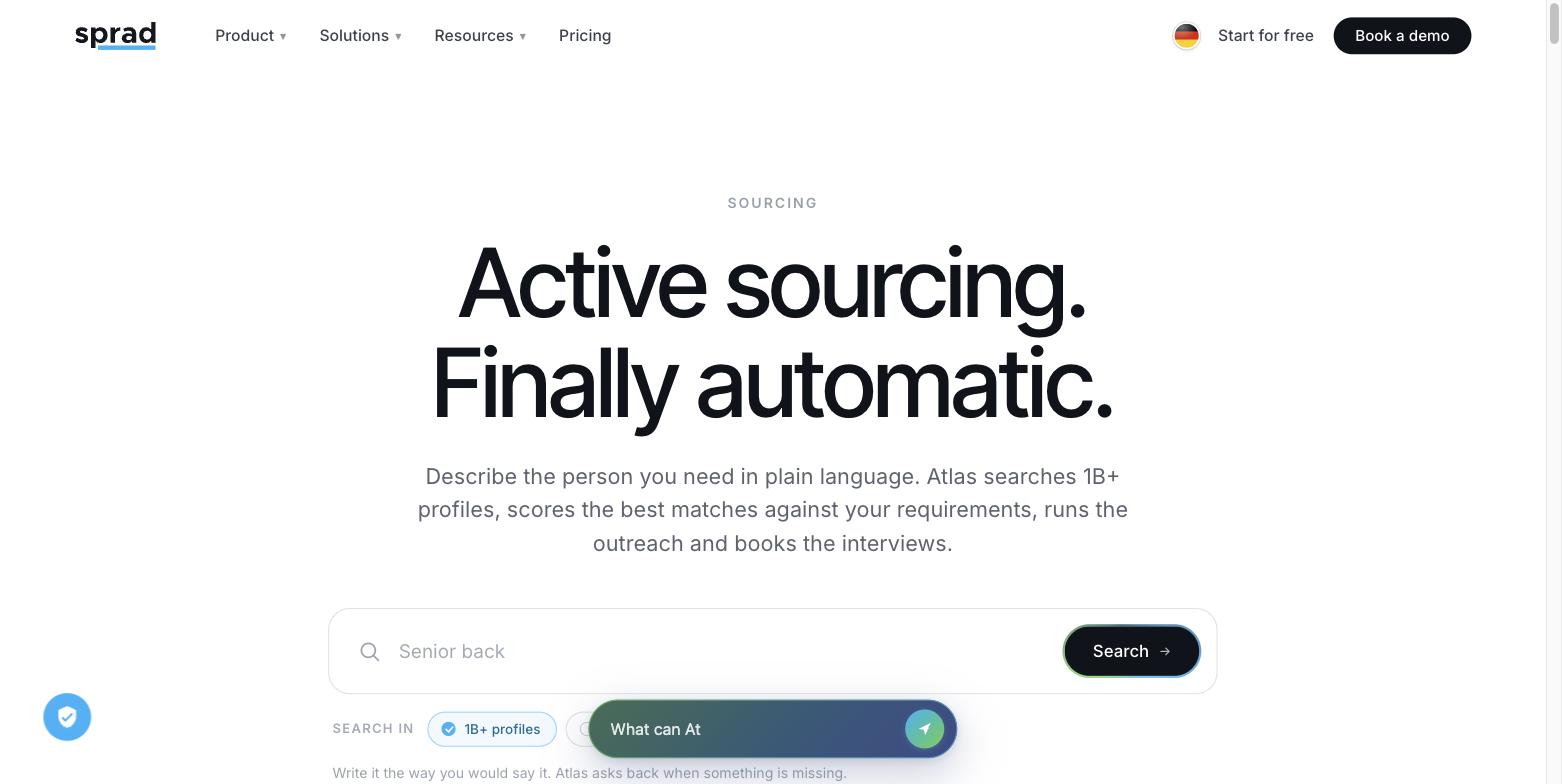
With Sprad, requirement search runs on credits rather than a seat licence: you pay 2 credits — roughly 12 to 16 cents, since 1 credit is priced at 6 to 8 cents — for each profile that actually clears your criteria, and profiles that don't clear the bar cost nothing. Every account gets 200 credits free, every month, no card required. The ATS and your own talent pool run 59 € per recruiter per month on top, separate from search usage.
That's a materially different economics than a Boolean-only seat licence charged whether or not the string finds anyone.
FAQ
Is Boolean search dead?
No. It's still the right tool for hard constraints, controlled databases, and audit trails. It's the wrong tool as your only discovery method, because it can only find people who describe themselves the way your string expects.
What exactly is "requirement search"?
A search method that takes a plain-language role description and checks it against full candidate profiles criterion by criterion, instead of matching keywords. Sprad's Atlas and other natural-language sourcing tools are both built around this idea, though they draw from different external data sources.
Do I need to give up LinkedIn to use requirement search?
No. The benchmark shows LinkedIn and requirement-search tools surface largely different, complementary people — it stays useful, especially where your target already has a strong presence there.
Does requirement search work for niche or blue-collar roles, not just tech?
The three benchmark roles were engineering, product and process-engineering positions, all knowledge-work roles. The underlying logic — reasoning about the work rather than the exact words — applies more broadly, but it hasn't been benchmarked outside that set.
How much would a full search across Sprad's requirement search cost?
At 2 credits (12–16 cents) per qualifying profile and 200 free credits a month, a search that surfaces 20 to 30 qualified profiles typically fits inside the free monthly allowance.
The bigger picture
Renting a Boolean-only seat means renting a tool that only finds candidates who use your words. Sprad's requirement search reads the role instead of the string, runs across more than a billion external profiles, and stays inside a talent pool your agency keeps — not one you rebuild every time a licence lapses. Sourcing is only half the job, though: finding the right people means little if you're pitching the client too late — see how agencies use job signals to win the mandate in the first place.
Start with 200 free credits a month, no card required, at sprad.io/industry/recruitment-agencies.
Jürgen Ulbrich
Jürgen Ulbrich has more than a decade of experience in developing and leading high-performing teams and companies. As an expert in employee referral programs as well as feedback and performance processes, Jürgen has helped over 100 organizations optimize their talent acquisition and development strategies.