The best place to find software developers is where their work is visible: public code, a stack-based search on LinkedIn or XING, referrals, and your own talent pool. The market has loosened in Germany (the Bundesagentur für Arbeit no longer lists software development as a shortage occupation in 2025), but hiring is not easy: according to Bitkom, 97 % of companies with open IT roles struggle to fill them.
Search by technology rather than job title, write to each person about their stack, and state the salary range up front. The gap is fit and seniority, not headcount.
Developer or engineer: what do you actually search for?
In job titles, "software developer" and "software engineer" overlap almost completely, and in German-speaking markets many profiles say "Softwareentwickler" or just the stack. Search several variants at once and let the technology decide. The table shows what to use per profile type.
| Profile type | Titles to search (EN / DE) | Stack signals | Typical mix-up |
|---|---|---|---|
| Frontend | frontend developer, UI engineer / Frontend-Entwickler | React, Vue, Angular, TypeScript, CSS, accessibility | Designers with some HTML |
| Backend | backend developer, software engineer / Backend-Entwickler, Softwareentwickler | Java, Kotlin, Go, Python, Node.js, SQL, Docker | DevOps or data roles |
| Full stack | full stack developer / Fullstack-Entwickler | React or Angular plus Spring, .NET or Node.js | Strong on one side only |
| Mobile | iOS / Android developer / Mobile-Entwickler | Swift, Kotlin, Flutter, React Native | Agency web developers |
How big is the market? Numbers with a date
| Figure | Value | Source, date |
|---|---|---|
| Software development as shortage occupation (Germany) | No longer visible in 2025; some specialist IT roles remain under observation | Bundesagentur für Arbeit, Informatik, August 2026 |
| Reported IT vacancies (annual average 2025) | about 13,000, down 22 %, lowest since 2015 | same source |
| IT specialists registered unemployed (2025) | about 54,000, highest in ten years | same source |
| Companies with open IT roles that struggle to fill them | 97 %; 31 % receive practically no applications | Bitkom study 2026, 3 September 2026 |
| Software developers, QA analysts and testers employed (US) | about 1.9 million; growth 10 % from 2025 to 2035 | US Bureau of Labor Statistics, May 2025 |
What follows: the broad market is not empty, but the people you want (the right stack, enough seniority, willing to move) are a small group. That is exactly why targeted active sourcing and a prepared message matter more than another job ad.
Where to find software developers
| Channel | Why it works | Catch |
|---|---|---|
| Referrals from your own engineers | Highest trust, the candidate arrives pre-qualified by a peer | Small volume, needs a bonus and quick feedback |
| Public code profiles | You see what a person builds and how they review | Not everyone publishes |
| LinkedIn and XING search by stack | Reach in Germany, Austria and Switzerland, both are used | Profiles lag behind real skills; titles are noisy |
| Meetups, conferences, open-source communities | Warm contact, shared interest | Slow to build; one person at a time |
| Your talent pool | People who already know you and applied before | Only as good as its upkeep |
| Job ads and job boards | Reach active job seekers | Developers who are happy in their role do not read them |
For the AI side of the search, see AI sourcing for engineering and tech talent.
Copy-paste search strings
Replace the technologies and cities. Test each string for two minutes and read the first 20 results before you scale it. How strings differ from a plain-language search is explained in Boolean vs requirement search.
- Frontend (LinkedIn Boolean): ("frontend developer" OR "frontend engineer" OR "frontend entwickler" OR "ui engineer") AND (React OR Vue OR Angular) AND TypeScript NOT (intern OR praktikant OR werkstudent)
- Backend: ("backend developer" OR "backend engineer" OR "software engineer" OR softwareentwickler) AND (Kotlin OR Go OR "Node.js" OR Python OR Java) AND (Docker OR Kubernetes OR AWS)
- Full stack: ("full stack" OR fullstack) AND (React OR Angular) AND (Spring OR ".NET" OR "Node.js")
- Google X-Ray: site:linkedin.com/in ("software engineer" OR softwareentwickler) (München OR Munich) (Kotlin OR Go) -recruiter -"talent acquisition"
What to write in the first message
Keep it short and specific. Name the stack, one concrete thing the person would work on, the salary range, and one easy next step. Drop "exciting opportunity" and "rockstar".
Hi [first name], I saw your work on [project or stack]. We are building [one concrete thing] with [stack] at [company, location or remote]. The role pays [range] and reports to [name], an engineer. If this is interesting, I can send the two-page brief; if not, no hard feelings. [Your name]
On the salary range: Directive (EU) 2023/970 gives applicants the right to receive the starting pay or its range before the interview (Art. 5; transposition deadline 7 June 2026, EUR-Lex). Check how your country has implemented it; naming the range early is good practice anyway.
Must-have and nice-to-have
Write the scorecard before you search. Three must-haves are enough; everything else goes to nice-to-have.
| Must-have (examples) | Nice-to-have (examples) |
|---|---|
| Production experience in the main language | A second language or paradigm |
| Has shipped and maintained a service or application | Open-source contributions |
| Works with code review and tests | Experience in your industry |
| Language level the team needs | Management or mentoring experience |
Five pre-interview questions
- Which project are you proudest of, and what did you personally decide?
- How does your team handle code review and releases today?
- What would make you leave your current setup?
- Which technology do you want to work with more, and which less?
- What are your salary expectation, notice period and preferred way of working?
Frontend developers: what changes
For frontend roles, search for the framework and for TypeScript: in the Stack Overflow Developer Survey 2025, 46.9 % of professional developers used React and 48.8 % used TypeScript (Stack Overflow, 2025). Ask for a live product or a repository, not just a portfolio. In Germany, accessibility is a real hiring filter: since 28 June 2025 the Barrierefreiheitsstärkungsgesetz requires many consumer-facing digital services to be accessible (BFSG), so experience with accessible components is a useful criterion for web and e-commerce teams.
What do developers earn?
Orientation, not an offer: in Germany, full-time IT specialists subject to social insurance earned a mean gross salary of 6,114 € per month in 2025 (Bundesagentur für Arbeit, Informatik; a mean across IT occupations, not a median for developers). In the US, software developers had a median annual pay of 135,980 $ in May 2025 (BLS).
Legal points before you write
- Data protection: if you collect data from public profiles, you must inform the person within one month (Art. 14 GDPR, EUR-Lex) and have a legal basis. Details in contacting candidates by email under GDPR.
- Cold email: unsolicited advertising by email needs consent under § 7 UWG (gesetze-im-internet.de); a personal one-to-one enquiry about a specific role is a different case, but get advice before bulk sending.
- Hiring from outside the EU: the EU Blue Card requires at least 50 % of the annual contribution ceiling, or 45.3 % with Federal Employment Agency approval for occupations such as ICT professionals (§ 18g AufenthG, text; the ministry publishes the annual amounts). For IT roles, § 6 BeschV drops the recognised-qualification requirement but still asks for two years of experience within the last five and a minimum salary (text). Check the current amounts with the authority before you promise anything.
How Sprad fits in
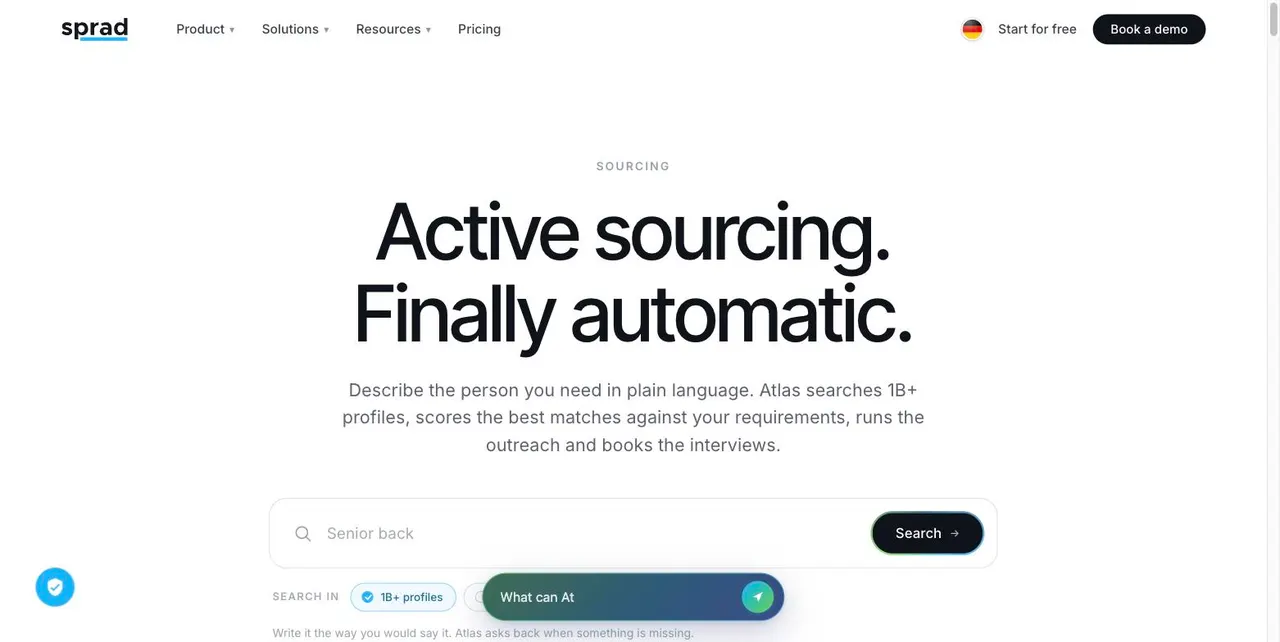
Sprad's active sourcing tool searches LinkedIn, XING, GitHub and your own talent pool in one search. You describe the role in your own words instead of building strings, the AI checks each profile against your requirements and gives a reason per requirement, and outreach goes out by LinkedIn and email from one inbox so nobody is contacted twice. A voice pre-interview in 12 languages costs 30 credits per candidate, a CV check 2 credits. Recruiter Lite costs 79 € per seat and month, there is a free plan with 100 credits a month, and a web search costs 2 credits per profile shown (see pricing, as of November 2026). The deep search takes several minutes. We are the vendor here; the channels above work without any tool.
Frequently asked questions
Where do I find software developers fastest?
Referrals and your own talent pool are fastest because the person already trusts a contact. For new names, search by stack on LinkedIn or XING and read public code before you write.
Is there a shortage of software developers in Germany?
Not in the broad statistical sense: the Bundesagentur für Arbeit no longer shows software development as a shortage occupation in 2025, and registered IT unemployment is at a ten-year high. Companies still report that specific profiles are hard to fill, so the shortage is by stack and seniority.
How long does hiring a developer take?
We found no reliable public figure for developers specifically, so we do not quote one. Track your own time from first message to signed contract and use it to plan.
Should I use a recruiting agency or search myself?
Agencies make sense for urgent or rare profiles and when you have no time. For repeat hiring in the same stack, an in-house search plus a talent pool is cheaper over time.
How many developers should I contact per role?
Plan on contacting a multiple of the number of interviews you need. That ratio is your own funnel: measure reply and interview rates on the first 30 messages and adjust the message before you send more.
Jürgen Ulbrich
Jürgen Ulbrich has more than a decade of experience in developing and leading high-performing teams and companies. As an expert in employee referral programs as well as feedback and performance processes, Jürgen has helped over 100 organizations optimize their talent acquisition and development strategies.