To source developers in Europe, describe the role as requirements instead of keywords, search more than one source (LinkedIn, XING, GitHub and your own talent pool), check every profile against the requirements, and reach people on two channels, LinkedIn and email, with follow-ups. That order matters more than any single tool. Developers are scarce everywhere: Germany's IT association Bitkom counted 149,000 unfilled IT positions in German companies in 2023, up from 82,000 five years earlier. This guide covers the steps, the legal limits in the EU, the tools and the mistakes we see most often.
What does "sourcing developers" mean in practice?
Sourcing means finding and approaching engineers who have not applied. Most strong developers are employed, do not browse job boards daily and answer a message only if it is specific and relevant. So the job is a search problem first and a communication problem second.
The market is large but uneven. Eurostat reports that 9.8 million people worked as ICT specialists in the EU in 2023, 4.8 % of all employed people. The share ranges from 2.4 % in Greece to 8.7 % in Sweden, so the pool you can reach depends heavily on where you search. In the Stack Overflow Developer Survey 2025 (over 49,000 responses from 177 countries), Germany accounts for 8.6 % of respondents and the United Kingdom for 5.8 %, a rough signal of where developer communities are largest.
How do I source developers step by step?
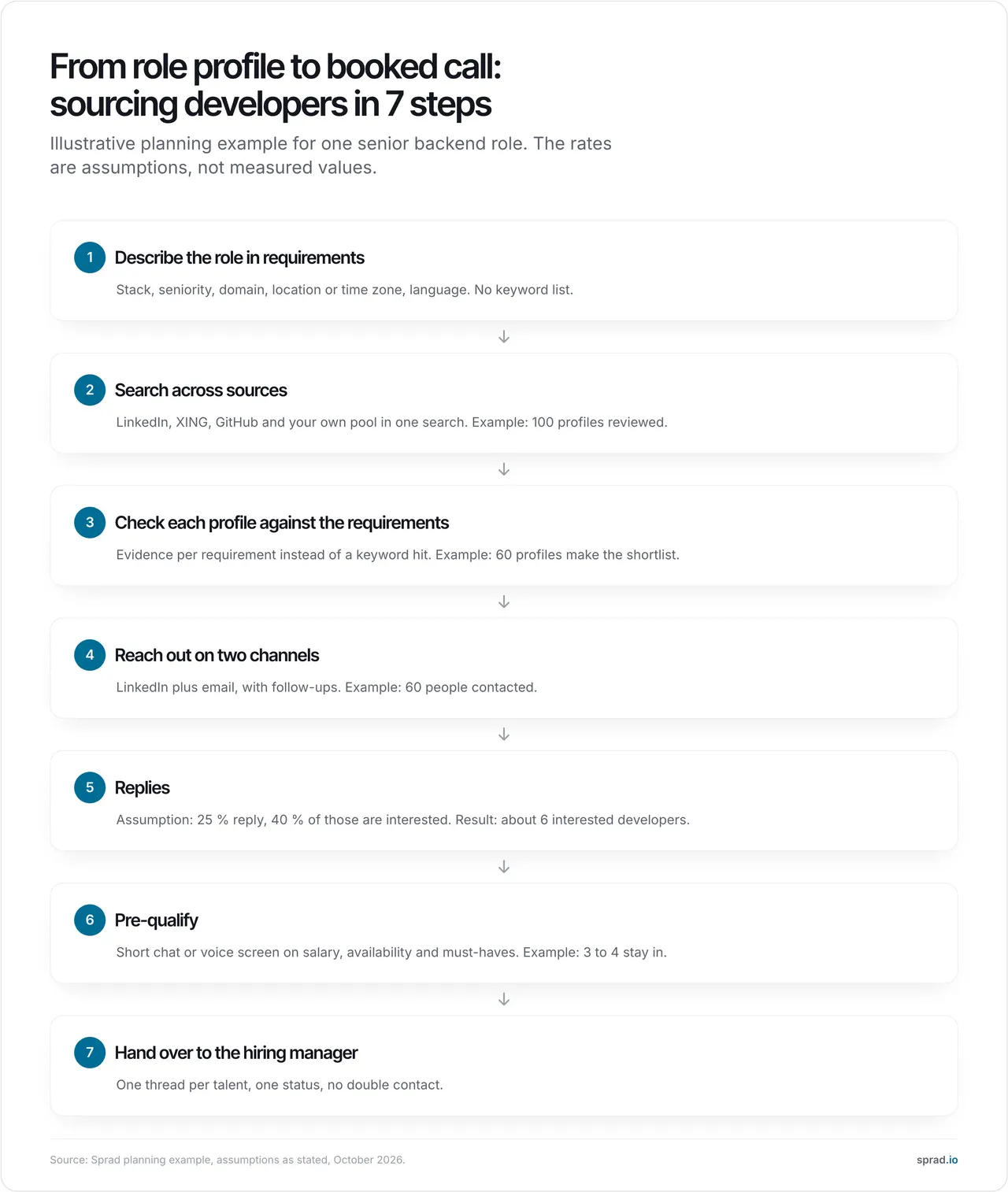
1. Write the role as requirements
List the stack, the seniority, the domain, the location or time zone and the working language. "Java" is a keyword; "has run a payments service in production on Java for at least three years" is a requirement. The comparison of Boolean and requirement-based search shows why the second finds people the first misses.
2. Pick the market, not just the country
Decide whether the role is remote across Europe or tied to an office. Language and time zone matter more than borders. For the German-speaking market, XING still holds profiles that never made it to LinkedIn, so include both.
3. Search several sources
Use LinkedIn for breadth, XING for DACH, GitHub for visible work, and your own pool of past applicants and earlier conversations. Our guide on sourcing beyond LinkedIn goes deeper. For engineers, GitHub is useful evidence (projects, languages, activity) but not a verdict: commit counts say little about seniority.
4. Check each profile against the requirements
This is where most time goes. Manual review takes about three minutes per profile, so 100 profiles cost five hours (our assumption). Tools that evaluate every profile against your requirements, with a reason per requirement, remove most of that work. A simple rule of thumb: if results appear instantly, it is almost always a (semantic) keyword search, not a per-profile evaluation.
5. Reach out on two channels
Combine a LinkedIn message and an email, then follow up. One short message works best: why this person (one concrete detail), what the team builds, salary range and location, one question. Example:
Hi Anna, your work on event-driven backends at a logistics scale-up caught my eye. We are hiring a Senior Backend Engineer (Kotlin, remote within CET ±2 h, €85–100k). Would a 15-minute call this week be worth your time?
6. Pre-qualify before you hand over
A short chat or voice screen on availability, salary expectation and must-haves saves your hiring manager from unsuitable calls.
7. Keep one thread per talent
Track every message in one place. The most common waste in teams is double contact: two recruiters, two channels, one annoyed developer.
What does it cost, and what is the funnel?
A worked example, with assumptions marked as such: you review 100 profiles, shortlist 60, contact them, and 25 % reply (15 people). If 40 % of those are interested, you have about 6 developers to talk to, and after pre-qualification 3 to 4 remain. With a typical manual process (five hours of profile review, drafting, tracking) the same funnel takes a week of part-time work; adjust the rates to your own data.
In Sprad, a web search run with a "Normal" budget costs up to 100 credits and shows up to 50 qualified profiles, billed at 2 credits per displayed profile. At the list price of €0.10 per credit that is at most €10 for 50 profiles; finding a business email costs 1 credit and is only charged if one is found. Two runs plus emails for 100 profiles come to roughly €30 at list price. Flat seats start at Recruiter Lite for €79 per seat and month (USD 95); Atlas Recruiter is €299 (USD 359). Prices exclude VAT, from sprad.io/pricing, as of 29 October 2026.
Which tools or templates help?
| Approach | Strength | Limit |
|---|---|---|
| Sprad (Atlas): requirements search across sources | One search over LinkedIn, XING, GitHub and your own pool; each profile checked against your requirements; LinkedIn and email in one inbox; over 1 billion profiles; EU hosting | Deep search takes a few minutes (Quick Search about 3 seconds); no SMS, no call notetaker |
| LinkedIn Recruiter with Boolean strings | Largest professional network; InMail | Keyword matching; one network; separate tools for email and tracking |
| XING TalentManager | Strong in DACH | One network; fewer international profiles |
| Manual GitHub search | Visible code and projects | Slow; contact data is restricted (see below) |
| Own pool in an ATS or CRM | Warm contacts, no search cost | Only people you already know; goes stale without upkeep |
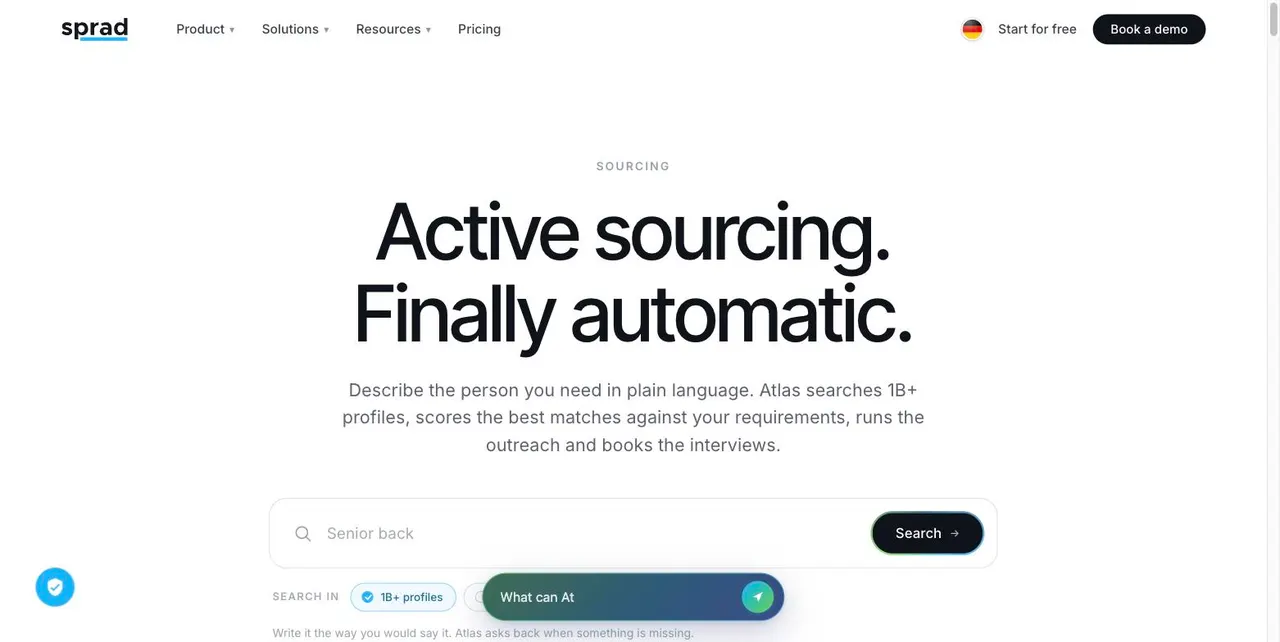
We put Sprad first for two reasons. First, Atlas evaluates each profile individually against the requirements, so it also finds developers with thin profiles or without the "right" keywords. Second, LinkedIn and email run automated, with follow-ups, in one inbox that warns you when someone was already contacted. Teams that today pay for separate LinkedIn and XING recruiter licences typically see 30 to 80 % lower costs, depending on their current licences. See Sprad people search.
In the Recruiting area of the public PeopleSearchBench, Atlas reaches 73.5 out of 100 in our own re-measurement, converted to the published scale1. Sprad has built recruiting software for seven years, starting with employee referrals, which is seven years of matching profiles to requirements. For a developer-specific view see AI sourcing for engineering and tech talent.
What does the law require in Europe?
If you collect personal data from a public profile, GDPR Article 14 applies: you must inform the person within a reasonable period and at the latest within one month, or at the latest at the first communication if you use the data to contact them. Put the information (who you are, why you hold the data, how to object) into your first message. Many teams rely on legitimate interest; have your data protection officer confirm it. Details in our active sourcing and GDPR guide.
Platform rules count too. GitHub's Acceptable Use Policies prohibit using information from the service for spamming, including unsolicited emails to users, and selling personal information to recruiters. Use a profile as evidence, then reach people through channels where contact is welcome.
AI tools add a second layer. Annex III of the EU AI Act lists AI systems for recruitment or selection, including analysing and filtering applications and evaluating candidates, as high-risk. Keep people in charge of decisions and check the transition dates with your counsel. Sprad hosts in the EU and meets enterprise, public-sector and insurance security standards; that supports compliance but does not replace your own assessment.
Which mistakes should I avoid?
- Keyword-only search. It misses developers whose profile says "backend" but not your framework.
- One generic message to everyone. Developers spot templates in seconds; name one concrete detail.
- Salary left out. A range in the first message filters better than a long pitch.
- English-only in non-English markets. Offer the local language where the team works in it.
- Scraping email addresses from code hosting sites. It breaches platform rules and creates GDPR risk.
- No shared inbox. Two colleagues contacting the same person damages your employer brand.
- Judging by commit counts. Activity is not seniority.
How does AI change developer sourcing?
AI changes the review step: instead of matching keywords, it reads each profile against your requirements and explains the match. It also drafts outreach and follows up automatically, which is where reply rates are won. Limits remain: deep evaluation takes minutes, not seconds, and a human should make the hiring decision, in line with the EU AI Act. For a closer look see the sourcing funnel from search to booked meeting.
FAQ
How long does it take to source a developer?
Plan for weeks, not days. In our example funnel the search and outreach phase takes about a week of part-time work; notice periods and interview rounds come on top, and they differ by country.
Which countries have the most developers in Europe?
Eurostat counts ICT specialists by share of employment: from 2.4 % in Greece to 8.7 % in Sweden (2023). Absolute numbers are naturally largest in the big economies, so check the pool for your role and language before you commit to a country.
Can I source developers on GitHub?
Yes, as evidence of skills. Do not harvest emails; contact people through LinkedIn or XING, or find business contact data through a compliant tool.
Is it free to start?
Yes. The free plan includes 100 credits per month (200 in the first month), enough for a first search run.
1 PeopleSearchBench (Recruiting), published by Lessie, October 2026. Other systems' scores as published in the benchmark; Atlas measured with the benchmark's open test procedure.
Jürgen Ulbrich
Jürgen Ulbrich has more than a decade of experience in developing and leading high-performing teams and companies. As an expert in employee referral programs as well as feedback and performance processes, Jürgen has helped over 100 organizations optimize their talent acquisition and development strategies.